Monday, October 8, 2012

e.e. cummings / Love is more thicker than forget

e.e.cummings

LOVE IS MORE THICKER THAN FORGET

love is more thicker than forget
more thinner than recall
more seldom than a wave is wet
more frequent than to fail

it is more mad and moonly
and less it shall unbe
than all the sea which only
is deeper than the sea

love is less always than to win
less never than alive
less bigger than the least begin
less littler than forgive

it is most sane and sunly
and more it cannot die
than all the sky which only
is higher than the sky


Wednesday, October 3, 2012

Rafael Cadenas / Untitled


Untitled
by Rafael Cadenas
Translated by Guillermo Parra

The poem in order to care for poetry

Shouldn’t seem like a poem

I don’t seek perfection but truth

It interests me even though I don’t know it

And I struggle to make it known

Hopefully it’ll turn up in my folders

Respectable listeners don’t be alarmed:

You know so well how to hide your head


Translator’s note: Poem in honor of Nicanor Parra being awarded the Cervantes Prize in Spain.
El País, 22 April 2012 


Friday, September 28, 2012

Ishmael Reed / Beware: Do Not Read This Poem


Beware: Do Not Read This Poem
by Ishmael Reed

tonite, thriller was
abt an ol woman, so vain she
surrounded her self w/
    many mirrors
It got so bad that finally she
locked herself indoors & her
whole life became the
    mirrors

one day the villagers broke
into her house, but she was too
swift for them. she disappeared
    into a mirror
each tenant who bought the house
after that lost a loved one to
    the ol woman in the mirror:
    first a little girl
    then a young woman
    then the young woman/s husband
the hunger of this poem is legendary
it has taken in many victims
back off from this poem
it has drawn in yr feet
back off from this poem
it has drawn in yr legs
back off from this poem
it is a greedy mirror
you are into this poem. from
    the waist down
nobody can hear you can they?
this poem has had you up to here
    belch
this poem aint got no manners
you cant call out frm this poem
relax now & go w/ this poem
move & roll on to this poem

    do not resist this poem
    this poem has yr eyes
    this poem has his head
    this poem has his arms
    this poem has his fingers
    this poem has his fingertips
this poem is the reader & the
    reader this poem

statistic: the us bureau of missing persons reports
    that in 1968 over 100,000 people disappeared
    leaving no solid clues
        nor trace only
    a space     in the lives of their friends


Tuesday, September 25, 2012

Thomas Lynch / Liberty


Thomas Lynch
LIBERTY
by Thomas Lynch

Some nights I go out and piss on the front lawn
as a form of freedom—liberty from
porcelain and plumbing and the Great Beyond
beyond the toilet and the sewage works.
Here is the statement I am trying to make:
to say I am from a fierce bloodline of men
who made their water in the old way, under stars
that overarched the North Atlantic where
the River Shannon empties into sea.
The ex-wife used to say, “Why can’t you pee
in concert with the most of humankind
who do their business tidily indoors?”
It was gentility or envy, I suppose,
because I could do it anywhere, and do
whenever I begin to feel encumbered.
Still, there is nothing, here in the suburbs,
as dense as the darkness in West Clare
nor any equivalent to the nightlong wind
that rattles in the hedgerow of whitethorn there
on the east side of the cottage yard in Moveen.
It was market day in Kilrush, years ago:
my great-great-grandfather bargained with tinkers
who claimed it was whitethorn that Christ’s crown was made rom.
So he gave them two and six and brought them home—
mere saplings then—as a gift for the missus,
who planted them between the house and garden.
For years now, men have slipped out the back door
during wakes or wedding feasts or nights of song
to pay their homage to the holy trees
and, looking up into that vast firmament,
consider liberty in that last townland where
they have no crowns, no crappers and no ex-wives.


Saturday, September 22, 2012

José Antonio Ramos Sucre / The Infallible Man

The Infallible Blind Man
by José Antonio Ramos Sucre
Translated by Guillermo Parra

     The indifferent page proclaims from a raft the countryside cereals. He negotiates the narrowness and vortex of the sedentary river. A rice paper hat defends his smooth, sculptural person.


     An old man with empty eyes executes a desolate music on his bamboo shepherd’s flute. He lives off alms at the entrance of my lacquer and porcelain trinkets store. At one point he refers to his captivity in the hideout of some highway robbers embittered by his sight, distrustful of his practice of the terrain.


     I exercise the even business of a shopkeeper in a withered city. I attain no amusement save the death of a beggar on the street and the cremation of his cadaver amidst a racket of scamps or otherwise the torture of a parricide sagaciously crushed and quartered by the executioner. 


     The page owes me his rearing. I saved him from succumbing amid some ruins, during a war with the pirates of Europe. The invader’s arms devastated the marble bridge of a metropolis and printed the dye of charcoal and soot on the effigies of some decorative lions. I discovered the infant in a wicker basket, abandoned by his servers in an orchard of camellias and hydrangeas. The smoke from the battle was offending the lofty wisteria, of aerial garland, with a blue flower.


     The old man with the empty eyes encourages my hope in the effects of good and promises me fortune’s grace. He ignores my diligence in defending a privileged child.


     I have followed the conduct of a fisherman in an honest episode and I imagine the visit of a princess with an ivory semblance, afflicted by the loss of a son. Her faculties should rescue me from penury.


El cielo de esmalte (1929)
http://venepoetics.blogspot.com/search?updated-max=2012-08-09T15:35:00-04:00


José Antonio Ramos Sucre
EL CIEGO INFALIBLE

    El doncel indiferente pregona desde una balsa los cereales de la campiña. Sortea la angostura y el vórtice del río sedentario. Un sombrero de paja de arroz defiende su persona lisa, escultural.

   Un anciano de ojos vacíos ejecuta una música desoladora en su caramillo de bambú. Vive de limosna a la puerta de mi tienda de abalorios de laca y de porcelana. Refiere alguna vez su cautiverio en el escondite de unos salteadores encarnizados con su vista, recelosos de su práctica del terreno.
  
   Ejercito el menester igual de comerciante en una ciudad mustia. No alcanzo ningún esparcimiento sino la muerte de un mendigo en la vía pública y la cremación de su cadáver en medio de una algazara de pilletes o bien el suplicio de un parricida estrujado y desarticulado sagazmente por el verdugo.
   
     El doncel me debe su crianza. Yo lo salvé de sucumbir en medio de unas ruinas, durante una guerra con los piratas de Europa. Las armas del invasor devastaron el puente de mármol de una metrópoli e imprimieron el tinte del carbón y del hollín sobre las efigies de unos leones decorativos. Yo descubrí al instante en una cesta de mimbre, abandonado de sus servidores en un vergel de camelias y hortensias. El humo de la batalla ofendía la glicina rozagante, de guirnalda aérea, de flor azul.

   El anciano de los ojos vacíos alienta mi esperanza en los efectos del bien y me promete una gracia de la fortuna. Ignora mi diligencia en defender a un niño privilegiado.
   
  He seguido la conducta de un pescador en un episodio honesto e imagino la visita de una princesa de semblante de marfil, atribulada con el extravío de un hijo. Sus dones deben de rescatarme de la penuria.


El cielo de esmalte, 1929


José Antonio Ramos Sucre
Obra poética
Buenos Aires, Sudamericana, 2001, p. 374


Sunday, September 16, 2012

José Antonio Ramos Sucre / The Herectics


The Heretics
by José Antonio Ramos Sucre
Translated by Guillermo Parra

     The maiden leans out to see the fields, to interrogate a tremulous distance. Her mind suffers the vision of the riders of extermination, described in the pages of Revelation and in a commentary of black stamps. 


     The popular voice decants the rain of blood and the eclipse and warns of the similitude with marvels of years past, contemporary to King Lear. 

     A captain, surly and insolent with his king, fixes the campaign tent, of crimson silk, amidst the ruins. The soldiers, the devils of war, reveal the soot from the fire or from hell on their arid complexion and red hair. A schemer, usurper of the Harlequin suit, persuades them to licentiousness and supplies them with pinchbeck and paper coins.

     The maiden moves the crowds away from the enemies, spending her nights in prayer. They retreat in front of an indelible undergrowth, after vainly exhausting themselves in the aperture of a trail. The blow of their irons could find no seat and was lost in the emptiness.


El cielo de esmalte (1929)
http://venepoetics.blogspot.com/


José Antonio Ramos Sucre
LOS HEREJES
  
 La doncella se asoma a ver el campo, a interrogar una lontananza trémula. Su mente padece la visión de los jinetes del exterminio, descrita en las páginas del Apocalipsis y en un comentario de estampas negras.
    La voz popular decanta la lluvia de sangre y el eclipse y advierte la similitud con las maravillas de antaño, contemporáneas del rey Lear.
    Un capitán, desabrido e insolente con su rey, fija la tienda de campaña, de seda carmesí, en medio de las ruinas. Los soldados, los diablos de la guerra, dejan ver el tizne del incendio o del infierno en la tez árida y su roja pelambre. Un arbitrista, usurpador del traje de Arlequín, los persuade a la licencia y los abastece de monedas de similor y de papel.
    La doncella aleja la muchedumbre de los enemigos, prodigando las noches de oración. Se retiran delante de una maleza indeleble, después de fatigarse vanamente en la apertura de un camino. El golpe de sus hierros no encontraba asiento y se perdía en el vacío.


El cielo de esmalte, 1929

José Antonio Ramos Sucre
Obra poética
Buenos Aires, Sudamericana, 2001, p. 352


Wednesday, September 12, 2012

José Antonio Ramos Sucre / The Vengeance of the God

The Vengeance of the God
by José Antonio Ramos Sucre

Translated by Guillermo Parra

     The excess of the inhabitants marred the fame of that pleasant land, dressed in flowers, broken by wild fountains, loved by the gauzy cloud and the paternal sun. It had a weird stone’s name and the sea as tributary in pearls.

     The God watched over the men’s crimes in the undeserving country, and hoped for the birth of a messenger of health and concordance, far from them, in the most umbrous jungle. He is born one night from the breast of a flower, by the lightning flash that paints a luminous stigma on his face. He’s raised under the care of the birds and the trees and by the kindness of the beasts.


     Those men receive the mission of virtue with daring actions and excesses and they pay the envoy with a trance of ignominious death. The God punishes them making the wealth of the land they sully bigger. He nourishes it with fatal treasures that are the unfolding of the sleeplessness of greed, who divide the people into angered bands of rich and poor. The new gifts infest with vengeful hatreds and populate with expiatory bones.

La torre de Timón (1925)
http://venepoetics.blogspot.com/


José Antonio Ramos Sucre
LA VENGANZA DEL DIOS

    El desafuero de los habitantes afeaba la fama de aquella tierra amena, vestida de flores, rota por manantiales ariscos, amada por la nube de gasa y el sol paternal. Tenía el nombre de una piedra rara y al mar de tributario en perlas.
    El Dios velaba el crimen de los hombres en el inmerecido país, y quiso el nacimiento de un mensajero de salud y concordia, lejos de ellos, en la más umbría selva. Nace una noche del seno de una flor, a la luz de un relámpago que pinta en su frente luminoso estigma. Crece al cuidado de las aves y de los árboles y al apego de las fieras.
    Aquellos hombres reciben la misión de virtud con atrevimientos y excesos y pagan al enviado con trance de muerte ignominiosa. El Dios los castiga engrandeciendo la riqueza de la tierra que mancillan. La nutre de tesoros fatales que son desvelo de la codicia, que dividen al pueblo en airados bandos de ricos y de pobres. Los nuevos dones infestan de odios vengativos y pueblan con huesos expiatorios.


La torre del timón, 1925


José Antonio Ramos Sucre
Obra poética
Buenos Aires, Sudamericana, 2001, p. 58


Friday, September 7, 2012

Raymond Carver / All Her Life

Raymond Carver in the summer of 1969
Photo by Gordon Lish

All Her Life
by Raymond Carver
BIOGRAPHY
I lay down for a nap. But everytime I closed my eyes,
mares' tails passed slowly over the Strait
toward Canada. And the waves. They rolled up on the beach
and then back again. You know I don’t dream.
But last night I dreamt we were watching
a burial at sea. At first I was astonished.
And then filled with regret. But you
touched my arm and said, "No, it's all right.
She was very old, and he'd loved her all her life."


Tuesday, September 4, 2012

Robert Bly / Three Poems

Robert Bly
THREE POEMS
by Robert Bly


Watering the Horse

How strange to think of giving up all ambition!
Suddenly I see with such clear eyes
The white flake of snow
That has just fallen in the horse's mane!

For Donald Hall

Have you heard about the boy who walked by
The black water? I won't say much more.
Let's wait a few years. It wanted to be entered.
Sometimes a man walks by a pond, and a hand
Reaches out and pulls him in.

There was no
Intention, exactly. The pond was lonely, or needed
Calcium, bones would do. What happened then?

It was a little like the night wind, which is soft,
And moves slowly, sighing like an old woman
In her kitchen late at night, moving pans
About, lighting a fire, making some food for the cat.

Living at the End of Time

There is so much sweetness in children’s voices,
And so much discontent at the end of day,
And so much satisfaction when a train goes by.

I don’t know why the rooster keeps crying,
Nor why elephants keep raising their trunks,
Nor why Hawthorne kept hearing trains at night.

A handsome child is a gift from God,
And a friend is a vein in the back of the hand,
And a wound is an inheritance from the wind.

Some say we are living at the end of time,
But I believe a thousand pagan ministers
Will arrive tomorrow to baptize the wind.

There’s nothing we need to do about John. The Baptist
Has been laying his hands on earth for so long
That the well water is sweet for a hundred miles.

It’s all right if we don’t know what the rooster
Is saying in the middle of the night, nor why we feel
So much satisfaction when a train goes by.


Thursday, August 30, 2012

Rae Armantrout / Six Poems


Six Poems 
by Rae Armantrout


THE GIFT

You confuse
the image of a fungus

with the image of a dick
in my poem

(understandably)

and three days later
a strange toadstool

(white shaft, black cap,
five inches tall)

appears
between the flagstones
in our path

We note
the invisible

web
between fence posts

in which dry leaves
are gently rocked.


SUSTAINED

     1

To come to
in the middle

of a vibrato—
an “is”—

that some soprano’s

struggling
to sustain.

     2

To be awake
is to discriminate

among birdcalls,
fruits, seeds,

“to work one’s way,”
as they say,

“through.”

     3

Just now
breaking

into awareness,
falling forward,

hurtling inland
in all innocence


BORDER PERFECTION

     1

The days are shorter,
but the light seems to stretch out,

to hark
from a long way off.

Horizons
snap into focus,

while shadows
are distended, smudged.

It’s happening again;
we take

discrepancies
for openings.

     2

The sign
that the guy behind me

in the “border protection” line
is demented

is his impatience,

the way he asks
again and again

what we’re waiting for


THE VESICLE

     1

To our amazement,
when fed on fatty acid,

the vesicle
did not simply grow,

it extended itself
into a filament.

Now the king’s youngest daughter said,

“I wish I had
something like that”—

and the whole vesicle
transformed

into a slender tube
which was quite delicate.

     2

Monks
mimed one another’s
squiggles

carefully
by candlelight

as if they thought
creation trailed something,

as if they knew
creation looked like this

from what is
always

the outside.


EXACT

Quick, before you die,
describe

the exact shade
of this hotel carpet.

What is the meaning
of the irregular, yellow

spheres, some
hollow,

gathered in patches
on this bedspread?

If you love me,
worship

the objects
I have caused

to represent me
in my absence.

     *

Over and over
tiers

of houses spill
pleasantly

down that hillside.
It

might be possible
to count occurrences.


WITH

It’s well
that things should stir
inconsequentially
around me
like this
patina of shadow,
flicker, whisper,
so that
I can be still.

     *

I write things down
to show others
later
or to show myself
that I am not alone with
my experience.

     *

“With”
is the word that
comes to mind,
but it’s not
the right word here.


CONJUNCTIONS:54, Spring 2010


Friday, August 24, 2012

Alberto Barrera Tyszka / Poetics


Poetics
by Alberto Barrera Tyszka
Translated by Guillermo Parra

It should be clean and brilliant,
like a razor blade
sunk in a glass of wine.

Like a sprig of basil
on the ice.

It should be mortal,
always.

Like desire.


Alberto Barrera Tyszka
Poética

Ha de ser limpia y brillante,
como una hoja de afeitar
hundida en una copa de vino.

Como un tallo de albahaca
sobre el hielo.

Ha de ser mortal,
siempre.

Como el deseo.


Monday, August 20, 2012

James Wright / Lazy on a Saturday Morning


Lazy on a Saturday Morning
By James Wright

Gulls poise on the wet arms
Of the woman who is in love with the sea.
She floats away from the shore on an oak leaf, calling me
By a strange name.


Sunday, August 12, 2012

Jacques Prevert / Family Life

FAMILY LIFE 
by Jacques Prevert
FAMILY LIFE (1)

The mother knits
The son goes to the war
She finds this quite natural, the mother
And the father?
What does the father do?
He has his business
His wife knits
His son goes to the war
He has his business
He finds this quite natural, the father
And the son
And the son
What does the son find?
He finds absolutely nothing, the son
The son: his mother does her knitting,
His father has his business
And he has the war
When the war is over
He'll go into business with his father
The war continues
The mother continues knitting
The father continues with his business
The son is killed
He doesn't continue
The father and mother visit the graveyard
They find this natural
The father and the mother
Life goes on
A life of knitting, war, business
Business, war, knitting, war
Business, business, business
Life with the graveyard

FAMILY LIFE (2)

The Mum knits
The kid goes off to the war
It seems kind of normal, to the Mum
And the Dad?
What's the Dad up to?
He's got his job
His old lady's got her knitting
His kid's gone off to the war
He's got his job
It seems kind of normal, to the Dad
And the kid?
What about the kid?
What does he make of it all?
Sweet fuck all
His old woman's got her knitting
His old man's got his job
And he's got the fucking war
And when the war's over
He'll get a job
Like his old man
Anyhow the war goes on
His old woman goes on with her knitting
His old man goes on with his job
He gets his fucking brains blown out
He doesn't go on
He goes under
The Mum and Dad
Go visit the grave
Which seems kind of normal
To the Mum and Dad
And life goes on
A life of knitting, the war, the job
War, knitting, war
Job, job, job
Life in a bloody graveyard


Monday, August 6, 2012

Jacques Prevert / Breakfast

Jacques Prevert
París, 1955
Photo by Robert Doisneau
Breakfast

He poured the coffee
Into the cup
He poured the milk
Into the cup of coffee
He added the sugar
To the coffee and milk
He stirred it
With a teaspoon
He drank the coffee
And put back the cup
Without speaking to me
He lit a cigarette
He blew some rings
With the smoke
He flicked the ashes
Into the ashtray
Without speaking to me
Without looking at me
He got up
He put his hat
On his head
He put on
His raincoat
Because it was raining
He went out
Into the rain
Without a word
Without looking at me
And I
I took my head
In my hands
And I wept


Tuesday, July 31, 2012

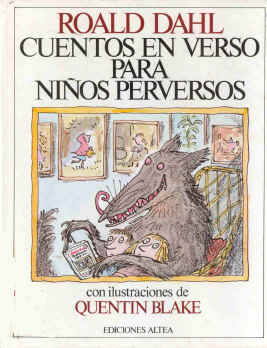
Roald Dahl / Little Red Riding Hood and the Wolf


Little Red Riding Hood and the Wolf
As soon as Wolf began to feel
That he would like a decent meal,
He went and knocked on Grandma’s door.
When Grandma opened it, she saw
The sharp white teeth, the horrid grin,
And Wolfie said, “May I come in?”
Poor Grandmamma was terrified,
“He’s going to eat me up!” she cried.
And she was absolutely right.
He ate her up in one big bite.
But Grandmamma was small and tough,
And Wolfie wailed, “That’s not enough!
I haven’t yet begun to feel
That I have had a decent meal!”
He ran around the kitchen yelping,
“I’ve got to have a second helping!”
Then added with a frightful leer,
“I’m therefore going to wait right here
Till Little Miss Red Riding Hood
Comes home from walking in the wood.”
He quickly put on Grandma’s clothes,
(Of course he hadn’t eaten those).
He dressed himself in coat and hat.
He put on shoes, and after that,
He even brushed and curled his hair,
Then sat himself in Grandma’s chair.
In came the little girl in red.
She stopped. She stared. And then she said,
“What great big ears you have, Grandma.”
“All the better to hear you with,”
the Wolf replied.
“What great big eyes you have, Grandma.”
said Little Red Riding Hood.
“All the better to see you with,”
the Wolf replied.
He sat there watching her and smiled.
He thought, I’m going to eat this child.
Compared with her old Grandmamma,
She’s going to taste like caviar.
Then Little Red Riding Hood said,
“But Grandma, what a lovely great big
furry coat you have on.”
“That’s wrong!” cried Wolf.
“Have you forgot
To tell me what BIG TEETH I’ve got?
Ah well, no matter what you say,
I’m going to eat you anyway.”
The small girl smiles. One eyelid flickers.
She whips a pistol from her knickers.
She aims it at the creature’s head,
And bang bang bang, she shoots him dead.
A few weeks later, in the wood,
I came across Miss Riding Hood.
But what a change! No cloak of red,
No silly hood upon her head.
She said, “Hello, and do please note
My lovely furry wolfskin coat.”
Caperucita Roja y el Lobo.
Estando una mañana haciendo el bobo
le entró un hambre espantosa al Señor Lobo,
así que, para echarse algo a la muela,
se fue corriendo a casa de la Abuela.
“¿Puedo pasar, Señora?”, preguntó.
La pobre anciana, al verlo, se asustó
pensando: “¡Este me come de un bocado!”.
Y, claro, no se había equivocado:
se convirtió la Abuela en alimento
en menos tiempo del que aquí te cuento.
Lo malo es que era flaca y tan huesuda
que al Lobo no le fue de gran ayuda:
“Sigo teniendo un hambre aterradora…
¡Tendré que merendarme otra señora!”.
Y, al no encontrar ninguna en la nevera,
gruñó con impaciencia aquella fiera:
“¡Esperaré sentado hasta que vuelva
Caperucita Roja de la Selva!”
-que así llamaba al Bosque la alimaña,
creyéndose en Brasil y no en España-.
Y porque no se viera su fiereza,
se disfrazó de abuela con presteza,
se dio laca en las uñas y en el pelo,
se puso la gran falda gris de vuelo,
zapatos, sombrerito, una chaqueta
y se sentó en espera de la nieta.
Llegó por fin Caperucita a mediodía
y dijo: “¿Cómo estás, abuela mía?
Por cierto, ¡me impresionan tus orejas!”.
“Para mejor oírte, que las viejas
somos un poco sordas”. “¡Abuelita,
qué ojos tan grandes tienes!”. “Claro, hijita,
son las lentillas nuevas que me ha puesto
para que pueda verte Don Ernesto
el oculista”, dijo el animal
mirándola con gesto angelical
mientras se le ocurría que la chica
iba a saberle mil veces más rica
que el rancho precedente. De repente
Caperucita dijo: “¡Qué imponente
abrigo de piel llevas este invierno!”.
El Lobo, estupefacto, dijo: “¡Un cuerno!
O no sabes el cuento o tú me mientes:
¡Ahora te toca hablarme de mis dientes!
¿Me estás tomando el pelo…? Oye, mocosa,
te comeré ahora mismo y a otra cosa”.
Pero ella se sentó en un canapé
y se sacó un revólver del corsé,
con calma apuntó bien a la cabeza
y -¡pam!- allí cayó la buena pieza.
Al poco tiempo vi a Caperucita
cruzando por el Bosque… ¡Pobrecita!
¿Sabéis lo que llevaba la infeliz?
Pues nada menos que un sobrepelliz
que a mí me pareció de piel de un lobo
que estuvo una mañana haciendo el bobo.


Versión de Miguel Azaola.
Little Red Riding Hood and the Wolf.(Revolting Rhymes)
Roald Dahl (Wales, 1916-1990)