
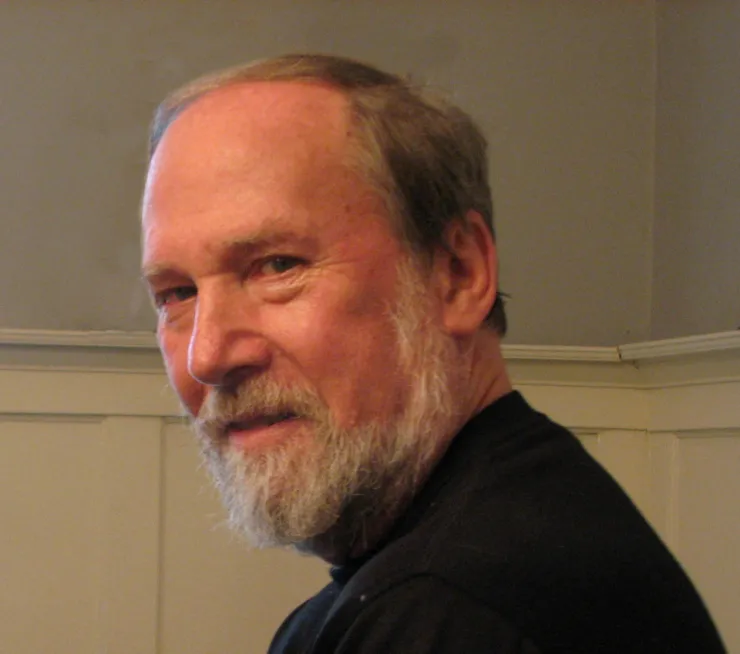
Stephen Dunn. Photo: Andrea Dunn
2001 Poetry winner Stephen Dunn died on June 24 at the age of 82. In 2016, he wrote about his influences in this reminiscence for the Pulitzer Prize centennial.
There are many beyond the three I will name — Robert Frost, Wallace Stevens, Theodore Roethke. But individually and collectively they, I think, are the most important and lasting for me. In a nutshell, Frost for his strategies of composition and his quotidian yet philosophical investigations. Stevens for teaching me that, if the music was right, I could love poems I didn't understand. Roethke for his sensual playfulness, but finally for his lyrical meditations, and his phrasing; yes, Roethke most of all.
All three taught me how to read, each involving a different attentiveness to tone. Of the three Stevens was the wildest, and perhaps the one with the most bifurcated life, insurance executive by day, composer of “The Emperor of Ice Cream” and “The Pleasures of Merely Circulating” by night. I quit my good-paying corporate job at age 26 to go to Spain to see if I could write. A novel, not poems. I wrote a very language-y, poorly plotted novel, and threw it away. It was all about me. Wasn't that poetry's province? I may still have thought it was, but I had two saving graces. I didn't think my life should be of interest to anyone, which the writing of the novel confirmed, and there was a notable absence of a first-person voice in most of Stevens' work. The only books of poems I'd brought with me were Stevens' Collected and a bilingual anthology of Spanish poetry. I was a poetry rookie. I went to graduate school when I was 29, and was amazed just how much of a rookie I was. All the 22-year-olds in the creative writing program at Syracuse were more advanced in their reading than I was. My advantage was that the talk about poems and poetry was all new to me. I had an amateur's wonderment.
I didn't read Stevens in college, but had a healthy dose of Frost. As I recall not one of my English professors knew how sly he was, and how well he balanced ideas. I, more or less, learned that on my own (''my own” taking many years with a little help from Randall Jarrell). I had been a history major in college. As such, I learned that there were versions of the truth, which prepared me, I suspect, for poems like “Mending Wall” and “The Road Not Taken,” among Frost's many others in which point-of-view plays such a large role. The more I read of Frost the more I wanted to seek surface clarities that served complexity. It remains a goal of mine — to let the reader in, to be the kind of guide like the narrator in “Directive,” who “only has at heart your getting lost.”
I encountered Roethke's work in graduate school, first in a book edited by Anthony Ostroff in which several of his peers — Lowell, Kunitz, Berryman, et al. — commented on his poem “In a Dark Time.” Though I've never suffered from mental illness, I've known a few dark times, and I found myself riveted by the poem's phrasing right from the outset. “In a dark time, the eye begins to see,/I meet my shadow in the deepening glade;/I hear my echo in the echoing wood ...” Man, did I want to write like that.
Later on, “Dark, dark my light, and darker my desire ...” and a question every thoughtful, introspective person at one time or another must ask himself, “Which I is I?” Earlier in the poem he poses a question that's maybe too self-flattering, “What's madness but nobility of soul/at odds with circumstance?”, but nevertheless is brilliantly provocative, and no doubt apt in some cases.
I fell in love with “I Knew a Woman” and “The Waking” and “Elegy for Jane,” and felt some ante being raised in The Far Field. Philip Booth, one of my great teachers at Syracuse, would sometimes write in the margins of my poems, “Deepen your concerns!” And that's what Roethke seemed to be doing in The Far Field, especially in its title poem and in “Meditation at Oyster River,” delivering a quieter, less sensational entree into the soulful varieties of the human condition.
PULITZER


No comments:
Post a Comment