'Amor difícil': una editorial española reedita un libro pionero con los sonetos homoeróticos de Lorca.
Este artículo tiene más de 9 meses de antigüedad.
Los poemas de Federico García Lorca fueron publicados anónimamente en 1983 después de haber permanecido ocultos por su familia durante 50 años.
Sam Jones en Madrid, viernes 13 de junio de 2025
En otoño de 1983, decenas de lectores cuidadosamente seleccionados recibieron un sobre que contenía un pequeño librito rojo con sonetos que habían permanecido guardados desde que fueron escritos casi 50 años antes por el poeta español más famoso del siglo XX.
Name of Federico García Lorca's lover emerges after 70 years
This article is more than 13 years old
Box of mementoes reveals that young art critic Juan Ramírez de Lucas had brief affair with Spanish poet
Giles Tremlette in Madrid
10 May 2012
The identity of the lover to whom Federico García Lorca wrote passionate verse in his final year has been a mystery ever since the poet's assassination during the Spanish civil war. But now, more than 70 years later, his name has finally emerged.
Lost Federico García Lorca verse discovered 93 years after it was written
Eight-line poem found on the back of a manuscript sheds light on Spanish poet’s preoccupation with time
Sam Jones in Madrid
Sat 18 Apr 2026 05.00 BST
A previously unknown verse attributed to Federico García Lorca has been discovered 93 years after the celebrated Spanish poet and playwright is believed to have jotted it on the back of one of his manuscripts.
Lorca is thought to have written the eight-line poem in 1933 while working on the collection Diván del Tamarit, a homage to the Arab poets of his native Granada.
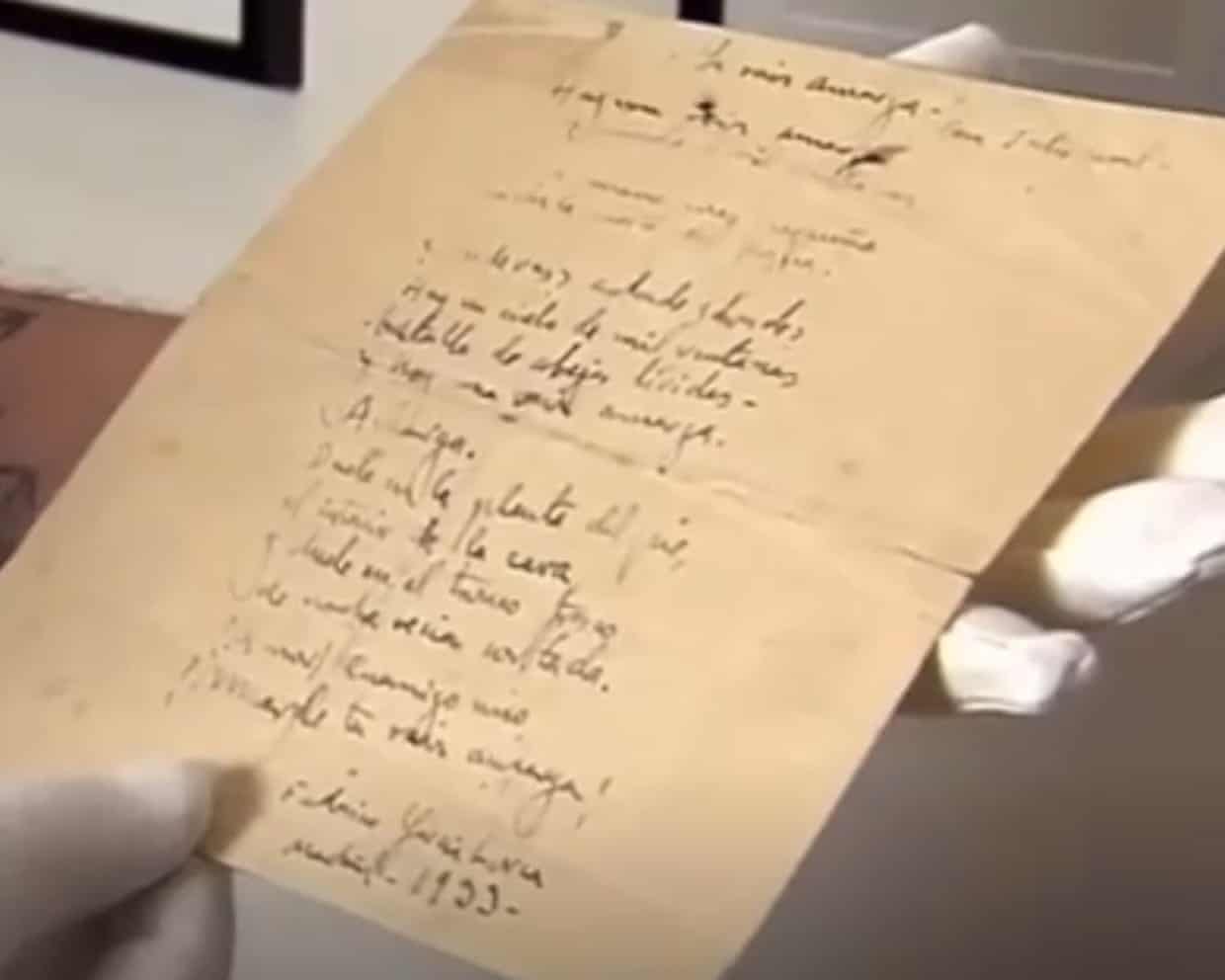
The newly discovered verse was found on the reverse of a manuscript of one of the Tamarit poems – Gacela de la raíz amarga – which the flamenco singer and Lorca enthusiast Miguel Poveda bought from a German antiquarian.
It has since been verified by the Lorca expert Pepa Merlo and will feature in a forthcoming book.
The brief verse, composed three years before Lorca was murdered in the early days of the Spanish civil war, reveals the poet’s familiar preoccupation with the passing of time: “The clock sings / I count the hours mechanically / Seven o’clock; twelve o’clock / It’s all the same / I am not here / It is the mark of flesh / That I left behind when I departed / So as to know my place / Upon my return.”
Poveda, who recently led efforts to turn Lorca’s childhood home into a cultural centre dedicated to the poet’s life and work, said he had been deeply moved by the fortuitous discovery.
The manuscript was bought by the flamenco singer Miguel Poveda. Photograph: RTVE
“My attention was grabbed when Pepa Merlo said to me, ‘That’s Federico’s handwriting. You’ve got something new by Federico there’,” he told the state broadcaster TVE on Thursday.
“For me, it’s a heartfelt gift. It’s all there in those lines, ‘It is the mark of flesh / That I left behind, when I departed / So as to know my place / Upon my return’.”
Merlo said that while the verse may have been overlooked because it was scribbled on the back of another work, it nonetheless revealed “the importance that the concept of time held for Lorca”.
The gay, progressive writer – whose works include Gypsy Ballads, Poet in New York, Blood Wedding, Yerma, and the House of Bernarda Alba – was shot by a rightwing death squad in August 1936, becoming perhaps the most prominent victim of Spain’s three-year civil war. His body has never been found and is thought to lie in a shallow grave at the bottom of a mountain slope near Granada.
Interest in Lorca has only grown as the centenary of his death draws near. Last summer, a facsimile edition of the poet’s homoerotic, anguished – and posthumously published – Sonnets of Dark Love was issued to bring the poems to a new readership.
Although long known to Lorca scholars, the sonnets had been hidden away by the poet’s family, who believed their tortured and sensual lines would taint his legacy and stir up old hatreds.
The newly discovered poem will be published in a book written by Poveda and Merlo titled Las cosas del otro lado. lo inédito en Federico García Lorca(Things from the Other Side: the Unpublished in Federico García Lorca).
by This article is more than 10 months oldby Michael Rosen Rosen
I lay in bed hardly able to breathe but there were people to sedate me, pump air into me calm me down when I thrashed around hold my hand and reassure me play me songs my family sent in turn me over to help my lungs shave me, wash me, feed me check my medication perform the tracheostomy people on this “island of strangers” from China, Jamaica, Brazil, Ireland India, USA, Nigeria and Greece.
I sat on the edge of my bed and four people came with a frame and supported me or took me to a gym where they taught me how to walk between parallel bars or kick a balloon sat me in a wheelchair taught me how to use the exercise bike how to walk with a stick how to walk without a stick people on this “island of strangers” from China, Jamaica, Brazil, Ireland India, USA, Nigeria and Greece.
If ever you’re in need as I was may you have an island of strangers like I had.
With chaste heart, and pure eyes I celebrate you, my beauty, restraining my blood so that the line surges and follows your contour, and you bed yourself in my verse, as in woodland, or wave-spume: earth's perfume, sea's music.
Nakedly beautiful, whether it is your feet, arching at a primal touch of sound or breeze, or your ears, tiny spiral shells from the splendour of America's oceans. Your breasts also, of equal fullness, overflowing with the living light and, yes, winged your eyelids of silken corn that disclose or enclose the deep twin landscapes of your eyes.
The line of your back separating you falls away into paler regions then surges to the smooth hemispheres of an apple, and goes splitting your loveliness into two pillars of burnt gold, pure alabaster, to be lost in the twin clusters of your feet, from which, once more, lifts and takes fire the double tree of your symmetry: flower of fire, open circle of candles, swollen fruit raised over the meeting of earth and ocean.
Your body - from what substances agate, quartz, ears of wheat, did it flow, was it gathered, rising like bread in the warmth, and signalling hills silvered, valleys of a single petal, sweetnesses of velvet depth, until the pure, fine, form of woman thickened and rested there?
It is not so much light that falls over the world extended by your body its suffocating snow, as brightness, pouring itself out of you, as if you were burning inside.
'There's no other poem like it': Why this Robert Burns classic is a masterpiece
Nicholas Barber 23 January 2026
Tam O'Shanter is a rip-roaring tale of witches and alcohol, but it has hidden depths. On Burns Night this Sunday – and 235 years after the poem was published in 1791 – Scots everywhere may well be treated to a masterwork with a unique, universal appeal.