Friday 12 August 2011
A
s Byron himself observed, he awoke one morning and found himself famous. He was 24 years old and had just published his third book, Childe Harold's Pilgrimage, a loosely autobiographical account of the continental tour he made after leaving Cambridge.
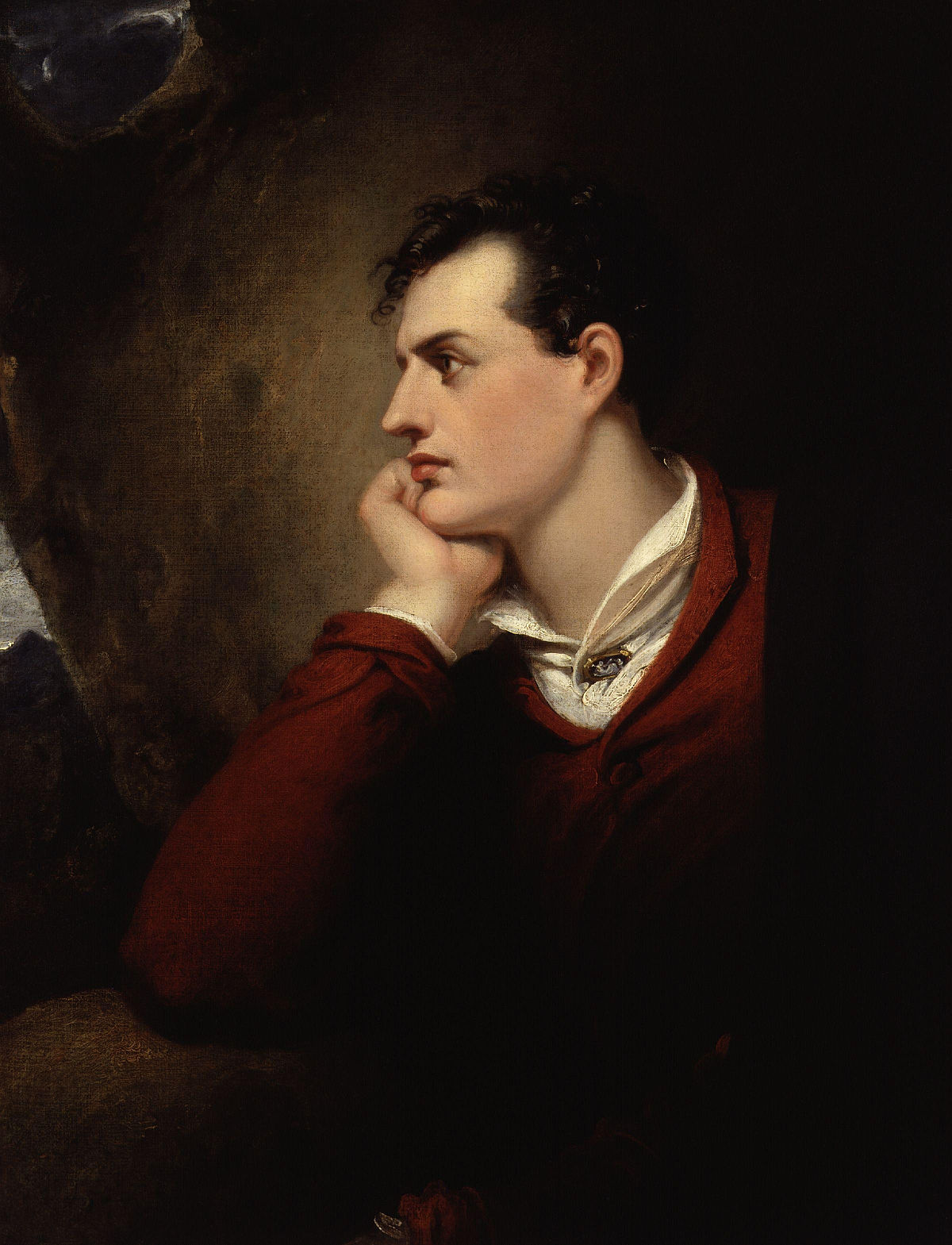
Next year is the 200th anniversary of its publication, and the poem, like Byron himself, has had a strange history. It is now most famous for making him famous. Byron is sometimes called the first modern celebrity, and much of the interest in him is biographical: the affairs with Caroline Lamb and his half-sister, the breakdown of his marriage, his death fighting for Greek independence. His writing tends to get lost in his biography; the line between his life and his work was always blurred. In early drafts of the poem Childe Harold was called Childe Burun, and even though Byron publicly objected to any identification between poet and hero, later cantos eventually abandoned the distinction altogether. His readers sometimes became his lovers: women who liked the poem acted on their admiration by offering themselves sexually to the poet.
Can you measure a book's quality by the number of lovers it gets you? Byron himself later justified his most controversial long work, Don Juan, in terms of his sexual experience. He wrote to his publisher, John Murray, that it could only have been written by someone who has "tooled in a post-chaise . . . in a hackney coach . . . in a Gondola . . . Against a wall" etc.
John Mortimer, in the character of Rumpole, talks about the sadness he felt when he realised that Wordsworth was a better poet than Byron – one of the rites of passage for a bookish teenager. You're meant to outgrow Byron. Only Don Juan is still considered truly first-class. But it's a mistake to dismiss the early work. There are questions still worth asking about Childe Harold. Did the poet know what he was doing or did he get lucky? What biographical factors prepared him to write the poem? Why was it so successful? What influence did it have on other writers? Is it any good?There is some evidence that Byron got lucky. Up to that point good luck and bad had been mixed fairly evenly in his life. He was born with a club foot. His father ran through his mother's fortune, then ran off himself and died when Byron was three. His mother took out on Byron her passionate conflicted feelings towards her husband. A nurse may have abused him sexually when he was nine. The Byrons didn't have much money and moved around rented lodgings in Aberdeen. Byron went to local schools and kept getting into fights. Other kids made fun of his lameness, which several people who knew him described as the greatest misfortune of his life.
When he was six, he got his first real piece of good luck – a distant cousin was killed by a cannonball in Corsica, making Byron heir presumptive to the title. At 10, he became a lord and inherited the rundown Newstead Abbey in Nottinghamshire and various other estates. The title got him to Harrow, where he was miserable at first, and then to Cambridge. He began writing poetry in school and published his first book of poetry, privately, after a year at Trinity. Later this formed the basis for his first public collection, Hours of Idleness. The mixed critical response inspired him to write a satirical reply, "English Bards and Scotch Reviewers", which he published just before leaving for Lisbon. The poem took a swipe at several prominent critics and writers, one of whom, the poet Thomas Moore, challenged him to a duel.
His continental tour lasted just over two years and changed his life. He experimented sexually, faced down bandits and dined with a pasha, who tried to seduce him. He saw famous historical sights and witnessed history in the making. The war with France had closed off much of Europe to English travellers, but Byron was among the first to visit key battlegrounds. Along the way he managed to write several short lyrics, some of which would still have been familiar to an educated Englishman a generation ago. He arrived home having completed two substantial works, a follow-up to "English Bards" called "Hints from Horace", and the first two cantos of Childe Harold's Pilgrimage.
TS Eliot wrote that great works of art exist in a timeless continuum. By this standard, Childe Harold is certainly not a great work of art – it has dated. But even to Byron's readers it would have appeared old fashioned. The poem took Spenser as a model, and was written deliberately in archaic language. After the conventional epic invocation, the second stanza introduces our hero: "Whilome in Albion's isle there dwelt a youth." "Whilome" appears at least three more times in the first canto.
Much of the poem is simply a travelogue. It describes the history, appearance and political context of the places Byron visited on his tour, and it seems likely that this kind of first-hand information was part of its appeal. Byron, in his preface, suggests that he guessed as much: "The following poem was written, for the most part, amidst the scenes which it attempts to describe. It was begun in Albania; and the parts relative to Spain and Portugal were composed from the author's observations of those countries."
First-hand information, however, can hardly account for the poem's sudden success. Byron's awkward, symbolic method of referring to places and events must have confused his readers. So what did they respond to? The answer lies in the personality of the poet, and his relation to the character of Harold. Those who argue that Byron was the first celebrity writer talk about his careful stage-management of his public personality. While management might not be the right word, Byron was clearly curious from the start of his career about the relationship between author and man. He prefaced his first publicly released volume, Hours of Idleness, with a kind of pre-emptive apology that made heavy weather out of his youth and nobility. Critics rightly mocked him for this preface, but it introduced into the reader's mind the idea of Byron as a character – as a young man and a lord.
He strikes the same note less apologetically in the preface to Childe Harold: "A fictitious character is introduced for the sake of giving some connexion to the piece; which, however, makes no pretension to regularity. It has been suggested to me by friends, on whose opinions I set a high value, that in this fictitious character, 'Childe Harold', I may incur the suspicion of having intended some real personage: this I beg leave, once for all, to disclaim – Harold is the child of imagination . . ."
Readers generally ignore such disclaimers, and writers have their own reasons for making them. Byron and Harold clearly had a lot in common: they were both British, noble and young; they possessed "ancient piles" and had travelled the continent.
So what are the other characteristics of this Harold, which the public imputed to Byron? Most are sketched out in the opening stanzas, and I imagine many of his readers would have waded through the political/historical material in the hope of seeing that sketch occasionally filled out. Harold is sinful, and "few earthly things found favour in his sight / Save concubines . . ." We'd seen such characters before, from Tom Jones to Toby Belch, but Byron adds three crucial details to this picture. Harold is unhappy ("Worse than adversity the Childe befell / He felt the fulness of satiety"), unrepentant ("For he through Sin's long labyrinth had run, / Nor made atonement when he did amiss"), and unrequitedly in love ("Had sigh'd to many though he loved but one / And that loved one, alas! could ne'er be his"). In short, he grounded the love-sick metaphysical world-weariness of Werther and Hamlet in extreme worldliness, and the Byronic hero was born.
Byron's poem posed his more ardent readers with a difficult challenge: they not only had to redeem his virtue but restore his sense of pleasure. And women, who themselves must have suffered from the paradoxes implied by their sexual role in society (to be chaste and attractive) rushed to meet the challenge. The fact that Byron married the chastest of his admirers, Annabella Millbanke (whom he once described as "a very superior woman a little encumbered with virtue"), suggests that he suffered from this paradox himself.
By adding debauchery to alienation, Byron had created a new kind of hero. I don't know whether he recognised the significance of this innovation when he conceived Childe Harold, but he certainly recognised it after the poem was published. He followed Harold with a series of "verse tales" that had little in common with it except that they allowed him to explore the character of the Byronic hero. "The Giaour", "The Bride of Abydos" and "The Corsair" sold 10,000 copies on the day of publication.
Other writers responded to the creation of this new type. Macaulay's description is probably the best: "a man proud, moody, cynical, with defiance on his brow, and misery in his heart, a scorner of his kind, implacable in revenge, yet capable of deep and strong affection". This is a guy we all recognise, from Heathcliffe to Jim Stark.
What's curious, though, about Byron's verse tales is that none of them play off that tension between character and writer that established the Byronic hero in the first place. "The Giaour" and "The Corsair" are both unBritish, and the plots in which they appear leave no room for conflation with their author. It wasn't until "Beppo" in 1819, a very different kind of poem with a different kind of hero, that Byron played again with the blurry line between fact and fiction.
His real literary descendants are 20th-century novelists – writers such as JM Coetzee and Philip Roth. It's no coincidence that Disgrace's David Lurie is a lecturer working on Byron. And Portnoy's Complaint is probably the closest modern equivalent to the instant success of Childe Harold's Pilgrimage. Roth, like Byron, made sexual capital out of his literary fame and responded to the problems of that fame by writing books which teased their readership with autobiographical hints and pseudo-revelations.
I don't think Byron fully understood the potential of fiction to conceal and reveal yourself before Childe Harold was published, and it took him seven years to work through the various temptations of success to get to the kernel of the breakthrough and develop it further. Byron once complained about Wordsworth that he made "the bard the hero of the story" – a criticism he levelled not at The Prelude (which went unpublished in their lifetimes) but at "The Idiot Boy". The Prelude is now considered one of the founding texts of modern poetry, partly because of its influence in turning poetry into a form of autobiography. But Wordsworth wrote without the veil of fiction, and what interested Byron, and what interests Roth, is the way you can use that veil.
Of course, it doesn't hurt to be famous. The point of celebrity, in this context, is to suggest half-knowledge – both to create the demand for real knowledge and give it something false to play against. All of which seems a pretty good summary of the writer's art. Byron may not have mastered that art by the time he wrote Childe Harold, but the success of the poem established a new relation between a writer and his public. Byron learned to exploit this, and it remains his legacy.
Childish Loves, the third novel in Benjamin Markovits's Byron trilogy, is published next week by Faber.