'Amor difícil': una editorial española reedita un libro pionero con los sonetos homoeróticos de Lorca.
Este artículo tiene más de 9 meses de antigüedad.
Los poemas de Federico García Lorca fueron publicados anónimamente en 1983 después de haber permanecido ocultos por su familia durante 50 años.
Sam Jones en Madrid, viernes 13 de junio de 2025
En otoño de 1983, decenas de lectores cuidadosamente seleccionados recibieron un sobre que contenía un pequeño librito rojo con sonetos que habían permanecido guardados desde que fueron escritos casi 50 años antes por el poeta español más famoso del siglo XX.
Name of Federico García Lorca's lover emerges after 70 years
This article is more than 13 years old
Box of mementoes reveals that young art critic Juan Ramírez de Lucas had brief affair with Spanish poet
Giles Tremlette in Madrid
10 May 2012
The identity of the lover to whom Federico García Lorca wrote passionate verse in his final year has been a mystery ever since the poet's assassination during the Spanish civil war. But now, more than 70 years later, his name has finally emerged.
Lost Federico García Lorca verse discovered 93 years after it was written
Eight-line poem found on the back of a manuscript sheds light on Spanish poet’s preoccupation with time
Sam Jones in Madrid
Sat 18 Apr 2026 05.00 BST
A previously unknown verse attributed to Federico García Lorca has been discovered 93 years after the celebrated Spanish poet and playwright is believed to have jotted it on the back of one of his manuscripts.
Lorca is thought to have written the eight-line poem in 1933 while working on the collection Diván del Tamarit, a homage to the Arab poets of his native Granada.
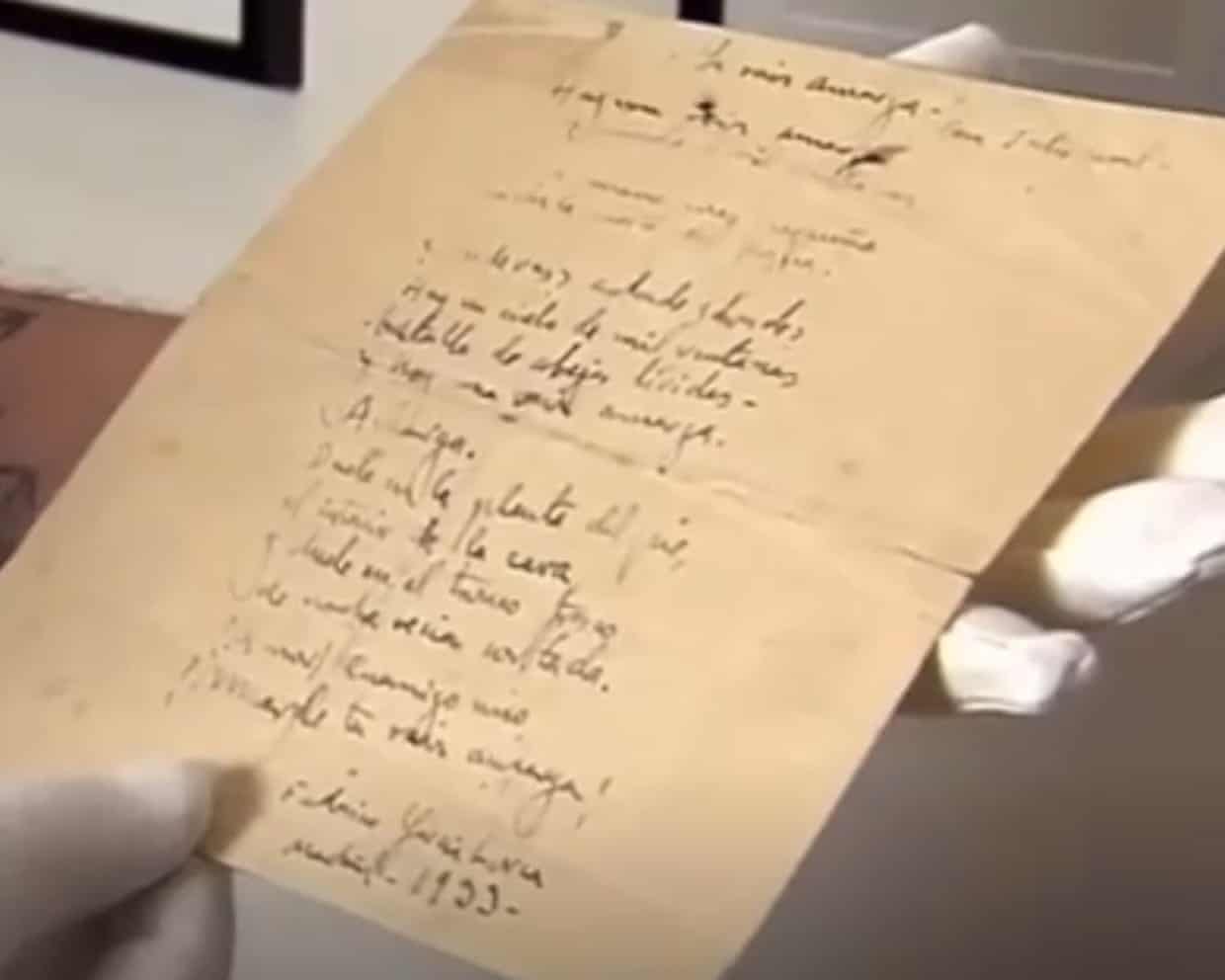
The newly discovered verse was found on the reverse of a manuscript of one of the Tamarit poems – Gacela de la raíz amarga – which the flamenco singer and Lorca enthusiast Miguel Poveda bought from a German antiquarian.
It has since been verified by the Lorca expert Pepa Merlo and will feature in a forthcoming book.
The brief verse, composed three years before Lorca was murdered in the early days of the Spanish civil war, reveals the poet’s familiar preoccupation with the passing of time: “The clock sings / I count the hours mechanically / Seven o’clock; twelve o’clock / It’s all the same / I am not here / It is the mark of flesh / That I left behind when I departed / So as to know my place / Upon my return.”
Poveda, who recently led efforts to turn Lorca’s childhood home into a cultural centre dedicated to the poet’s life and work, said he had been deeply moved by the fortuitous discovery.
The manuscript was bought by the flamenco singer Miguel Poveda. Photograph: RTVE
“My attention was grabbed when Pepa Merlo said to me, ‘That’s Federico’s handwriting. You’ve got something new by Federico there’,” he told the state broadcaster TVE on Thursday.
“For me, it’s a heartfelt gift. It’s all there in those lines, ‘It is the mark of flesh / That I left behind, when I departed / So as to know my place / Upon my return’.”
Merlo said that while the verse may have been overlooked because it was scribbled on the back of another work, it nonetheless revealed “the importance that the concept of time held for Lorca”.
The gay, progressive writer – whose works include Gypsy Ballads, Poet in New York, Blood Wedding, Yerma, and the House of Bernarda Alba – was shot by a rightwing death squad in August 1936, becoming perhaps the most prominent victim of Spain’s three-year civil war. His body has never been found and is thought to lie in a shallow grave at the bottom of a mountain slope near Granada.
Interest in Lorca has only grown as the centenary of his death draws near. Last summer, a facsimile edition of the poet’s homoerotic, anguished – and posthumously published – Sonnets of Dark Love was issued to bring the poems to a new readership.
Although long known to Lorca scholars, the sonnets had been hidden away by the poet’s family, who believed their tortured and sensual lines would taint his legacy and stir up old hatreds.
The newly discovered poem will be published in a book written by Poveda and Merlo titled Las cosas del otro lado. lo inédito en Federico García Lorca(Things from the Other Side: the Unpublished in Federico García Lorca).
Irish-born scholar’s work on writer to be reprinted to mark 80th anniversary of his death
English version bySusana Urra
Jesús Ruiz Mantilla 25 January, 2016
Life with Federico García Lorca is a pilgrimage that involves carrying the load of injustice on your back.
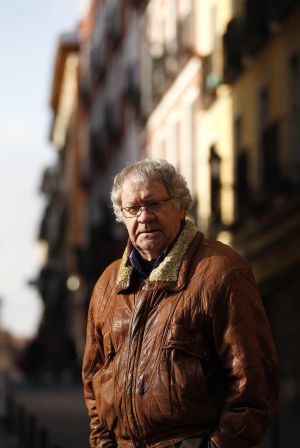
It has its moments of satisfaction, says scholar Ian Gibson, but also its sorrows – such as realizing that some people in Spain still prefer ignorance over knowledge of what happened on the day a firing squad ended the writer’s life at the onset of the Spanish Civil War.
Ever since he was a young 18-year-old student in Dublin, Gibson has spent most of his time unraveling the mysteries that surround the Spanish author ofBlood WeddingandPoet in New York. His complete works on the subject are to be reprinted this year, to coincide with the 80thanniversary of Lorca’s murder on August 19, 1936.
“He is the most famous missing person in the world,” says Gibson, alluding to the fact that Lorca’s body has still not been found despite several high-profile attempts.
Sitting inside a bar in Lavapiés, the Madrid neighborhood where he lives, Gibson explains how Lorca became the focal point of his career. “It could have been Baudelaire,” he admits. “But it was Federico who dazzled me.”
At age 76, he still doesn’t quite know why. “It was a very intimate, very profound thing that his poetry revealed to me. It had to do with the atavistic, with something primitive and instinctive. He was an eminently telluric poet.”
“It could have been Baudelaire. But it was Federico who dazzled me”
His first reading of El romancero gitano(translated as Gypsy Ballads) left a mark for life. Later, piqued by clues offered by Gerald Brenan in his 1950 book The Face of Spain, Gibson decided to investigate Lorca’s killing.
The result was his book The Death of Lorca, which addressed a taboo subject in 1970s Spain, then still under the yoke of Francoism.
Later came his main work, the 1998 biography Vida, pasión y muerte deFederico García Lorca, and offshoots such as 2009’s Lorca y el mundo gay and the more recent Poeta en Granada (2015).
“People think I’m obsessed,” he says, before admitting that maybe it is no wonder. “He is everything to me.”
Whether he likes it or not, Lorca is the central element that has enabled Gibson to approach other areas of research. It was Lorca who led him to Salvador Dalí, Antonio Machado and Rubén Darío, whose biographies he ended up writing as well.
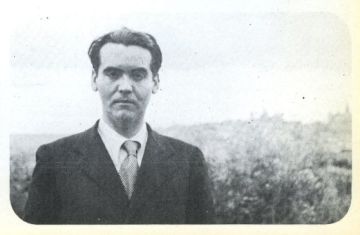
Federico García Lorca in a picture taken by French writer Marcelle Auclair.
Gibson also played a role in the efforts to exhume Lorca’s body after putting forward a possible location of the mass grave in which he is thought to lie, together with a schoolmaster and two bullfighter assistants. That attempt proved fruitless, as did the others.
“I have gone over the notes, the recordings. I still think he is buried very near the memorial park in Alfacar, but I have no problem with people investigating other possibilities, like the researchers Miguel Caballero, Javier Navarro and their people are doing,” he says. “All leads must be followed, no doubt. All I am interested in are the scientific results.”
But Gibson is not just attracted to the shadows surrounding the writer’s death. He is also intrigued and moved by certain episodes in his life.
“He had this sense of abandonment during his childhood years. Perhaps there was a wet nurse. His love trauma must have come from some very deep place. Like he used to say: every abandoned child is a story that got erased.”
But there was a lot of light in his life as well: there was joy, there was music, and a passionate determination to follow up on what he called his inclinations. Nobody can be left indifferent after getting to know Federico. To study Lorca is to study inner prisons and how to escape from them.
Gibson had found a soulmate. “He taught me both to detect and to wish to free myself of the puritanical environment I experienced as a child in a Protestant family surrounded by a Catholic country,” he notes.
“If I live in Lavapiés, it’s because of him, because this is where I came searching for his trail,” he adds. “I never dreamed I would end up living here.”
Ultimately, he even applied for dual citizenship. This has been a source of joy and sadness, as Gibson cannot understand why his adoptive country sometimes seems unwilling to get to the bottom of the Lorca issue.
Not that he hadn’t been forewarned “by a great observer of this country, Richard Ford,” he says about the 19th-century travel writer who wrote the influential A Handbook for Travellers in Spain.
“In one of the passages he comes up with a dazzling definition of this country,” says Gibson: “Unamalgamating Spain.”
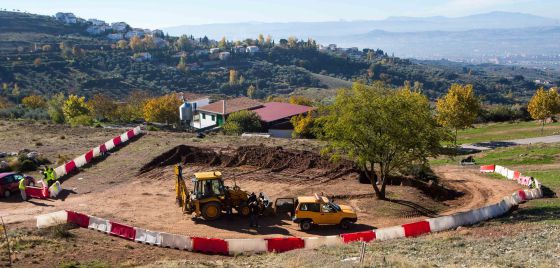
In November of last year, researchers dug at a spot called Peñón Colorado.M.ZARZA
Lorca’s grave: third time lucky?
After two failed attempts, researchers in Granada think they know where the poet is buried
Jesús Ruiz Mantilla
Granada, 27 October 2015
Upon reaching the spot, one cannot help but think of that line from Poema de la Soleá: “Tierra seca, tierra quieta de noches inmensas” (Dry land, quiet land of immense nights). If ever there was a genius who was able to create unsettlingly premonitory work, it was Federico García Lorca.
Somewhere beneath the dry land of what is now Plot No.9 in Alfacar (Granada), a barren wasteland of weeds and rocks, within a 160-meter radius – that is where the body of the playwright and poet might be.
So say Miguel Caballero and Javier Navarro, heads of the research team looking for the exact location of Lorca’s grave.
Now we have to look for a needle in a haystack. If everything had been left the way it was, we would have found the remains already”
MIGUEL CABALLERO, HEAD RESEARCHER
The search is about to enter a new phase after the Andalusian government granted permission to seek out the place where the author of Poet in New York and Blood Wedding was buried, together with other victims of a firing squad on August 17, 1936, at the beginning of the Spanish Civil War.
A bevy of historians, archeologists, geologists and forensic experts from Spain, Argentina and Britain are waiting their turn to dig. It will be the third attempt to find Lorca’s grave. Two earlier and much-publicized attempts both ended in failure.
The first try was in 2009, and was based on a lengthy investigation by the renowned historian and Hispanist Ian Gibson, who has written extensively about Lorca. There was a second attempt last year by the same team that is about to try again, just a few meters away from where they left off.
Blame it on the cold weather. Winter came around, and the digger that was being used at the site was required elsewhere for snow-removal duties. Or perhaps there just wasn’t enough political will to carry through with the plans. But the attitude seems to be changing, both at the local and regional levels.
The project’s finances have also improved greatly thanks to a global crowdfunding drive that attracted many donors, some anonymous. This came on top of the €16,500 in unspent money left over from a grant provided by the Andalusian government in 2014.
This time, Miguel Caballero and dig director Javier Navarro are confident that they will be successful.
“If they are there, we will find them,” says Navarro, in reference to Lorca and to the teacher and two bullfighter’s assistants who were shot and buried with him. “We’ve made progress on our knowledge of the ground, with scientific work that has ruled out certain spots.”
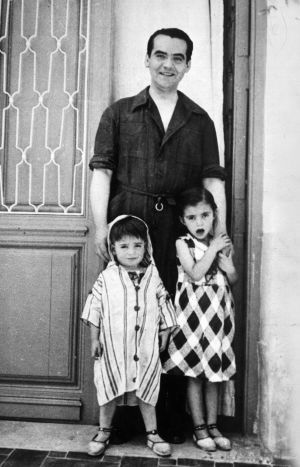
Federico García Lorca with his nieces.
Their search is based on information that differs significantly from that used by Ian Gibson as reference.
“Our reference is the work by the Granada researcher Eduardo Molina Fajardo, published posthumously in 1983,” they say. That document, titled Los últimos días de García Lorca (or, The last days of García Lorca) was written by a man who supported the Franco side and featured testimony by people involved in the crime, besides containing a wealth of data regarding places and times provided by direct witnesses.
The son of one of the people named in the book has certified the relevance of the new investigation. Fernando Nestares, a retired general, was taken to the spot of the execution by some of the people whom he says participated directly in it.
“There were three of them,” says General Nestares. “I was taken by the assault guards to the place where they said they had killed them. One of them was named Antonio Benavides and he was a real show-off.”
According to Nestares, the victims were brought there in two trucks: “One was transporting García Lorca and the anarchist banderilleros [bullfighter’s assistants] Juan Arcoya Cabezas and Francisco Galadí. The other one was carrying Dióscoro Galindo, a republican teacher from Publiana, who was also executed.”
Some members of the firing squad were recruited for their accurate aim, while others joined out of personal pleasure
Some members of the firing squad were recruited for their accurate aim, while others, like Antonio Benavides, joined out of personal pleasure, according to Miguel Caballero, who defined him as a natural-born killer.
Meanwhile, Ian Gibson had based his research on testimony by Manuel Castilla Blanco, aka “Manolillo the Communist,” who allegedly buried the bodies. He led Gibson to a different spot around 400 meters from the current dig site.
Miguel Caballero has stated that this man’s testimony is not to be trusted, as he arrived in Alfacar in September 1936 – the crime was committed in August. “In those times of need, anybody was willing to offer a version of events in exchange for something.”
But Gibson is adamant. “Taking a foreigner there in those days was risky. I think he was there. He was convinced that he was telling me the truth.”
The historian Ian Gibson was part of the first attempt at finding Lorca's body.LUIS SEVILLANO
The trouble with the new spot, which has been closed off with stakes, is that it is covered with around eight meters of earth due to earlier plans for a soccer field. On the same spot where researchers believe that Lorca is buried, there was once a training ground for Franco’s forces, then a motocross circuit, and finally plans for a residential estate and sports complex.
But Isabel García Lorca, the poet’s sister, campaigned to stop the construction project and wrote to the mayor in October 1998. She also sent a fax to the Andalusian premier, then Manuel Chaves. The plans were halted.
“But the main damage had already been done,” says Caballero, referring to the fresh layer of earth. “Now we have to look for a needle in a haystack. If everything had been left the way it was, we would have found the remains already.”