Showing posts with label Paul Muldoon. Show all posts

Monday, September 2, 2024

Paul Muldoon / For me, Meeting the British blew away the very idea of certainty

For me, Meeting the British blew away the very idea of certainty

Paul Muldoon’s 1987 collection was a profound influence on me as a writer, not least in how it shows how fixed ideas are subject to slippage
    • The Guardian, 

Writer Paul Muldoon
‘All through Meeting the British, you can see Paul Muldoon giving himself over to the play of language.’ Photograph: Murdo Macleod
In 1986, fresh from Africa, I arrived at university with a sheaf of poems. Nothing unusual there, except in that year Paul Muldoon was the Judith E Wilson fellow at Cambridge, and by good fortune he was in residence at my own college, Fitzwilliam. There, once a week, at about six in the evening, he convened a writing group. It wasn’t a creative writing workshop, but something more fluid. People would read out poems or short pieces of prose. Once, I remember, Lee Hall, later the writer of Billy Elliot and The Pitmen Painters, brought along his guitar and sang a song. The group was a mixture of students and Cambridge residents, of varying ages. We all smoked, of course, and there was a fair bit of covert flirting.
Muldoon’s responses to the work were elliptical, like his own writing, which we were beginning to discover in collections such as Quoof (1983) and a slim Selected Poems (1986). Once he described one of my poems – I think it was about cycling – as “very regular”. It took me some time to realise he probably wasn’t just talking about the metre.
It was Muldoon’s next book, published just after he left Cambridge for the University of East Anglia and then Princeton, which had a big effect on me. From Meeting the British (1987) I learned many things that helped my own writing when I began to publish novels, a decade or so later.
The title poem dramatises the encounter between a group of native Americans and British colonial soldiers during the 1760s: “They gave us six fishhooks / and two blankets embroidered with smallpox.” Half-Irish, half-English, brought up in Africa, I began, after reading this, to see that I myself had emerged from a quasi-colonial situation: the last, half-embarrassed splutter of empire, which despite independence in the late 1960s continued coughing on for at least 15 years, determining political and social norms in many of the African countries in which I had lived.
I realised that I had been involved in a movement, a process from origin to destination, something spectral. I also came to see identity like this, understanding the distant past (my Kerry grandmother reminiscing about hiding under the bed when the Black and Tans raided the farm) and the near past (watching police attack rioting crowds in Nigeria) in a different way. I suppose I woke up from the idyll of politically neutral insulation that is, to this day, the bane of expatriate life.
This realisation coincided with a boom in postcolonial studies in an academic sense. People such as Homi Bhabha were beginning to theorise key concepts such as hybridity, boundary areas and ambivalence. And it seemed to me that Muldoon was putting these ideas into practice poetically, with his shape-shifting rabbits and badgers, lobsters and dolphins – even that “hacienda’s frump / of pampas-grass, / a pair of cryptic / eagles guarding its front door”.
Part of the ambivalence of Muldoon’s own poems resides in modal verbs and associated speech acts, which together somehow clear a space between what is certain or not (“I must have been dozing in the tub / when the telephone / rang …”). These formulations – the longer one occupies them as a reader – appear to open up political possibilities; or rather, the possibilities of new politics. Muldoon’s forms, his metaphors, even his famous half-rhymes, now seem proleptic, throwing themselves forward to the realities of the peace process that would begin to emerge materially in Northern Ireland in the early 90s, like the forked twig “astounding itself as a catapult” in another poem in the book.
Yet there is never, in Meeting the British, any sense of settling into a particular political narrative. The associative power of language is constantly brought in to show us how fixed ideas are subject to slippage, like the length of chain from which the poet Gérard de Nerval hangs himself in one poem, which makes the speaker of the poem “think of something else, then something else again”. All through the book you can see Muldoon giving himself over to the play of language like that, and I suppose that one of the other things that changed me, on reading it, was realising that even in fictional prose, which tends to be more subject to external structures (the drama, the plot, the situation), a writer needs to be open to that.
That said, the collection contained Muldoon’s most structured piece of dramatic writing to date: 7, Middagh Street realises the voices of the illustrious occupants of a house in Brooklyn Heights in the early 1940s, including WH Auden, Chester Kallman, Louis MacNeice, Carson McCullers, Salvador Dali, Benjamin Britten and Gypsy Rose Lee. As a whole, this long poem is a consideration of the relation between politics and art. I suppose what I learned from 7, Middagh Street was that, in the right circumstances, it’s OK to voice actual historical figures, as I did with Idi Amin in The Last King of Scotland, and that the brute material of history and politics can sometimes be corralled in art – even if there is always a cost, a cargo, some kind of residue of actual lived experience.
That’s always there in Muldoon, the feeling inscribed in the form. So it’s fitting that none of the so-called literary lessons of Meeting the British were the really important ones. The poems in it about love and death spoke to me most strongly, in particular the elegies for Muldoon’s father, to whom the book is dedicated. Everyone has a father story, of course, and it is a testament to Muldoon’s universalism that when he sees his father in a badger, we can see ours in his.


Tuesday, October 28, 2014

A life in poetry / Paul Muldoon

Paul Muldoon: a life in poetry

I'm interested in what can be done with words, but I like to jazz things up a bit
    • The Guardian, 

Paul Muldoon
The poet Paul Muldoon … 'I'm horrified at how many lyrics I can still remember from songs from the 50s.' Photograph: Murdo Macleod for the Guardian
Collecting lyrics from the more literary end of pop songwriting into a book is nothing new. In recent years Leonard Cohen, Bob Dylan, Jarvis Cocker, Ian Dury and Paul Simon are just some of those whose words have been stripped of the music and presented essentially as poetry, taking their chances with exposure to the unforgiving white page. Their efforts are joined this month by another book of lyrics, The Word on the Street, by Paul Muldoon. As a Pulitzer prize winning poet, former Oxford professor of poetry and current New Yorker poetry editor, Muldoon is no stranger to the challenges of making words stand alone on the page. But for all his successes, he is also aware of the pitfalls.
"You never really know how people are going to respond to something like this," he says. "The tradition of reading lyrics on a page is a little bit iffy. Some of us of a certain age will remember lyrics on album sleeves, which is now not such a feature as it used to be. But in a sense they educated us in how to read them. One took them somewhat seriously, but maybe not completely seriously. I'm a bit conflicted myself." He says there have already been a couple of American reviews saying the book is "not quite up to par. You can see how people might be slightly disconcerted – these things are not quite poems, and yet they are sort of like poems."
Whatever people's responses to the project, no one can say it comes as a surprise. Muldoon has had an obsessive interest in pop and rock music throughout his life, has played in bands, written libretti for opera and collaborated with musicians. In 2006 he published a collection of lyrics, General Admission (Gallery Press), that included "My Ride's Here", a song co-written with his late friend, the musician Warren Zevon, that was later covered by Bruce Springsteen. Last year he published Songs and Sonnets (Enitharmon), in which he explicitly explored the relationship between verse and song, and now The Word on the Street. These lyrics have been written for Muldoon's band, the Wayside Shrines, based in Princeton where he teaches, and the songs are available on the band's website.
"Songs and poems have always existed together for me," he explains. "At school we studied English poetry, French and Latin poetry, as well as Irish, that is Gaelic, poetry, which we were often taught as songs. Yeats wrote a fantastic number of poems with the word song in the title, and used, as I myself have been using, the refrain. I've written quite a few poems in the last few years that have been refrain driven, and so this book is not so strange a development."
Muldoon was born in 1951 in rural County Armagh in Northern Ireland, and recalls a childhood in which there was still a tradition of "the knock on the door and a neighbour dropping by to sit by the fire and maybe being persuaded to give you a bar or two of a song or recite a poem. Recitation was a big thing and a living tradition. People had been forced to learn poems at school, and so had by heart bits of Shakespeare and Byron and Wordsworth that they would call on quite normally and naturally. These guys were farmers for the most part, but they could also recite a bit of a Robert Service poem about life in the Yukon or the Klondike, popular stuff that lived in a sort of netherworld between poetry and song."
As a teenager Eliot was Muldoon's first poetic catalyst, "but that was also, in a way, tied up with song," he says. "One of things people forget about Eliot is that the amount of popular music in The Waste Land is phenomenal. He clearly knew an awful lot about music hall and had a great ear. I'm sure that is one of the reasons he is so memorable. A lot of the stuff is quite dense, but we remember it because he had a good ear for a catchy line, something you must also have in the song business."
Muldoon eventually abandoned "Eliotic parodies" after encountering Seamus Heaney's early work and coming to the realisation that he could write about the world around him. And so he emerged as the great prodigy of Irish poetry who, as a teenager, sent some poems to Heaney asking what was wrong with them. Heaney, so the legend has it, replied in one word: "Nothing". Muldoon has said that even he is sketchy as to the details of the story, but acknowledges its essential truthfulness in that Heaney, who taught him at Queen's University, Belfast, was indeed a huge supporter and recommended him to fellow Ulsterman and Faber poetry editor Charles Monteith, resulting in Muldoon's first book, New Weather, being published when he was still a student in 1973.
After graduating Muldoon worked as a BBC radio and television producer in Belfast before teaching at Cambridge and the University of East Anglia. His 1977 collection, Mules, signalled his first explicit engagement with the Northern Irish Troubles, it was followed by Why Brownlee Left(1980) and Quoof (1983). In 1987 he left to teach in America, where he published The Annals of Chile (1994), featuring the acclaimed elegy for a former lover, "Incantata". His 2002 collection, Moy Sand and Gravel,won the Pulitzer prize. As an academic, Muldoon was Professor of Poetry at Oxford between 1999 and 2004, but his home remains in America, where he is married and has two children aged 13 and 20. Since 1990 he has taught at Princeton, from where The Word on the Street references the details of New Jersey life and lore.
So is he writing out of the great tradition of blue-collar music from the garden state? "I like New Jersey and love the tradition of it in song. Obviously Bruce Springsteen is a huge part of that. Maybe it's a small joke that we're a Jersey band, but it's a large collective really, and while there are three or four Princetonians, many of us are not." Muldoon plays guitar in the Wayside Shrines but says "I have a few chords, and that's about it. I had piano lessons as a child but very little of it stuck. Yet I loved the music I heard on the radio and am horrified at how many lyrics I can still remember from songs from the 50s. So I find myself simultaneously, and paradoxically, steeped in music, yet I know almost nothing about it."
As a big fan of Irish traditional music, his first instrument was actually a banjo. He speaks admiringly of Luke Kelly of the Dubliners and his version of the Patrick Kavanagh poem "On Raglan Road". "It's one of Kavanagh's best-known pieces, and I was always interested in the fact that he could pull that off in addition to all the other things he could do. Folk and rock lived alongside each other for me, so I also tried to play T Rex songs on the banjo, but that didn't really work."
On the classic divide between 60s music fans, Muldoon came down on the side of the Stones, "but I still go to see Paul McCartney every chance I get and he is still a phenomenal performer. Just before last Christmas, in a 10-day period, I saw the Stones, the Who, Dylan and Neil Young. They would all be getting their discounts from the grocery store and they were all fabulous. It is hilarious to see how well so many of these guys have weathered. But I'm also a fan of songwriters of earlier eras. Not just the Tin Pan Alley gang, but Cole Porter, Noël Coward, even Gilbert and Sullivan. They were very good at what they did. I'm just as interested in Gilbert and Sullivan as I am in Wagner. Maybe more so."
He says one of the practical reasons he began writing lyrics was that "it might be a way to avoid writing a poem every time some bright idea flew into my head, because most of the time what seem to be bright ideas are not that bright at all. And at the risk of sounding hierarchical, I think there are things you can get away with in a song. The pressure per square inch is a little lower, and, frankly, it has the capacity to deal in what might be truism or cliché."
His favourite title from The Word on the Street is "I Don't Love You Anymore". "I think all songs should be called 'I Don't Love You Anymore'. It allows you to then just get on with it. There's even one called 'Days of Yore'. I mean, you just could not call a poem that, let alone, on a good day, maybe even get away with it." The poem name-checks another notably inventive writer, Ian Dury: "We also discuss how a kid with polio / And a half-decent portfolio / Could get into the Royal College of Art / In those far off days of yore." "I've just read a book of his lyrics edited by his daughter. The best of them stand up extremely well on the page. He was a great writer – a genius really."
The lyrics are full of Muldoon's trademark wit, virtuosic verbal dexterity and tricksiness. "Like most writers, though I know some people might doubt this is true of me, I'm as interested in clarity and simplicity as the next person. I'm not setting out to be what people sometimes think I am. I am setting out to be clear, and songs can be more direct and immediate."
The subject matter ranges from spoilers for Hollywood films to American foreign policy, the state of the economy as well as personal relations. "It's not that poetry can't say things. Of course it can. And it's not that I haven't written poems about American politics, not to mention poems about Irish politics. But there is something about the way music can deliver you to an emotional place. The combination of music and words is a very powerful force in our lives. It's not that I'm going over to that form of writing forever. I'm still very interested in what may be done with words alone, but I like to jazz things up a bit, almost literally sometimes."
His next music project is a collaboration with the composer Mark-Anthony Turnage and the London Symphony Orchestra, to be performed during the Derry-Londonderry City of Culture festival this summer, commemorating the 400th anniversary of the building of the city walls. He says he also has a lot more song lyrics, "probably another book's worth, but whether I'll publish them I don't know. I certainly don't think I'll publish it next." Instead he is currently "attempting to write a few poems" that he suspects will reflect his lyric writing "for better or worse. When I first wrote librettos, that influenced the way I wrote poems. Songwriters have very particular skills. The great ones are great storytellers, and I'm interested in what I might learn from this and be able to bring back into the poetry business. So it has been fun for me and one hopes that it will be fun for other people too. I think I'll be back to poetry next, but I can't help thinking that I might just continue to do both."


Monday, October 27, 2014

Paul Muldoon / Poems on war

by ERNEST DESCALS

Poems on war: Paul Muldoon is inspired by Rupert Brooke

Muldoon writes new poem "Dromedaries and Dung Beetles" in response to Brooke's "The Soldier"
The Guardin, Saturday 26 October 2013
  • Paul Muldoon
Paul Muldoon. Photograph: Murdo MacLeod for the Guardian
I'm a huge fan of Rupert Brooke, one of the first poets I read. In fact, the only poet whose work was in my childhood home. I thought it might be interesting to rejig Brooke's idea of the corner of a foreign field and make it "forever Ireland" rather than "England". I also recently visited the battlefields of Gallipoli, not far from where Brooke died, as well as Morocco. I traced what must have been a distant relative who died in the second world war somewhere in north Africa. All of these ideas came together in the poem "Dromedaries and Dung Beetles".

"Dromedaries and Dung Beetles" by Paul Muldoon

An eye-level fleck of straw in the mud wall
is almost as good as gold . . .
I've ventured into this piss-poor urinal
partly to escape the wail
of thirty milch camels with their colts
as they're readied for our trek
across the dunes, partly because I've guzzled
three glasses of the diuretic
gunpowder tea the Tuareg
hold in such esteem. Their mostly business casual
attire accented by a flamboyant
blue or red nylon grab-rope
round their lower jaws, dromedaries point
to a 9 to 5 life of knees bent
in the service of fetching carboys
and carpetbags from A to B across the scarps.
Think Boyne coracles
bucking from wave to wave. Think scarab
beetles rolling their scrips
of dung to a gabfest. These dromedary-gargoyles
are at once menacing and meek
as, railing against their drivers' kicks and clicks,
they fix their beautiful-ugly mugs
on their own Meccas.
The desert sky was so clear last night the galaxies
could be seen to pulse …
The dromedaries were having a right old chinwag,
each musing on its bolus.
Every so often one would dispense some pills
that turned out to be generic
sheep or goat. The dung beetles set great store
not by the bitter cud
nor the often implausible Histories
of Herodotus but the stars
they use to guide
themselves over the same sand dunes
as these thirty milch camels
and their colts. They, too, make a continuous
line through Algeria and Tunisia.
Dung beetles have been known to positively gambol
on the outskirts of Zagora, a boom
town where water finds it hard not to gush
over the date-palms.
Despite the clouds of pumice
above Marrakesh even I might find my way to Kesh,
in the ancient Barony of Lurg,
thanks to Cassiopeia
and her self-regard. Think of how there lurks
in almost all of us a weakness for the allegorical.
Think of a Moroccan swallow's last gasp
near the wattle-and-daub oppidum
where one of my kinsmen clips
the manes of a groaning chariot-team . . .
Think of Private Henry Muldoon putting his stamp
on the mud of Gallipoli
on August 8 1915. It appears
he worked as a miner at Higham Colliery
before serving in the Lancasters and the 8th Welsh Pioneers.
His somewhat pronounced ears
confirm his place in the family gallery.
'It's only a blink,' my father used to say . . . 'Only a blink.'
I myself seem to have developed the gumption
to stride manfully out of a Neo-Napoleonic
latrine and play my part in the march on Casablanca
during the North African campaign.

"The Soldier" by Rupert Brooke

If I should die, think only this of me:
That there's some corner of a foreign field
That is for ever England. There shall be
In that rich earth a richer dust concealed;
A dust whom England bore, shaped, made aware,
Gave, once, her flowers to love, her ways to roam,
A body of England's, breathing English air,
Washed by the rivers, blest by suns of home.
And think, this heart, all evil shed away,
A pulse in the eternal mind, no less
Gives somewhere back the thoughts by England given;
Her sights and sounds; dreams happy as her day;
And laughter, learnt of friends; and gentleness,
In hearts at peace, under an English heaven.


Sunday, October 26, 2014

Paul Muldoon / Love Poem with Pig

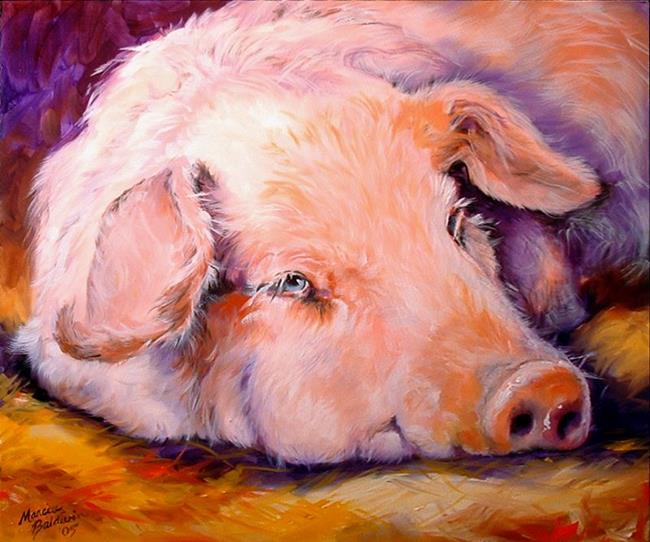
Pink pig
by Marcia Baldwin

Love Poem with Pig

by Paul Muldoon
When the people of Smartno threw their very last pig to the Turks
who had for months beset their hilltop town
they were gratified to look down
next morning and find the siege works
abandoned. Only stout defenders, the Turks concluded, would conjoin
blasphemy with beneficence. The way you poke a fork
at a slab of pork
shoulder or pork loin
on which you've yet to put your stamp
suggests you might succumb if my steadfastness were itself to fail.
Before you undermine
my confidence so I suddenly decamp
and go looking for some other hilltop town to assail
maybe you'll toss me a little something? Maybe you'll give me a sign?