Suspected radical Taliban have attacked a shrine to the memory of Rahman Baba, the best known and best loved Sufi poet in Afghanistan. Rochsana Soraya spoke to the Afghan journalist and literary critic Mohammad Zarin Anzor about the poet's life and work
Rahman Baba's grave was destroyed in an attack on March 5th. The shrine at the site was severely damaged
Mr Anzor, as one of the best known literary critics in Afghanistan who has written academic studies of Rahman Baba, how would you present him to an international public?
Mohammad Zarin Anzor: Rahman Baba, is one of the great Afghan poets of the seventeenth century; his writings are devoted to the awareness of God and the Sufi Muslim mysticism. I believe that no other classical Pashto poet has won so much affection as he has: he is celebrated, loved and honoured. That's why he's known as Baba, little father or grandfather. This is a title which is only awarded to elders who are worthy of honour in our society.
Rahman Baba's poetry is also wonderfully expressive of love and affection, and his poems are not just loved by religious people and dervishes, but also by women, young people and all kinds of people who love life. His poems also portray the world view of the Pashtuns of the time; that ought to be of great interest to people.
What makes Rahman Baba stand out from other great Pashto poets?
Anzor: Beside Rahman Baba, there were many other great Sufi poets, like Mirza Khan Ansari, Daulat Luani, Wasel Rokhani and Mullah Arzani in the sixteenth century, Abdul Qader Khattak in the seventeenth), or Pir Mohammad Kaker in the eighteenth, just to name a few. The topics of mysticism and awareness of God are central to Pashto literature up to modern times. But Rahman Baba's mystical poetry is different from that of the others because it is not entirely dedicated to God, but also reflects the wishes of the people of his time. Rahman Baba deals with social issues and other important topics which concern everyone. For example, you can find in his Diwan the following lines:
Greater than building Abraham's Qaaba Is it, to heal the wounded heart of another.
What are the typical characteristics of his poetry?
Rahman Baba's shrine after the attack. Rahman Baba's Diwan, a collection of poems, is his only work. It has only recently been fully translated into English
Anzor: Rahman sees awareness of God as part of human evolution. How can human beings free themselves from the animalistic world and reach a higher spiritual status? Another characteristic is the moral aspect of his poetry, from which people can take examples for their own lives. Most of his poems are Ghazals; he almost always stuck to this form, whatever the content of his poems. There are a few examples of Mokhamas (five line poems) and Qasida (poems with over 15 lines).
People are so fond of Rahman Baba's poems because the language as well as the images and metaphors are very simple. It's only when you take the poem as a whole that you find a highly complex philosophical view of the world.
Orientalists who have translated Rahman's work, like Major Raverty in the nineteenth century or Annemarie Schimmel in the twentieth, emphasise the aspects of love and praise of God in his poems. How far can Rahman Baba be seen as a socially critical poet?
Mohammad Zarin Anzor says than Rahman's poetry is marked by a subtle rhythm and a musicality
Anzor: Like Khoshal Khan, Rahman Baba lived and wrote during the period of Mogul rule. Khoshal fought against the Moguls after he'd been imprisoned by them, and he incited a revolt against Mogul domination. Some of his poetry deals with this issue. But Rahman Baba is not a poet of national resistance. He never submitted to any rulers, or worked and wrote under them. He dealt with all the social issues of his time in a critical manner. He belonged to the Momand tribe, but in one of his poems he writes:
I am a lover and I concern myself incessantly with love
I am not a Khalil, not a Daudzai, not a Momand
For Rahman, it was humanity which stood at the centre of his thoughts, and not the more or less random membership of a particular group.
Western academics often see Rahman's poems as being in the tradition of the Persian-language Sufi poetry of Jalal ud Din Rumi. The topics of Rahman's poetry and his manner of expression have something timeless and universal about them. Can one not see in his poetry the values of the kind of spiritual and philosophical development which later became known in Europe as humanism?
Anzor: In oriental writing, and especially in that which deals with awareness of God and mysticism, there are common values and metaphors shared by Arabic, Persian, Turkish, Indian and Afghan lyrical poetry which are not totally unknown in Western poetry and literature. Some of the metaphors belong to the cultural heritage of humanity. It would be an offence against the principles and values which characterise Muslim mystical and love poetry if one were to draw clear borders.
From the point of view of an international readership, what is the literary value of Rahman's Diwan? Is it world literature which still has to be discovered?
Anzor: Aside from its importance for Pashto literature, Rahman Baba's Diwan is of great value for an international public. But it's not just the Diwan – it's also the works which were written before and after Rahman Baba of which people need to become aware. People will see that the Afghans were able to develop a complex value system and philosophical depth. That will help the world to grow together a little more and it will remove another empty space on the map of world literature. The whole world is looking towards the Pashtuns, but no-one is taking any interest in their cultural heritage.
Mohammad Zarin Anzor is an Afghan journalist, literary critic and writer who is currently living in Germany. He studied journalism and Pashto literature at the universities of Kabul and Peshawar.
Another Birth, Other Words: Queering the Poetry of Forough Farrokhzad in Translation
POSTED ON
The following is a guest post by Nazila Ghavami Kivi, an editor of Danish queer feminist magazine Friktion, where the piece was originally published in Danish.
In the piece, Kivi discusses the challenges of translating poetry from the gender-neutral Persian language into Danish and the queering potential of poetry that transcends language, time and traditional gender roles.
Recently, the Swedish Academy responsible for the dictionary of Swedish language added the new gender neutral pronoun hen to the newest edition of their work. The news reached international media and reaffirmed the idea of Scandinavian countries as being the ‘frontrunners of gender equality.’
The application of the gender neutral pronoun isn’t all that new, though. It has been a subject of debate among feminist-leftist circles since the 1970s. Swedish kindergarten Egaliaeven applied the use of hen back in 2011. Egalia’s mission to undo gender stereotypes entailed among other things the substitution of the gendered pronouns han and hon (he and she) with the gender-neutral neologism hen.
The Scandinavian narrative of progressiveness and gender equality isn’t without its challenges and controversies, however. Internal disputes within leftist-feminist circles suggest that some see the gender neutral pronoun as a liberating panacea, bound to revolutionize binary gender roles, while others view it as an unrealistic utopian project that will only serve to blur actually-existing inequalities. Semantics won’t fix the lived experiences of sexism, they argue.
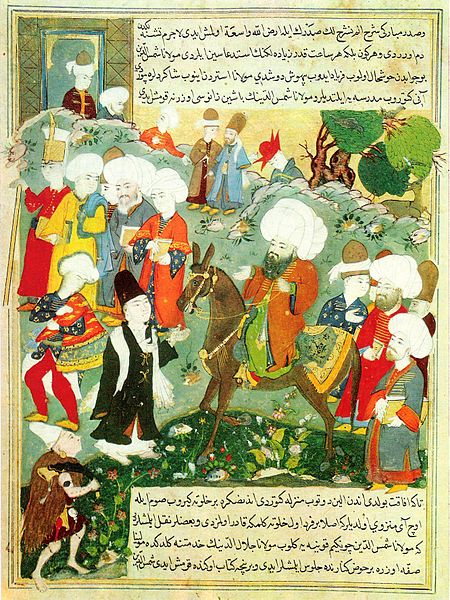
The meeting of Rumi and Shams, as depicted in an Ottoman miniature from 1600.
What those opposed to linguistic gender neutrality forget, however, is that this trend is often not nearly as ‘exotic’ or foreign a phenomenon as is often cast. You don’t have to travel farther than Finland — Sweden’s neighbor — before you encounter a gender-neutral language, where the neutral (and only) 3rd person pronoun is hän. This word has served as an inspiration for the Swedish equivalent: hen and the Danish: høn.
Even further afield, another language remotely related to Danish with shared Indo-European roots is Persian, in which some of the oldest and most influential literature in history has been written. Throughout history, Persian’s lack of gendered pronouns has allowed for the production of subversive texts that have confounded and enchanted readers and leaders alike.
The world-renowned Sufi poet Jalal ad-Din Mohammad Molana Rumi, who lived in the 13th century and wrote in Persian, is often brought forth as an example of this subversive poetic tradition, where the Persian neutral pronoun ou (او) allows for a wide array of interpretative possibilities. His object of desire could be a monotheistic God, a deity of the earth, a woman, or his friend and mentor Shams-e-Tabrizi.
Although some read his poems as homoerotic, there is no known proof that Rumi was homosexual or had a physical relationship with his mentor, Shams. What is beyond dispute, though, is their intense love and admiration for each other.
While some call it wishful thinking or a product of the ‘modern queering’ of Rumi to read his poetry as if it was written by a contemporary gay or bisexual man, it is equally reasonable to question the heteronormative readings of 13th century poetry, written long before the dominance of 19th and 20th century binary gender identities. The possibility of Rumi having been read and translated in a heteronormative light becomes even more probable when considering other cases of heteronormative interpretations of historical sources.
Modern Assyriologists’ readings of ancient Babylonian poetry suggest that transgendered or gender transitive identities have often been erased by Orientalist readings of the original writings. Instead they have been re-cast as prostitutes, eunuchs, or “hermaphrodites” according to the Orientalist views of the ‘East’ as sexually deviant and perverted.
These ambiguities and different modes of interpretation are not limited to older literature. Modern Persian poetry, she’r-e no, that was first introduced by Nima Youshij (1895-1960) during the early part of 20th century brought new rhymes, rhythms, and techniques as well as more social and political subjects to Persian poetry.
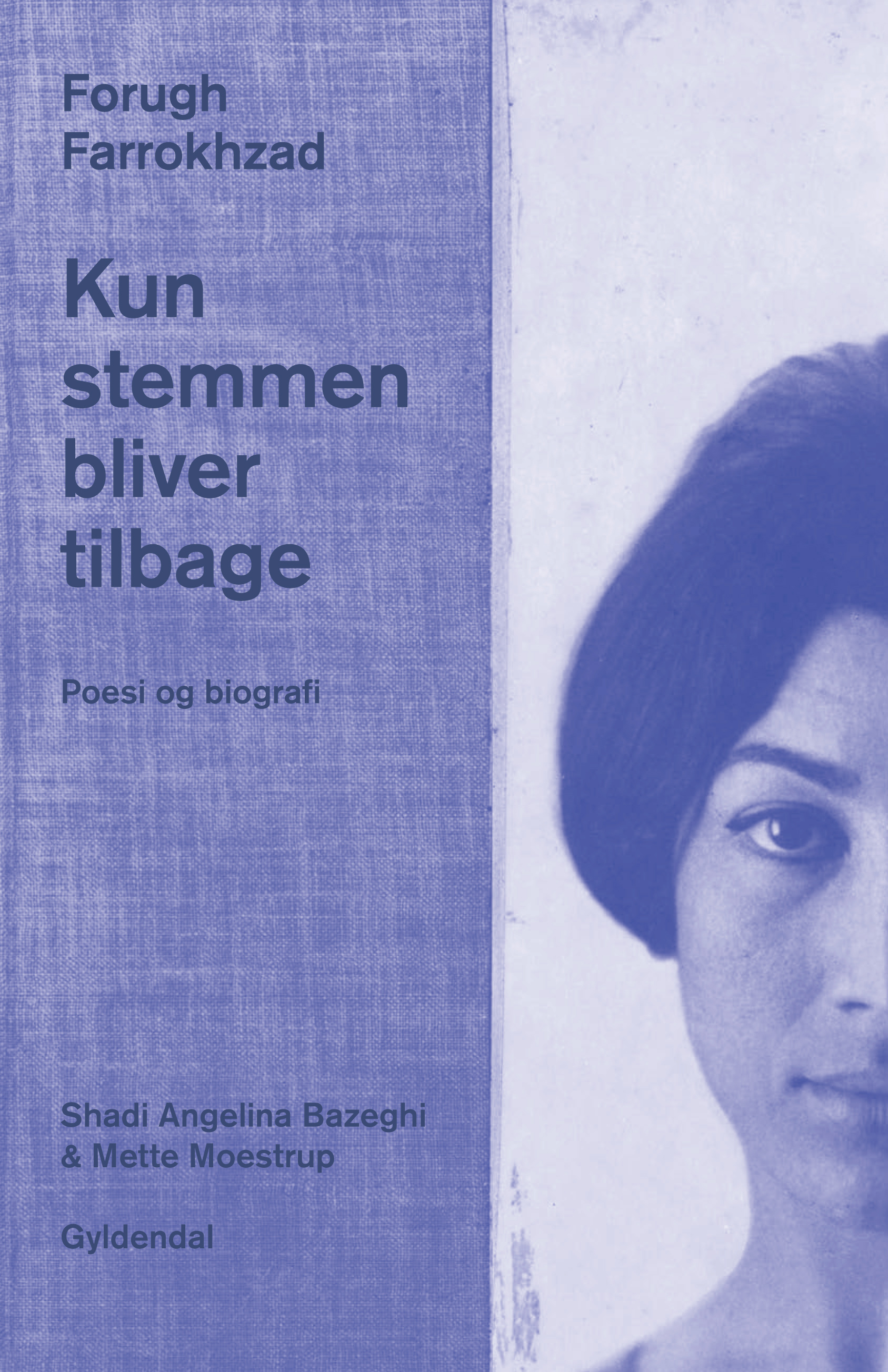
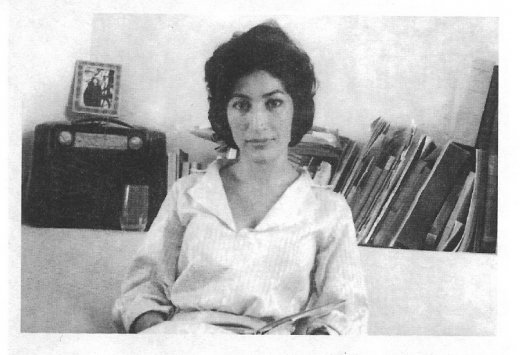
While Youshij is considered the founder of modern Persian poetry, one of the most well-known and internationally acclaimed representatives of Iranian modern literature is the controversial poet and filmmaker Forough Farrokhzad.
Born in Tehran in 1934, Farrokhzad managed to challenge all reigning norms, both in her private life and in her work as an artist. She divorced at 18, wrote poems about desire and eroticism, shunned literary traditions, and directed the acclaimed documentary The House is Black about life in a colony reserved for lepers in Iran. She died in a car accident at the young age of 32.
I spoke to poet and writer Shadi Angelina Bazeghi about the challenges in reading and translating Farrokhzad from a gender neutral language to a gendered one. Along with Danish author Mette Moestrup, Bazeghi has written Kun stemmen bliver tilbage (Only the Voice Remains), the first thorough introduction to Farrokhzad for a Danish audience, including some of Farrokhzad’s prose and her two last poetry collections. Bazeghi has been in charge of the translation and expands on the possibilities of a gender-neutral language:
“When, as a poet, you are not limited by the restraints of writing of a certain gender, it opens up to new nuances in language. Not only is it liberating to the artist themselves to be able to write from numerous positions, but also the object is divorced from gender and can claim many parts, both relating to gender, but also relating to who is object and subject in the poem.”
Shadi Angelina Bazeghi is also familiar with the expanse of interpretative possibility in classical Iranian poetry. Sticking with tradition, she will sometimes crack open a random page in Hafez’s (1320-1390) poetry collection and read a “favorite.” According to folklore, Hafez will give the exact answer to any question posed.
“The poem often consists of two figures, a narrator and a recipient. And due to the gender-neutral nature of the language, it is difficult to discern who is subject and who is object. Multiple people are referred to with the pronoun ou, and it’s actually pretty nuts that I sometimes can’t discern if one or the other is a man or a woman. That’s the potentiality that language contains. Classic poets like Hafez and Rumi have also utilized it — there is an expansion of a poetic space where the task of “gendering” is on the reader, be it as a man, woman, queer or…”
According to Bazeghi, many poets whose poems can be interpreted as erotic, like Hafez and Rumi, switch up the relations between gender, physical versus spiritual being, and geographic-national senses of belonging.
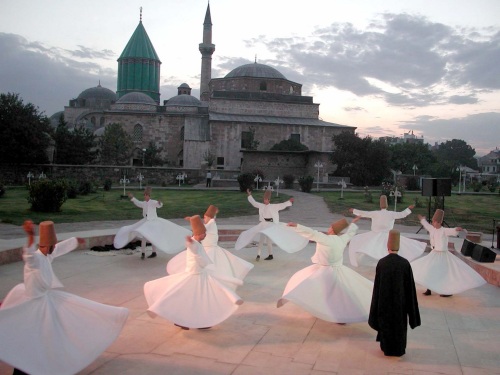
Dervishes at the tomb of Rumi in Konya in central Turkey.
“Rumi writes himself out of a gendered body that belongs to East or West, any religion or nation etc. Instead he defines himself as an un-gendered body that belongs to love, and is intoxicated, spiritually elevated, by love itself.”
“That might be one of the reasons why so many Iranians read poetry, regardless of gender. This is especially true of Forough Farrokhzad. Her poems can be read in different ways, and part of this stems from the gender-neutral language. This makes the content much more relatable to larger groups of people. How you, as a reader, are situated in the poem is not a given. Thus, all poetry becomes more engaging.”
“This is not to say that the language is completely devoid of gender,” Bazeghi notes. “For instance, ‘the lover,’ meaning the active part, has traditionally been male, whereas the ‘the beloved’ e.g. the passive, was female.”
But even in the dominantly gender-neutral language, Forough manages to experiment with these positions by using a traditionally female word for the obviously male object of desire. One could say that she’s queering up the heterosexual hierarchy, where roles are given based on a person’s assigned gender within a binary system, like women being passive and men being active. Forough doesn’t comply with that, but manages to challenge it boldly.
But how does one go about translating these lingual finesses?
“As a Danish translator, I have to make some choices. In Persian, the word for the beloved, ma’shough (معشوق) is oftentimes associated with ethereal love or the feminine, even if the word is technically gender-neutral — seeing as the word ma’shoughe (معشوقه) means female lover. Even so, Forough chooses to use the word ma’shoughe man (معشوق من) i.e. my beloved to speak of the object of the poem. She could easily have chosen a different word that is solely associated with the masculine.
Forough deliberately seeks to overhaul the traditional roles, and it is the male role in the erotic play that she wants to rattle, and by extension that of the female, which she clearly identifies with. At the same time she equalizes the carnal and the ethereal love, the latter having commonly been thought of as superior.”
In Danish, the word has become min elsker. In principle, this is a male lover in Danish, because there is a female equivalent with a feminine suffix. However, it can be viewed as somewhat neutral, like “my beloved” in English. Bazeghi has, because of the way she reads Farrokhzad, been forced to sometimes use gender specific pronouns.
“It is limiting to transition from a gender-neutral to a gendered language. This is not to say, however, that a neutral language solves all problems. Outside the sphere of poetry, people are still targets of harassment, sexism, and homophobia no matter if they live in a gender-neutral or gendered language speaking area. But in the literary realm the gender-neutral facilitates an inclusive community where lived experience can be shared across gender lines.”
“Some people refer to it as “playing with language”, but for me, it’s important to get across that to Forough, this certainly was not a game. It was an earnest experimental process concerning language and poetry, and an opposition to traditional norms and values – both inside and outside poetry, and she did that with tremendous costs to herself, personally.
***
I asked Shadi Angelina Bazeghi to re-translate the poem Connection, from Another Birth 1959-1963, with the English gender-neutral pronoun ze to give readers an idea of how it changes the expression.
Emma Holtens has translated the poem to English from the Danish version by Shadi Angelina Bazeghi:
Connection
The dark pupils, oh,
my plain lonesome Sufis
had lost their temper
in ze’s eyes ritual attraction
I saw ze billow across my body
Like a scorching reddish flame
Like the ripple of water
A quivering brimming cloud
A sky of the seasons’ heated breath
Ze stretches
Till infinity
Till the other side of life
I saw my material being
Dispersed
By the gust of ze’s hands
I saw that ze’s heart’s adrift resonance
Had enchanted my heart
The clock flew
The wind seized the curtain
I had embraced ze
In the glow of fire
I wanted to say something
But gaped
Ze’s eyelashes
Were like threads of silk
Motioned in the depth of dark
After a protracted desire
And a quiver, a fierce quiver as if into death,
Toward the end of my lost I
I saw my release
I saw my release
I saw my skin crack from the expanse of love
I saw my flaming substance
Melting so slowly
And currents, currents, currents
Into the moon, the moon that lingered by the depth, the restless
1

When the moon appears
and a few wind-stricken barns stand out
in the low-domed hills
and shine with a light
that is veiled and dust-filled
and that floats upon the fields,
my mother, with her hair in a bun,
her face in shadow, and the smoke
from her cigarette coiling close
to the faint yellow sheen of her dress,
stands near the house
and watches the seepage of late light
down through the sedges,
the last gray islands of cloud
taken from view, and the wind
ruffling the moon's ash-colored coat
on the black bay.


2

Soon the house, with its shades drawn closed, will send
small carpets of lampglow
into the haze and the bay
will begin its loud heaving
and the pines, frayed finials
climbing the hill, will seem to graze
the dim cinders of heaven.
And my mother will stare into the starlanes,
the endless tunnels of nothing,
and as she gazes,
under the hour's spell,
she will think how we yield each night
to the soundless storms of decay
that tear at the folding flesh,
and she will not know
why she is here
or what she is prisoner of
if not the conditions of love that brought her to this.


3

My mother will go indoors
and the fields, the bare stones
will drift in peace, small creatures --
the mouse and the swift -- will sleep
at opposite ends of the house.
Only the cricket will be up,
repeating its one shrill note
to the rotten boards of the porch,
to the rusted screens, to the air, to the rimless dark,
to the sea that keeps to itself.
Why should my mother awake?
The earth is not yet a garden
about to be turned. The stars
are not yet bells that ring
at night for the lost.
It is much too late.
- See more at: http://www.poets.org/viewmedia.php/prmMID/15670#sthash.BAOOBWRe.dpuf
Raymond Antrobus explores love, marriage and brotherhood in All the Names Given. Photograph: Suki Dhanda
The best recent poetry – review roundup
All the Names Given by Raymond Antrobus; The Sun Is Open by Gail McConnell; Single Window by Daniel Sluman; The Kids by Hannah Lowe
Mary Jean Chan Fri 3 Sep 2021 12.00 BST
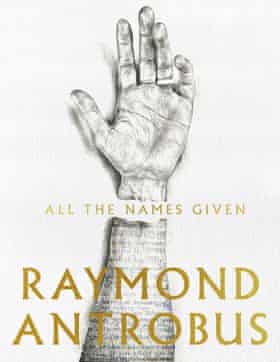
Raymond Antrobus’s second collection, All the Names Given(Picador), builds on themes in his award-winning debut, The Perseverance, including meditations on the d/Deaf experience. In this book, Antrobus brings history to bear on the present through references to poets ranging from William Blake to Kamau Braithwaite, exploring love, marriage and brotherhood, as well as colonial inheritance, racism, ableism and intergenerational trauma. In “Plantation Paint”, Antrobus responds to “Plantation Burial”, an artwork by the 19th-century painter John Antrobus, and wonders how one might make sense of a surname “so anciently English that it has become foreign to itself”. The speaker asks: “Tell me if I’m closer / to the white painter / with my name than I am / to the black preacher, / his hands wide to the sky, / the mahogany rot / of heaven”. These lyric poems are also linguistically innovative, spanning standard English, Jamaican patois and British sign language. Elsewhere, a sequence of caption poems inspired by Deaf sound artist Christine Sun Kim serves as an important riposte to the hegemony of our hearing-centric world:
[sound of strangers arriving] [squirming in suit] [sound of light between us]
Moving deftly between tenderness and violence, hope and grief, praise and lament, this is a deeply evocative collection that will linger in the reader’s mind.
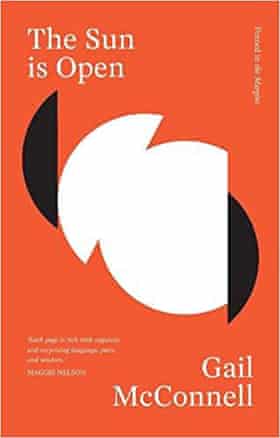
Gail McConnell’s first full-length collection The Sun Is Open(Penned in the Margins) is a vivid exploration of the intricacies of grief surrounding a beloved father’s murder by the IRA in Belfast, 1984. These fragmentary and visually striking sequences cohere into prose poems and concrete poetry, some featuring lacunae or using found text to evoke an almost unspeakable loss. Through collage and quotation, McConnell enables the deceased to speak again, with entire lines lifted from her father’s undergraduate diary. After one such poem, the speaker verbalises the anti-lyric sentiment at the heart of this unique approach to elegy: “copy all this out / and I won’t have to address you”. While the lyric is aimed at an addressee, elegiac writing cannot hope to be heard by those who cannot respond. As Declan Ryan observed of Emily Berry’s Stranger, Baby: “An elegy is a want that can never be answered.” In this devastating yet immersive book, McConnell skilfully utilises juxtaposition, understatement and negative space to offer us an intimate work of poetic testimony.
Daniel Sluman’s third collection, Single Window(Nine Arches), is a book-length poem meditating on “the loneliness and fear experienced by disabled people living in Tory Britain”, drawn from his and his wife Emily’s experiences over the last five years. Using the seasons as a framing device, Sluman documents the painful minutiae of life lived indoors: “we count down the seconds / before our pills sing their gospel inside us”. Hours later, another bleak ritual: “all day we drink tea piled with sugar / & wake in yesterday’s clothes / to this piss-bright sunrise”. There is a luminosity to this world that is otherwise suffused with suffering, illustrated by intermittent photographs: a syringe next to a box of morphine sulphate, or a pair of crutches leant against a wall. Describing a carer’s visit to the house, the speaker confesses: “a middle-aged woman peels off our socks / & strips us layer by layer / like she’s fleecing sheep”, an act that requires precision as well as a practised but jarring detachment. Overall, an encounter with this book will leave one feeling “quiet / as a broken bone knitting back together”.
Hannah Lowe’s previous two collections, Chick and Chan, focused on her relationship with her Jamaican-Chinese father, alongside coming-of-age recollections. The Kids(Bloodaxe) marks a departure: an introspective book of modern sonnets, it offers a glimpse into her experiences of teaching in an inner-city London sixth form. The collection includes homages to her own teachers, and concludes with a sequence lovingly written for her young son Rory. In “Sonnet for the A Level English Literature and Language Poetry Syllabus”, Lowe conveys the combination of dedication and exasperation: “all summer term reading poems – / down in the mud / of words, wanting / the kids to hear what I heard – / breaking the poems apart, slapping / their parts to the board – ” Elsewhere, her work takes a more tender turn: “I find him balancing / a handful of bubbles back to bed. It is /so hot, and why have the birds stopped singing / darling? Who can sleep on a night like this?” This is a playful yet moving collection that will make the reader frown and laugh, sometimes both at once.




+(1).jpg)