Sunday, July 23, 2023

Monica Jones, Philip Larkin and Me by John Sutherland review


Philip Larkin and Monica Jones


Monica Jones, Philip Larkin and Me by John Sutherland review

She was a vile racist, a depressed companion to a constitutionally unfaithful man, but Monica Jones was also the woman who cultivated the aesthetic sensibility of one of the greatest poets of the last century, says Tomiwa Owolade

Towiwa Owolade

15 April 2021


J

ohn Sutherland’s memoir-cum-biography hinges on a profound question: how well do we truly know a person? Sutherland - who is Emeritus Lord Northcliffe Professor of Modern English Literature at UCL, and author of, among other books, Lives of the Novelists: A History of Fiction in 294 Lives - ponders which Monica Jones is more real: “The Monica I knew as a young man in the 1960s? Or the Monica I now know from thousands of pages of manuscript documentation, sixty years on?”.  

Jones, who was born in 1922 and died in 2001, was a lecturer in the English department at University College, Leicester. It was in this capacity that Sutherland, who studied there as an undergraduate student in the early 1960s, came to know her. 

But she is best known as the partner of Philip Larkin. Along with Andrew Motion and Anthony Thwaite, she was named one of Larkin’s literary executors. After he died in 1985, she organised his diaries to be shredded and burned.

Roger Lewis condemned her as “the biggest criminal in literary history”. Christopher Hitchens called her “frigid, drab and hysterical”. And Kingsley Amis fictionalised her as Margaret Peel in his campus comedy novel Lucky Jim; a neurotic academic who is Jim Dixon’s love interest until he ultimately abandons her for a younger, prettier

Sutherland wants to revive her from these portraits, offer a more balanced account of her life: “Monica deserves, after all these years, clear-sighted judgement”. The book flits between distance and intimacy. It is partly a biography of Jones’s life - her upbringing, her time at Oxford, her move to Leicester, and her relationship with Larkin.

For this, Sutherland relies on her letters archived at the Bodleian library, and the work on Larkin done by Motion, Thwaite, and James Booth. Other parts of the book are written with the intimacy of an insider - Sutherland, Boswell-like, portrays her in all her convivial wit and striking personality.  

Margaret Monica Beale Jones was born in Llanelli to a working-class Methodist family. They later moved to Stourport-on-Severn, in Worcestershire, where she grew up. Her father’s side of the family came from that part of the country; her mother’s side came from Northumberland, and Jones, throughout her life, maintained a strong affinity with the North. She was an only child. And she was fiercely independent. She wanted, Sutherland quotes her, “a life chosen by one’s self and not imposed on one”. 

This individualism was manifested in her dress style. “My first acquaintance with her”, Sutherland writes, “was ocular. That was how she was publicly known: the flamboyance (floating flame) of her dress”. She never published an academic article or book in her career - probably because of this, she was never promoted, in her 37 years at Leicester, to the position of Senior Lecturer. 

Lecturing utterly consumed her at the university. In the most engaging part of the book, Sutherland writes how, “Miss Jones would, on occasion, become so impassioned at the lectern that she ripped the pages of her handwritten text”. He emphasises this point by adding that, “On other occasions she would be so moved by the beauty of the poetry she was reading out that she would break down, croakingly, in tears and be unable, for a minute or two, to continue”. She scorned Theory and modernism; to qualify as worthwhile, a literary work needs to touch you. She shared, in short, Larkin’s aesthetic vision.  

Although they were both at Oxford at exactly the same time, Jones and Larkin first met in Leicester in 1946. They became lovers in 1950 - the year Larkin moved to Belfast to take up a librarian post. For the rest of their relationship, which lasted until Larkin’s death in 1985, he had significant affairs with three other women: Patsy Strang, Maeve Brennan, and Betty Mackereth. Patsy, who was a married woman, got pregnant by him and suffered a miscarriage. He also pursued a mostly chaste seventeen-year romantic affair with Maeve, his Hull University library colleague, which ended soon after she broke with her devout Catholic faith by having premarital sex with him. And he started his affair with his library secretary Betty when he was still in a relationship with both Jones and Maeve. Larkin was the only man Jones ever slept with. 

After the death of her parents, in 1959, she became dependent on Larkin. Sutherland argues that Larkin “stripped away connection from her living family to have sole dominance”. What makes this stranger is they were still living separately, in different cities. As Sutherland brilliantly puts it: “Theirs was a relationship without the conjugal cement of cohabitation. It was a house built on ink, paper and postage-stamp”. Larkin was incapable of fully committing. He suffered from what Sutherland calls “relational impotence”. Why did Jones, a confident, strong-willed, good-looking woman sacrifice her independence for a man who continually betrayed her? This is one of the questions Sutherland ponders. It is, he concludes, because of the poetry. Sutherland says of Jones and Maeve Brennan: “They conspired in the injury because they believed his literary genius made sacrifice a tribute“.  

And she loved Larkin: “He lied to me, the bugger, but I loved him”. One thing that deeply connected them, apart from shared literary sensibility, was venomous spite. “In Monica”, Sutherland writes, “spite was a sign of life”. This spite sometimes manifested itself in gratuitous racism. Sutherland shares some of this in the main body of text, but only properly confronts the full scale of it in his afterword. This is a structural flaw of the book that aims to offer a balanced portrait. 

Larkin and Jones conceived a ditty together in response to Harold Wilson becoming Prime Minister in 1964 with the verse: “Prison for strikers / Bring back the cat. / Kick out the n*****s / How about that?”. Jones told Larkin in a letter she enjoyed singing the song alone “to relieve my feelings”. And you can hear the evident relish with which she sings it in a recorded audio clip of them singing it together. (Which you can find on Youtube here, from minute 43:58). She was also viciously anti-Semitic. In one incident, she describes a socialist woman talking in the university common room as a “mincing lisping foreign Jew dwarf”.  

So who is the real Monica Jones? Sutherland affirms near the start of the book. “The case I make in the following pages is not a partisan vindication, nor nil nisi memorial, nor the fond recollections of an undergraduate in the presence of a woman of cultivated mind and life-changing kindness to him”. However, he later states: “Despite what has recently passed under my eyes, I hold on, stubbornly, to the image of what Monica was to me in the 1960s”. If he is “stubbornly” holding on to that image, rather allowing it to be complicated, how is this book not “partisan”?  

Larkin himself embodied complicated tensions. He was the pooterish man of Middle England who at times dressed as a dandy in bow ties and red socks. He preferred Beatrix Potter to most modern novelists yet owned a large collection of pornography. He was a passionate jazz aficionado who denounced the Wilson government as “n*****-mad”. 

The same is true, in her own way, of Jones. She was a vivacious lecturer; but she was also a vile racist. She was a depressed companion to a constitutionally unfaithful man; but she was also the woman who cultivated the aesthetic sensibility of one of the greatest poets of the last century.

To borrow a phrase from Walt Whitman: she “contained multitudes”. Sutherland’s book - often moving, with some wonderfully-expressed insights - would have been greatly strengthened by formally acknowledging her multitudinous character rather than searching, desperately, for the “real” Monica Jones. 

Monica Jones, Philip Larkin and Me: Her Life and Long Loves by John Sutherland (W&N, £20)

EVENING STANDARD


Friday, July 21, 2023

How a stone knight inspired two very different visions of love from John Keats and Philip Larkin


John Keats


How a stone knight inspired two very different visions of love from John Keats and Philip Larkin

Richard Marggraf-Turley
Published: July 16, 2019 10.59am BST

Any prize for the most enigmatic character in English poetry would probably go to the truant knight in John Keats’s much-loved 1819 ballad La Belle Dame Sans Merci. All the desolate knight is able to tell us with any clarity is that a beautiful lady whom he met “in the meads” stole his heart before cruelly abandoning him. Even that account is open to interpretation, since we never hear La Belle Dame’s own version of events.

200 years on, we’re no closer to agreeing what the highly symbolic poem might mean, let alone to tracing the knight back to an actual historical figure. But a new discovery from the archives of the British Museum might be about to change that.

At some level, the ballad probably registers Keats’s own sense of doom over his relationship with fiancée Fanny Brawne. Illness and financial uncertainty were proving barriers to consummation and marriage. Beyond that lies only guesswork. Many have grown used to thinking about the famous romantic poem as the purest example of spontaneous inspiration. It even appears without preamble in one of Keats’s letters, increasing the impression that it arrived out of nowhere, dictated by the muse.

But that’s not how Keats usually worked. Many of his best-known poems take vital cues from the physical objects he saw around him. Think of the “heifer lowing at the skies” in Ode on a Grecian Urn. The mooing cameo owes its existence to a sculpted cow on the Parthenon frieze that Keats saw in the British Museum. Similarly, the anguished Titans in The Fall of Hyperion were likely inspired by the grimacing statues depicting manic and melancholic madness that adorned the gateposts of Bethlem Hospital (known to London and the world as Bedlam). Keats knew them only too well as a young boy growing up in Moorfields.


Philip Larkin


Stoney origins

In the run-up to the ballad’s composition Keats was in Chichester to finish his medieval romance The Eve of St Agnes. During his stay he visited Chichester Cathedral, where a very striking knight-at-arms was housed. Millions of readers know it today from the perennial favourite Philip Larkin poem, An Arundel Tomb. Larkin visited in 1956, when the brawny alabaster effigy of a chain-mailed Richard FitzAlan, tenth Earl of Arundel, lying hand-in-hand beside his own Belle Dame, Eleanor of Lancaster, inspired one of the poet’s most quoted lines: “What will survive of us is love”.

It’s never occurred to anyone that Keats’s imagination might also have been set racing by the stone avatars of the Arundels, because the serene gleaming effigies don’t seem to have much in common with Keats’s haggard knight. However, intriguing visual evidence in the form of two little-known sketches in the British Museum may hold the key to the mystery.

Larkin viewed the alabaster effigies after their Victorian restoration. In 1843, the extensively damaged statues of Richard and Eleanor, which had been torn apart to save space, were reunited, presenting the sentimental tableau of conjugal affection that moved Larkin to an uncharacteristic moment of (albeit cagey) optimism about love.

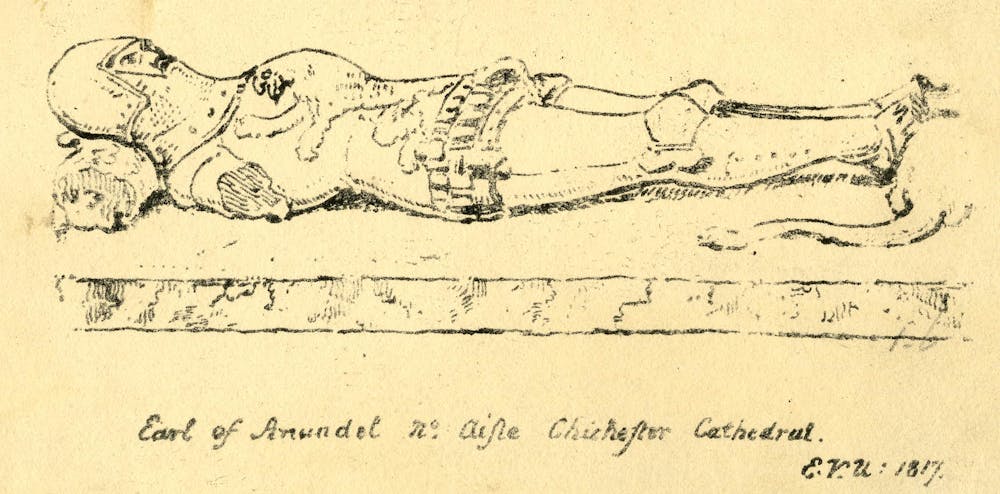
When Keats visited the cathedral in January 1819, things were very different. The recumbent knight was grimy and badly weathered from having lain for a century outside in the elements (“sadly mutilated”, in the words of the 1844 Antiquarian and Architectural Yearbook). He was heavily graffiti-ed with “dates and initials of the mischievous and ignorant”, the earliest from 1604 – and he was missing an arm. His lady lay not beside him but stowed a few metres away at his feet, separated by a pillar. He was the very model of woe-begone.


Edward Vernon Utterson’s 1817 sketch of the Tomb of the Earl of Arundel in Chichester Cathedral, with effigy as a knight, head to left, his right arm missing. ©Trustees of the British MuseumCC BY-NC-SA

The effigies also retained faint traces of medieval paint, including “small quantities of crimson”, which perhaps throw light on the “fading rose” of the feverish knight’s complexion in Keats’s ballad.

Sketch of a lady seated on a knight’s tomb - which also has a missing arm - in Chichester Cathedral, made by John Flaxman in 1826. ©Trustees of the British MuseumCC BY-NC-SA

After visiting Chichester, Keats moved on to nearby Bedhampton, where he stayed with prosperous millers John and Letitia Snook. When illness allowed him to venture beyond the garden gate, he would have found a granary, a sedgy lake, and in the centre of the village Bidbury Mead. All feature in La Belle Dame Sans Merci, from the withered vegetation around the lake, and the meads where the knight encounters the lady, to the “squirrel’s granary”.

Visions of love


Could Chichester Cathedral’s famous effigies have inspired not just one but two well-known – though very different – visions of love? Larkin’s holds out the possibility that love conquers all. Keats’s looks towards the abyss. It’s even possible that Keats wasn’t above a dark pun at the effigy’s expense. Could it really be a coincidence that Keats came up with the idea of a “knight-at-arms” after seeing the cathedral’s wounded knight-without-arms? Whatever the case, the emasculated effigy of Richard FitzAlan would have resonated with Keats’s own precarious sense of virility.

Even the ballad’s birds who do not sing may have their origins in a real absence. The damp, wetland habitat around Bedhampton’s lakes made a perfect home for sedge warblers. These chattery passerines would have been wintering in sub-Saharan Africa when Keats arrived in the village. In other words, we may now know the sound of one of the most famous of literary silences.

Poems can rarely be chased back to a single source of inspiration. Even ekphrastic poems, which deliberately set out to describe physical objects, are hardly ever one-to-one engagements with their subjects. The poetic imagination simply doesn’t work like that. That’s especially true of La Belle Dame Sans Merci, a particularly rich example of writing that resists explanation. Nevertheless, Chichester Cathedral’s armless knight, usually associated with Larkin’s An Arundel Tomb, deserves to be recognised as part of the heady mix that produced a lover’s complaint which has haunted generations of read

THE CONVERSATION


Thursday, July 20, 2023

Monica Jones, Philip Larkin and Me by John Sutherland review – a poisonous love

‘A victim of misogyny, she was a bit of a misogynist herself’ … Monica Jones with Philip Larkin.


Monica Jones, Philip Larkin and Me by John Sutherland review – a poisonous love

In thrall to Larkin’s genius: racism, drink and despair in a generous account of a tortured relationship over four decades


Blake Morrison

17 April 2021


Poor Monica Jones. She would have liked to marry Philip Larkin but he kept her at arm’s length (or the 100 miles between Hull and Leicester) for more than 30 years. An academic, she loved her subject, English literature, but failed to publish any books and, as a result, was never promoted by her university department. She dressed with flair and flamboyance but was dismissed by Larkin’s friends as “a grim old bag”, “a beast”, “frigid, drab and hysterical”, and appeared, thinly disguised, as the appalling Margaret Peel (her own middle name was Beale) in Kingsley Amis’s debut novel Lucky Jim. “I dread the whole of the rest of my life,” she wrote in her 30s, and death has done little to rescue her reputation.

Enter, like a shining knight, John Sutherland, who was taught by Jones as an undergraduate, became a good friend and drinking partner, and rightly believes she has been hard done by. “In crucial ways Monica made me,” he says, and his book pays generous tribute to the woman who kick-started his prolific academic career. As the first scholar to see Jones’s letters to Larkin (all 54 boxes of them in the Bodleian Library), he has also learned things about her he didn’t know, some of them hard to take.


Born in Llanelli, south Wales, the only child of upwardly mobile working-class parents, Jones was the archetypal school swot, a keen reader and occasional writer of poetry (a few of the lines Sutherland quotes aren’t bad). A scholarship took her to Oxford at the same time as Larkin, but they didn’t meet until he joined the library at what was then University College, Leicester shortly after she’d been appointed as a lecturer. To begin with, the English department consisted of just her and one other lecturer; by 1960, when Sutherland arrived, there were 15, with Jones still the only woman, a distinction she enjoyed. (A victim of misogyny, she was a bit of a misogynist herself.) With her blond hair, horn-rimmed specs and elegant legs, she was considered sexy, and had a habit of matching her dress to her lecture topics – tartan for Macbeth, pearls for Cleopatra.

No feminist, with a particular aversion to George Eliot, she had a passion for boxing and cricket. The evenings she spent in pubs with Sutherland and other favoured male students (“my boys” as she called them) were among her happiest, as she was careful to let Larkin know: “I’d never have expected I’d be a great success with a lot of young men but I can see that they all like me.” If his jealousy was piqued, it wasn’t enough to lure him into marriage; he had another woman on the go by then, Maeve Brennan, as Jones would painfully discover. When Sutherland and other proteges moved on, she boozed alone at home and would turn up drunk to 9am staff meetings. Only for the last couple of years of his life did she and Larkin live together, “in mutual collapse”. Till then, for decades, her time with him was rationed to weekends (roughly one in every four), annual holidays on Sark and test matches at Lord’s.

Sutherland’s memories of Jones – as loud, witty, inspirational – are in stark contrast to the letters he quotes from, which are full of suffering, paranoia, despair and self-loathing (“I am simply ridiculous – a reject, an incapable”). She wrote to Larkin late at night and would run on for 30 pages, with brave attempts to entertain him, before lapsing into grievance and reproach. The low point came when she was lampooned in Lucky Jim: rather than spring to her defence, Larkin proclaimed the novel (which he’d helped to edit) the funniest book he’d ever read. His one piece of gallantry, or cowardice, was to abandon the novel he’d been working on himself: “If it is to be written at all,” he told another of his lovers, “it should be largely an attack on Monica, & I can’t do that.” She felt rejected even so – and destroyed all the letters he sent in the months after Lucky Jim came out.

When he died she destroyed his journals, too, before her co-executors could intervene. It seems unlikely that she did so protectively, to conceal evidence of his racism, since her own was even more extreme. Sutherland experienced a little of it in their Leicester days and reproaches himself for not calling her out. But the extent of it in her letters – from virulent antisemitism to endorsement of Enoch Powell – came as a shock. It wasn’t just Larkin’s poetry Jones nurtured but his bigotry too.

The relationship was sad and sometimes toxic, as Sutherland’s excellent biography shows. Jones’s awareness of her lover’s damaging effect – how she “sparkled” in the company of young men whereas with him “I’m always hopeless, cut eye in the first round” – left him, in return, consumed by guilt: “It seems to me I am spoiling yr life in a hideously ingenious way.” A woman would have told her where to stick him. But Jones had no female friends. In thrall to his genius, her love for Larkin endured – and so did the misery that went with it.

 Monica Jones, Philip Larkin and Me: Her Life and Long Loves is published byWeidenfeld. 

THE GUARDIAN