For nearly sixty years, Philip Levine has been praising the famous men and women of the Detroit auto industry, as well as a wide range of unsung others, including relatives, jazz musicians, adolescent lovers, moguls, fellow poets, martyrs, and schoolmates. While Levine’s lucid, declarative voice resonates throughout all twenty of his books of poetry, agreeing at every turn with Emily Dickinson’s claim that “Drama’s Vitallest Expression is the Common Day / That arise and set about Us,” his compassion leads him repeatedly to identify both tenderly and self-effacingly with others. Few other poets of his generation, with the exception of James Wright, have woven lyrical expression into demotic narratives with a comparably deft hand and persevering vision of the downtrodden and disenfranchised.
In his new book, News of the World, Levine complements this strategy with metaphysical intimations. By frequently invoking silence at the end of his poems, Levine continues to report everyday news, while also intoning intimations of the ineffable.
If he came
To my door now on his trek To nowhere I’d welcome him back With black wine and black bread, A glass of tea, a hard wood floor To sleep on, and hope the new day Brought him the music of silence.
(from “Yakov”)
… the sea taught you and you taught me: the sea goes out and nothing comes back.
(from “My Fathers, The Baltics”)
Now you say this is home, so go ahead, worship the mountains as they dissolve in dust, wait on the wind, catch a scent of salt, call it life.
(from “Our Valley”)
As in his previous nineteen books, Levine leads his reader in News of the World through the purlieus and hubs of his old haunts—Detroit, Manhattan, Havana, Barcelona, Lisbon, Philadelphia, and Dearborn, showing and telling the news of ordinary men and women, such as the Cuban lieutenant’s blind devotion to Hemingway in “The White City,” or the husband’s ironic happiness in prison in “Not Worth The Wait.” In addition to his mostly short-lined verse poems, Levine includes a fascinating eight-page section of prose poems. While less lyrical than his verse poems, they facilitate a more straightforward reportage of his poetic news. With little irritable reaching after his subjects and a limpid verse style, Levine allows simple, memorable truths to emerge naturally from his poetic storytelling. He has honed his narrative expression, employing speakers who keep an objective distance from both themselves and their subjects. Such distance makes for a kind of double accounting in which Levine’s witness becomes a fascinating combination of no-nonsense observer and incisive commentator.
In this latest book, which Levine claims took a long time to cohere, he takes a bold new step in addressing the mystery of his voice head-on. In his remarkable poem “Two Voices,” he concludes with this apostrophe to an unspecified other who could easily be his reader:
Let’s say I phone you tonight and tell you my little adventure which came to nothing. What will you think? Not what will you say, you’ll say it was an illusion or you’ll say there was a deep need in me to hear that particular voice, or sometimes the voices of the air—all the separate voices in so public a place—can unite for a moment to produce “Philip” or “John” or “Robert” or whatever we expect. I don’t know what you’ll think. I’ve never known, even when you and I were together, and I’d waken in the false dawn to hear you in the secret voice that was yours crying out into the dark a name not mine.
It’s in just this self-effacement and unknowing that Levine ironically finds what he earlier in the poem refers to as the disembodied “huge voice, deep and resonant”—the same voice that humbles itself before the “the music of silence” and, in so doing, discovers what Wallace Stevens called “the voice that is great within us.”
This guy makes is Getting in Buzz Alden’s Face, or perhaps it’s that he wants Buzz To admit, to cry, to repent that it’s all been A joke, a hoax, that Moon stuff, just something Home made with lights and mirrors; remember Playing “Space-boy”, your cardboard box lifting off The living room carpet, and there you go, The ceiling, the roof, the diminishment of the streets Through your scissor-cut window, away, away, Then the corrugated darkness, and stars.
But it’s a cardboard box, and the gravity Of your parent’s house, where a kid, as we know Has to snap out of it, sooner or later, or they Begin to worry about where you’ll land.
So down from the beautiful, silent orbit, That slow brake called reason, the weight Of the real world dragging your arms. Come on,
The man insists, like your father’s hand ruffling Your pillow with a quarter, caught, when all He wanted was for you to believe, just for a bit Longer, that that baby tooth of yours called Beings invisible to your bed, stop lying And tell us the truth. O, intangible worlds, An astronaut ignites his fingers, and his fist Is launched to the chin of the idiot moon.
-To Tracy K. Smith
Cornelius Eady is the author of eight books of poetry, including Hardheaded Weather: New and Selected Poems (Putnam, April 2008). His second book, Victims of the Latest Dance Craze, won the Lamont Prize from the Academy of American Poets in 1985; in 2001 Brutal Imagination was a finalist for the National Book Award. His work in theater includes the libretto for an opera, “Running Man,” which was a finalist for the Pulitzer Prize in Drama in 1999. His play, “Brutal Imagination,” won Newsday’s Oppenheimer award in 2002. In 1996 Eady co-founded, with writer Toi Derricotte, the Cave Canem summer workshop/retreat for African American poets. More than a decade later, Cave Canem is a thriving national network of black poets, as well as an institution offering regional workshops, readings, a first book prize, and the summer retreat. Eady has been a teacher for more than twenty years, and is now a professor at Notre Dame University.
I learn you are also a rheumatologist in Bethesda, a realtor in Orlando. In 1902, you were a universalist and rained pages of the Bhagavad-Gita from a glider. You were a general and a saint—either way lifting hands and when you did there was silence. Baseball coach who died near third base waving his runner home. It would be easier if you were dead—skeleton with a gold tooth in a bay-sunk galleon, field mouse picked at first by vulture then by cricket then lonely churn of time. If you were a ventriloquist’s doll. Then we could say “he knows not what he does,” and then we too could be forgiven. For Googling your name instead of trying to do the work of dismantling the mysterious machine that put you wherever it is you are, so far from where you began, in a place that looks for some reason like home. It has flowers, anyway.
Jeff Whitney is the author of five chapbooks, two of which were co-written with Philip Schaefer. Recent poems can be found in 32 Poems, Adroit, Booth, Muzzle, Prairie Schooner, The Puritan, and Verse Daily. He lives in Portland.
Baby of the mistaken hue, child of the wrong nose with its measure unleashed, baby of the nappy knot, I am your mother. Mad at your whole damned face, I swear to the task of torching the regrettable Delta from your disobeying braids. I pinch your breathing shut to reteach the bone, smear guaranteed cream on your pimpled forehead, chin, and cheeks. I am the corrector. Soaking a kitchen towel with the blaze of holy water, I consider just what you are naked, recoil at the insistent patches of midnight blanketing your skin and I scrub, scrub, push the hard heel of my hand deep into the dark, coax cleansing threads of blood to the stinging surface, nod gently in the direction of your Mama, don’t! I command you to bend, to turn, to twist in the wobbly dinette chair and reveal what hides from me, those places on you that still insist on saying Negro out loud. Remember how the nonbelievers screeched their nonbelief at Jesus even as He laid His giving hands upon them? One day you will comprehend the torch I am. You will be burned smaller, lighter, ever closer to the whiteness of my God, who loves you as you are.
Patricia Smith is the author of six books of poetry, including Shoulda Been Jimi Savannah, winner of the 2014 Rebekah Bobbitt Prize from the Library of Congress, the 2013 Lenore Marshall Poetry Prize from the Academy American Poets and the Phillis Wheatley Award in Poetry; Blood Dazzler (a National Book Award finalist); and Teahouse of the Almighty (a National Poetry Series winner). She has won two Pushcart Prizes and has been awarded fellowships to Yaddo and the McDowell Colony, where she worked in a studio once occupied by James Baldwin. This poem originally appeared in Tin House #47: The Mysterious.
The poet Warsan Shire writes primarily about the immigrant experience, but also tweets about reality television.Photograph by Amaal Said
The Writing Life of Warsan Shire, a Young, Prolific Poet
Alexis Okeowo
October 21, 2015
It’s a rare poet who can write movingly about African migration to Europe and also tweet humorously about the VH1 reality show “Love & Hip-Hop: Atlanta.” Every generation of writers and readers has mourned the shrinking place of poetry in our lives, and they may not be wrong. They also may not be looking in the right places. Young poets are on Tumblr and Twitter, composing affecting and funny verse as short as a hundred and forty characters and also stretching much longer. Verse that is then reblogged and retweeted by thousands of followers who see themselves reflected in the posts. Of this new genre of poets, Warsan Shire, a twenty-six-year-old Somali-British woman, is a laureate.
Shire was the actual Young Poet Laureate of London in 2014, the city’s first. Born in Kenya to parents from Somalia, Shire grew up in London, where she has always felt like an outsider, and embodies the kind of shape-shifting, culture-juggling spirit lurking in most people who can’t trace their ancestors to their country’s founding fathers, or whose ancestors look nothing like those fathers. In that limbo, Shire conjures up a new language for belonging and displacement. What she has described, in an interview, as the “surrealism of everyday immigrant life—one day you are in your country, having fun, drinking mango juice, and the next day you are in the Underground in London and your children are speaking to you in a language you don’t understand.”
Her poetry evokes longing for home, a place to call home, and is often nostalgic for memories not her own, but for those of her parents, grandparents, uncles and aunts, people who forged her idea of her ancestral homeland through their own stories. With fifty thousand Twitter followers and a similar number of Tumblr readers, Shire, more than most today, demonstrates the writing life of a young, prolific poet whose poetry or poem-like offhand thoughts will surface in one of your social media feeds and often be exactly what you needed to read, or what you didn’t know that you needed to read, at that moment.
In 2011, Shire published “Teaching My Mother How to Give Birth,” a spare collection of poems that was outsize in its sensuality, wit, and grief. She opens the book, her first, with “I have my mother’s mouth and my father’s eyes / On my face they are still together.” In “Beauty,” she tells us of someone’s older sister: “Some nights I hear in her room screaming / We play Surah Al-Baqarah to drown her out / Anything that comes from her mouth sounds like sex / Our mother has banned her from saying God’s name.” In “Your Mother’s First Kiss,” she writes, “The first boy to kiss your mother later raped women / when the war broke out. She remembers hearing this / from your uncle, then going to your bedroom and lying down on the floor. You were at school.” At the end of the poem: “Last week, she saw him driving the number 18 bus / his week a swollen drumlin, a vine scar dragging itself / across his mouth. You were with her, holding a bag of dates to your chest, heard her let out a deep moan / when she saw how much you looked like him.”
How much of the book is autobiographical is never really made clear, but beside the point. (Though Shire has said, “I either know, or I am every person I have written about, for or as. But I do imagine them in their most intimate settings.”) It’s East African storytelling and coming-of-age memoir fused into one. It’s a first-generation woman always looking backward and forward at the same time, acknowledging that to move through life without being haunted by the past lives of your forebears is impossible.
Shire has said that she is most interested in writing about people whose stories are either not told or told inaccurately, especially immigrants and refugees, and so she brings out her Dictaphone when relatives come to her with tales from their experiences so that she can record them faithfully before turning them into poetry. Her tone lightens in “Maymuun’s Mouth” and “Birds.” In those poems, Shire writes tenderly and hilariously of a Somali woman removing her body hair and “dancing in front of strangers” as she adjusts to her new life abroad, and of a girl who, with pigeon’s blood, fooled her new husband and his mother into thinking she was a virgin. Later, evoking the memories of mothers caught in the worst turmoil of Somalia’s conflicts, “In Love and in War” reads, “To my daughter I will say / ‘when the men come, set yourself on fire.’ ” The collection feels confiding, occasionally brutal, but somehow still playful.
Since “Teaching My Mother,” Warshan’s profile has only grown. In addition to the Young Poet Laureate position, she received Brunel University’s inaugural African Poetry Prize, in 2013, was chosen as Queensland, Australia’s poet in residence in 2014, and has had her work published in various literary journals and anthologies. In June, the New York Times editorial board quoted from her poem “Home” in a piece urging Western countries to give more aid and safe passage to refugees: “You have to understand / that no one puts their children in a boat / unless the water is safer than land.” The editorial ran the same month that Shire tweeted about her adoration of a “Love & Hip-Hop” star known for her wild antics (“a bit in love with joseline”), which was a month before she tweeted “fat and perfect, perfect and black, black and fat and perfect” (retweeted three hundred and eighty-two times; she has struggled with bulimia), and a few months after she cryptically tweeted “mama i made it (out of your home alive),” retweeted two hundred and seventy-four times. Periodically, I will see tweets discovering a video of her reciting her most famous and viral poem, “For Women Who Are Difficult to Love,” which has become a self-affirmation mantra for lovelorn women online.
Shire’s work, she has said, is a project of “documentation, genealogy, preserving the names of the women came before me. To connect, honor, to confront.” But it’s her documenting of the present, always coming back to the subject of love and its many tender and punishing forms, that is enthralling. The simultaneous specificity and breadth of her appeal, across gender, race, and nationality based on her self-professed fans, is remarkable, and it took me by surprise the first time I started following her online. She tweeted “my dj name is dj eldest immigrant daughter” not long ago. I favorited it immediately.
Alexis Okeowo, a staff writer at The New Yorker, is the author of “A Moonless, Starless Sky.” In 2020, Okeowo was named journalist of the year by the Newswomen’s Club of New York.
Rewriting Hafez: Re-theorizing Untranslatability in Persian Poetry
POSTED ON
July 8, 2014
A guest post by Aria Fani. A native of Shiraz, Aria Fani studies towards a Ph.D. in Near Eastern Studies at the University of California in Berkeley. All translations are by the author unless otherwise noted. ariafani@berkeley.edu
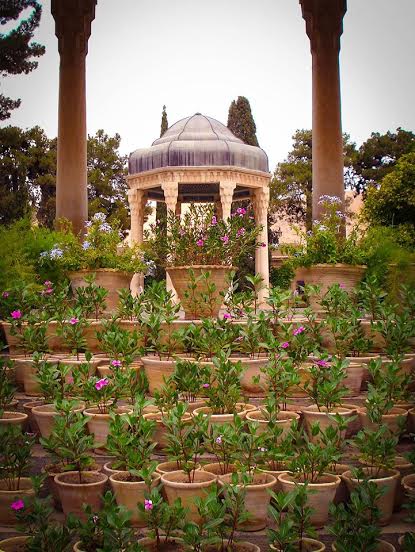
Tilework underneath the dome of the Hafeziyeh (Photo Credit: Aria Fani).
و الشعر لا يسطاع ان يترجم و لا يجوز عليه النقل. و متی حول تقطع نظمه و بطل وزنه و ذهب حسنه و سقط موضع التعجب منه و صار كالكلام المنثور. و الكلام المنثور المبتدأ علی ذلك احسن و اوقع من المنثور الذي حول من موزون الشعر– الجاحظ | كتاب الحيوان
Poetry [shi‘r] is untranslatable; it cannot be transferred from one language into another. Translation breaks its metrical arrangements [naẓim] and spoils the rhythm [wazin], ruins its aesthetics [ḥusn], and flattens the element of wonder [muḍi‘ al-ta‘ajjub]. Translation turns poetry into prose, and prose originally written as such is preferred over what has been turned into prose as a result of translating verse– al-Jaḥiẓ | Kitab al-Hayawan.
Near Eastern thinkers, perhaps as early as al-Jaḥiẓ, the eighth century Arab writer and polemicist, have commented on the problem of literary translation, particularly concerning poetry. While al-Jaḥiẓ points to broad challenges encountered in translating lyrical poetry, he gives more weight to translation as an end result, characterized by various layers of loss consequent to this linguistic transfer. One implication of reading translation merely as a product is to indict translation as an intellectual enterprise—as often has been done—and place it within the reductionist model of “betrayal” versus “faithfulness.” However, al-Jaḥiẓ’s view also lends itself to the notion of developing a critical awareness towards translation as a process of linguistic and cultural negotiation between the source and target language and their literary traditions. In other words, literary translation does not end by acknowledging the concept of untranslatability, it begins with it and furthermore testifies to the translator’s difficult task of doing justice to what he or she perceives as the poem’s internal vision.
Untranslatability is a trope standard to writing and rewriting, and is not limited to translation. In this vein, one can view failures, disappointments, and success not as a fixed form of assessment, but as an open discussion of the translator’s vision and accommodations within the fluid context of his or her era, language, target audience, and mode of reading. Untranslatability can be a humbling acknowledgement made by a translator well-acquainted with the poetic system of the source language, one who fully understands components such as naẓim, wazin, ḥusn, and muḍi‘ al-ta‘ajjub, prior to translating the work. “Untranslatable” could indicate that no translator has yet engaged this process for a “general” audience, or existing translations have not found wide readership. It is translation as a process of negotiating between two (or more) literary traditions, models of reading, and target audiences that I am concerned with in this article, and less with its end result.
The Hafeziyeh in Shiraz, Iran (Photo Credit: Aria Fani).
Translation can be characterized as an interplay between literary traditions (source and target languages are rooted in multiple traditions of their own), a process that illuminates the difference in approaches to and articulation of poeticity. Consequently, linguistic and cultural challenges arise that need to be addressed by the translator regardless of his or her approach to translation. The Persian literary tradition presents unique challenges that are particularly well-revealed in the ghazaliyyāt of Shams al-Din Muhammad Hafez of Shiraz (circa 1315-1389), a poet who is widely read in Persianate societies. Poets and scholars alike have expressed the difficulty of translating Hafez.
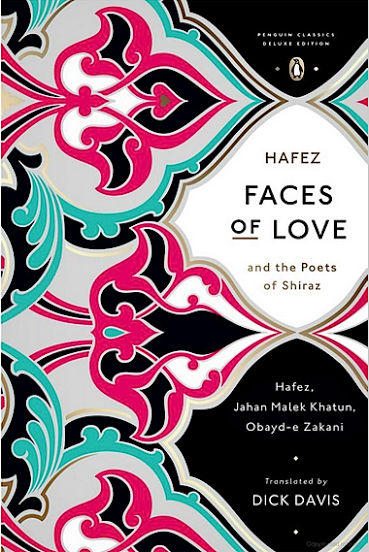
In his famous essay, “On Not Translating Hafez” (New England Review, 1999), Dick Davis engages the many facets of translating the Persian poet, maintaining at the end that his verse is untranslatable. Davis, who has now attempted the feat himself in his Faces of Love: Hafez and the Poets of Shiraz (Penguin Books, 2013), characterizes these challenges broadly as linguistic and cultural. Linguistic challenges are often in the form of translating idioms, puns, and rhymed phrases. Cultural resonance, embedded in the source text, constitutes even greater weight for the translator; the ghazals of Hafez are composed against the backdrop of an intertextual dialogue with various dimensions of Islam, a background readily accessible to certain Persian readers and largely missing in cultural and linguistic communities in the West.
As an example of cultural resonance, Davis uses wine metaphors in the poetry of Hafez to further unpack this challenge. He writes: “It would never occur to a Western poet to express the forbidden intoxications of mysticism by alluding to the forbidden intoxications of wine, for the simple fact that the intoxications of wine have never (if we exclude the brief and local moment of prohibition in the United States) been forbidden in the West.” The Hafezian metaphor resides in the realm of culture, not words or images; it is a capacity he exploits throughout his poetry.
Similarly, in an essay entitled dar tarjumah napaziri-i shi‘r [On the Untranslatability of Poetry, Iran shinasi, 2002], Mohammad Reza Shafi‘i-Kadkani highlights the difficulty of communicating the semantic complexity of Hafezian metaphors while arriving at the same conclusion: Hafez is untranslatable. Shafi‘i offers a beyt (line) as case in point, and zeroes in on one phrase of a single misra‘ (hemistich). Here I will unpack the entire beyt, partially relying on the commentaries of Shafi‘i and Baha al-din Khurramshahi [ḤāfiẓʹNāmah, Shirkat-i Intishārāt-i ʻIlmī va Farhangī, 2005]:
Transliteration:
bih may sajādih rangin kun garat pir-i mughān guyad kih sālik bikhabar nabvad z-i rāh-u-rasm-i manzilhā
The literal translation of this ghazal, closely approximating the Persian syntax, is as follows: “with wine prayer rug make colorful, should pir-i mughan ask /// for salik oblivious should not be to the path and way of Homes.” Reproducing the rhyme and meter of the Hafezian ghazal—a quality intimately associated with classical Persian poetry as with all poetry—is very challenging, one that most translators of Hafez decide not to undertake. The first misra‘ directly addresses readers in second person singular, and is grammatically conditional (do “x” if one were to ask you). Its central concepts are wine, prayer rug, and pir-i mughan: Wine, evoked as an impure element, is positioned against the cleanliness and purity of the prayer rug, a small carpet placed between the bare ground and the Muslim worshipper. Furthermore, both prayer rug and wine can be read as metonymy for orthodox religiosity and the forbidden respectively.
Pir-i mughan is principally a Zoroastrian elder who sells wine, and has later gained different semantic layers through Sufi teachings. However, in this context, the earlier referent is being evoked. The second misra‘ is grammatically ambiguous for nabvad is both imperative and indicative; some have translated nabvad as an opinion or piece of advice (Pilgrims should show each stage’s rule), while others have rendered it as a statement (That seasoned voyager knows the ways of the road). In both translations, the ambiguity of the Persian is necessarily removed.
Salik is approximated by wayfarer or seeker—one who embarks on a journey. Salik is deeply rooted in Sufi traditions, a protean and transnational phenomenon that broadly captures the mystical dimensions of Islam.Rah-u-rasm refers to the path and the way of mystical principles; although grounded in a different tradition, Christian poetry makes use of these concepts as well;one such example is “Enter not into the path of the wicked, and go not in the way of evil men” [Proverbs 4:14, KJV]. Rah-u-rasm has been translated as each stage and the ways respectively by Dick Davis and Peter Avery and John Heath-Stubbs. Last, but not least, the concept of manzil is approximated by the “realm of the divine,” sought by the seeker. Thus far, our rough draft appears as follows; the Persian terms are retained in the English to further invite non-initiated readers to research these concepts:
Make your prayer rug colorful with wine, if pir-i mughan asks you for salik shouldn’t be oblivious to the way of the higher path.
Having annotated the linguistic aspect of the source text, the translator arrives at a different problem: how does one uproot the poem from its cultural soil and replant it in an unaccustomed earth? This is an area in which a literal translation may not prove to be a viable option. For instance, “make your prayer rug colorful with wine” accurately reflects the Persian, but fails to convey the subversive message of the ghazal’s speaker for English readers unfamiliar with Perso-Islamic culture. Hafez’s metaphor functions through a source domain—readily accessible for Persian readers who are familiar with Qur’anic and pre-Islamic lore and intertextuality—in which wine is conceptualized as najis, or impure, and prayer rug as tahir, or free of impurity.
The concept of najis/tahir is grounded in a cultural understanding of cleanliness, partially informed by sharia, one that is not closely approximated by the English terms clean/unclean.Clean for most English-language readers may simply mean free from dirt, marks, or stains, while pure–free from a contaminating substance–is closer in meaning, all the same fails to convey the cultural significance of tahir in Perso-Islamic culture.
Wine has its own semantic associations in the West, for example it can symbolize the Blood of Christ, and as such can be deemed Holy. The sacrilegious request of the pir-i mughan is entirely lost in a literal translation, and would need to rely on footnotes–or other forms of discussion– to convey the poem’s central metaphor. It must also be added that Hafez’s ghazal speaks from the margins of mainstream Sufism at the time; it is a Zoroastrian wine-seller that shows the seeker “the Path and the Way,” not a spiritual Sufi leader to whose (institutional) order he adheres. From every angle, this ghazal is culturally and socially subversive.
Our discussion of the linguistic and cultural aspects of translating Hafez merely scratches the surface of the dialogue between literary traditions; in this case, subversive, Sufi, Islamic, Persian, Christian, and English traditions are implicated. It is a dialogue shaped by the poetry of Hafez and mediated by his translator(s) as well as publisher(s). It goes without saying that it is absolutely paramount that such mediators be fully bilingual and competently bicultural.
More often than not Hafez’s verse has been rendered into English by translators whose lack of proficiency in Persian does not allow them to engage the source text directly; they are more accurately characterized as “versioners, adapters and impersonators” by Franklin Lewis [Rumi: Swallowing the Sun, Oneworld, 2008, xiv]. The list of individuals who have attempted to use Hafez as a ladder to climb into literary fame is rather lengthy; it will suffice to mention Daniel Ladinsky, contemporary American poet, who has sold several collections of poetry as “translations” of Hafez. Ladinsky does not know Persian while his poems bear little or no resemblance to what Hafez has composed. Ladinsky’s work–and others who adhere to the literary model of cultural appropriation–exists as a symptom of highly unequal power relations between the source and target language and culture, in this case Persian and English are implicated. If examined as a symptom of an asymmetrical cultural context–and not an indictment of translation–such reductive models can critically inform the development of more egalitarian metaphors for translation, namely translation as inter-cultural negotiation.
Many contemporary thinkers have offered us thought provoking metaphors for the difficulty of translation. Walter Benjamin’s influential essay, “The Task of the Translator” (1923), itself a retelling of multiple traditions—Jewish, Kabbalistic, Christian—underlines the importance of allowing the source text to shine through the target language. He treats translation as a “mode” that allows the kinship of languages to be “conveyed,” a relationship best highlighted by “conveying the form and meaning of the original as accurately as possible” (Illuminations, Harcourt, Brace & World, pp. 69-82). The translator’s efforts to meditate on all the possibilities offered by English and bend the target language beyond its comfort zone to accommodate the Persian mode of signification will highlight the kinship between English and Persian and demonstrate what this negotiation can achieve.
Rather than placing translation within the reductive and primitive metaphors of betrayal and faithfulness, one might suggest a creative and scholarly process of inter-cultural and linguistic negotiation—a more productive and egalitarian model—that enriches the target language by expanding its linguistic components, offering new cultural metaphors, and cultivating its theoretical landscape, and equally adds deeper nuances to the reception of the literary work in the source language. Vigorous engagement with the work—consequent to the process of negotiation—often results in rewarding moments, however brief the moment of contact between the source and target language may be, as powerfully underlined by Benjamin. Such translations bring the reader closer to the source text, much like a detour that never loses sight of the main road and attempts to guide the reader via its own road signs, albeit placed in different locations. Only a brief examination of two translations of Hafez’s beyt demonstrates the different creative and scholarly measures taken by its translators:
به می سجاده رنگین کن گرت پیر مغان گوید که سالک بی خبر نبود ز راه و رسم منزل ها
And if the wine-seller says wine Should dye your prayer-mat…dye it! Pilgrims should show each stage’s rule And seek to satisfy it. –Dick Davis (Faces of Love, pg 10)
Stain your prayer-mat with wine if the Master tells you: That seasoned voyager knows the ways of the road. –Peter Avery & John Heath-Stubbs (Hafiz of Shiraz, Handsel Books, 2003, pg. 25)
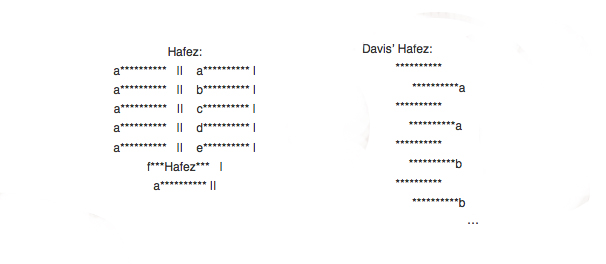
Dick Davis has opted for a simple and contemporary diction and has remained close to the source text. Although different from the mono-rhyme of the Persian ghazal, his translation has developed its own rhyme at the end of each even misra‘, and every beyt has been expanded to four lines:
Davis’ translation is aligned with Khurramshahi’s interpretation, namely that pir-i mughan in this ghazal alludes to a Zoroastrian wine-seller, and its mystical reading (pir as a Sufi sage) is only suggested in the background. To keep mystical interpretations of Hafezian figures seamlessly in the background, he has rendered salik as pilgrim, as opposed to seeker. The concept of rah-u-rasm that guides the salik to manzilha is expressed through “seek[ing] to satisfy each stage’s rule,” which reflects the notion of traversing levels of mystical Islam, critiqued by Hafez in this ghazal.
Peter Avery and John Heath-Stubbs’ translation does not rhyme; all the same, it has struck its own meter in English. They have opted for stain, rather than rangin kun [make colorful]; their rendition may not reflect the source lexicon, but does convey the Hafezian metaphor, a reasonable compensation. However, they have decided to over-impose a mystical interpretation on the ghazal by translating pir-mughan as “the Master,” which necessarily defangs Hafez’s critique of institutional Sufism and its practices. “Ways of the road” reflects the linguistic metaphor of the source text that “Goals are Destinations,” embedded in rah and manzil. Both versions are close to the source text and, through recalling different possibilities of English, they have put Persian and English poetics in conversation with one another.
Hafez was first introduced to English-speaking readers through Sir Williams Jones’s version of a ghazal, titled “A Persian Song of Hafiz” in 1771. Translators of Hafez have come a long way ever since, taking his poetry in numerous directions based on their local variant, target audience, reading models, and approaches to translation. Julie Meisami’s essay in the Encyclopedia of Literary Translation Into English examines the historical and stylistic trajectory of these works [Routledge, 2000, pp. 600-602]. Hafez’s English translations, all surrounding his work akin to exegetical exercises of the Persian, have histories and traditions of their own. For instance, there are as many equivalents suggested for pir-i mughan and salik as there are English translators of Hafez.
Translation
pir-i mughan
salik
Metaphor
Arberry, A. J., Hafiz: Fifty poems, 1947.
taverner
[one] whose wont is on this road to go
Let wine upon the prayer-mat flow
Clarke, H. W. The Divan of Hafiz, 1974.
Pir of the magians (the perfect murshid)
holy traveller (the perfect murshid)
With wine, becolour the prayer-mat
Kashani, A. A., Odes of Hafiz: Poetical Horoscope, 1984.
The experienced sage
us/my friend
“Wash your prayer-rug in red wine, my friend”
Bell, G. The Teachings of Hafiz, 1985.
Tavern-keeper
traveller
“With wine, with red wine your prayer carpet dye!”
Smith, P. Divan of Hafiz, 1986.
Master
This experienced traveller
With wine dye your prayer-mat
Gray, E. The Green Sea of Heaven, 1995.
Magus
traveller
Stain your prayer mat with wine
Alston, A. J., In Search of Hafiz, 1996.
Magian Teacher
the true traveller
Dye your prayer-carpet in wine
Newell, J. R. The Songs of Hafiz, 2001.
master
that holy one
Dye your prayer mat red with wine
If examined carefully in the light of translation as a process—not merely an end result—of cultural and linguistic negotiation, these translations can point us to new and unprecedented horizons and challenge the idea of languages as fixed and unevolving literary idioms strictly associated with a particular religion or culture. In the past several decades, English has become a common vehicle for the expression of Islamic and Sufi thought, both through creative and scholarly writing. The central metaphor of Hafez’s ghazal may be unique to Persian, but the source concepts it evokes–that of religiosity and subversion–is common among all languages. English will continue to search for the voice of Hafez—and poets in other languages—and with each vigorous process of negotiation, we move a step closer in the Benjaminian direction of highlighting the “kinship” of all languages, their interconnectedness in what they wish to express.
_ _ _
This essay was written in close dialogue with Chana Kronfeld and my colleagues in her graduate seminar, “The Politics and Poetics of Translation” at the University of California, Berkeley. I would also like to thank my colleagues Leyla Rouhi, Tracy Cummings, and Franklin Lewis for their critical comments.
Bibliography
1. Davis, Dick. “On Not Translating Hafez.” New England Review (1990), Vol. 25, No. ½, Translation: Double Issue (Winter-Spring, 2004), pp. 310-318.
2. Shafi‘i-Kadkani, Mohammad Reza. “Dar tarjumah napaziri-i shi‘r.” Iran shinasi. 56 (1381/2002): 743-749. Iran Shinasi may not be the primary publisher of this essay as it has been featured in various other publications in Iran and abroad.
3. Hāfiz, and Bahāʼ -D. Khurramshāhī. ḤāfiẓʹNāmah: Sharḥ-i Alfāẓ, Aʻlām, Mafāhīm-i Kalīdī Va Abyāt-i Dushvār-i Ḥāfiẓ. Tihrān: Shirkat-i Intishārāt-i ʻIlmī va Farhangī, 2005.
4. Davis, Dick, Ḥāfiẓ, Zākānī N.-D. ʻUbayd, and Malik K. Jahān. Faces of Love: Hafez and the Poets of Shiraz. New York: Penguin Books, 2013. Pg. 10.
5. Ḥāfiẓ, Peter Avery, and John Heath-Stubbs. Hafiz of Shiraz: Thirty Poems: an Introduction to the Sufi Master. New York, NY: Handsel Books, 2003. Pg. 25.
6. On the question of mystical Islam, please see: Schimmel, Annemarie. Mystical Dimensions of Islam. Chapel Hill: University of North Carolina Press, 1975.
7. Jalāl, al-Dīn Rumi, and Franklin Lewis. Rumi: Swallowing the Sun: Poems Translated from the Persian. Oxford, England: Oneworld, 2008. xiv.
8. Benjamin, Walter. “The Task of the Translator.” Illuminations. New York: Harcourt, Brace & World, 1968, pp. 69-82.
9. I have benefited from George Lakoff’s metaphor theory. See: Lakoff, George, and Mark Turner. More Than Cool Reason: A Field Guide to Poetic Metaphor. Chicago: University of Chicago Press, 1989.
10. Meisami, Julie. “Shams al-Din Muhammad Hafiz” Encyclopedia of Literary Translation Into English. London/Chicago: Routledge, 2000, pp. 600-602.