My body, you are an animal whose appropriate behavior is concentration and discipline. An effort of an athlete, of a saint and of a yogi.
Well trained, you may become for me a gate through which I will leave myself and a gate through which I will enter myself. A plumb line to the center of the earth and a cosmic ship to Jupiter.
My body, you are an animal for whom ambition is right. Splendid possibilities are open to us.
English version by Czeslaw Milosz and Leonard Nathan
I am born for the second time. I am light as the eyelash of the wind. I froth, I am froth.
I walk dancing, if I wish, I will soar. The condensed lightness of my body condenses most forcibly in the lightness of my foot and its five toes. The foot skims the earth which gives way like compressed air. An elastic duo of the earth and of the foot. A dance of liberation.
I am born for the second time, happiness of the world came to me again. My body effervesces, I think with my body which effervesces.
Great humility fills me, great purity fills me, I make love with my dear as if I made love dying as if I made love praying, tears pour over my arms and his arms. I don't know whether this is joy or sadness, I don't understand what I feel, I'm crying, I'm crying, it's humility as if I were dead, gratitude, I thank you, my fate, I'm unworthy, how beautiful my life.
jagged are names and not our creatures – veronica forrest-thomson
i wish i had a better name to be called by like you might call a dog at a lake and she would surely turn & i could eat your name for days: i would gladly bow my head o as the ploughman to the plough & become the machine that made me that gave me my name my job (& what would i be called then) for now i sit & wait in boots i made myself & laced in faith on better days than this with better names & all & thinking on the names that trump other names & who wears them; how for example when you search for yourself you don’t always find what you’re looking for or say your name & feel like a stranger at the bank with your wad of cash for rent or at the park you stop when called to find a pup called sophie chasing down a human you don’t know. do you have a problem in your life? no. buddha says: look on the internet & you will surely find one i mean a problem. i had 107 problems & i named them all to keep them safe (each of them is called ‘<3’) & then i kissed them on the back and sides, i brushed their hair & called them my baby diamonds. buddha says: name your price. so i named my price sophie & she is high & heavy, she is surely gold, but now i want to call my price better i want to make my price a price a dog would pay. besides you can call my price by any name and she will come just the same. like dogs we neglect our work & lie on soft carpet and laugh and rofl about to the tune of the internet & shed our love all upon & around our bumbling manchild that we made & named. you can say eat the cake & you can even eat it but you can’t say anna mae & no you can’t turn her. how stupid & crazy to always have to say everything so much, to have to tell people not to hit it up or be a fucking joker, to have to always be the one to say no & then the long walk back to womanhood so obvious and boring to you so you make up names & say you are anything or write some awkward long-limbed poem just to remember that you have a clit. if you turn the head of my dog she will surely come but my cat does not come when i call he doesn’t come anywhere at all but stays home all day shagging blankets or crying on the roof & waiting for my face at the window. buddha says: do you get naked in the distant thunder. no sir. i keep my clothes on so my pets will know me so my poems will know me.
fucking up on the rocks
ducking my head under each wave on fire island i try to think of other times ive felt this done w/life & survived frank o’hara died here everybody knows alcoholics die everywhere all the time everybody knows he was purple wherever his skin showed i never thought of myself as a useless drunk i never felt so unspecial through the white hospital gown in the daytime it feels like it would be easy to die to dip my head under just a second too long but in the dark death is real like an animal up close he was a quarter larger than usual on the edge of sleep you could fall straight into & thru it & nobody wld know yr name there naked in the atlantic at midnight cutting a path where the moon hits the water i could swim a straight line out into forever & nobody would stop me. would know my name. every few inches there was some sewing composed of dark blue thread i want to shut my eyes i want to shut a million things strawberry moon orange to silver my simple tits bobbing on the water some stitching was straight and three or four inches longothers were longer and semicircular urge to die breathing out & folding in on itself until it feels like nothing we get out shiver lose the keys to the house find them & laugh on the porch the lids of both eyes were bluish black jameson drinking an inch of mezcal & me sucking on my seltzer like it’s a beer alive smiling only half-quitting only half-gone a normal heart flashing in & out on the shore it was hard to see his beautiful blue eyes which receded a little into his head the wifi is out my 4g is fake replacing each image in my recent life with a square and a ? (i know rite) he breathed with quick gasps. his whole body quivered. i have taken a solemn vow to stop looking at your face on the internet to stop imagining your unkind thoughts of me my life as a little nobody there was a tube in one of his nostrils down to his stomach i go to sleep in a wood-panelled room the same length & width as my bed & count the waves as they break over my head i sleep like im already dead face to the wall greedy for the nothing won’t fall in the crib he looked like a shaped wound i wake up constipated in the morning sun drink coffee & smoke on the beach feeling full of shit & good to no-one his leg bone was broken and splintered and pierced the skin every rib was cracked. a third of his liver was wiped out by the impact i could make a home here prone forever belly to the sand let my messages go unread let my phone battery run flat let the sun burn my back let all the ships fuck up on the rocks indistinguishable baby small little pieces floating like the world floats gay unbroken bloated & golden a monument to my favourite alcoholic the greatest homosexual who ever lived & died
sunshine belt machine
happy valentines i am not at my jazziest matching sweat shirt hair in a cheerful pony so dirty it would stay up by itself ‘i hope you’re as good at sucking dick as you are at being lonely’ unknown quantity of poems inside me unknown quantity of living moments moon’s outside almost full blood on my pillow never these days i take care of myself okay like a baby something like a mama something & my eyes dressed like candy big as the moon & it’s fine to be full of pretty much anything just for a while i love life i love being alive one day after another forever. what’s next.
Sophie Robinson
Sophie Robinson teaches Creative Writing at the University of East Anglia and is the author of A and The Institute of Our Love in Disrepair. Recent work has appeared in n+1, the White Review, Poetry Review, the Brooklyn Rail, Ploughshares and BOMB Magazine. Her third full collection, Rabbit, is published by Boiler House Press, 2018.
The late author's UK editor remembers a funny, gracious, kind, demanding, delightful and wise human being – and writer of one of the world's great autobiographies
Maya Angelou was one of the world's most important writers and activists. She lived and chronicled an extraordinary life: rising from poverty, violence and racism, she became a renowned author, poet, playwright, civil rights' activist – working with Malcolm X and Martin Luther King – and memoirist. She wrote and performed a poem, "On the Pulse of Morning", for President Clinton on his inauguration; she was given the Presidential Medal of Freedom by President Obama and was honoured by more than 70 universities throughout the world.
Maya Angelou and Lennie Goodings at Maya's 70th birthday party
I last saw her at the beginning of this month in her home in Winston Salem, North Carolina, and though she obviously wasn't entirely well, she was very much her larger-than-life self: funny, gracious, kind, demanding, delightful and wise. Our conversation ranged over Michelle and Barack Obama, for whom she held huge respect; her "daughter" Oprah; her son and grandchildren, and my family. She talked about James Baldwin and Malcolm X, and we ate pancakes and then, later, wonderful spare ribs. We laughed and we drank. At the time I thought how blessed I am, and now I know I was.
Her first book, I Know Why the Caged Bird Sings is one of the best memoirs I have ever read. Almost like a novel, it takes the reader into a time and place – 1930s Stamps, Arkansas, the segregated southern US town where her grandmother ran the general store – that is never to be forgotten. It was first published in America by Random House in 1969. Angelou said that Bob Loomis (who was her editor in America for 40 years) asked her many times to write her life story – she was convinced he was put up to it by "Jimmy" Baldwin – and she demurred until finally he said: "Well, it's hard to write a good autobiography." "I will start tomorrow," came her answer.
It was hugely acclaimed in America, but when it was shown to British publishers in the 1970s, according to Maya, they said that British people wouldn't care about a young black girl growing up in the American south in the 1930s. So no British edition appeared. In the mid 1980s Ursula Owen, then editorial director of Virago, visited Random House US, where the rights director suggested she have a look. Owen knew immediately it was for us.
I was the publicity director at the time and, soon after, a seriously crazily typed letter from Jessica Mitford arrived for me. She was going to make it her business to tell the world about her great friend and this book! We wondered how these two women had become friends – and we later discovered that they were devoted to each other. Jessica, claimed Maya, came once to her rescue to face down the Ku Klux Klan, saying she was Maya's mother. I copied parts of her letter to send to all the press and the response was immediate.
Then Maya came to London. Well, that is just too tame a description. In our tiny office, 6ft Maya sang and danced and laughed her way into our lives. She recited her poem "Phenomenal Woman" in our office. We were astonished and thrilled – and very much awed.
So it was that 15 years after the first US publication, we published I Know Why the Caged Bird Sings in a Virago paperback. Maya appeared on Afternoon Plus. It was a heartfelt, bold interview, and Maya talked about the part in her book where she is raped at eight and how she became mute until literature coaxed her back into speaking. The TV switchboards were jammed; the reviews and features that followed were stunning. Maya beamed straight into British hearts.
I don't think we quite knew what we had. Our first print run was around 8,000 paperbacks and was sold out before publication. We printed another cautious 8,000. Today, the Virago edition of I Know Why the Caged Bird Sings has sold more than 600,000 copies, and it's still selling year on year, month on month. It's on courses, reading lists and remains, to my mind, one of the world's great autobiographies. We went on to publish all Maya's works: six more volumes of autobiography, her poetry, essays and cookbooks.
She brought us bestsellers but, more than that, she brought us a reminder that the human need for dignity and recognition is a gift easily given to one another, but frighteningly easy to withhold. Maya's fierce belief was that each of us has a deep worth – a simple yet profound fact. She was an indomitable force, famed for her spirit and style, courage and laughter.
In 2009 she wrote: "My life has been long, and believing that life loves the liver of it, I have dared to try many things …" She was a wonderful teacher: "You may not control all the events that happen to you, but you can decide not to be reduced by them … Do not complain. Make every effort to change things you do not like … Be certain that you do not die without having done something wonderful for humanity."
I know. I know they are limited, have different needs andconcerns. but I watch and learn from them. I like the little they know, which is so much. they complain but never worry, they walk with a surprising dignity. they sleep with a direct simplicity that humans just can’t understand. their eyes are more beautiful than our eyes. and they can sleep twenty hours a day without hesitation or remorse. when I am feelinglow all I have to do is watch my cats and my courage returns. I study these creatures. they are my teachers.
It only takes one person to change a lot of minds. I went to what can only be described as a slum school in Salford – rough and full of trainee punks – but I was very lucky in that I had one inspiring teacher, John Malone, who gave the whole class an interest in romantic poetry. Somehow he created a hothouse, competitive atmosphere. Poetry, because of him, became a macho thing at our school, and we discovered very quickly that it was a great way to impress chicks.
I’m not fond of crowds. I’m no jittery neurotic, but I don’t really want to be surrounded by a lot of people if I have a choice. A big audience though… now that I love.
By the 80s, anything to do with punk was perceived as rancid. Me being known as the “punk poet” meant my work and I plummeted. I spent a decade living a feral existence on very little, and heroin became a big part of that. Slowly, with help, I managed to get myself out.
Impotent rage is my default setting. Specifically when it comes to politics. I can’t believe the ideas people walk around with. I try not to get too upset but it’s got to the point where I’d like to stop reading the news, as I’m infuriated on a daily basis.
I worry about other people’s kids. I watched a guy in the street yesterday pushing his daughter in a pram while he had his phone wedged between his ear and shoulder. The thought of him crossing the road without looking horrified me.
A dry martini and the odd flutter on the nags are my lasting vices. I don’t drink until after 6pm – I’m no lush – but a few glasses of wine with dinner and chat is a nice way to spend an evening, isn’t it?
The last time I cried was today, when I heard an old friend had died. I’ve said goodbye to a lot of my pals in recent years. I guess it’s an occupational hazard at this point in my life.
If I’d have known how much fun fatherhood would be, I would have started way earlier than 45. I know that men can still father children into their late years, but we decided not to. My daughter is a great kid.
Films are one of my greatest loves. Old films, with proper film stars like John Wayne and Dean Martin. You don’t get screen stars of that magnitude any more. Most of them couldn’t chew gum and fart at the same time.
I’m writing more poetry now than everbecause the world is infuriating. My poetry can come from anger at something on the telly or the radio, and then it just blurts out. It’s always about real stuff – I don’t have time for fiction or fantasy.
I’m a total control freak. If I wasn’t a poet, I’d probably be some tin-pot dictator of a banana republic. Whatever I do, I’ve got to be in charge.
I’ve turned into my dad. He was always a bit of a comedian. My aunts used to say that I was a miniature version of him and encouraged me to be entertaining, but it’s only now when I bet on a horse or have a drink that I see that I’m actually morphing into him.
I look like a ruined matinée idol. I fucking hate getting old, but it’s too late to complain – I’m already there.
POSTED ON NOVEMBER 24, 2014A guest post by Aria Fani. A native of Shiraz, Fani studies towards a Ph.D. in Near Eastern Studies at the University of California in Berkeley.
هشتاد سالگی و عشق؟ تصديق کن که عجيب اس
حوّای پیر، دگر بار، گرمِ تعارفِ سيب است
Love at Eighty? Admit it: it’s bizarre.
Ancient Eve is, once again offering apples
Simin Behbahani, distinguished Persian-language poet, passed away on August 19 in Tehran. Behbahani was a major figure on the Iranian literary landscape whose work enjoyed readership not only in Iran but also in the wider Persianate world. Born in 1927 in Tehran, Behbahani began composing poetry at the age of 14. Having initially experimented with chaharparah and shi‘r-i naw (free verse), from the mid-1970s she turns to the ghazal as the main vehicle for her poetic expression. Like most her literary predecessors, she adds new themes and original meters to the classical form. Unlike many of them, Behbahani does so with much success. One may ask, what factors contribute to her critical acclaim and popularity? The dynamic interaction of what Behbahani–in dialogue with her literary milieu–has conceptualized as old and new, formally and thematically, has led to the composition of ghazals that speak powerfully to multiple realities and emotions.
With over 15 volumes of published works (spanning over 600 poems), Behbahani’s work deals with love, war, peace, revolution, class disparities, gender discrimination, polygamy, marital life, domestic violence, patriotism, prostitution, aging, poverty, and global violence. She has won numerous accolades over the decades; more recently MTV U crowned her Poet Laureate for 2009. A Cup of Sin (1999), Maybe It’s the Messiah (2004), and My Country, I Shall Build You Again (2009) present selections of her verse in English translation.
Since her passing, a host of obituaries has appeared in such reputable venues as The New York Times, The Economist, The Guardian, BBC, NPR, Al Jazeera, and PBS.Writing brief narratives that speak to the multifaceted legacy of Behbahani — poet, writer, educator, and activist — may be beyond the scope of obituary writers unfamiliar with the Persian literary tradition. Obituaries briefly touch upon different aspects of a figure’s life while highlighting their greatest accomplishments. It is particularly bizarre that all the aforementioned papers have opted to frame Behbahani as a national political dissident and situate her poetry exclusively within the context of her social activism, designating her as a standalone figure. There is a deliberate effort to cast Behbahani as a national voice in direct opposition with the Iranian regime, a reductive framework that necessarily occludes the complexity of her verse and reception. Consider the following titles:
“Simin Behbahani: Iran’s most famous female poet and defender of human rights”–Guardian
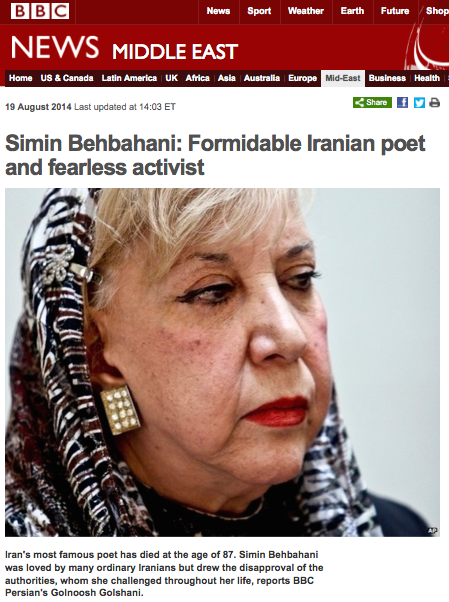
“Simin Behbahani: Formidable Iranian poet and fearless activist”–BBC
“Iran’s last great female poet Simin Behbahani, whose poetry was quoted by Barack
Obama, has died aged 87. But her work lives on.”Al Jazeera
A BBC headline covering Behbahani’s death
Another pattern emerges in these headlines: even as English-language papers define and celebrate Behbahani, they define themselves, their ideological purposes and political dispositions. In other words, Simin Behbahani is used to tell other stories. Some of these stories overlap with her literary and social preoccupations. But mostly, these stories tell us more about their storytellers than the protagonist of their narrative, the deceased poet. Primarily, inserting Behbahani into an “Iranian national canon” ignores her readership and reception in Afghanistan and Tajikistan and frames her work as a national allegory, the voice of an entire nation. Reductive and modern epithets such as “Iran’s national poet” divorces Behbahani from her literary culture, one that has operated across a diverse ethnic and religious territory with permeable frontiers and multiple participants over the course of one millennium.
What does it mean to imagine Persian literature as a “national canon,” a tradition whose history–except the last century–predates the era of flags, borders and passports? Writing “nation” on the body of Persian literature participates in the erasure of dynamic and ongoing conversations on genre, form, and style that have shaped the contours of this literary tradition across a vast geography that in the premodern world stretched from Anatolia to the Bay of Bengal. What does it mean to imagine Persian literature as a “national canon” even today? For instance, Mahmoud Dowlatabadi (b. 1940), often framed as Iran’s national novelist, imbues his prose with distinctly Khurasani expressions and lore. While a glossary is appended to many of his novels for Tehrani (Isfahani, Shirazi, etc) readers unfamiliar with Dowlatabadi’s lexicon, his readers in Kabul, Balkh and Herat are familiar with the novelist’s Khurasani heritage and rarely feel the need to consult a dictionary. The framework of “national literature” has proven inadequate and reductive time and again in the context of literary and cultural studies. Once interrogated and put in conversation with literary history, it fails to accurately reflect the evolution and complexity of a literary tradition as wide-reaching as Persian literature.
The poetry of Simin Behbahani stands on an ongoing conversation with and an acute understanding of the Persianate literary past; it is precisely based on this foundation that Behbahani appropriates, reshapes, and reinterprets the Persian ghazal. I use “Persianate” here– instead of Persian or Iranian–a term coined by the historian Marshall Hodgson (d. 1968). Persianate refers to a cultural expanse that has been cultivated by different participants who may not have been ethnically Persian or inhabitants of the Iranian Plateau, all the same have necessarily shared the distinct elements of Persianate cultural heritage, mainly literary preoccupation with Persian. This narrative serves as a more robust backdrop against which Behbahani’s poetic legacy can be set.
An Iranian publication featuring a young Behbahani
Furthermore, the primitive syntax of “He is the national x of Iran” or “She is the female y of Afghanistan,” a well-known remnant of colonial practices, occludes the protean and permeable nature of Persianate literary culture and confines Behbahani within a “national canon.” Another figure that immediately comes to mind is Forugh Farrokhzad (d. 1967), a poet and filmmaker whose verse has been turned into an arena for obsessive treatments of her sexuality and gender. The work of no other contemporary Persian-language poet has been biographized to the extent Farrokhzad’s oeuvre has been. These practices have been more extensively examined within the context of Persian in South Asia. More recently, Rajeev Kinra (2012) has convincingly demonstrated how European historiographers rewrite Chandar Bhan–a seventeenth-century Persian-language litterateur and state secretary of Mughal India–as a standalone Hindu figure who gained success by virtue of writing in a “foreign” language (Persian) and in spite of his “non-Islamic” (Brahman) faith. Kinra’s scholarship participates in the process of recovering the legacy of Chandar Bhan by placing him in his own historical context, much the same way I suggest that a close examination of Behbahani’s oeuvre will be a great step in the retrieval of an important voice from such colonial framings as “Behbahani, Iran’s national poet” or “Iran’s last great female poet.”
Behbahani was primarily a poet and is remembered by her readers as such. Yet, she is characterized mostly by extra-literary titles: female poet, defender of human rights, Lioness of Iran, Iran’s national poet, and fearless activist. Assigning the qualifier “female poet,” one that Behbahani has never used to refer to herself, reinforces the subclassification of her poetry without giving any insights into how her “femaleness” distinguishes her verse from work by other poets. Behbahani is hailed as a “lioness” for choosing to remain in Iran, resist the Iranian regime’s efforts to restrict her mobility and oppose censorship. Following this background, only two out of seven obituaries fail to mention President Obama’s 2011 Nowruz greetings wherein he criticizes Iran’s human rights record and ends his message by quoting a poem by Behbahani. Such narrative co-opts Behbahani’s voice, in all its diversity and complexity, into an overtly politicized and dehistoricized paradigm. While every obituary quotes Obama so to validate the “universality” of Behbahani’s verse, they all fail to critically examine how Obama attempts to draw validity from a Persian-language poet to color his own policies (i.e. economic sanctions) towards Iran as just and unavoidable.
BBC goes one step further and calls Behbahani “fearless.” A description that raises many questions: would English-language papers call an English or European poet “fearless” ? What if their poetry engages such issues as military occupation, capitalism, or drone attacks? What type of rubric does “fearless” lay out for “female poets” in Iran who choose not to engage socio-political issues, or those whose poetry does not lend itself to a political critique of the Iranian regime? Would English-language media even hear their voices? How would a critical poet who has left Iran be characterized? Fearful yet outspoken? BBC’s designation is downright irresponsible at best and colonial at worst; it erases the complex and protean context wherein Behbahani’s poetry has interacted with the discourse of power in Iran.
To reject any trace of an autobiographical voice in Behbahani’s verse, partially informed by her struggles for civil liberties, would be equally a disservice to her legacy. Nonetheless, such examination will have to consider Behbahani’s entire oeuvre within the context of Persian poetic conventions. Ideological framings of Simin Behbahani by English-language papers function no differently than mechanisms of censorship that defang any given work by uprooting it from its historical context and co-opt it within a politicized framework. The political power of Behbahani’s work does not solely rest on its social critique of this or that government in Tehran, as suggested by these obituaries. It will suffice to say that her refiguration of ghazal’s expressive capacity, in conversation with Persianate literary tradition, is profoundly subversive.
The Behbahanian ghazal is a robust rebellion against a poetics that deemed being modern synonymous with doing away with all that is (perceived as) old. Behbahani puts forth a new poetics, one that in the space of several decades goes from challenging the rhetoric of modernist canon formation to creating a canon of its own. This is a legacy rendered invisible by a language (i.e English media) that forbids nuance and discards ambiguity. It is a language burdened with awe and praise (i.e. fearless, outspoken, great female poet), one that seeks to stabilize the meaning of political poetry solely as critique of state. It is a language that comforts its readers (that there are internal voices critical of the Iranian regime) while it fails to reflect upon its own participation in the erasure of Behbahani’s voice and that of many others. Such trends in the West join in alliance with the very mechanisms of political repression in Iran that set to create a homogenous literary language that does not afford any critique of the state. To indicate how easy it is to fall into such traps, I refer to my own essay, written two years ago, where I characterized Behbahani as Iran’s Lady of Ghazal. These statements need to be engaged and interrogated, whether made by English-language media or Persian-language commentators.
It goes without saying that Behbahani has been widely published in Iran, her poems have been turned into popular songs, and recited in literary circles. Behbahani’s readers know where to find her voice:
آدم! بيا به تماشا، بگذر ز چالش و حاشا هشتاد ساله حوّا با بيست ساله رقيب است
Adam! Come see the spectacle. Leave behind your denial and conceits and watch as the Eve of eighty rivals the twenty-year-old she.
For those who do not know her, these obituaries only offer a name, one to explore and investigate (see bibliography). Behbahani was one of the most distinguished poets of our time writing in Persian, and English-language papers failed to rise to the occasion and gravely missed the mark on remembering this multifaceted figure. Behbahani, like many women from the so called “third world,” is framed to represent her nation while her most powerful legacy– her literary voice– has been defanged and dehistoricized through series of politicized and extra-literary epithets. Nonetheless, these obituaries–unmistakable symptoms of much broader historiographical patterns–document an illuminating account of dual rubrics informed by ideological convictions rather than the standards of balanced and careful journalism.
This essay was written in dialogue with Leyla Rouhi, Wali Ahmadi, and Sara Salem.