Monday, March 28, 2016

Philip Larkin is far from forgotten in Hull


 The Philip Larkin statue at Hull Paragon station.
Photograph: Alamy

Philip Larkin 

is far from forgotten in Hull


Letters
Monday 7 December 2015 19.38 GMT


What a pity that Mike Godwin (Letters, 3 December) spent the 30th anniversary of Philip Larkin’s death on a lonely pilgrimage to Larkin’s grave in Cottingham. If only he had thought a bit about it, he might have found his way to the Brynmor Jones Library at the University of Hull, where Larkin was librarian for 30 years. There he would have discovered more than 150 members of the Larkin Society, including his biographer James Booth and his formidable secretary Betty Mackereth, enjoying wine and food in their annual celebration of the great poet, surrounded by a wonderful exhibition of Larkin photographs.
As chair of Hull City of Culture 2017, I was invited to speak about “Larkin in the light of 2017”, and did so with the assistance of my cherished first edition copy of  The Whitsun Weddings. The night was a joyous and totally unforlorn occasion, held in the building he loved. I suspect Larkin would have revelled in it. Next December, we shall all be at Westminster Abbey for the unveiling of Larkin’s plaque in Poets’ Corner. I suggest Mike Godwin comes along.

Rosie Millard
Chair, Hull City of Culture 2017


Thursday, March 24, 2016

Jhumpa Lahiri / Closing the Circle

Jhumpa Lahiri

Closing the Circle

BY JHUMPA LAHIRI
Alberto de Lacerda, one of Portugal's greatest poets in the second half of the twentieth century, died this past August at the age of seventy-eight. I met Alberto in September 1993, when I was a graduate student in literature at Boston University. He was teaching a seminar about Fernando Pessoa, and I was the only registered student (there was also one auditor). I had no prior interest in Pessoa, had never heard of him, in fact. But Alberto came recommended. 


When we crossed paths he was a small man in his sixties with a gentle sing-song voice and white wispy hair, but he made a formidable first impression, enough to make me consider dropping the course. My staying made the class possible, but Alberto seemed, in those early weeks of the semester, suspicious of my reasons for being there. He lectured without notes, an intense, virtuosic delivery peppered with occasionally condescending asides. In the course of making a reference to a painting by Picasso or a passage from King Lear, he would turn to me and ask, "Do you know whom I mean by Picasso? You are familiar with Lear?" 


The first of the many things I learned at Alberto's table was not to let these remarks bother me. We dove, our modest party of three, headlong into Pessoa, but in spite of the seminar's singular focus, Alberto's lectures knew no bounds, his mind skipping from Mozart to Duchamp to Dylan Thomas. I brought a pen and a notebook to class, but mainly I just listened. By the middle of the term the class was no longer a class but rather an escape from the ordinary, and I approached our weekly three-hour sessions with the pleasure of visiting a dear and exceptionally learned friend. 


Though Alberto's creative life was no secret, he was quiet about the fact that he was an acclaimed, working poet. Like his hero, Picasso, he believed that artists were born and sustained in the process of studying other artists. His attitude toward Pessoa and the other geniuses he loved was pure, visceral, inexhaustible, devotional. Alberto's mission was not to explain a poem or a painting, but to absorb it. He approached art matter-of-factly, ritually, as one approaches a meal, as if his very existence depended on it. Ever the aesthete, he was also a great gossip. Tea with Edith Sitwell, sitting next to T.S. Eliot at a dinner party—these were among the anecdotes he mentioned now and again. (On Sitwell: "She was a snob, but wonderfully generous to me. And had fabulous hands.") 


He gave me a bilingual edition of 77 Poems, his first published volume (translated by Alberto with Arthur Waley and published in 1955), without fuss one day, inscribing it with a ballpoint pen as I sat across from him in a pizza place that doubled as his public office, on Boston's Commonwealth Avenue. By then we had been friends for four years. Before handing over the book, he turned to a page that was in Portuguese and corrected an error in the text, even though he knew that I did not understand Portuguese and that my eye would never fall there. Alberto seemed shy on his side of the table, as I did on mine. It is always strange to experience, for the first time, the creative work of a friend. And it is rare to know a friend for so long and not encounter the work. In a way, I knew that it was irrelevant to Alberto whether or not I liked the poems. I did. They were transparent in the best sense: they hid nothing. They were fearless and vulnerable, the two things, I was beginning to learn, that an artist must be. I was haunted by the frank expression of melancholy and loneliness, by the combined detachment from, and desperate connection to, the world. Rereading 77 Poems after Alberto's death, I was undone, because so many, written when he just in his twenties, seemed uncannily to predict the course of his life, and to articulate beliefs he held into old age. "The only usefulness of the poet/Is to exist" he wrote in "Poem 75," a credo that distills so much of Alberto's essence to me. Here are the first two stanzas from poem 24, titled "The Shore": 


My song dies away beyond this life 
Because it does not belong to it entirely; 
Facing death, and lonely, 
I am going to close the tragic circle. 


Friends I had not, and that loving 
Vision which Love forbade me here— 
I slowly suffered their absence 
In my agony of interrupted Wing.


Though Alberto in fact had many friends and delighted in their company, there was an impenetrable aspect to him, a privacy he ferociously guarded. He could be remarkably hospitable but invited next to no one into his home. In 1996, he retuned to London, the place he considered his center. For the next eleven years he continued to write poems, and during that time he wrote me a number of letters. He quoted Blake, told me to go see the Ingres exhibit at the Metropolitan, warned me of the tyranny of editors. In 1998 he wrote: "I've written quite a bit since I returned [to London]. Not lately. It doesn't matter. I've done enough; anyway, I never had that kind of anxiety." 


In 1999, three years after Alberto gave me 77 Poems, I, too, shyly presented him with my first published effort. Before then, I never mentioned to Alberto that I was an aspiring fiction writer. If he intuited anything, which most likely he did, he never pried. It was better that way. And yet he influenced me deeply. "I've just, this very moment, finished writing a poem," he began one letter. "If you knew Portuguese, I would send it to you. It may survive; maybe reading it tomorrow, I'll tear it up." He never opened the door of his apartment to me, but from that declaration of camaraderie and trust, that cold, clear-eyed appraisal of a writer's process, I glimpsed something more precious. 


Anyone who knew Alberto, even briefly, understood that he was an idiosyncratic, outspoken, in some senses anachronistic man. He was not afraid to say what he thought, not afraid, now and again, to make an enemy. But I believe that in the most profound aspect of his life—his work—he found peace. He understood the importance of art and the mystery of it, accepted the inability, ultimately, to control what is produced and what becomes of it in the eyes of the world. The point, he knew, was to stay inspired. It is an awareness that, I think, grounded and accompanied him throughout his life.

Originally Published: January 2, 2008


Wednesday, March 16, 2016

Dorothy Parker / A Very Short Song


A Very Short Song 
by Dorothy Parker
Once, when I was young and true,
Someone left me sad-
Broke my brittle heart in two;
And that is very bad.

Love is for unlucky folk,
Love is but a curse.
Once there was a heart I broke;
And that, I think, is worse. 


Thursday, March 10, 2016

José Asunción Silva / Tropical Landscape


Tropical Landscape
By José Asunción Silva

The river spills its soporific magic
Into the journey’s calm monotony,
And in the distance vistas are erased
As shadows lengthen toward infinity.
A lone thatched hut slips past, glimpsed
Through a matted jungle tapestry
That casts designs of tangled leaves and vines
Worked in tones of dusk’s variety.
Venus comes to life in purest space,
Below, a native hollowed-out canoe
Grooves the drowsy current, swift and sure,
As in the west, the fiery setting sun
Forges a second green and rose-tinged sky
In the lazy river’s liquid mirror.
—Published in El libro de versos, 1923


Wednesday, March 2, 2016

Philip Levine / Something Has Fallen

Hand
 by Jean-Baptiste Huynh
Something Has Fallen

by Philip Levine

Something has fallen wordlessly
and holds still on the black driveway.

You find it, like a jewel,
among the empty bottles and cans

where the dogs toppled the garbage.
You pick it up, not sure

if it is stone or wood
or some new plastic made

to replace them both.
When you raise your sunglasses

to see exactly what you have
you see it is only a shadow

that has darkened your fingers,
a black ink or oil,

and your hand suddenly smells
of classrooms when the rain

pounded the windows and you
shuddered thinking of the cold

and the walk back to an empty house.
You smell all of your childhood,

the damp bed you struggled from
to dress in half-light and go out

into a world that never tired.
Later, your hand thickened and flat

slid out of a rubber glove,
as you stood, your mask raised,

to light a cigarette and rest
while the acid tanks that were

yours to clean went on bathing
the arteries of broken sinks.

Remember, you were afraid
of the great hissing jugs.

There were stories of burnings,
of flesh shredded to lace.

On other nights men spoke
of rats as big as dogs.

Women spoke of men
who trapped them in corners.

Always there was grease that hid
the faces of worn faucets, grease

that had to be eaten one
finger-print at a time,

there was oil, paint, blood,
your own blood sliding across

your nose and running over
your lips with that bright, certain

taste that was neither earth
or air, and there was air,

the darkest element of all,
falling all night

into the bruised river
you slept beside, falling

into the glass of water
you filled two times for breakfast

and the eyes you turned upward
to see what time it was.

Air that stained everything
with its millions of small deaths,

that turned all five fingers
to grease or black ink or ashes.


Monday, February 15, 2016

Dorothy Parker / From a letter from Lesbia


FROM A LETTER FROM LESBIA
by Dorothy Parker

... So, praise the gods, Catullus is away!
And let me tend you this advice, my dear:
Take any lover that you will, or may,
Except a poet. All of them are queer.

It's just the same. — a quarrel or a kiss
Is but a tune to play upon his pipe.
He's always hymning that or wailing this;
Myself, I much prefer the business type.

That thing he wrote, the time the sparrow died —
(Oh, most unpleasant — gloomy, tedious words!)
I called it sweet, and made believe I cried;
The stupid fool! I've always hated birds...


Friday, February 12, 2016

The Poetry of Raymond Carver Makes a Leap to E-Books

Raymond Carver

The Poetry of Raymond Carver Makes a Leap to E-Books


Raymond Carver, the noted author of short stories and poetry, died nearly 27 years ago, long before the digital revolution upended the publishing industry. And until now, his legacy has been confined to print.

That will change this week, when 10 of Mr. Carver’s books will be published digitally for the first time. Vintage Books is publishing e-book editions of the author’s entire backlist, including six collections of short stories and four volumes of poetry, for $9.99 to $11.99.

Tuesday, February 9, 2016

Raymond Carver / Stupid


Stupid

By Raymond Carver

 It's what the kids nowadays call weed.
 And it drifts
like clouds from his lips.
 He hopes no one
comes along tonight, or calls to ask for help.

Help is what he's most short on tonight.

A storm thrashes outside.
 Heavy seas
with gale winds from the west.
 The table he sits at
is, say, two cubits long and one wide.

The darkness in the room teems with insight.

Could be he'll write an adventure novel.
 Or else 
a children's story.
 A play for two female characters,
one of whom is blind.
 Cutthroat should be coming
into the river.
 One thing he'll do is learn
to tie his own flies.
 Maybe he should give
more money to each of his surviving
family members.
 The ones who already expect a little
something in the mail first of each month.

Every time they write they tell him
they're coming up short.
 He counts heads on his fingers
and finds they're all survivng.
 So what
if he'd rather be remembered in the dreams of strangers?
He raises his eyes to the skylights where rain
hammers on.
 After a while --
who knows how long? -- his eyes ask
that they be closed.
 And he closes them.

But the rain keeps hammering.
 Is this a cloudburst?
Should he do something? Secure the house
in some way? Uncle Bo stayed married to Aunt Ruby for 47 years.
 Then hanged himself.

He opens his eyes again.
 Nothing adds up.

It all adds up.
 How long will this storm go on?


Friday, February 5, 2016

Raymond Carver / Drinking While Driving


Drinking While Driving
by Raymond Carver


 It's August and I have not 
Read a book in six months 
except something called The Retreat from Moscow
by Caulaincourt 
Nevertheless, I am happy 
Riding in a car with my brother 
and drinking from a pint of Old Crow.
 
We do not have any place in mind to go, 
we are just driving.
 
If I closed my eyes for a minute 
I would be lost, yet 
I could gladly lie down and sleep forever 
beside this road 
My brother nudges me.
 
Any minute now, something will happen.


Monday, February 1, 2016

Raymond Carver / An Afternoon

A Nude Woman doing her Hair before a Mirror
by Christoffer Wilhelm Eckersberg

An Afternoon

by Raymond Carver


 As he writes, without looking at the sea,
he feels the tip of his pen begin to tremble.

The tide is going out across the shingle.

But it isn't that.
 No,
it's because at that moment she chooses
to walk into the room without any clothes on.

Drowsy, not even sure where she is
for a moment.
 She waves the hair from her forehead.

Sits on the toilet with her eyes closed,
head down.
 Legs sprawled.
 He sees her
through the doorway.
 Maybe
she's remembering what happened that morning.

For after a time, she opens one eye and looks at him.

And sweetly smiles.


Raymond Carver / My Crow and other poems
Raymond Carver / Your Dog Dies
Raymond Carver / Happiness
Raymond Carver / All Her Life
Raymond Carver / Fear
Raymond Carver / Poems
Raymond Carver / Late Fragment
Raymond Carver / An Afternoon


Thursday, January 28, 2016

Don Paterson / Reading Shakespeare’s Sonnets / Review


40 Sonnets review – the perfect vehicle for Don Paterson’s craft and lyricism


The poet tugs and stretches a demanding form to its limit in work of vividness and potency


Sarah Crown
Saturday 26 September 2015

D
on Paterson has a thing for sonnets. Back in 1999 he brought out an anthology of 101 of his favourites, and in 2012 he delved deeper into their history with Reading Shakespeare’s Sonnets, a passionate, personal response to the great man’s form-defining sequence. Nor has he confined himself to curation and criticism: in 2006, he produced a warm, responsive reworking of Rilke’s 55-sonnet cycle, Orpheus, while his original collections are punctuated by his own efforts, some of which (such as Landing Light’s superlative “Waking with Russell”) count among his finest poems. “The square of the sonnet exists for reasons which are almost all direct consequences of natural law … and the grain and structure of the language itself,” he said, attempting to explain the form’s abiding appeal – and his own fascination with it – in an article in this newspaper. “Or to put it another way: if human poetic speech is breath and language is soapy water, sonnets are just the bubbles you get.”

Monday, January 25, 2016

Juana Inés de la Cruz / She expresses her loving respect


She expresses her loving respect, explaining what she means when she says Her Ladyship the Vicereine, Marquise de la Laguna, belongs to her.

by Juana Inés de la Cruz

My divine Lysis
pardon me if I dare
then to address you thus,
since to be called yours exceeds my merit
and to this I cannot presume. 
To call you mine I would be placed
at the mercy of your sovereign darting rays
if in my boldness I have overreached, and dared.
It is an error of the tongue
when that which is called imperial
and mastered, and of the dominion
appear to be the slave’s possessions.
“My king” declares the vassal,
“My prison” claims the prisoner, 
and the most humble slave
without the slightest offense can claim her master as her own.
Thus when I call you mine
I am not in the least pretending
that you will be adjudged to belong to me, 
but solely that I wish to be yours.
I saw you – but just stop there:
in order to say there is a fire
it is sufficient to show the cause
there is no need to affix blame on anyone for the result.
To see you so elevated
does not impede my audacity, 
for there is no deity who can remain beyond
the reach of  lofty flights of cogitation.
And yet there are those, more deserving – 
in their proximity to heaven – 
equally placed is the humble valley
as the superbly high mountain.
Finally, I must be confessed
of this sin, which is my adoration –
and if you wish to chastise me,
your chastening will be my reward.


Friday, January 22, 2016

Antonio Cicero / Perplexity

Portrait of a Dead Man
by Damien Mammoliti
 PERPLEXITY
by Antonio Cicero
Translated by Emiliano Battista


Antonio Cicero / Perplexidade (Pessoa)

Not sure just where I lost my way,
Or whether I lost it at all.
Still, I can't help thinking it odd
That this had always been my lot.


Friday, January 15, 2016

John Ashbery / The Art of Poetry


John Ashbery

The Art of Poetry 

No. 33


Interviewed by Peter A. Stitt

Winter 1983
No. 90


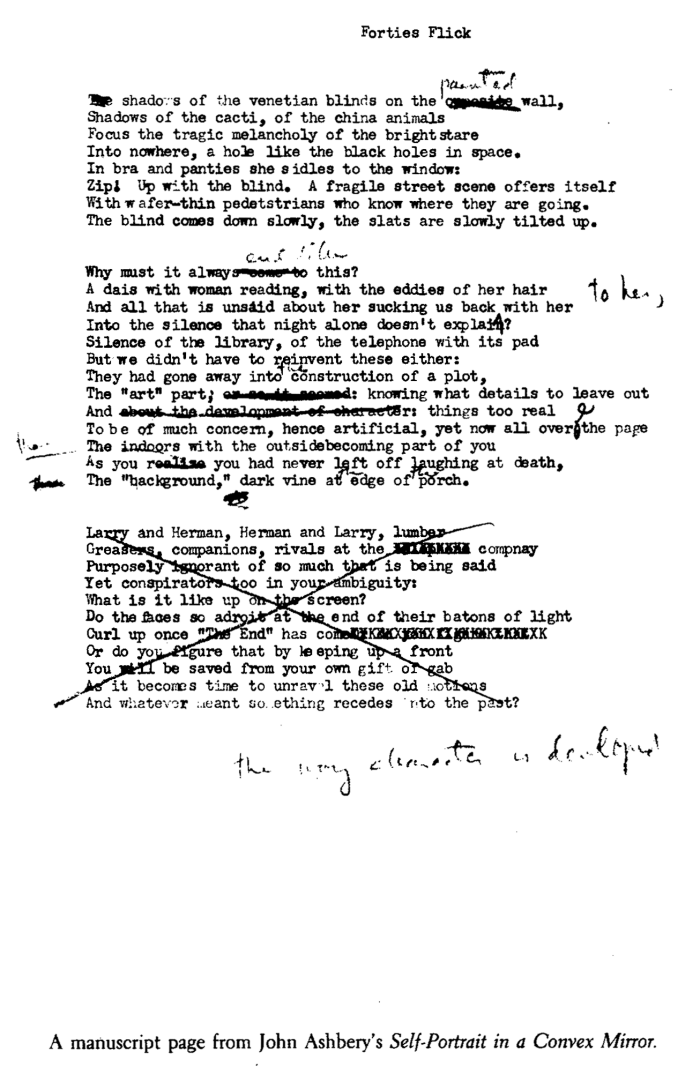
The Art of Poetry No. 33 Manuscript


The interview was conducted at John Ashbery's apartment in the section of Manhattan known as Chelsea. When I arrived, Ashbery was away, and the doorman asked me to wait outside. Soon the poet arrived and we went up by elevator to a spacious, well-lighted apartment in which a secretary was hard at work. We sat in easy chairs in the living room, Ashbery with his back to the large windows. The predominant decor was blue and white, and books lined the whole of one wall.