Wednesday, July 30, 2014

Liz Berry / Bostin Fittle


Liz Berry, winner of the Forward First Collection prize 2014

Bostin Fittle

by Liz Berry
At Nanny's I ate brains for tea,
mashed with hard-boiled egg,
or trotters, groaty pudding,
faggots minced with kidney and suet.
Right bostin fittle, Nanny said.
She knew hunger, knew how
to press a blade sure and firm
on the pig's fat ribs, clack the neck
of the cockerel. An apprentice,
I studied her careful craft:
the sweet heart hidden in the rotten 
cabbage, chitterlings plaited
like a rope of hair.
Elbow deep in rabbit, floury
chunks of lard, I touched
my lips to the hide of the past:
salty, dark, unexpected
as the rook she'd baked
for her bride-feast, that flew,
crawing from her hands to his tongue.

bostin fittle great food

• From Black Country by Liz Berry 


Sunday, July 20, 2014

Kathryn Simmonds / In the Woods


In the Woods
BY KATHRYN SIMMONDS
The baby sleeps.
Sunlight plays upon my lap, through doily leaves a black lab comes,
a scotty goes, the day wears on, the baby wakes.

The good birds sing,
invisible or seldom seen, in hidden kingdoms, grateful for the in-
between. The baby sleeps. Elsewhere the Queen rolls by

on gusts of cheer — 
ladies wave and bless her reign. The baby frets. The baby feeds.
The end of lunch, a daytime moon. The leaves

are lightly tinkered with.
It’s spring? No, autumn? Afternoon? We’ve sat so long, we’ve walked
so far. The woods in shade, the woods in sun, the singing birds,

the noble trees.
The child is grown. The child is gone. The black lab comes,
his circuit done. His mistress coils his scarlet lead.

Kathry Simmond
The Visitations 
Seren, 2013


Friday, July 18, 2014

Kevin Prufer / How He Loved Them


How He Loved Them
by Kevin Prufer
How much the colonel loved his granddaughters
you will never know.
                           Their laughter filled his black Mercedes
the way a flock of starlings might fill a single tree
with song.
              What he’d had to do that day, he’d done
with a troubled heart,
                            but now their laughter overwhelmed him
with such unarticulable love
                                    he could hardly
contain it
             and neither could the empathetic little bomb
in the engine,
                  which chose that moment
to burst through the hood with self-obliterating joy.

+
And the Mercedes burned in front of the courthouse.
And the black smoke billowed and rose like a heart full of love.
And the colonel rose, too,
                                 like burning newspaper
caught in the wind,
                         a scrap of soot, then nothing, then unknowable—

+
You will never know
                          what dying is like.

The colonel’s granddaughters are still laughing in the backseat,
or they are uncomfortable in the new bodies
the bomb made for them.

Oh, darling, darling, one of them recalled,
you are burning up
                         with fever—her mother’s cool hand on her forehead,
then the sense of slipping under,
                                          into black sleep. She’s asleep now,
the voice said, turning out the light,
                                              closing the door.

+
And in every hand, smartphones made footage
of their bodies,
                    the heaps and twists of metal.

The smoke uploaded the wreckage
                                             to the screenlike sky
where it goes on burning forever—

you will never know if dying is like that,
the same scenes repeated across a larger mind
                                                             than yours—

+
Is it like a small girl with a high fever asleep in a dark room
recollected for a moment
                                 as the brain closes down?
She’s asleep, the voices say, she is resting.

(My fleeting one, my obliterated device, my bit of pixilated
soot.) Hit PAUSE
                     and the smoke stops: a black pillar
that weighs the wreckage down.
                                          Then PLAY
how much he loved them,
                                  unknowable—

+
What the colonel had done that day
                                              had troubled his heart,
but the sound of his granddaughters’ laughter
lifted him high into the air
                                   like a scrap of burning paper
blown from the street into the trees.


Monday, July 14, 2014

Philip Larkin / Days


Days

by Philip Larkin
What are days for?
Days are where we live.   
They come, they wake us   
Time and time over.
They are to be happy in:   
Where can we live but days?


Ah, solving that question
Brings the priest and the doctor   
In their long coats
Running over the fields.

Philip Larkin
“Days” from Collected Poems.
Farrar Straus and Giroux, 2001


Tuesday, July 8, 2014

Ezra Pound / In a Station of the Metro


IN A STATION OF THE METRO
by Ezra Pound


The apparition of these faces in the crowd;
Petals on a wet, black bough.


Friday, July 4, 2014

Mattew Hollis / The last Years of Edward Thomas


The Last Years of Edward Thomas
by Mattew Hollis

Matthew Hollis's award-winning book tells the story of the last four years of writer & poet Edward Thomas. I've always loved Thomas's poetry & I've read several books about his life including the memoirs of his wife, Helen, & the memoir written by Eleanor Farjeon about their friendship.This book is different because, although it also concentrates on those last four years of his life, as Farjeon's did, it's really about his evolution as a poet. It's also about his friendship with the American poet, Robert Frost, and the influence of that friendship on his writing.

Thomas is not an easy man to like. Frequently withdrawn, taciturn & depressed, he was frustrated in his working life & very difficult to live with. The family always seemed to be just on the edge of poverty as Thomas worked as a freelance writer, picking up commissions to write books about literature & the English countryside, resenting the hack work all the time. He often took his frustrations out on his family & his moods could be frightening. More than once he threatened to commit suicide. His frustration was partly at his inability (as he saw it) to properly provide for his family & partly because his commissioned writing left him no time or energy to write anything else. Yet he was also a very attractive character, whose friends loved him. Helen adored him & her memoirs, collected as Under Storm's Wing, are very moving. Edward, however, grew to resent her need of him & the constant need to provide for the family. Eleanor Farjeon, the poet & children's writer, loved him & wrote movingly of their friendship in Edward Thomas : the Last Four Years.

Perhaps the most important friendship of Thomas's life was with Robert Frost. Frost had brought his family to England from New Hampshire to see if he could make a name for himself as a poet. In the years before WWI, Harold Monro's Poetry Bookshop in London was the place for poets & poetry lovers to meet. Monro's anthologies, Georgian Poetry, were immensely influential & made the reputations of several poets. When Frost & Thomas finally met, they became friends & spent days walking through the countryside talking about everything & anything - their families, their work, the coming war. Frost encouraged Thomas as he began tentatively to write poetry. Once he started, the poetry poured out of him, sometimes he was writing a poem a day.

This is the point where this book really took hold of me & I found it difficult to put it down. Hollis is a poet & his descriptions of the way Thomas wrote his poetry are fascinating,

His first poem had emerged in an unwieldy manner from his prose, but it was, in an important sense, better than his prose. The prose had done everything asked of it: polite, unshowy lines pitched at the level of a quietly spoken conversation; but the poem had that and more besides: it had cadence and it had drama. It was an extraordinary first effort, full of character and good phrasing; tonally, perhaps, it borrowed from his friend, Robert Frost, and by the standards of poetry it carried a prosaic bagginess that he would have to shake off; but in places it soared with an energy and confidence that showed glimpses of the promise to come.

That first poem, Up in the Wind, has all the qualities of Thomas's verse. Quiet, conversational, alive with the details of country life. Thomas is called a war poet but more because he was killed in the war than for any other reason. None of his poetry is explicitly about the war in the way that Sassoon or Owen wrote about the war. The war is often there, in the background, as in my favourite of his poems, As the Team's Head-Brass. The war is there in the quiet conversation of the speaker & the ploughman but the scene is somewhere in England, not France or Flanders.The scene is a field not a trench.

Thomas's most famous poem is probably Adlestrop.

Yes, I remember Adlestrop - 
The name, because one afternoon
Of heat the express-train drew up there
Unwontedly. It was late June.

Hollis shows how the poem was written, from the notes he jotted down  in June 1914 in the field notebooks he always carried with him, to the many attempts at that first verse, changing words until he found the right ones. It was as if all the prose Thomas had written over so many years had all been leading him to the point where he could write poetry. Often it was one of his articles or notebooks that suggested a poem or reminded him of an incident or conversation that he could turn into verse.

When the war broke out, Thomas initially had no thought of joining up. Robert Frost had taken his family back to New Hampshire, along with Thomas's son, Mervyn. The rest of the Thomas family or at least Edward himself, had plans to follow them. Thomas was in his mid 30s and there was no conscription to force him into the Army. Gradually, however, he came to feel that it was his duty to join up. He grew uncomfortable with the thought that other men were fighting for the country he loved so much. There was also a more pressing financial incentive. Freelance literary work had almost completely dried up & if he was in the Army, Helen & the children were guaranteed an income, especially if he served overseas.

Thomas joined the Artists Rifles & eventually became an officer in an artillery regiment. I hadn't realised that he was in camp at Hare Hall at the same time as Wilfred Owen. Hollis speculates that Owen was probably trained in map reading by Thomas but, as Owen hadn't been part of the poetry scene in London before the war, he didn't know of Thomas's reputation as a writer & critic. Thomas had not had any of his poems published &, when he did send them out to magazines, he used the pseudonym Edward Eastaway. Hollis wonders what the effect would have been on Owen's development as a poet if he had come under Thomas's influence at this point rather than the influence of Siegfried Sassoon whom he met at Craiglockhart Hospital in 1917.

Thomas could have stayed in England with a staff job but volunteered for service in France where he was killed at Arras on Easter Monday, April 9th 1917. He didn't see his poetry in print but a volume was published soon after his death & his reputation has grown ever since. Now All Roads Lead To France is a fascinating look at the evolution of a poet. It's interesting to speculate about Thomas's future if he'd survived the war. I don't think he would have been defined by his war service & his war poetry as Sassoon was. His subject matter was much broader. I wonder if he would have been a happier, more contented man if he had returned from France to continue writing poetry & maybe visit America & farm with Frost as they had once dreamt of doing. It's another of the great What Ifs of literature.

ABOUT ME

My Photo
MELBOURNE, VICTORIA, AUSTRALIA
I'm an avid reader who loves middlebrow fiction, 19th century novels, WWI & WWII literature, Golden Age mysteries & history. Other interests include listening to classical music, drinking tea, baking cakes, planning my rose garden & enjoying the antics of my cats, Lucky & Phoebe. Contact me at lynabby16AThotmailDOTcom

http://preferreading.blogspot.mx/search/label/poetry


Friday, June 20, 2014

Antônio Moura / The Wait


THE WAIT

by Antônio Moura
Translated by Stefan Tobler


Waiting, standing, on the rock,
between the sea's green sphere

and the star that nears
every night, you speak

more and more mutely,
with a voice that listens to the bottom

of another voice that comes
and saysandoesn't in an echo,

in uh? seaweed language,
a wee bit like this deaf sound:

nada, dressed in body and Karma
while the world dissolves


From Silence river, 2012.


Friday, June 13, 2014

Eugenio Montejo / The Trees


THE TREES
By Eugenio Montejo
Translated by Peter Boyle


The trees speak so little, you know.
They spend their entire life meditating
and moving their branches.
Just look at them closely in autumn
as they seek each other out in public places:
only the oldest attempt some conversation,
the ones that share clouds and birds,
but their voice gets lost in the leaves
and so little filters down to us, nothing really.
It’s difficult to fill the shortest book
with the thoughts of trees.
Everything in them is vague, fragmented.
Today, for instance, on the way to my house
hearing a black thrush shriek,
the last cry of one who won’t reach another summer,
I realized that in his voice a tree was speaking,
one of so many,
but I don’t know what to do with this sharp deep sound,
I don’t know in what type of script
I could set it down.


From The trees. Selected poems 1967-2004 
Salt Publishing, 2004


Sunday, June 8, 2014

Clarilda Oliver Labra / Eve's Discourse


Eve's Discourse
by Carilda Oliver Labra 

Translation by Daniela Gioseffi

Today, I brutally greet you
with a grunt
or a kick.
Where are you hiding,
where have you fled with your wild box
full of hearts,
and your stream of gunpowder?
Where are you now;
in the ditch where all dreams are finally tossed,
or in the jungle's spidery web
where fatherless children dangle?

I miss you,
you know I do--
as myself
or the miracles that never happen--
you know I do?
I'd like to entice you with a joy I've never known,
an imprudent affair.

When will you come to me?
I'm anxious to play no games,
to confide to you: "my life"--
to let thunder humble us
to let oranges pale in your hand.
I want to search your depths
and find veils
and smoke,
that will vanish at last in flame.

I love you truly
but innocently
as the transparent enchantress of my thoughts,
but, truly, I don't love you,
though innocently
as the confused angel that I am.
I love you,
but I don't love you.
I gamble with these words
and the winner shall be the liar.
Love!. . .
(What am I saying? I'm mistaken,
because here, I wanted to write, I hate you.)
Why won't you come to me?

How is it possible
you let me pass by without requiting our fire?
How is it possible you're so distant, so paranoid
that you deny me?
You're reading the newspapers
passing through
death
and life.
You're with your problems
of groans and groin,
listless,
humiliated,
entertaining yourself with an aspiration to mourning.
Even though I'm melting you,
even though I insult you,
bring you a wilted hyacinth
approve your melancholy;
call forth the salt of heaven,
stitch you into being:
what?
When are you going to murder me with your spit,
hero?
When are you going to overwhelm me again beneath the rain?
When?
When are you going to call me your little bird,
your whore?
When are you going to profane me?
When?
Beware time that passes,
time,
time!
Not even your ghosts appear to me now,
and I no longer understand umbrellas?
Every day, I become more honest with myself,
magnificently noble. . .
If you delay,
if you hesitate and don't search for me,
you'll be blinded;
if you don't return now,
infidel, idiot, dummy, fool,
I'll count myself nothing.

Yesterday, I dreamt that while we were kissing,
a shooting star exploded
and neither of us gave up hope.

This love of ours
belongs to no one;
We found it lost,
stranded
in the street.
Between us we saved it, sheltered it.
Because of that, when we swallow each other
in the night,
I feel like a frightened mother left
alone.
It doesn't matter,
kiss me again and over again
to come to me.
Press yourself against my waist,
come to me again;
be my warm animal again,
move me, again.
I'll purify my leftover life,
the lives of condemned children.

We'll sleep like murderers
who've saved themselves
by bonding together in incomparable blossoming.
And in the morning when the rooster crows,
we will be nature, herself.
I'll appear like your child asleep in her cradle.

Come back to me, come back,
penetrate me with lightening,
Bend me to your will.
We'll turn the record player on forever.
Bring me that unfaithful nape of your neck,
the blow of your stone.
Show me I haven't died,
my love, and I promise you the apple.


Thursday, June 5, 2014

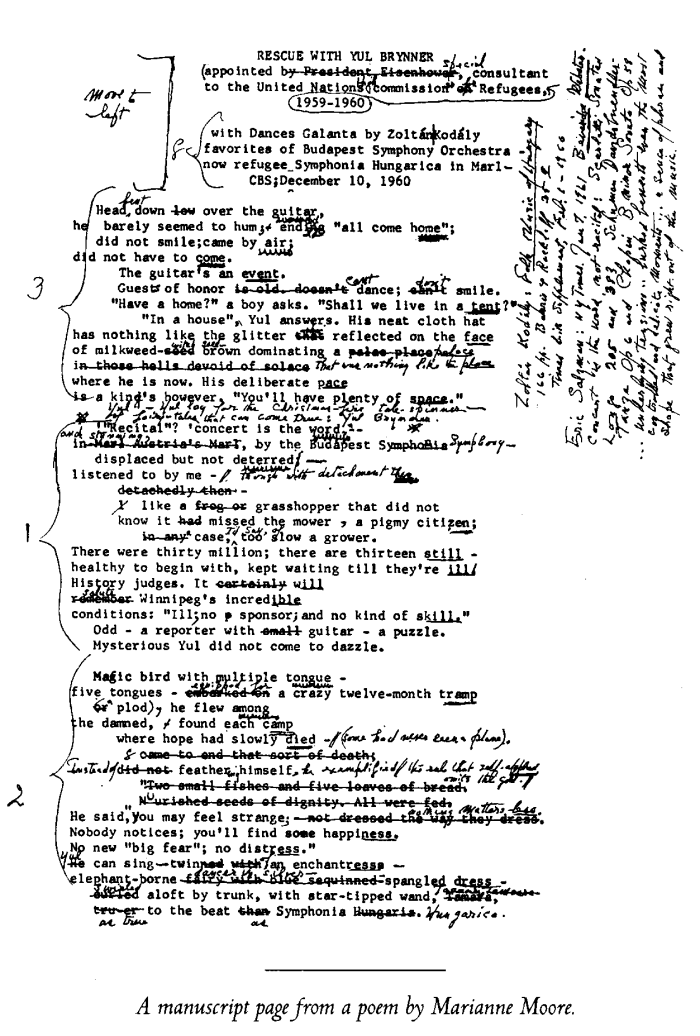
Marianne Moore / The Art of Poetry

Marianne Moore,1935
Photo by George Platt Lynes.

Marianne Moore 

The Art of Poetry 

No. 4

Interviewed by Donald Hall

The Paris Review

Summer-Fall 1961
No. 26


The Art of Poetry No. 4 Manuscript


American poetry is a great literature, and it has come to its maturity only in the last seventy years; Walt Whitman and Emily Dickinson in the last century were rare examples of genius in a hostile environment. One decade gave America the major figures of our modern poetry: Wallace Stevens was born in 1879, and T. S. Eliot in 1888. To the ten years that these dates enclose belong H. D., Robinson Jeffers, John Crowe Ransom, William Carlos Williams, Ezra Pound, and Marianne Moore.
Marianne Moore began to publish during the First World War. She was printed and praised in Europe by the expatriates T. S. Eliot and Ezra Pound. In Chicago, Harriet Monroe’s magazine Poetry, which provided the enduring showcase for the new poetry, published her too. But she was mainly a poet of New York, of the Greenwich Village group which created magazines called Others and Broom.
To visit Marianne Moore at her home in Brooklyn, you had to cross the Brooklyn Bridge, turn left at Myrtle Avenue, follow the elevated for a mile or two, and then turn right onto her street. It was pleasantly lined with a few trees, and Miss Moore’s apartment was conveniently near a grocery store and the Presbyterian church that she attended.
The interview took place in November 1960, the day before the presidential election. The front door of Miss Moore’s apartment opened onto a long narrow corridor. Rooms led off to the right, and at the end of the corridor was a large sitting room that overlooked the street. On top of a bookcase that ran the length of the corridor was a Nixon button.
Miss Moore and the interviewer sat in her sitting room, a microphone between them. Piles of books stood everywhere. On the walls hung a variety of paintings. One came from Mexico, a gift of Mabel Dodge; others were examples of the heavy, tea-colored oils that Americans hung in the years before 1914. The furniture was old-fashioned and dark.
Miss Moore spoke with an accustomed scrupulosity, and with a humor that her readers will recognize. When she ended a sentence with a phrase that was particularly telling, or even tart, she glanced quickly at the interviewer to see if he was amused, and then snickered gently. Later Miss Moore took the interviewer to an admirable lunch at a nearby restaurant. She decided not to wear her Nixon button because it clashed with her coat and hat.

Sunday, June 1, 2014

Robert Lowell / The Art of Poetry

Robert Lowell
by James Loucks 

Robert Lowell 

The Art of Poetry 

No. 3

Interviewed by Frederick Seidel

The Paris Review

Winter-Spring 1961
No. 25


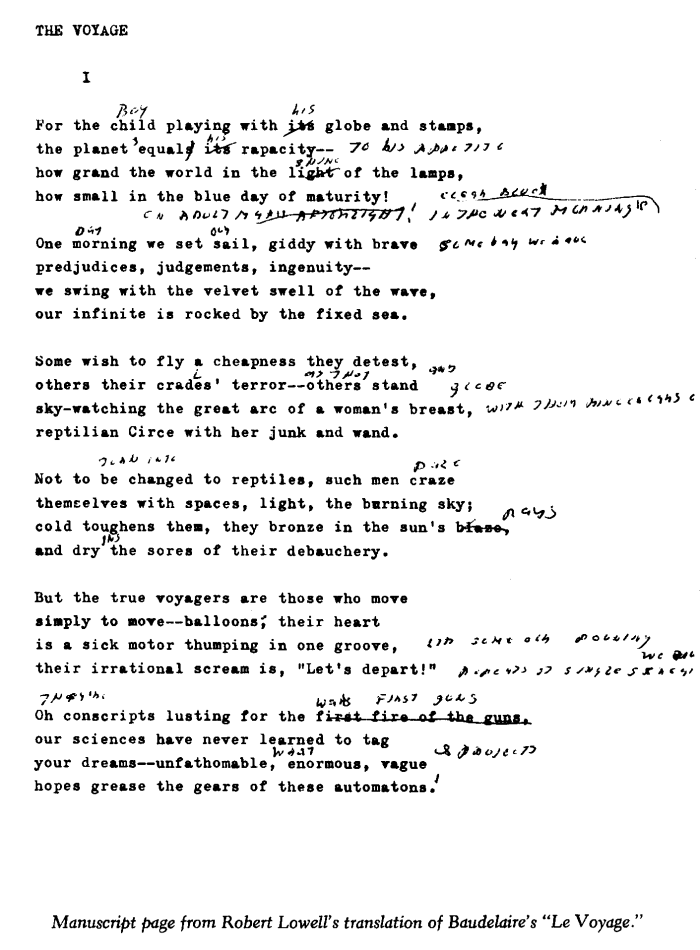
The Art of Poetry No. 3 Manuscript

On one wall of Mr. Lowell’s study was a large portrait of Ezra Pound, the tired, haughty outlines of the face concentrated as in the raised outlines of a ring seal in an enlargement. Also bearded, but on another wall, over the desk, James Russell Lowell looked down from a gray old-fashioned photograph on the apex of the triangle thus formed, where his great-grandnephew sat and answered questions.
Mr. Lowell had been talking about the classes he teaches at Boston University.
Four floors below the study window, cars whined through the early spring rain on Marlborough Street toward the Boston Public Garden.

INTERVIEWER
What are you teaching now?

ROBERT LOWELL
I’m teaching one of these poetry-writing classes and a course in the novel. The course in the novel is called Practical Criticism. It’s a course I teach every year, but the material changes. It could be anything from Russian short stories to Baudelaire, a study of the New Critics, or just fiction. I do whatever I happen to be working on myself.

Saturday, May 31, 2014

William Carlos Williams / Poem

POEM
by William Carlos Williams

The Rose fades
and is renewed again
by its seed, naturally
but where
save in the poem
shall it go
to suffer no diminution
of its splendor

Pictures from Brueghel, 1962.


Friday, May 30, 2014

Sara Teasdale / It Is Not A Word


It Is Not A Word
Sara Teasdale 


It is not a word spoken,
Few words are said;
Nor even a look of the eyes
Nor a bend of the head,
But only a hush of the heart
That has too much to keep,
Only memories waking
That sleep so light a sleep.


Sunday, May 25, 2014

Jarosław Iwaszkiewicz / From The Brotherhood of Man

Jarosław Iwaszkiewicz

Jarosław Iwaszkiewicz
From The Brotherhood of Man
Translated by Adam Gillon and Ludwik Krzyzanowski

When tempests rage upon the ocean, and many-storied
waves clap
against each other,
emitting sounds like many thousands clapping hands,
and toss ships and fishing boats against the rocks,
and cast men upon the waters of the sea, their heads
bobbing
like wooden logs from shipwrecks -
then suddenly the clouds are rent asunder, like grey
curtains upon
the stage, and a solitary ray falls,
like a gigantic arrow, or a chord that joins the sky
with sea, and
the sea is calmed, and the vessels creep to their ports,
lowering their
tattered sails.
As a mother standing over her son’s grave drops her
arms.
And the ray upon the turgid but already clearer wave
draws the word: pax, pax, pax…
Thus we too await for heavens to draw open and to
give a sign
to all of us, to clasp our hands,
and to exclaim as that ray of sun:
pax
Think of those whose mouths were filled with plaster,
and of those felled by bullets before they could cry out,
and of those who eyes were filled with blood and could
not cast a glance upon the sky,
as you look upon it now,
nor on the victorious banner,
because they died in degradation -
and think about the brotherhood of Man!
And if you cannot fight for man
and if you too take to swords and rifles
and kill your brothers -
mankind shall not attain salvation.
Think, think of this now.
Think of happiness and freedom.
For only the struggle for good can win goodness
and only the degradation of evil can elevate goodness
and only the brotherhood of man can raise upon the
mast
the Olympic flag, great as the world.
Take each other’s hand and sing:
paxpaxpax -
to signify the brotherhood of Man.