Wednesday, July 5, 2023

‘We exist upon the fringe of the world’ / The queer American poets who battled madness and obscurity

‘Poems are my salvation alone’ … John Wieners. Photograph: Allen Ginsberg


‘We exist upon the fringe of the world’: the queer American poets who battled madness and obscurity

Jack Spicer and John Wieners both wrote about their homosexuality – and in 50s America, that made them a threat. Forgotten for decades, finally their strange, anguished work has been unearthed


Ralf Webb

Monday 3 July 2023


In mid-century America, avant garde and alternative poetry was considered subversive, dangerous and hostile. To write and publish poems about drugs and sexuality, or poems with anti-nationalist, anti-war sentiment, was to attract suspicion from the authorities. It may have even landed you in prison: Amiri Baraka and Diane Di Prima were among many poets arrested on obscenity charges. Predictably, such subversive writing was often rejected by mainstream publishers – the result being that a lot of great poets and their work fell into obscurity.

Pilot Press, an imprint founded to “retrieve a philosophy of publishing lost to Aids and capitalism”, is attempting to remedy this with two publications: A Book of Music by Jack Spicer and Solitary Pleasure: Selected Poems, Journals and Ephemera of John Wieners. Spicer and Wieners were mid-century American poets and their work appeared in the groundbreaking The New American Poetry anthology, published in 1960. This collection defined a post-second world war generation of avant garde poets, from John Ashbery to Jack Kerouac, who were linked by a shared disillusionment with the hierarchies of the literary establishment. Spicer belonged to the Beat-adjacent San Francisco Renaissance, where he presided over an experimental reading group named The Dharma Committee, which, fuelled by narcotics, attracted the attention of the FBI. Wieners was part of an emergent set of peripatetic poets who vagabonded between different artistic spheres, as comfortable among Spicer’s north California coterie as he was alongside the New York School’s “artworld cocktail ballet scene”, as Allen Ginsberg described it.

Spicer and Wieners were queer men who wrote about queerness during the US’s Lavender Scare, a cultural moral panic which made “homosexuality” metonymic with “national security threat”. To be queer was to be mentally ill, deviant, perverted: to be queer was to be a literal and figurative outlaw. In this sense, Spicer and Wieners lived lives of precarity and nonconformity, their day-to-day tinctured by a psychic terrorism surely impossible to imagine. “We exist upon the fringe of the world,” Wieners wrote in Prose Poem, “small bright fragments that somehow burn away the fire’s edge.” It is tempting, though reductive, to see their fates as resulting solely from this marginality: Wieners, after years of drug misuse, spent the 60s in and out of mental institutions, where he was subjected to the hell of electroconvulsive therapy; Spicer died in the poverty ward at San Francisco General hospital, in 1965.

Jack Spicer.
A fierce critic … Jack Spicer. Photograph: The Estate of Jack Spicer

Solitary Pleasure is a selected collection of Wieners’ poems, appended with letters and journal entries. An introduction, written by contemporary poet Nat Raha, makes a powerful case for reading Wieners’ work as art born from “the heart of struggle”. The poems themselves are offhand and diaristic. Sometimes, they deploy childlike rhymes that purposely steer close to nonsense, successfully generating a sense of wonder (“If I had a canoe / I’d fill it with you / Then what would you do”). The Wieners of Solitary Pleasure is a poet eager to vocalise queer desire. “The beauty of men never disappears,” he writes, later portraying desire as something that must be “choked” out of him. Occupying nearly a third of Solitary Pleasure are his “Asylum Poems”, which Wieners wrote in 1969 – the summer of the Stonewall riots – while in a psychiatric institution. These poems spotlight the connection between art and affliction, but challenge us to consider creative expression as a very real mode of survival and salvation, and not merely, as current wellness discourses suggest, a potential curative or preventive to mental ill-health.

Spicer’s A Book of Music – a 14-poem pamphlet – is reissued without commentary or contextualising ephemera. The poems are weird songs which trouble the connection between sound and sense, suggesting that poetic utterance is a music – “a tree growing just behind my throat” – that can rearrange our relationship to reality and the objects in it. This mysterious pamphlet makes for a fitting introduction to Spicer, who dabbled in bibliomancy and tarot and considered the poet a “radio” capable of receiving missives from another realm. For Spicer, poetry could also be a “collage of the real” – as though the form could trap life and foil decay. In this context, Spicer’s assessment of Wieners – or “Hotdog”, as he sometimes referred to him – seems a high compliment: “Bright coloured bits of reality stick to him,” Spicer wrote after seeing Wieners’ perform in 1959.

Rarely was Spicer so generous. A fierce regionalist, he reviled the notoriety achieved by his contemporaries, believing that fame is anathema to artistry, that success defangs a poet’s truth. Therefore, Ginsberg’s Howl – “the best-publicised poem in the world”, according to Spicer – was “crap”. Frank O’Hara he dismissed as a “third-hand Rimbaud”. Spicer was also a misogynist – not especially surprising in a poetic demimonde formed almost exclusively of men – and a venomous racist and antisemite. The latter found expression in a paranoid, sometimes wholesale rejection of New York, where he thought Jewish people ran the poetry and “homosexual” networks.

To recover poets from the past, poets whose unimaginable nonconformity contributed to their contemporary obscurity, is a necessary task. How we read those poets – particularly if we hope their work might help us navigate our own precarious present – is more complex. Perhaps the challenge is to do so with care and without sentimentality. Or should we defer to the poets themselves? “Poems,” wrote Wieners, several months before he was first institutionalised, “are my salvation alone. The reader can do with them what he likes.”


THE GUARDIAN


Tuesday, July 4, 2023

Dear Bird by Howard Altmann


Poem of the week: Dear Bird by Howard Altmann

A dead bird stumbled upon during a walk leads the poet on an inward journey confronting historical and biological cycles and the act of writing itself


Carol Rummers
Monday 3 July 2023


Dear Bird

A dead bird in the snow is not how I wish
to begin this walk, yet there it is, feathers
all bloodied and frozen to the ground,
giving flight to cause and effect, the mind
trampled by where it has gone before,
an image faithfully lodged, falling along
sandy shores and leafy trails, in the chaos
of a lonely night, dear bird might you share
your name, must I nurse you till the end,
patch you with experience, pitch storylines
to your wound, killed by man killed by animal,
the reflection of a tree, well, you seem to be
thriving, as metaphor as travelling companion,
and whom to blame whom to assign fault,
an egress offering sanctuary I kneel and gently
raise you from your bed, hold you in my hand,
my body temperature meeting yours, a trickle
of blood beginning to line my palm, your death
now in slow motion, dear bird who hasn’t lost
their way, forsaken the known upended by
the unknown, determined predetermined
no need to go there, to the sky we look for
what is coming, the two birds in endless loop
voracious hunger, a language not ours
and ours to run with.

THE GUARDIAN


Monday, July 3, 2023

Poem About a Crow / A work by the killed Ukrainian writer Victoria Amelina

When Russia invaded Ukraine, Amelina set aside most of her writing to document war crimes.
Photograph: Daniel Mordzinski


Poem About a Crow: a work by the killed Ukrainian writer Victoria Amelina

Amelina has died, aged 37, from injuries sustained in a Russian missile strike in Kramatorsk


Monday 3 July 2023


Victoria Amelina was a Ukrainian novelist, poet and public intellectual. When Russia launched its full-scale invasion of her country in 2022, she set aside most of her writing to document and research war crimes.

Amelina understood the risks she ran with this work, both as a citizen who chose to stay in her country during war, and as a writer facing an invading army bent on destroying Ukrainian national identity.

She moved her son to safety in Poland, but kept returning herself. When Kyiv came under bombardment in early summer she watched the explosions from her apartment and wrote: “The war is when you can no longer follow all news and cry about all neighbours who died instead of you a couple of miles away. Still, I want to not forget to learn the names.”

She died on 1 July, aged 37, from injuries sustained in a Russian missile strike on a pizza restaurant in the eastern town of Kramatorsk.

Two weeks before she died, she wrote about a painter, Polina Rayko, whose work had been largely obliterated in the floods unleashed by the collapse of the Kakhovka dam: “Art lives as long as the world sees it.”

Below is Poem About a Crow, inspired by her work interviewing women who lived through Russian occupation. Translated by Uilleam Blacker.


Poem About a Crow


In a barren springtime field

Stands a woman dressed in black

Crying her sisters’ names

Like a bird in the empty sky

She’ll cry them all out of herself


The one that flew away too soon

The one that had begged to die

The one that couldn’t stop death

The one that has not stopped waiting

The one that has not stopped believing

The one that still grieves in silence


She’ll cry them all into the ground

As though sowing the field with pain


And from pain and the names of women

Her new sisters will grow from the earth

And again will sing joyfully of life


But what about her, the crow?


She will stay in this field forever

Because only this cry of hers

Holds all those swallows in the air


Do you hear how she calls

Each one by her name?


THE GUARDIAN


Sunday, July 2, 2023

For Ukrainians, poetry isn’t a luxury, it’s a necessity during war


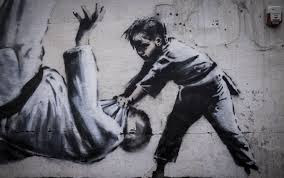
Banksy


For Ukrainians, poetry isn’t a luxury, it’s a necessity during war

This article is more than 6 months old


Poetry is fulfilling a very human need – to make sense of the senseless and tell their stories

Charlotte Higgins
Friday 9 December 2022


“There is so much poetry coming out of Ukraine now that I’m barely keeping up with it,” the Ukrainian translator and scholar Oksana Maksymchuk tells me. It is hardly the first thing that one would expect of a country at war. But poetry’s ability to, as she says, “crystallise a particular moment in time, or an emotion that is fleeting”, has led to an outpouring of poems – not so much emotion recollected in tranquillity, as the spontaneous overflow of powerful feelings. Often these poems are posted by their authors on social media; the literary journal 


Banksy


Chytomo has been gathering up and publishing examples, some by established poets, many by those new to the form, including soldiers. There is even a Ukrainian government website that encourages members of the public to upload their work. “Every poem, every line, every word is part of Ukrainian history,” the site says. “We know for sure that wars end, but poetry does not.” At the time of writing, more than 24,000 poems had been added to the site.

It is true that when Russia’s full-scale invasion started on 24 February, literature was the last thing on people’s minds – “you could not protect your family from a rifle with your poems”, as the writer Oleksandr Mykhed put it. But as the conflict has continued, the power of writing to record, to testify and to witness has seemed more and more important. Many Ukrainians started to keep diaries, the “first responder”, perhaps, among literary genres, able to gather experience and emotion in its rawest form. But in surprising numbers, Ukrainians are also turning to poetry, while setting aside for the time being that time-greedy literary form, the novel. “It’s the condensation, the density of it, the way that you can arrange words so that they carry a lot,” explains Max Rosochinsky who, with Maksymchuk, is co-editor of an anthology of Ukrainian poems, Words for War, born from the conflict that began in 2014 with Russian annexations in the Donbas and Crimea.


Some poets, during the current full-scale invasion, have found themselves harnessing their words to song, attracted to the direct catchiness of lyrics. Lyuba Yakimchuk, for example, has collaborated on an album called Ukrainian Songs of Love and Hate – a collection of sarcastic, pitch-dark pop songs, one of them titled, uncompromisingly, I Have a Dream (Moscow’s Burning). Another leading Ukrainian poet, Serhiy Zhadan, was posting poems on his Facebook page right up until the invasion in February; lately, though, his most prominent output has been with his ska band Zhadan i Sobaky (Zhadan and the Dogs), including a song, Metro, that reflects the experience of spending nights sheltering from missile attacks in a Kharkiv underground station.

Ukrainian poet Serhiy Zhadan performs in a bomb shelter in Kharkiv, eastern Ukraine, in April 2022.
Ukrainian poet Serhiy Zhadan performs in a bomb shelter in Kharkiv, eastern Ukraine, in April 2022. Photograph: Sergey Bobok/AFP/Getty Images

Daryna Gladun, a poet based in Bucha before the invasion, has written that the work she is producing at the moment “sits at the boundary between literature and journalism. It is poetry in uniform. I set aside metaphors to speak about the war in clear words.” It interests me that she uses metaphor to describe this process at the same time as apparently eschewing it: in the end, metaphor will out. If war involves a fracturing of language, it is poetry that will eventually creep in to fill the gaps.

One poet, Lesyk Panasiuk, has produced a poem (translated into English by Ilya Kaminsky and Katie Farris) that embodies the idea of the rupture of language through the physical collapse of signs and lettering on buildings hit by missiles. In the Hospital Rooms of My Country refers to “sentences that are blown by the mines in the avenues, stories/ shelled by multiple rocket launches”.

The novelist Victoria Amelina has turned for the moment from fiction to poems because the time is not right for novels, yet; as she writes in one poem, the new “war reality” is “devouring plot coherence”. Titled No Poetry, it expresses anxiety about its own status as literature, when there are more urgent tasks at hand than writing poems. “As if shells hit language/ the debris from language/ may look like poems/ But they are not/ This is no poetry too/ Poetry is in Kharkiv/ volunteering for the army.”

The rupture of language – inextricable from the violent rupture of “normality” for Ukrainians – has one starting point in war’s euphemisms and lies. According to Vladimir Putin, for example, the invasion is not really an invasion, but a “special military operation”. When explosions are reported in the Russian media, they are often referred to as “claps”, like the innocuous clapping of hands. But for a slight difference in pronunciation, the Russian word for clap, chlopok, is identical to the Russian word for cotton. The Ukrainians have started facetiously using their own word for cotton, bavovna, for such explosions; at the same time, a cloud of fluffy cotton fibre might remind you of smoke from a missile strike. That kind of wordplay is already on a path towards the poetic; one of Yakimchuk and co’s songs, indeed, is a dark lullaby based on that very slippage of meaning.

Poets, word-watchers par excellence, are watching meaning shifting its ground daily during this invasion. Yakimchuk, when we met in a Kyiv cafe, told me how in this time of war, she has watched the old symbolic systems no longer functioning, the usual cliches failing. You can’t say something’s “going nuclear” when nuclear missiles are an actual possibility, she says. Simple, everyday words suddenly come with a different weight. Take the word “light”, for example. “I used to think of light as something that brought clarity. Then, after the invasion, we had to dim our lights at night, we masked our light,” she says – she is speaking of urban blackouts. Now, though, “we have a totally different situation with electricity and attacks on energy infrastructure. Light has become more precious and valuable.” Light – and all its attendant metaphors – has indeed become something that might be extinguished without warning.

Ostap Slyvynsky, a poet and translator based in Lviv, describes how Ukrainians have found themselves reaching back into history to find words capable of describing their situation. Gauleiter, the word for the German officials who governed conquered areas during the second world war, has sprung back into use to describe those administering Russian-occupied areas of Ukraine.

At the beginning of the war, Slyvynsky eschewed writing in favour of volunteering at Lviv railway station. Handing out hot drinks and food to those fleeing from the east, though, he soon discovered that the refugees had another human need: to tell their stories. Their tales of loss, dislocation and escape often turned on the way a once familiar word had transformed its significance. He began working on what he calls a Dictionary of War, charting these metamorphoses through short stories or vignettes. “It is pure documentary,” he says. “There is nothing imagined, nothing fictionalised, nothing created by me in this text, but there came a moment when I understood that this was also poetry.” Ukrainian writers often tell me that now is not the time for literary experimentation, but rather for directness and documentary. What is clear, though, is that they are experimenting almost despite themselves, as they edge towards the impossible task of expressing the inexpressible.

 Charlotte Higgins is the Guardian’s chief culture writer

THE GUARDIAN


Saturday, July 1, 2023

The Afternoon Sun by Cavafy


A Sketch for 'Afternoon Sun', Alekos Levidis, (mixed technique) 


The Afternoon Sun
by  Cavafy
 
This room, how well I know it.
Now they're renting it, and the one next to it,
as offices. The whole house has become
an office building for agents, businessmen, companies.
 
This room, how familiar it is.
 
The couch was here, near the door,
a Turkish carpet in front of it.
Close by, the shelf with two yellow vases.
On the right - no, opposite - a wardrobe with a mirror.
In the middle the table where he wrote,
and the three big wicker chairs.
Beside the window the bed
where we made love so many times.
 
They must still be around somewhere, those old things.
 
Beside the window the bed;
the afternoon sun used to touch half of it.
 
... One afternoon at four o'clock we separated
for a week only ... And then -
that week became forever.