|
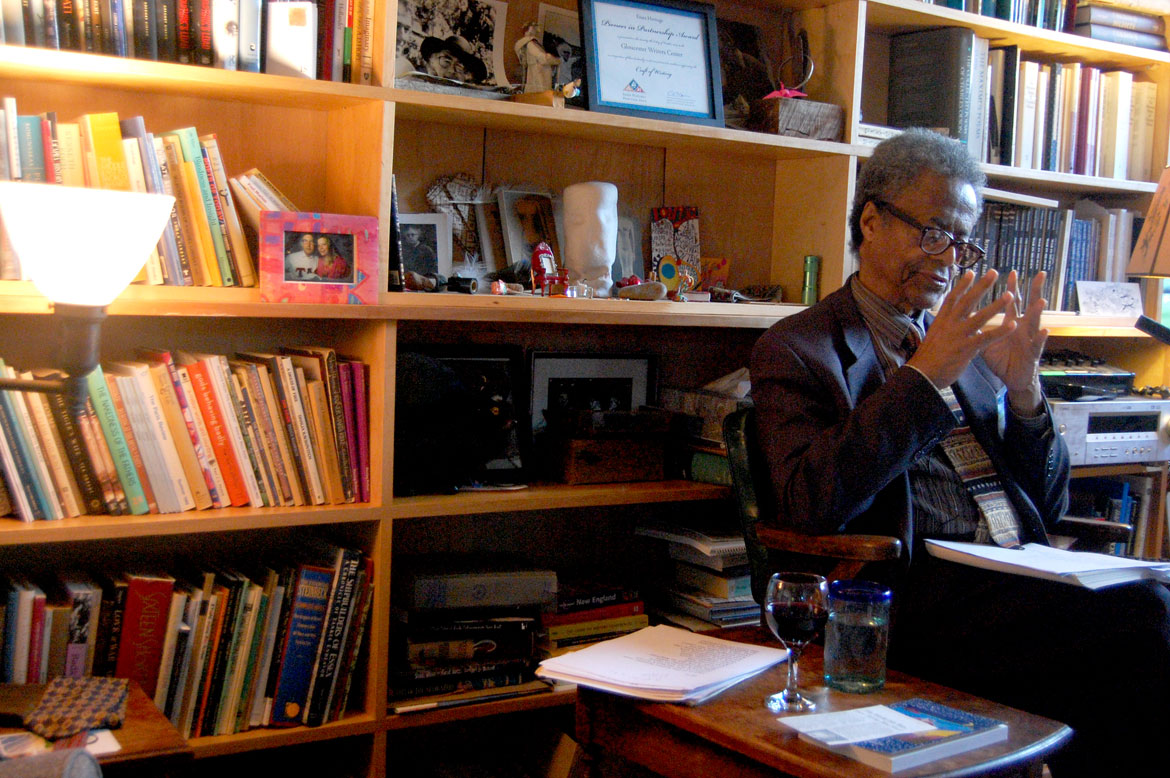
| Nicanor Parra |
CHRONICLESearching for Nicanor
by Leila Guerriero
CHRONICLESearching for Nicanor
by Leila Guerriero
He is a man, but he could be something else: a catastrophe, a roar, the wind. Sitting in a a low armchair, covered by a wool blanket, he wears a denim shirt, a beige sweater with several holes, corduroy trousers. Behind his back, a glass door separates the sitting room from a balcony with two chairs, and, beyond that, a yard covered in bushes. After that, the Pacific Ocean, the waves biting at rocks that look like black hearts.1
“Come in, come in.”
He is a man, but he could be a dragon, the death rattle of a volcano, the rigidity that comes before an earthquake.
“Come in, come in.”
It’s easy to find the house on Calle Lincoln, in the coastal town of Las Cruces, two hundred kilometers from Santiago de Chile, where Nicanor Parra lives. The hard part is finding Nicanor Parra himself.
***
Nicanor. Nicanor Parra. Born in San Fabián de Alico, the first son of a total of eight brought into the world by the union of Nicanor Parra, a high school teacher, and Clara Sandoval. He was twenty-five when World War II began, sixty-six when John Lennon was killed, eighty-seven when the planes hit the Twin Towers. Nicanor. Nicanor Parra. Born in 1914. In September he turned ninety-seven. Some believe he is no longer among the living.
***
Las Cruces is a little town of two thousand residents, protected from the Pacific Ocean by a bay that connects various towns: Cartagena, El Tabo. Nicanor Parra’s house sits at the edge of a ravine, facing the sea. In the front garden, a staircase ascends toward the door, marked by graffiti painted by the local punks so that no one will dare lay a finger on the house. It reads, “Antipoesía.” In the hallway that leads to the sitting room, written in thick marker on the walls in masterful calligraphy, are the names and phone numbers of some of his children: Barraco, Colombina.
“Come in, come in.”
Nicanor Parra’s hair is a sulfuric white. His beard is growing out, and he has no wrinkles: only furrows on a face that looks like it’s made of things of the earth. His hands are tanned, with no marks or folds, like two roots polished by the water. On a low table sits the second volume of his complete works (Obras completas & algo +), published five years after the first by Galaxia Gutenberg, compiled by Niall Binns of England and Ignacio Echevarría of Spain, with a preface by Harold Bloom that says, “...I firmly believe that, if the most powerful poet to have come out of the New World thus far is still Walt Whitman, Parra must stand with him as an essential poet of the Lands of Twilight.” At the end of the eighties, when he still lived in Santiago, Parra stopped giving interviews and, although there have always been exceptions, direct questions displease him in unexpected ways, such that any conversation with him takes place under the influence of an unforeseeable drift, with topics that repeat and that he brings up with any excuse: his grandchildren, the Manusmṛti, the Tao Te Ching, Neruda.
“Men of the south. How did they say men of the south. Let’s see, let’s see…”
He tilts his head back, closes his eyes, repeats the peremptory mantra:
“Let’s see, let’s see… What did they call the people of the south, the first people of Chile? They used to call them Ona, Alacalufe, Yaghan…”
“Selk'nam?”
“That’s it, that’s it. Selk'nam. There is a line. ‘The land of fire goes out.’ Author: Francisco Coloane. A great line. But he was a rather nasty person, eh? Unbearable.”
“Do you know Tierra del Fuego? The ‘land of fire’?”
“I’ve passed through there with my grandson, Tololo. He has also created some phenomenal lines. The first thing he said was ‘dadn.’ And then ‘diúk.’ Years later I told him, ‘You’re going to tell me what ‘dadn’ was supposed to mean.’ At the time I was translating King Lear and I was pacing one way and another, and he was in his crib, and I recited, ‘I thought the king had more affected the Duke of Albany than Cornwall.’ And I thought, ‘How should I translate that?’ And that’s where he got the ‘diúk.’ And I asked him, ‘And the ‘dadn’?’ And he said to me, ‘To be or not to be: that is the question.’ That is: ‘dadn.’ Once the director of his high school called his mother to an urgent meeting because she was calling roll and Tololo didn’t answer. So she asked him, ‘Hey, kid, why don’t you answer when I call roll?’ ‘I can’t because my name is not Cristóbal any more. Now my name is Hamlet.’ Since them, I gave up on literature and devoted myself to writing down the children’s sayings.”
This might seem like a joke, but no: Parra takes note of the words of his grandchildren, or Rosita Avendaño, the woman who cleans his house, or the people who pass by, and he transforms them into the deceitful simplicity of his poems: “Then they wanted to send me to high school / Where the sick kids were / But I couldn’t stand them / Because I’m no sick little girl / It’s hard for me to say the words / But I’m no sick little girl,” he wrote in “Rosita Avendaño.”
“Have you been to India? I was there for a week. I didn’t get to know the Manusmṛti. If I had, I would’ve stayed there. The final verse of the Manusmṛti reads, ‘Why?, one asks oneself. Because there exists no greater humiliation than existing.’”
He counts the syllables on his fingers, marking the rhythm with his feet.
“Pay attention. The Manusmṛti says: the ages of man are not two or three, but four. First, novice. Second, gallant. Third, anchorite. When the first grandchild is born, the man retires from the world. No more woman. No more family. No more material goods. No more search for fame.”
“And the fourth age?”
“Ascetic or shining butterfly. Whoever has passed through all these ages will be rewarded. And whoever remains halfway down the path, punished. He will be reborn. But the other, the ascetic, is not reborn. Because there is no greater humiliation than existing. The greatest reward is to be erased from the map. And what does one do after that? One leaves India and comes to Las Cruces.”
***
He had a childhood of scarcities and moves until, at sixteen or seventeen, he left for Santiago, alone. Thanks to a grant from the League of Poor Students, he completed his studies in a prestigious institute. Since he had high grades in humanities, but not in sciences, he studied Mathematics and Physics at the University of Chile “to show those morons they knew nothing about mathematics.” In 1938, while he was making a living as a teacher, he published Cancionero sin nombre [Unnamed songbook]. In 1943, he traveled to the United States to study advanced mechanics; in 1949, he went to England to study cosmology; starting in 1951, he taught mathematics and physics at the University of Chile. In 1954, he published Poems and Antipoems, a book that, with apparently simple language but a very sophisticated approach, revolutionized Latin American poetry: “Neither too bright nor totally stupid / I was what I was. A mixture / Of oil and vinegar / A sausage of angel and beast.” It included a prologue by Neruda, with whom Parra would sustain a relationship heavy with contradictions, in part because his poems began to be read as a reaction to any form of high-minded poetry, and were received with high praise. After that came a period of generous production. He published La cueca larga [The long cueca] in 1958; Versos de salón [Sitting room verses] in 1962 (“For half a century / Poetry was the paradise / Of the solemn fool. / Until I came / and built my rollercoaster.”); Manifiesto in 1963; Canciones rusas[Russian songs] in 1967. In 1969, he won the National Prize for Literature and compiled his work in Obra Gruesa [Thick work]. At fifty-five years old, he was pro-Castro and a juror of the Casa de las Américas Prize when, in 1970, he attended a meeting of writers in Washington and, along with other guests, he paid a visit to the White House. They were received, unexpectedly, by Nixon’s wife, who invited them for tea. The cup of tea with Nixon’s wife, in the midst of the Vietnam War, was, for Parra, annihilation: the Casa de las Américas took away his juror’s privileges and insults rained down upon him. If his political position fell under suspicion, his literary work didn’t take long to suffer the same fate: in 1972 he published Artefactos [Artefacts], a series of sayings accompanied by drawings that moved between irreverence, blasphemy, and political incorrectness: “The right and left united will never be defeated,” “White House House of the Americas Madhouse.” The kindest critics said this was not poetry. The cruelest said it was the best propaganda that the fascists could hope for. In 1977, during Pinochet’s dictatorship, he published Sermones y prédicas del Cristo de Elqui [Sermons and preachings of the Christ of Elqui] (“I bet my head / that nobody laughs like me when the Philistines torture him”) and Chistes para desorientar a la policía [Jokes to disorient the police] (“Upon appearing I appeared / but only on the list of the disappeared”). But, just like other poets who remained in Chile during those years, he suffered under the weight of the suspicion that he did not oppose the regime with sufficient vigour. In 1985, he published Hojas de Parra[Leaves of Parra], and, shortly after, he went to live in Las Cruces. Then came twenty years of silence until, in 2004, he published, through Ediciones Universidad Diego Portales, a translation of Shakespeare’s King Lear, which was received as the best ever translation of the play to Spanish.
***
Nicanor. Nicanor Parra. He writes with an everyday ballpoint pen in everyday notebooks, he takes ascorbic acid in massive doses, he always eats the same things: stews, roulades, soups. He was a candidate for the Nobel Prize on several occasions, and is eternally up for the Cervantes. A while ago they asked him to film an ad for milk, and, since Shakira was part of the project, he asked to receive the same pay as her. They ended up paying him thirty thousand dollars for every half-minute of his time, and, since then, he often repeats that his rate is one thousand dollars per second. He has two houses in Santiago, one in Las Cruces, another on Isla Negra. Nobody knows what he does with the houses where he doesn’t live.
***
“He’s well aware of what he’s worth, and in that sense he’s also an antipoet,” says Matías Rivas, director of Ediciones Universidad Diego Portales and the man who approached Parra to propose the publication of his translation of King Lear. “After we published his King Lear, he came to the university with thousands of students behind him. He came back transformed into a rock star. He’s more alive and more awake than anyone. That’s why peers of his age, or a little younger, get scared by the Artefactos. Nicanor is part of the punk wave, and the older readers arrived during his jazz wave. ‘New is better than good,’ he always says.”
The sentence is not an empty declamation: not long ago, Parra wrote a rap verse, “El rap de la Sagrada Familia” [The rap of the Holy Family], that tells of the relationship between an old man and a student, and his production of Artefactos, which he now accompanies with a drawing of a heart with eyes, has not only continued to grow but has also come to include his Trabajos prácticos [Practical works], modified objects like a cross on which, instead of Christ, there hangs a poster that reads “I come and go,” or a photo of Bolaño with a quote from Hamlet: “Good night sweet prince.”
***
In 1940, he married Anita Troncoso, with whom he had three children. In 1951, he married Inga Palmen. He had one child with Rosita Muñoz, who was his employee, and two more with Nury Tuca, who was thirty-three years his minor. In 1978, he met Ana María Molinare, who was a little over thirty. She left him, and he, biting the dust, wrote a radioactive mantra, a poem called “The Imaginary Man”: “The imaginary man / lives in an imaginary house / in the midst of imaginary trees / on the bank of an imaginary river.” Three years later, Ana María Molinare committed suicide. In the mid-nineties, he met Andrea Lodeiro, who was several decades his minor—maybe six—and with whom he stayed until 1998. Since then he has remained—more or less—alone. “What I urgently need / is a María Kodama / to take care of the library… with a young widow on the horizon / ...the coffin is colored pink / even the belly pains / provoked x the academics of Stockholm / disappear as if x enchantment,” he wrote. In his later years, he began to cultivate a gauche image. He buys second-hand clothes in the Puerto de San Antonio, a low-class place through which he moves comfortably, as he does everywhere. When, some time ago, some of his writing notebooks disappeared from his house and he learned that some local dealers had received them as payment, he went in search of them and they were returned to him with apologies. His reticence toward publishing is legendary. Even when Ediciones Universidad Diego Portales put out two more of his books—Discursos de sobremesa [After-dinner speeches] (2006) and La vuelta del cristo de Elqui [The return of the Christ of Elqui] (2007)—he took years to sign a contract, and months to arrive at a version of the texts with which he was comfortable. The process of publishing his complete works took almost a decade. In November of 1999, Ignacio Echeverría and Roberto Bolaño, who had become a great promoter of Parra’s work (“he writes as if he were going to be electrocuted the next day,” he wrote), came to visit him.
“On the way back to Barcelona,” says Ignacio Echeverría, “Roberto suggested to me that we put together Parra’s complete works. Everyone told me it was impossible, but I proposed it to him and he said he was willing. Of course, after that I sent him the contract, he had it for six months and then told me he’d lost it, and we had to do the whole thing again. Three years went by until, after Bolaño’s death, I traveled to Chile. I visited him and he told me, ‘I’m going to sign the contract. Roberto would have liked that, right? We’ll do it for Roberto.’ But I still suffer an ever-growing doubt about having pressured Parra to do something he didn’t want to do. He conceives of antipoetry as something that is written on a wall, on a napkin. And I think the idea of the complete works repulses him.”
***
In the house’s bathroom, hanging from a nail over the commode, is a cardboard plaque that, in his calligraphy, says, “Do not throw paper in the toilet bowl.” In the sitting room, Parra drinks tea and recites, in Greek, the first verses of the Iliad. Then, he tilts his head back and places the tea bag over his right eye.
“I’ve got something in my eye. This’ll fix it. Last time I went running to the clinic, in Santiago. The urologist told me, ‘Get ready, my friend, because tomorrow you’re going into surgery. A simple cytology.’ And then I told him, ‘I’d rather die. Let me go or I’ll jump out of that window.’ And I was going to jump. I just discovered a book called The Book of Disquiet in my library.”
“By Pessoa.”
“It doesn’t work anymore. That thing with the pen names. Okay, man, we get it. He has one poem that’s unbeatable. It says, ‘All love letters are ridiculous. They wouldn’t be love letters if they weren’t ridiculous.’ And it continues, ‘In my time I also wrote love letters, equally, inevitably ridiculous.’ Think of all the somersaults he does. Like those Argentine women poets. That María Elena… María Elena... “
“Walsh?”
“Yeeeah. Let’s see, there are others.”
“Alejandra Pizarnik?”
“Ah, that Alejandra Pizarnik. Fantastic. And which of them wrote ‘La vaca estudiosa’ [The studious cow]?”
“María Elena Walsh wrote for children mostly, but not exclusively, and in that area she earned high prestige. But, in any case, her work is very different from that of Alejandra Pizarnik, an obscure poet who commited suicide in 1972. ‘La vaca estudiosa’ is a song by María Elena Walsh that tells the story of a cow who wants to study.”
“Oh, how marvellous. And to stave off her boredom the cow enrolls in a school. And she draws the children’s attention, so she says, ‘No, I commit to being a studious cow.’ No, that María Elena. We’re with her one hundred percent.”
***
“He’s got that cunning about him, Nicanor, to discredit without stridency,” says Alejandro Zambra, who worked with Parra on King Lear and who, like other young writers, assures that he has always carried himself with titanic generosity. “He won’t tell you anything negative about Neruda, but he’ll tell you something in such a way that you feel solidarity with him, and not with Neruda.”
“He’s a stray cat,” says Sergio Parra, an editor and poet who has known Parra since the eighties. “Once we were in his house and he went to look for his notebooks. He told me, ‘I’m going to read you some texts.’ And suddenly he turns around and tells me, ‘But don’t move, eh?’”
***
“Did I tell you the story of the huiña? The huiña is a wild cat, from the forest.”
Parra opens the door that separates the sitting room from the balcony and points at a piece of wood among the plants in the back garden.
“She was unfriendly. But one day she came close and I was able to touch her. And the next day she was dead. It bothered her that I touched her. She felt deflowered. She’s buried here. We gave her a funeral.”
Back in the sitting room, he puts on a green jacket and a straw hat.
“Let’s have lunch.”
In the car, en route to the restaurant, he looks out the window and says, amused, “You’re from Buenos Aires? Once they asked Borges what was going on with Chilean poetry and he said, ‘What’s that?’ And they told him that there was a Nobel Prize winner here, who was Pablo Neruda. And he said, ‘Juan Ramón Jiménez already said it, a great bad poet.’ And the problem was that Neruda hadn’t discovered kitsch yet. And they asked him about Nicanor Parra. And he said, ‘There can’t be a poet with such a horrible name.’”
The restaurant is a family-style place, with a menu offering empanadas and seafood that he scrutinizes, not using the magnifying glass he carries in his pocket (he doesn’t wear glasses).
“I’ll have a shrimp empanada,” he tells the waitress.
“It comes with two.”
Parra is silent for a moment.
“Then I don’t want anything.”
“Nothing?”
Another silence.
“Well, alright. Two empanadas. And nothing else. I’m already mad, that’ll do.”
The conversation turns to certain Chilean poets, to a visit by the Argentine photographer Sara Facio in the fifties to his house on Isla Negra to take his portrait.
“Sarita’s visit was a turning point. A magazine put my photo on the cover with the caption, ‘The poet of Isla Negra: Nicanor Parra.’ Neruda saw that and said, ‘This is the head of an international anti-Neruda conspiracy, and I’m going to unload all my ammunition against the Nicanor Parra’s head.’ Said and done. He unloaded all the power of the international Communist Party against me.”
“Do you remember that line of Neruda’s, ‘or kill a nun with a blow on the ear’?”
“A poet, Braulio Arenas, taught me that every ten lines you’ve got to throw in an obscure one, one that no one understands, not even yourself. And that’s how it’s done.”
Later, on the way back to his house, in the car, he points out a hill.
“There’s a car junkyard there. I go sometimes. I like that place.”
“Are you happy with your Obras completas?”
“Surprised. I read those poems and I don’t feel like the author. I don’t think I’m the author of anything. I’ve always just grasped the things that were floating in the air.”
The asphalt slides by, smooth, between the pines and the sea, under a soft light.
“Pretty, eh?”
“Makes you want to live here.”
“To die here, that is.”
Something about the afternoon calls to mind the calm breathing of a sleeping animal.
“Think about all they’ve done, and they haven’t been able to resolve the issue.”
“What issue?”
“The issue of death. They’ve resolved other things. But why don’t they focus on that?”2
Translated by Arthur Dixon
1 This chronicle was published on December 3, 2011, under the title “El aire del poeta” [The air of the poet], in the Babelia supplement of El País, Spain.
2 On Tuesday, January 23, 2018, Nicanor Parra died at the age of 103.

Leila Guerriero (1967, Junín, Argentina) is a journalist. She publishes in Latin American and European outlets such as La Nación and Rolling Stone in Argentina, Gatopardo in Mexico, El Mercurio in Chile, L’Internazionale in Italy, and El País in Spain. Among others, she has published the nonfiction books Los suicidas del fin del mundo [The suicides at the end of the world] (2005), Frutos extraños [Strange fruit] (2009), Una historia sencilla [A simple story] (2011), and Zona de obras [Work zone] (2013). Her work has been translated into English, Italian, Portuguese, German, French, and Polish. In 2010, she received the CEMEX-FNPI prize. In 2013, she won the González Ruano journalism prize from the Fundación Mapfre. She is editor of Gatopardo for Latin America and director of the collection "Mirada crónica" from Tusquets Argentina. She also works as an editor for Ediciones Universidad Diego Portales (Chile), and since 2016 she has directed the Major in Journalism of the Fundación Tomás Eloy Martínez (Buenos Aires).
Arthur Dixon works as a translator and as Managing Editor of Latin American Literature Today. His translation of Andrés Felipe Solano’s “The Nameless Saints” (WLT, Sept. 2014) was nominated for a 2014 Pushcart Prize, and his most recent project is a book-length translation of Arturo Gutiérrez Plaza’s Cuidados intensivos (see WLT, Sept. 2016).