Wednesday, March 2, 2016

Philip Levine / Something Has Fallen

Hand
 by Jean-Baptiste Huynh
Something Has Fallen

by Philip Levine

Something has fallen wordlessly
and holds still on the black driveway.

You find it, like a jewel,
among the empty bottles and cans

where the dogs toppled the garbage.
You pick it up, not sure

if it is stone or wood
or some new plastic made

to replace them both.
When you raise your sunglasses

to see exactly what you have
you see it is only a shadow

that has darkened your fingers,
a black ink or oil,

and your hand suddenly smells
of classrooms when the rain

pounded the windows and you
shuddered thinking of the cold

and the walk back to an empty house.
You smell all of your childhood,

the damp bed you struggled from
to dress in half-light and go out

into a world that never tired.
Later, your hand thickened and flat

slid out of a rubber glove,
as you stood, your mask raised,

to light a cigarette and rest
while the acid tanks that were

yours to clean went on bathing
the arteries of broken sinks.

Remember, you were afraid
of the great hissing jugs.

There were stories of burnings,
of flesh shredded to lace.

On other nights men spoke
of rats as big as dogs.

Women spoke of men
who trapped them in corners.

Always there was grease that hid
the faces of worn faucets, grease

that had to be eaten one
finger-print at a time,

there was oil, paint, blood,
your own blood sliding across

your nose and running over
your lips with that bright, certain

taste that was neither earth
or air, and there was air,

the darkest element of all,
falling all night

into the bruised river
you slept beside, falling

into the glass of water
you filled two times for breakfast

and the eyes you turned upward
to see what time it was.

Air that stained everything
with its millions of small deaths,

that turned all five fingers
to grease or black ink or ashes.


Monday, February 15, 2016

Dorothy Parker / From a letter from Lesbia


FROM A LETTER FROM LESBIA
by Dorothy Parker

... So, praise the gods, Catullus is away!
And let me tend you this advice, my dear:
Take any lover that you will, or may,
Except a poet. All of them are queer.

It's just the same. — a quarrel or a kiss
Is but a tune to play upon his pipe.
He's always hymning that or wailing this;
Myself, I much prefer the business type.

That thing he wrote, the time the sparrow died —
(Oh, most unpleasant — gloomy, tedious words!)
I called it sweet, and made believe I cried;
The stupid fool! I've always hated birds...


Friday, February 12, 2016

The Poetry of Raymond Carver Makes a Leap to E-Books

Raymond Carver

The Poetry of Raymond Carver Makes a Leap to E-Books


Raymond Carver, the noted author of short stories and poetry, died nearly 27 years ago, long before the digital revolution upended the publishing industry. And until now, his legacy has been confined to print.

That will change this week, when 10 of Mr. Carver’s books will be published digitally for the first time. Vintage Books is publishing e-book editions of the author’s entire backlist, including six collections of short stories and four volumes of poetry, for $9.99 to $11.99.

Tuesday, February 9, 2016

Raymond Carver / Stupid


Stupid

By Raymond Carver

 It's what the kids nowadays call weed.
 And it drifts
like clouds from his lips.
 He hopes no one
comes along tonight, or calls to ask for help.

Help is what he's most short on tonight.

A storm thrashes outside.
 Heavy seas
with gale winds from the west.
 The table he sits at
is, say, two cubits long and one wide.

The darkness in the room teems with insight.

Could be he'll write an adventure novel.
 Or else 
a children's story.
 A play for two female characters,
one of whom is blind.
 Cutthroat should be coming
into the river.
 One thing he'll do is learn
to tie his own flies.
 Maybe he should give
more money to each of his surviving
family members.
 The ones who already expect a little
something in the mail first of each month.

Every time they write they tell him
they're coming up short.
 He counts heads on his fingers
and finds they're all survivng.
 So what
if he'd rather be remembered in the dreams of strangers?
He raises his eyes to the skylights where rain
hammers on.
 After a while --
who knows how long? -- his eyes ask
that they be closed.
 And he closes them.

But the rain keeps hammering.
 Is this a cloudburst?
Should he do something? Secure the house
in some way? Uncle Bo stayed married to Aunt Ruby for 47 years.
 Then hanged himself.

He opens his eyes again.
 Nothing adds up.

It all adds up.
 How long will this storm go on?


Friday, February 5, 2016

Raymond Carver / Drinking While Driving


Drinking While Driving
by Raymond Carver


 It's August and I have not 
Read a book in six months 
except something called The Retreat from Moscow
by Caulaincourt 
Nevertheless, I am happy 
Riding in a car with my brother 
and drinking from a pint of Old Crow.
 
We do not have any place in mind to go, 
we are just driving.
 
If I closed my eyes for a minute 
I would be lost, yet 
I could gladly lie down and sleep forever 
beside this road 
My brother nudges me.
 
Any minute now, something will happen.


Monday, February 1, 2016

Raymond Carver / An Afternoon

A Nude Woman doing her Hair before a Mirror
by Christoffer Wilhelm Eckersberg

An Afternoon

by Raymond Carver


 As he writes, without looking at the sea,
he feels the tip of his pen begin to tremble.

The tide is going out across the shingle.

But it isn't that.
 No,
it's because at that moment she chooses
to walk into the room without any clothes on.

Drowsy, not even sure where she is
for a moment.
 She waves the hair from her forehead.

Sits on the toilet with her eyes closed,
head down.
 Legs sprawled.
 He sees her
through the doorway.
 Maybe
she's remembering what happened that morning.

For after a time, she opens one eye and looks at him.

And sweetly smiles.


Raymond Carver / My Crow and other poems
Raymond Carver / Your Dog Dies
Raymond Carver / Happiness
Raymond Carver / All Her Life
Raymond Carver / Fear
Raymond Carver / Poems
Raymond Carver / Late Fragment
Raymond Carver / An Afternoon


Thursday, January 28, 2016

Don Paterson / Reading Shakespeare’s Sonnets / Review


40 Sonnets review – the perfect vehicle for Don Paterson’s craft and lyricism


The poet tugs and stretches a demanding form to its limit in work of vividness and potency


Sarah Crown
Saturday 26 September 2015

D
on Paterson has a thing for sonnets. Back in 1999 he brought out an anthology of 101 of his favourites, and in 2012 he delved deeper into their history with Reading Shakespeare’s Sonnets, a passionate, personal response to the great man’s form-defining sequence. Nor has he confined himself to curation and criticism: in 2006, he produced a warm, responsive reworking of Rilke’s 55-sonnet cycle, Orpheus, while his original collections are punctuated by his own efforts, some of which (such as Landing Light’s superlative “Waking with Russell”) count among his finest poems. “The square of the sonnet exists for reasons which are almost all direct consequences of natural law … and the grain and structure of the language itself,” he said, attempting to explain the form’s abiding appeal – and his own fascination with it – in an article in this newspaper. “Or to put it another way: if human poetic speech is breath and language is soapy water, sonnets are just the bubbles you get.”

Monday, January 25, 2016

Juana Inés de la Cruz / She expresses her loving respect


She expresses her loving respect, explaining what she means when she says Her Ladyship the Vicereine, Marquise de la Laguna, belongs to her.

by Juana Inés de la Cruz

My divine Lysis
pardon me if I dare
then to address you thus,
since to be called yours exceeds my merit
and to this I cannot presume. 
To call you mine I would be placed
at the mercy of your sovereign darting rays
if in my boldness I have overreached, and dared.
It is an error of the tongue
when that which is called imperial
and mastered, and of the dominion
appear to be the slave’s possessions.
“My king” declares the vassal,
“My prison” claims the prisoner, 
and the most humble slave
without the slightest offense can claim her master as her own.
Thus when I call you mine
I am not in the least pretending
that you will be adjudged to belong to me, 
but solely that I wish to be yours.
I saw you – but just stop there:
in order to say there is a fire
it is sufficient to show the cause
there is no need to affix blame on anyone for the result.
To see you so elevated
does not impede my audacity, 
for there is no deity who can remain beyond
the reach of  lofty flights of cogitation.
And yet there are those, more deserving – 
in their proximity to heaven – 
equally placed is the humble valley
as the superbly high mountain.
Finally, I must be confessed
of this sin, which is my adoration –
and if you wish to chastise me,
your chastening will be my reward.


Friday, January 22, 2016

Antonio Cicero / Perplexity

Portrait of a Dead Man
by Damien Mammoliti
 PERPLEXITY
by Antonio Cicero
Translated by Emiliano Battista


Antonio Cicero / Perplexidade (Pessoa)

Not sure just where I lost my way,
Or whether I lost it at all.
Still, I can't help thinking it odd
That this had always been my lot.


Friday, January 15, 2016

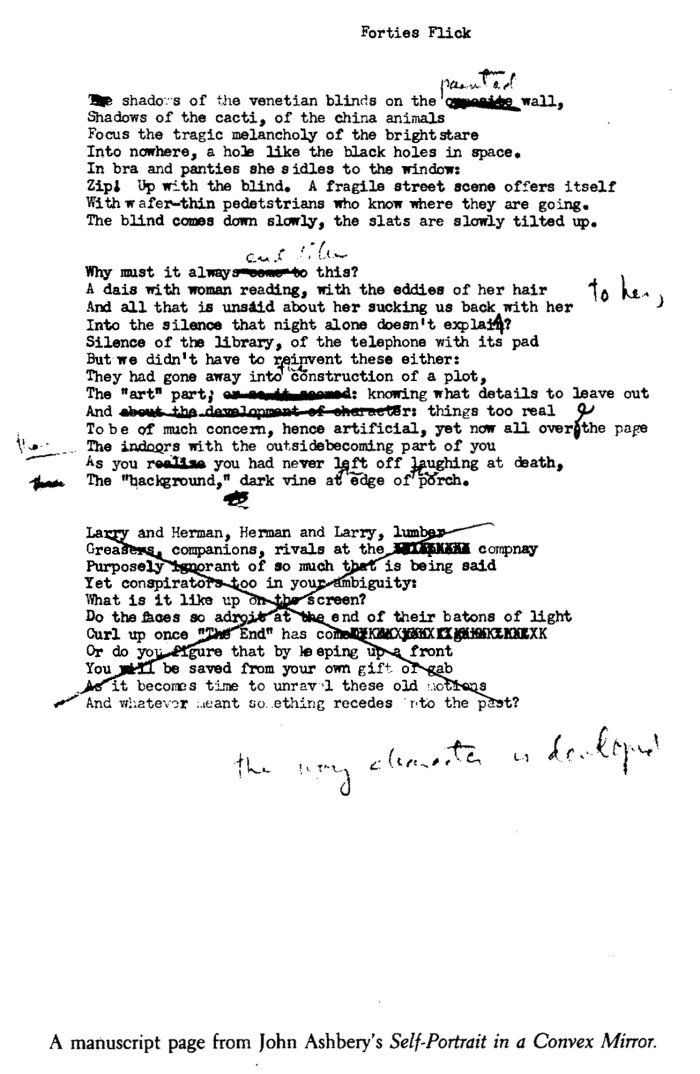
John Ashbery / The Art of Poetry


John Ashbery

The Art of Poetry 

No. 33


Interviewed by Peter A. Stitt

Winter 1983
No. 90


The Art of Poetry No. 33 Manuscript


The interview was conducted at John Ashbery's apartment in the section of Manhattan known as Chelsea. When I arrived, Ashbery was away, and the doorman asked me to wait outside. Soon the poet arrived and we went up by elevator to a spacious, well-lighted apartment in which a secretary was hard at work. We sat in easy chairs in the living room, Ashbery with his back to the large windows. The predominant decor was blue and white, and books lined the whole of one wall.

Tuesday, January 12, 2016

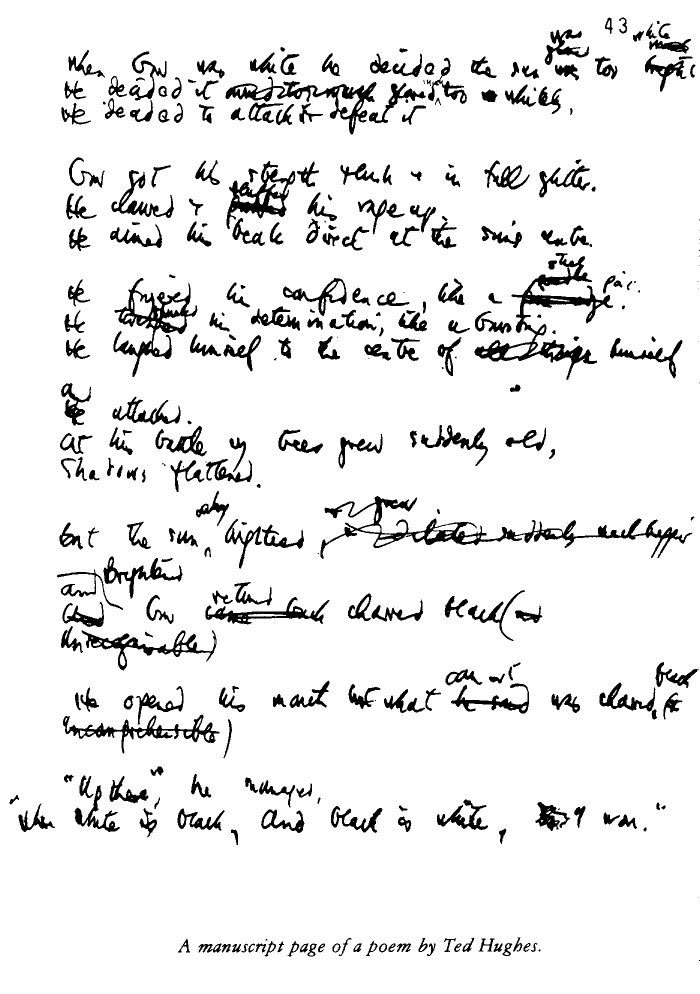
Ted Hughes / The Art of Poetry

Ted Hughes

Ted Hughes

The Art of Poetry 

No. 71

Interviewed by Drue Heinz

Spring 1995
No. 134


The Art of Poetry No. 71 Manuscript


Ted Hughes lives with his wife, Carol, on a farm in Devonshire. It is a working farm—sheep and cows—and the Hugheses are known to leave a party early to tend to them. “Carol’s got to get the sheep in,” Hughes will explain.
He came to London for the interview, which took place in the interviewer’s dining room. The poet was wearing a tweed jacket, dark trousers, and a tie whose predominantly blue color matched his eyes. His voice is commanding. He is often invited to read his work, the flow of his language enlivening the text. In appearance he is impressive, and yet there is very little aggression or intimidation in his look. Indeed, one admirer has said that her first thought sitting opposite him was that this was what God should look like “when you get there.”

Sunday, January 10, 2016

E.R. Kennedy / Jean Rhys

Jean Rhys
Illustration by Triunfo Arciniegas
Jean Rhys
I'm preparing myself for an extended period of loneliness
That will begin very soon I think
I've illegally downloaded two new depressing songs
I've placed a copy of Good Morning, Midnight under my pillow for easy reference
I've printed out the tablature for every Morrissey song I know so I can sing them to myself
Alone in my room
Just a few things are needed really
To make me calm
While I figure out a simple, clean, and effective way to kill myself,
With minimal stress for the person who has to find and dispose of my body
But I'll probably never think of a way
Because I'll probably never kill myself
I'll just lie in my bed suffocating myself with my pillows
While listening to the four songs you said were your favorite
And maybe burn myself a little with the iron
On special occasions
And the next time I'm in a subway station,
I'll stand a little further on the yellow line
Or maybe the next I'm at your apartment
I'll try a little harder

Ellen Kennedy, 
Sometimes My Heart Pushes My Ribs.
Muumuu House, 2009)


Wednesday, January 6, 2016

Elizabeth Bishop / Manners

Illustration by Nicoletta Ceccoli
MANNERS

by Elizabeth Bishop

For a Child of 1918


My grandfather said to me
as we sat on the wagon seat,
"Be sure to remember to always
speak to everyone you meet."

We met a stranger on foot.
My grandfather's whip tapped his hat.
"Good day, sir. Good day. A fine day."
And I said it and bowed where I sat.

Then we overtook a boy we knew
with his big pet crow on his shoulder.
"Always offer everyone a ride;
don't forget that when you get older,"

my grandfather said. So Willy
climbed up with us, but the crow
gave a "Caw!" and flew off. I was worried.
How would he know where to go?

But he flew a little way at a time
from fence post to fence post, ahead;
and when Willy whistled he answered.
"A fine bird," my grandfather said,

"and he's well brought up. See, he answers
nicely when he's spoken to.
Man or beast, that's good manners.
Be sure that you both always do."

When automobiles went by,
the dust hid the people's faces,
but we shouted "Good day! Good day!
Fine day!" at the top of our voices.

When we came to Hustler Hill,
he said that the mare was tired, 
so we all got down and walked,
as our good manners required.


Monday, January 4, 2016

Katherine Mansfield / The Storm


The Storm 
by Katherine Mansfield
BIOGRAPHY

I ran to the forest for shelter,
Breathless, half sobbing
I put my arms round a tree
Pillowed my head against the rough bark
Protect me, I said. I am a lost child.
But the tree showered silver drops on my face and hair.
A wind sprang up from the ends of the earth
It lashed the forest together
A huge green wave thundered and burst over my head.
I prayed, implored, "Please take care of me!"
But the wind pulled at my cloak and the rain beat upon me.
Little rivers tore up the ground and swamped the bushes.
A frenzy possessed the earth: I felt that the earth was drowning
In a bubbling cavern of space. I alone--
Smaller than the smallest fly--was alive and terrified.
Then for what reason I know not, I became triumphant.
Well kill me – I cried – and ran out into the open.
But the storm ceased: the sun spread his wings
And floated serene in the silver pool of the sky.
I put my hands over my face: I was blushing
And the trees swung together and delicately laughed.


Friday, January 1, 2016

Katherine Mansfield / Loneliness


Loneliness 
by Katherine Mansfield
BIOGRAPHY

Now it is Loneliness who comes at night
Instead of Sleep, to sit beside my bed.
Like a tired child I lie and wait her tread,
I watch her softly blowing out the light.
Motionless sitting, neither left or right
She turns, and weary, weary droops her head.
She, too, is old; she, too, has fought the fight.
So, with the laurel she is garlanded.
Through the sad dark the slowly ebbing tide
Breaks on a barren shore, unsatisfied.
A strange wind flows... then silence. I am fain
To turn to Loneliness, to take her hand,
Cling to her, waiting, till the barren land
Fills with the dreadful monotone of rain.