Saturday, August 16, 2025

Biographies / Roddy Lumsden


Roddy Lumsden

Roddy Lumsden

1966–2020


Roddy Lumsden was born in St. Andrews, Scotland. He described his upbringing as small-town and working-class. His earliest exposure to literature came from his mother and older brother, who read aloud to him when he was a child. Later, when he attended school, his writing was influenced by the works of W.S. GrahamPhilip LarkinThom GunnT.S. Eliot, and Sylvia Plath, and by song lyrics.

Roddy Lumsden’s poetry collections include So Glad I'm Me (2017), Melt and Solve (2015), Not All Honey (2014), Terrific Melancholy (2011), Third Wish Wasted (2009); Vitamin Q (2005), Mischief Night: New and Selected Poems (2004), Roddy Lumsden Is Dead (2003), The Book of Love (2000), and Yeah, Yeah, Yeah (1997). His work is marked by an attention to formal traditions and a voice both streetwise and regretful. Matthew Smith, reviewing Mischief Night: New and Selected Poems (2004), noted that “the ongoing affair between hedonism and mortality in Lumsden’s poetry is as much context as a subject for his work.” He also observed his “flair for formal roguery” and commented that “although the verse is hopping with linguistic antics, the foci of the language are music and rhetoric.” His last book, So Glad I'm Me (2017), was shortlisted for the T.S. Eliot Prize.

Lumsden received an Eric Gregory Award and was Writing Fellow for the City of Aberdeen. Lumsden worked as a freelance writer, editor, teacher, and writer of puzzles and quizzes for newspapers. He edited Identity Parade (2010), an anthology of recent UK / Irish poetry. In 1999 he cowrote The Message, a book on poetry and music. He also composed a poem, “Bloom,” on the set of “Flowers for Kate”—a photo shoot of the model Kate Moss for V magazine. From 2010 to 2013 he served as poetry editor of Salt Publishing, for whom he was also the Series Editor of The Best British Poetry anthologies.

Lumsden lived in London, where he taught at The Poetry School and and served as organiser and host of the monthly reading series BroadCast. He died in early 2020.


POETRY FOUNDATION


Friday, August 15, 2025

Hall Gardner / Sub-Urban Trust: Annuit Coeptis


Sub-Urban Trust: Annuit Coeptis


Sub-Urban Trust: Annuit Coeptis

(God Has Smiled On Our Undertaking)

18 OCTOBER 2018, 


I
Am
Ever
Lasting
Omnivision! 

An austere monument,
built over eons by the brute
whip and rolling of hand-hewn
boulders upon logs one-by-one glued
together with a mortar of crushed skulls.
Yes, astonishingly, it is still with us, not yet
crumbled ash to ash, dust to gray dust: For not all
of Ozymandias' treasured legacies have parted from
us as Shelley did prophesy. For in the midst of our very
presence, from where we peer through Venetian blinds by
which we queue without a whisper, its cyclopean eye can now
be seen as it hovers like a flock of buzzards over its pyramidal base
upon lime-green sands which reek the sickly mirage of an oasis. There—
without our consent, this omniscient tyrant defies the very laws of gravity—
secretly recording our every scratch, nose pick, and yawn for all of posterity. 

Thursday, August 14, 2025

In name of Matisse / If this Creation Is Not Religious, it is Not....


Henri Matisse. The Dance


If this Creation Is Not Religious, it is Not....

In name of Matisse

18 AUGUST 2018, 


“All art worthy of the name is religious.
Whether made of lines or of colors,
if this creation is not religious, it is not art.
It is nothing more than… an anecdote.” 

(Henri Matisse) 

Tuesday, August 12, 2025

War Guilt / Saigon Dauphin, a repetitive nightmare sequence


Saigon Dauphin, a prose-poem
Saigon Dauphin, a prose-poem 


War Guilt

Saigon Dauphin, a repetitive nightmare sequence

18 JULY 2018, 

Saigon Dauphin is a prose-poem about American war guilt, based upon my trip to Vietnam in 1989. I then wrote my first editorial in the LA TimesThose Stumbling Blocks to Recognizing Vietnam Don’t Have to Trip US Now. Since I wrote several versions of the prose-poem, I decided to combine them in a kind of repetitive nightmare sequence. 

Sunday, August 10, 2025

Hall Gardner / Two Poems


Home and Abroad
Home and Abroad

Two Poems

Home and Abroad


18 JUNE 2018, 

Canto por una Salvadoreña

Blown free in this land without mangos,
You teach me, the gringo,
as you would teach a small child,
las palabras of your tongue… latino

Friday, August 8, 2025

Hall Gardner / Homage to Marcello Cammi


Homage to Marcello Cammi


Ingresso Libero: Free Entry

Homage to Marcello Cammi, 1912-1994

18 MAY 2018, 

I.
The arrow of a rusty sign points the way
To what was once your Galleria d’Arte.
[Ingresso Libero: Free Entry …] 

Wednesday, August 6, 2025

Hall Gardner / Three Working Poetraits


Three Working Poetraits

Three Working Poetraits

Errand Boy, Your Stepmother Calls You “Pussy”, Transport Craft

18 APRIL 2018, 

 Boy

At Chemteks, yu'd think all them
scientists were real Einstein's or somethin'. When
I’s went theres to delivers some sack of ingredients
I’s thoughts they waz all slinkin' aroun'
thinkin' up some secret formulas or somethin'.
When I's returns, turns out they was debatin'
the right temperature to bakes a pizza. 

Now if I’s weren't fooled! Yu'd be too!

Yeah, yu might think they're real smart
and know all that E=MC TWO stuff. But
when it comes to somethin' down to eart'
they can't do nothin' like I’s saw one
stickin' his face so close to the soda
machine that it 'bout bit his nose off.
He didn't know where the hell to put the coin. 

Now if I’s weren't fooled! Yu'd be too!

If yu'se thinks I's jokin' well yu'se go over
theres yourself and see those big wigs
in action. Ain't nothin' to it, I’s tell ya'.
Ain't nothin' to dancin' around dyein'
scented toilet paper purple and orange.
Even I’s could do that—just by shittin' after
a good night drinkin'. And at half the wage! 

Now if I’s weren't fooled! Yu'd be too!

Monday, August 4, 2025

Poem of the week / Sea-Fever by John Masefield


Poem of the week: Sea-Fever by John Masefield

A single missing word in the 1902 poem sparks a deeper look at rhythm, dialect and longing


Sea-Fever

I must down to the seas again, to the lonely sea and the sky,
And all I ask is a tall ship, and a star to steer her by.
And the wheel’s kick and the wind’s song and the white sail’s shaking,
And a grey mist on the sea’s face and a grey dawn breaking.

I must down to the seas again, for the call of the running tide
Is a wild call and a clear call that may not be denied;
And all I ask is a windy day with the white clouds flying,
And the flung spray and the blown spume, and the seagulls crying.

I must down to the seas again to the vagrant gypsy life,
To the gull’s way and the whale’s way where the wind’s like a whetted knife;
And all I ask is a merry yarn from a laughing fellow-rover,
And quiet sleep and a sweet dream when the long trick’s over.


Sunday, August 3, 2025

Hall Gardner / Poems Against the Most Monstrous Arms Buildup in World History


A 'Sub-Urban' Landscape

One Nuke, Two Nuke, Blue Yook, Orange Zook 

Poems Against the Most Monstrous Arms Buildup in World History


18 SEPTEMBER 2018, 

A 'Sub-Urban' Landscape

Upon the backs of horses
across oceans these houseflies sailed. 

Not native to this clover,
honeybees ambush the toes of infants. 

The creek vaporized:
tadpoles no longer blossom into frogs. 

On bedroom walls roaches scamper
to the smell of burnt pasta. 

Amid the sky—blue as a robin's egg—
gnats gyrate like eee-leccc-tronnns… 

Friday, August 1, 2025

Hall Gardner / Vincent’s Room


Vincent Van Gogh
Vincent Van Gogh

Vincent’s Room

A visit to the last residence of Vincent Van Gogh in Auvers-sur-Oise

18 JULY 2019, 

I stayed in Paris only three days, and the noise, etc., of Paris had such a bad effect on me that I thought it wise for my head’s sake to fly to the country...

(Letter from Vincent van Gogh to Paul Gauguin, Auvers-sur-Oise, c. 17 June 1890)

Thursday, July 31, 2025

Hall Gardner / So much depends upon and other poems


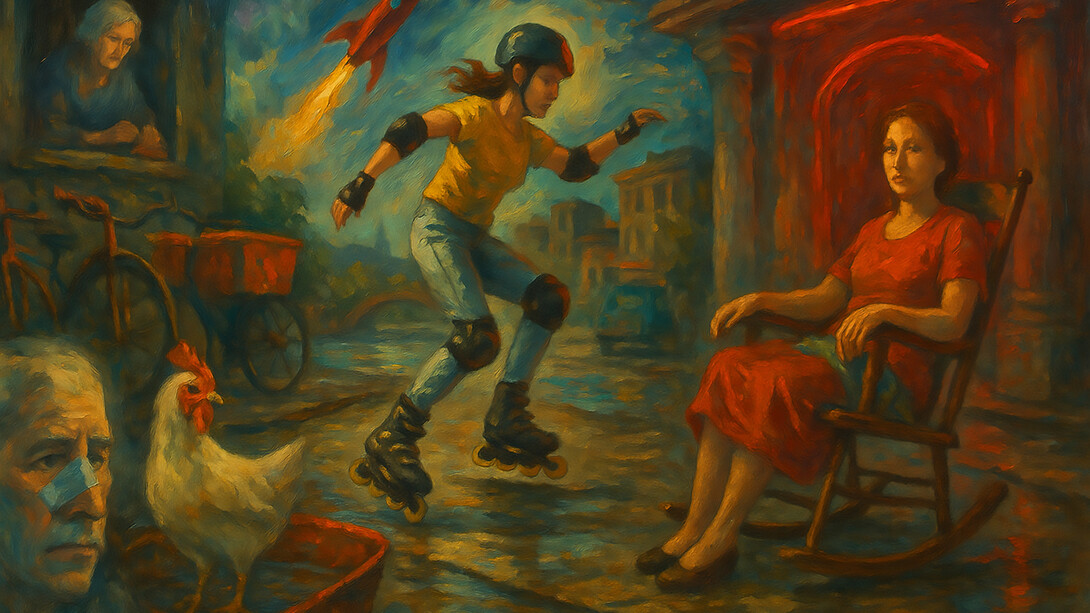
A surreal, dreamlike oil painting captures the fusion of modern disconnection and poetic imagination

So much depends upon and other poems

Signals from the fringe

18 JULY 2025, 

Telephatic Lines

Swerve of high tech roller blades―
Not those antediluvian metal Edsels
So incapable of transcending gravel―
But those sugar-coated rollers: 

Gliding waltz, ballet grace,
Lifting knee pads high, figure eight,
Touching toes, guffawing in reverse.
Count down…3... 2... 1.... 

Cartwheel and lift off into
The stratosphere, eardrums wired into
Inter-stellar muse within
The crash helmet of astronauts. 

Weaving through pedestrian wayfare,
She sweeps by plenipotentiary
And pariah alike, leaps sidewalk curbs
As if dodging asteroids. 

Watch her spacecraft streak by:
She opens telepathic lines to
Earthlings or whatever creatures (???)
Are presently orbiting 51 Pegasus!!! 

Wednesday, July 30, 2025

Dávid Locker / Reflection Holds the Knife


Dávid Locker

Dávid Locker

Dávid Locker: Reflection Holds the Knife

"The stakes of Locker’s subjective poetry are without a doubt life itself: the experience, understanding, and operation of both ourselves and the world," from A Bay of Megaphones, a new bilingual anthology of young Hungarian poets, a poem by Dávid Locker in Austin Wagner's translation, introduced by Katalin Szlukovényi.


16th May, 2023

The stakes of Locker’s subjective poetry are without a doubt life itself: the experience, understanding, and operation of both ourselves and the world. The narrative momentum and colloquial familiarity of his free verse sweeps the reader along with a crushing force. ... 

Tuesday, July 29, 2025

Satirical brilliance in Pope's 'The Rape of the Lock'


'Sir Plume demands the restoration of the lock,' an oil painting by Charles Robert Leslie, inspired by Alexander Pope's 'The Rape of the Lock,' exhibited in 1854

Satirical brilliance in Pope's 'The Rape of the Lock'

Delving into the social commentary and symbolism of Alexander Pope's masterpiece

20 JUNE 2024, 

The first part of the eighteenth century was regarded as the Augustan Age due to poets such as Pope and Swift. Augustan poetry incorporates references to Greek and Roman writers: Virgil, Ovid, and Horace. Pope in The Rape of the Lock refers to supernatural beings such as the sylph inhabitants of the air and nymphs of the water, along with gnomes who are demons of the earth and delight in mischief. He is also characterised by his satire, making fun of human flaws.

Sunday, July 27, 2025

Virtue and vanity in Pope's eighteenth-century women


Alexander Pope (21 May 1688 – 30 May 1744) is generally regarded as the greatest English poet of the eighteenth century, portrait by Michael Dahl


Virtue and vanity in Pope's eighteenth-century women

Analyzing Martha’s role as the ideal woman in Pope’s poem

20 JULY 2024, 

Felicity Nussbaum, in her critique of the poem, argues there is no single theme that unifies the poem, suggesting various ideas are repeated. Martha becomes the embodiment of eighteenth-century conduct book expectations for women: good humor, sense, social love, and a quiet, unassuming wit. Compared to other women who are imposters with assumed identities, she is presented as genuine. In contrast are the portraits of the women condemned by society for being fickle, inconsistent, excessive self-love, and ostentatious displays of wit. These attributes were condemned as a self-centered approach, as they could be seen as challenging men’s positions in an effort to outshine them. Wit was associated with immorality due to the prejudice against women learning, as when taken to extremes, it could make them violent, quarrelsome, and destructive of the social order. James Fordyce stated that women who sought knowledge looked for control and power. His solution was they should confine themselves to the domestic sphere.