
Showing posts with label Hafez. Show all posts

Tuesday, January 4, 2022

Rewriting Hafez / Re-theorizing Untranslatability in Persian Poetry


Rewriting Hafez: Re-theorizing Untranslatability in Persian Poetry

July 8, 2014

A guest post by Aria Fani. A native of Shiraz, Aria Fani studies towards a Ph.D. in Near Eastern Studies at the University of California in Berkeley. All translations are by the author unless otherwise noted. ariafani@berkeley.edu

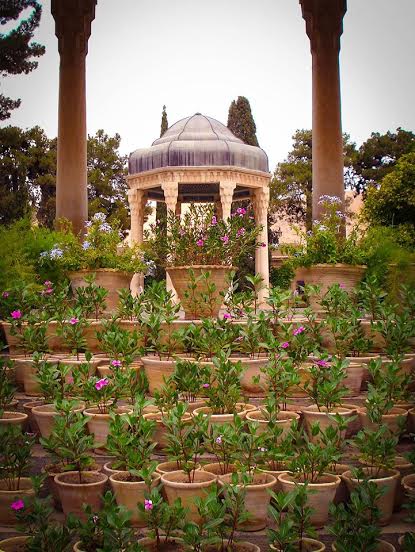
Tilework underneath the dome of the Hafeziyeh (Photo Credit: Aria Fani).


و الشعر لا يسطاع ان يترجم و لا يجوز عليه النقل. و متی حول تقطع نظمه و بطل وزنه و ذهب حسنه و سقط موضع التعجب منه و صار كالكلام المنثور. و الكلام المنثور المبتدأ علی ذلك احسن و اوقع من المنثور الذي حول من موزون الشعر– الجاحظ | كتاب الحيوان

Poetry [shi‘r] is untranslatable; it cannot be transferred from one language into another. Translation breaks its metrical arrangements [naẓim] and spoils the rhythm [wazin], ruins its aesthetics [ḥusn], and flattens the element of wonder [muḍi‘ al-ta‘ajjub]. Translation turns poetry into prose, and prose originally written as such is preferred over what has been turned into prose as a result of translating verse– al-Jaḥiẓ | Kitab al-Hayawan.


Near Eastern thinkers, perhaps as early as al-Jaḥiẓ, the eighth century Arab writer and polemicist, have commented on the problem of literary translation, particularly concerning poetry. While al-Jaḥiẓ points to broad challenges encountered in translating lyrical poetry, he gives more weight to translation as an end result, characterized by various layers of loss consequent to this linguistic transfer. One implication of reading translation merely as a product is to indict translation as an intellectual enterprise—as often has been done—and place it within the reductionist model of “betrayal” versus “faithfulness.” However, al-Jaḥiẓ’s view also lends itself to the notion of developing a critical awareness towards translation as a process of linguistic and cultural negotiation between the source and target language and their literary traditions. In other words, literary translation does not end by acknowledging the concept of untranslatability, it begins with it and furthermore testifies to the translator’s difficult task of doing justice to what he or she perceives as the poem’s internal vision.

Untranslatability is a trope standard to writing and rewriting, and is not limited to translation. In this vein, one can view failures, disappointments, and success not as a fixed form of assessment, but as an open discussion of the translator’s vision and accommodations within the fluid context of his or her era, language, target audience, and mode of reading. Untranslatability can be a humbling acknowledgement made by a translator well-acquainted with the poetic system of the source language, one who fully understands components such as naẓim, wazin, ḥusn, and muḍi‘ al-ta‘ajjub, prior to translating the work. “Untranslatable” could indicate that no translator has yet engaged this process for a “general” audience, or existing translations have not found wide readership. It is translation as a process of negotiating between two (or more) literary traditions, models of reading, and target audiences that I am concerned with in this article, and less with its end result.   
unnamed
The Hafeziyeh in Shiraz, Iran (Photo Credit: Aria Fani).

Translation can be characterized as an interplay between literary traditions (source and target languages are rooted in multiple traditions of their own), a process that illuminates the difference in approaches to and articulation of poeticity. Consequently, linguistic and cultural challenges arise that need to be addressed by the translator regardless of his or her approach to translation. The Persian literary tradition presents unique challenges that are particularly well-revealed in the ghazaliyyāt of Shams al-Din Muhammad Hafez of Shiraz (circa 1315-1389), a poet who is widely read in Persianate societies. Poets and scholars alike have expressed the difficulty of translating Hafez.

In his famous essay, “On Not Translating Hafez” (New England Review, 1999), Dick Davis engages the many facets of translating the Persian poet, maintaining at the end that his verse is untranslatable. Davis, who has now attempted the feat himself in his Faces of Love: Hafez and the Poets of Shiraz (Penguin Books, 2013), characterizes these challenges broadly as linguistic and cultural. Linguistic challenges are often in the form of translating idioms, puns, and rhymed phrases. Cultural resonance, embedded in the source text, constitutes even greater weight for the translator; the ghazals of Hafez are composed against the backdrop of an intertextual dialogue with various dimensions of Islam, a background readily accessible to certain Persian readers and largely missing in cultural and linguistic communities in the West.

As an example of cultural resonance, Davis uses wine metaphors in the poetry of Hafez to further unpack this challenge. He writes: “It would never occur to a Western poet to express the forbidden intoxications of mysticism by alluding to the forbidden intoxications of wine, for the simple fact that the intoxications of wine have never (if we exclude the brief and local moment of prohibition in the United States) been forbidden in the West.” The Hafezian metaphor resides in the realm of culture, not words or images; it is a capacity he exploits throughout his poetry.

Similarly, in an essay entitled dar tarjumah napaziri-i shi‘r [On the Untranslatability of Poetry, Iran shinasi, 2002], Mohammad Reza Shafi‘i-Kadkani highlights the difficulty of communicating the semantic complexity of Hafezian metaphors while arriving at the same conclusion: Hafez is untranslatable. Shafi‘i offers a beyt (line) as case in point, and zeroes in on one phrase of a single misra‘ (hemistich). Here I will unpack the entire beyt, partially relying on the commentaries of Shafi‘i and Baha al-din Khurramshahi [ḤāfiẓʹNāmah, Shirkat-i Intishārāt-i ʻIlmī va Farhangī, 2005]:

Transliteration:

bih may sajādih rangin kun garat pir-i mughān guyad
             kih sālik bikhabar nabvad z-i rāh-u-rasm-i manzilhā

The literal translation of this ghazal, closely approximating the Persian syntax, is as follows: “with wine prayer rug make colorful, should pir-i mughan ask /// for salik oblivious should not be to the path and way of Homes.” Reproducing the rhyme and meter of the Hafezian ghazal—a  quality intimately associated with classical Persian poetry as with all poetry—is very challenging, one that most translators of Hafez decide not to undertake. The first misra‘ directly addresses readers in second person singular, and is grammatically conditional (do “x” if one were to ask you). Its central concepts are wine, prayer rug, and pir-i mughan: Wine, evoked as an impure element, is positioned against the cleanliness and purity  of the prayer rug,  a small carpet placed  between the bare ground  and the Muslim worshipper. Furthermore, both prayer rug and wine can be read as metonymy for orthodox religiosity and the forbidden respectively.

Pir-i mughan is principally a Zoroastrian elder who sells wine, and has later gained different semantic layers through Sufi teachings. However, in this context, the earlier referent is being evoked. The second misra‘ is grammatically ambiguous for nabvad is both imperative and indicative; some have translated nabvad as an opinion or piece of advice (Pilgrims should show each stage’s rule), while others have rendered it as a statement (That seasoned voyager knows the ways of the road). In both translations, the ambiguity of the Persian is necessarily removed.
unnamed

Salik is approximated by wayfarer or seeker—one who embarks on a journey. Salik is deeply rooted in Sufi traditions, a protean and transnational phenomenon that broadly captures the mystical dimensions of Islam.Rah-u-rasm refers to the path and the way of mystical principles; although grounded in a different tradition, Christian poetry makes use of these concepts as well;one such example is “Enter not into the path of the wicked, and go not in the way of evil men” [Proverbs 4:14, KJV]. Rah-u-rasm has been translated as each stage and the ways respectively by Dick Davis and Peter Avery and John Heath-Stubbs. Last, but not least, the concept of manzil is approximated by the “realm of the divine,” sought by the seeker. Thus far, our rough draft appears as follows; the Persian terms are retained in the English to further invite non-initiated readers to research these concepts:

Make your prayer rug colorful with wine, if pir-i mughan asks you
for salik shouldn’t be oblivious to the way of the higher path.

Having annotated the linguistic aspect of the source text, the translator arrives at a different problem: how does one uproot the poem from its cultural soil and replant it in an unaccustomed earth? This is an area in which a literal translation may not prove to be a viable option. For instance, “make your prayer rug colorful with wine” accurately reflects the Persian, but fails to convey the subversive message of the ghazal’s speaker for English readers unfamiliar with Perso-Islamic culture. Hafez’s metaphor functions through a source domain—readily accessible for Persian readers who are familiar with Qur’anic and pre-Islamic lore and intertextuality—in which wine is conceptualized as najis, or impure, and prayer rug as tahir, or free of impurity.

The concept of najis/tahir is grounded in a cultural understanding of cleanliness, partially informed by sharia, one that is not closely approximated by the English terms clean/unclean.Clean for most English-language readers may simply mean free from dirt, marks, or stains, while pure–free from a contaminating substance–is closer in meaning, all the same fails to convey the cultural significance of tahir in Perso-Islamic culture.

Wine has its own semantic associations in the West, for example it can symbolize the Blood of Christ, and as such can be deemed Holy. The sacrilegious request of the pir-i mughan is entirely lost in a literal translation, and would need to rely on footnotes–or other forms of discussion– to convey the poem’s central metaphor. It must also be added that Hafez’s ghazal speaks from the margins of mainstream Sufism at the time; it is a Zoroastrian wine-seller that shows the seeker “the Path and the Way,” not a spiritual Sufi leader to whose (institutional) order he adheres. From every angle, this ghazal is culturally and socially subversive.

Our discussion of the linguistic and cultural aspects of translating Hafez merely scratches the surface of the dialogue between literary traditions; in this case, subversive, Sufi, Islamic, Persian, Christian, and English traditions are implicated. It is a dialogue shaped by the poetry of Hafez and mediated by his translator(s) as well as publisher(s). It goes without saying that it is absolutely paramount that such mediators be fully bilingual and competently bicultural.

More often than not Hafez’s verse has been rendered into English by translators whose lack of proficiency in Persian does not allow them to engage the source text directly; they are more accurately characterized as “versioners, adapters and impersonators” by Franklin Lewis [Rumi: Swallowing the Sun, Oneworld, 2008, xiv]. The list of individuals who have attempted to use Hafez as a ladder to climb into literary fame is rather lengthy; it will suffice to mention Daniel Ladinsky, contemporary American poet, who has sold several collections of poetry as “translations” of Hafez. Ladinsky does not know Persian while his poems bear little or no resemblance to what Hafez has composed. Ladinsky’s work–and others who adhere to the literary model of cultural appropriation–exists as a symptom of highly unequal power relations between the source and target language and culture, in this case Persian and English are implicated. If examined as a symptom of an asymmetrical cultural context–and not an indictment of translation–such reductive models can critically inform the development of more egalitarian metaphors for translation, namely translation as inter-cultural negotiation.

Many contemporary thinkers have offered us thought provoking metaphors for the difficulty of translation. Walter Benjamin’s influential essay, “The Task of the Translator” (1923), itself a retelling of multiple traditions—Jewish, Kabbalistic, Christian—underlines the importance of allowing the source text to shine through the target language. He treats translation as a “mode” that allows the kinship of languages to be “conveyed,” a relationship best highlighted by “conveying the form and meaning of the original as accurately as possible” (Illuminations, Harcourt, Brace & World, pp. 69-82). The translator’s efforts to meditate on all the possibilities offered by English and bend the target language beyond its comfort zone to accommodate the Persian mode of signification will highlight the kinship between English and Persian and demonstrate what this negotiation can achieve.

Rather than placing translation within the reductive and primitive metaphors of betrayal and faithfulness, one might suggest a creative and scholarly process of inter-cultural and linguistic negotiation—a more productive and egalitarian model—that enriches the target language by expanding its linguistic components, offering new cultural metaphors, and cultivating its theoretical landscape, and equally adds deeper nuances to the reception of the literary work in the source language. Vigorous engagement with the work—consequent to the process of negotiation—often results in rewarding moments, however brief the moment of contact between the source and target language may be, as powerfully underlined by Benjamin. Such translations bring the reader closer to the source text, much like a detour that never loses sight of the main road and attempts to guide the reader via its own road signs, albeit placed in different locations. Only a brief examination of two translations of Hafez’s beyt demonstrates the different creative and scholarly measures taken by its translators:

به می سجاده رنگین کن گرت پیر مغان گوید
که سالک بی خبر نبود ز راه و رسم منزل ها

And if the wine-seller says wine
Should dye your prayer-mat…dye it!
Pilgrims should show each stage’s rule
And seek to satisfy it.
–Dick Davis
(Faces of Love, pg 10)

Stain your prayer-mat with wine if the Master tells you:
That seasoned voyager knows the ways of the road.
–Peter Avery & John Heath-Stubbs
(Hafiz of Shiraz, Handsel Books, 2003, pg. 25)

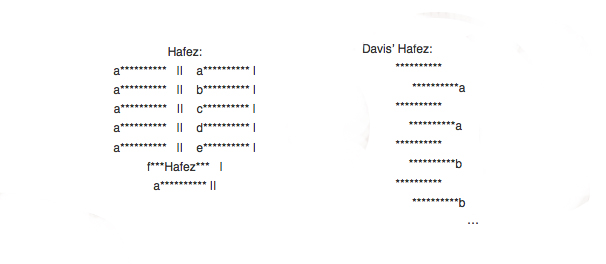
Dick Davis has opted for a simple and contemporary diction and has remained close to the source text. Although different from the mono-rhyme of the Persian ghazal, his translation has developed its own rhyme at the end of each even misra‘, and every beyt has been expanded to four lines:
Screen Shot 2014-07-08 at 11.05.59 AM

Davis’ translation is aligned with Khurramshahi’s interpretation, namely that pir-i mughan in this ghazal alludes to a Zoroastrian wine-seller, and its mystical reading (pir as a Sufi sage) is only suggested in the background. To keep mystical interpretations of Hafezian figures seamlessly in the background, he has rendered salik as pilgrim, as opposed to seeker. The concept of rah-u-rasm that guides the salik to manzilha is expressed through “seek[ing] to satisfy each stage’s rule,” which reflects the notion of traversing levels of mystical Islam, critiqued by Hafez in this ghazal.

Peter Avery and John Heath-Stubbs’ translation does not rhyme; all the same, it has struck its own meter in English. They have opted for stain, rather than rangin kun [make colorful]; their rendition may not reflect the source lexicon, but does convey the Hafezian metaphor, a reasonable compensation. However, they have decided to over-impose a mystical interpretation on the ghazal by translating pir-mughan as “the Master,” which necessarily defangs Hafez’s critique of institutional Sufism and its practices. “Ways of the road” reflects the linguistic metaphor of the source text that “Goals are Destinations,” embedded in rah and manzil. Both versions are close to the source text and, through recalling different possibilities of English, they have put Persian and English poetics in conversation with one another.

Hafez was first introduced to English-speaking readers through Sir Williams Jones’s version of a ghazal, titled “A Persian Song of Hafiz” in 1771. Translators of Hafez have come a long way ever since, taking his poetry in numerous directions based on their local variant, target audience, reading models, and approaches to translation. Julie Meisami’s essay in the Encyclopedia of Literary Translation Into English examines the historical and stylistic trajectory of these works [Routledge, 2000, pp. 600-602]. Hafez’s English translations, all surrounding his work akin to exegetical exercises of the Persian, have histories and traditions of their own. For instance, there are as many equivalents suggested for pir-i mughan and salik as there are English translators of Hafez.


Translationpir-i mughansalikMetaphor
Arberry, A. J., Hafiz: Fifty poems, 1947.taverner[one] whose wont is on this road to goLet wine upon the prayer-mat flow
Clarke, H. W. The Divan of Hafiz, 1974.Pir of the magians (the perfect murshid)holy traveller (the perfect murshid)With wine, becolour the prayer-mat
Kashani, A. A., Odes of Hafiz: Poetical Horoscope, 1984.The experienced sageus/my friend“Wash your prayer-rug in red wine, my friend”
Bell, G. The Teachings of Hafiz, 1985.Tavern-keepertraveller“With wine, with red wine your prayer carpet dye!”
Smith, P. Divan of Hafiz, 1986.MasterThis experienced travellerWith wine dye your prayer-mat
Gray, E. The Green Sea of Heaven, 1995.MagustravellerStain your prayer mat with wine
Alston, A. J., In Search of Hafiz, 1996.Magian Teacherthe true travellerDye your prayer-carpet in wine
Newell, J. R. The Songs of Hafiz, 2001.masterthat holy oneDye your prayer mat red with wine

If examined carefully in the light of translation as a process—not merely an end result—of cultural and linguistic negotiation, these translations can point us to new and unprecedented horizons and challenge the idea of languages as fixed and unevolving literary idioms strictly associated with a particular religion or culture. In the past several decades, English has become a common vehicle for the expression of Islamic and Sufi thought, both through creative and scholarly writing. The central metaphor of Hafez’s ghazal may be unique to Persian, but the source concepts it evokes–that of religiosity and subversion–is common among all languages. English will continue to search for the voice of Hafez—and poets in other languages—and with each vigorous process of negotiation, we move a step closer in the Benjaminian direction of highlighting the “kinship” of all languages, their interconnectedness in what they wish to express.


_ _ _

This essay was written in close dialogue with Chana Kronfeld and my colleagues in her graduate seminar, “The Politics and Poetics of Translation” at the University of California, Berkeley. I would also like to thank my colleagues Leyla Rouhi, Tracy Cummings, and Franklin Lewis for their critical comments.


Bibliography
1. Davis, Dick. “On Not Translating Hafez.” New England Review (1990), Vol. 25, No. ½, Translation: Double Issue (Winter-Spring, 2004), pp. 310-318.
2. Shafi‘i-Kadkani, Mohammad Reza. “Dar tarjumah napaziri-i shi‘r.” Iran shinasi. 56 (1381/2002): 743-749. Iran Shinasi may not be the primary publisher of this essay as it has been featured in various other publications in Iran and abroad.
3. Hāfiz, and Bahāʼ -D. Khurramshāhī. ḤāfiẓʹNāmah: Sharḥ-i Alfāẓ, Aʻlām, Mafāhīm-i Kalīdī Va Abyāt-i Dushvār-i Ḥāfiẓ. Tihrān: Shirkat-i Intishārāt-i ʻIlmī va Farhangī, 2005.
4. Davis, Dick, Ḥāfiẓ, Zākānī N.-D. ʻUbayd, and Malik K. Jahān. Faces of Love: Hafez and the Poets of Shiraz. New York: Penguin Books, 2013. Pg. 10.
5. Ḥāfiẓ, Peter Avery, and John Heath-Stubbs. Hafiz of Shiraz: Thirty Poems: an Introduction to the Sufi Master. New York, NY: Handsel Books, 2003. Pg. 25.
6. On the question of mystical Islam, please see: Schimmel, Annemarie. Mystical Dimensions of Islam. Chapel Hill: University of North Carolina Press, 1975.
7. Jalāl, al-Dīn Rumi, and Franklin Lewis. Rumi: Swallowing the Sun: Poems Translated from the Persian. Oxford, England: Oneworld, 2008. xiv.
8. Benjamin, Walter. “The Task of the Translator.” Illuminations. New York: Harcourt, Brace & World, 1968, pp. 69-82.
9. I have benefited from George Lakoff’s metaphor theory. See: Lakoff, George, and Mark Turner. More Than Cool Reason: A Field Guide to Poetic Metaphor. Chicago: University of Chicago Press, 1989.
10. Meisami, Julie. “Shams al-Din Muhammad Hafiz” Encyclopedia of Literary Translation Into English. London/Chicago: Routledge, 2000, pp. 600-602.
AJAM MEDIA COLLECTIVE


Monday, November 12, 2018

On Not Translating Hafez


On Not Translating Hafez

Dick Davis
Vol. 25, Nos. 1-2 (2004)

A couple of years ago I was asked by a publisher if I would be interested in producing a volume of verse translations of the poems of Hafez. I was very pleased to be asked, since Hafez (he flourished in the mid-fourteenth century) is pretty universally regarded as the greatest of Persian lyric poets, and to produce versions of his poems seemed a serious challenge worthy of serious effort. I began trying my hand at a few, but rewrite and start over as I might, I consistently came up with generally disappointing results. All the problems I had encountered when trying to translate other medieval Persian poets seemed compounded, and then, as it were, distilled and essentialized, in trying to translate Hafez’s ghazals, and my frustration set me to thinking about just what those problems are. This essay is a result of those ruminations.

Two kinds of problems for the translator of a literary text are well-recognized, and these we may call, for convenience’s sake: first, the linguistic and second, the cultural; naturally, the two often overlap.

The linguistic problem is the easiest to formulate. We know that exact synonyms do not exist between languages; idioms are even more challenging to the translator and a literal word-for-word translation will often convey virtually nothing of the originally intended meaning. Persian, for example, has some extremely inventive—one might almost call them Gongoristic—ways of cursing or threatening people, and a literal translation will convey very little of their intended force. One such locution means literally, “I will bring your father out,” a threat that seems at once mysterious and reassuringly mild in its implications. What it actually means is, “I will give you one hell of a hard time (either because you have already done X, or if you don’t in the future do Y).” Various origins for the phrase have been suggested, the most plausible perhaps being that it means “I will give you such a hard time that your father will rise up out of his grave in consternation.” Clearly, to translate the phrase—for example, as part of a character’s speech in a novel—one can only abandon literal translation altogether and search instead for some threat that carries equivalent force and menace in the target language. Similarly, puns can rarely be translated; only in English can one make Sidney Smith’s joke on two housewives yelling at each other from opposite houses: “They will never agree, for they are arguing from different premises.” Only in the Romance languages do love and death—l’amore e la morte, l’amour et la mort—seem to be on terms of such ghostly intimacy. Only in Persian will the pun in the medieval poet Mas’ud Sa’d’s line “Nalam bedel chu nai man andar hesar-e nai” be evocative: the pun is on the word nai, which means a reed, and by extension a reed flute, and also alludes to the name of a fortress used as a prison. Hence the line means “While I am (imprisoned) in nai (the fortress), I complain in my heart like a nai (reed flute).”
Like the use of puns, rhyme too is a device that depends on accidents of sound: that “breath” and “death” rhyme in English can seem somehow cosmically right to the unreflective English poet, but of course words for the concepts they express don’t rhyme in other languages. A brief rhymed phrase can sum up a whole ethos and way of life—like the “razm o bazm” (roughly, “battles and banquets,” “fighting and feasting”) of the epic poet Ferdowsi, for example—and it is virtually certain that no translator will be able to reproduce the meaning as pithily and inclusively by any rhyme in another language. Paucity of rhyme can have its effect, too; because it has more vowel sounds than either Italian or Persian, English is to that extent poor in rhymes compared to either language. How many English would-be lyric poets have cursed the fact that the only rhymes available to them for “love” are the overused “dove” and “above,” the irrelevant “glove,” the impossible “shove,” and the phonetically dubious “of”? “Self?” and “world,” both words that can seem inevitable in lyric verse, present even more intractable problems as rhyme words. Accidents of sound—such as those found in puns and rhymes—are of course particularly important to poetry, many of the effects of which are based on repetitions or variations of sound patterns—and the difficulties of a translator of poetry are thereby increased.

The second obvious problem faced by a translator inheres in those parts of a text which have clear cultural resonance for the original audience and very little or absolutely no resonance for the linguistic community of the target language. An obvious example of this for translators from almost any Persian text from the sixteenth century on is the lore of Shi’i Islam, an intimate knowledge of the main features of which is automatically assumed by most post-fifteenth-century Persian authors, though this is of course a knowledge almost entirely lacking in the linguistic communities of the West. When we turn to Persian poetry such cultural problems can be particularly intrusive. There is the fact that after the thirteenth century virtually all Persian poetry has at least a tinge of Sufism to it, if it is not outrightly mystical in intent, and mysticism is not a subject accorded particular importance by the poetry of the major Western languages. True, Dante is a major Italian poet, but he is remembered more for the terribilità of the Inferno than for the mysticism of the Paradiso, and besides he is an anomaly, a uniquely splendid and solitary figure in Italian literature. The best mystical poet England can boast is probably Crashaw, who by any ranking is a very minor poet indeed. Dr. Johnson said he thought the notion of good religious poetry to be a contradiction in terms. When a reader who has grown up in the tradition of English verse picks up a book of poetry, he does not expect to encounter mysticism or religious dogma; he does not consider either to be the obvious subject for verse in the way that his Persian counterpart does. The language of religious or mystical devotion does not appear to him to be intrinsically poetic, as it does to a Persian reader.

A subdivision of this mystical problem is the set of ideas metaphorically expressed in Persian poetry by wine, drunkenness, the opposition of the rend (approximately “libertine”) and the zahed (“ascetic”), and so forth. None of these notions have any force whatsoever in the Western literary tradition. It would never occur to a Western poet to express the forbidden intoxications of mysticism by alluding to the forbidden intoxications of wine, for the simple fact that the intoxications of wine have never (if we exclude the brief and local moment of prohibition in the United States) been forbidden in the West. The whole topos of winebibbing and the flouting of sober outward convention, so dear to Persian Sufi poetry, can seem in earlier translators’ work to be little more than a kind of rowdy undergraduate hijinks, and in more recent versions it can take on the ethos of Haight-Ashbury in the late sixties. But in both cases the deeper resonances of the topos are not obvious for a Western audience: they have to be explained—and to explain a resonance is like explaining a joke; when the explanation is over, no one laughs, except out of pained politeness, and no one is moved.

A further cultural barrier, and one that can prove particularly difficult to negotiate, is the prevalence of the cult of pederasty in much medieval Persian verse. Sometimes it exists simply in and for itself, but often it is present chiefly as a metaphorical expression of mysticism. Like the mysticism to which it often refers, this too has never been a serious mainstream subject in Western verse, and although it is clearly taken casually and conventionally in a great deal of Persian medieval poetry, its presence can be a major problem for the translator who has no equivalent set of conventions in the target language in which to place the topos. Here he is helped by Persian grammar and its lack of gender-specific pronouns (the same pronoun means “he,” “she,” or “it”), but in availing himself of this help he is, as he knows, often fudging the issue, quietly bowdlerizing the texts. And our contemporary relative celebration of homosexuality hardly facilitates matters, as the kind of homosexuality implicit in Persian medieval verse is, like that usually present in ancient Greek literature, between an older man and a young adolescent, one who would now be thought of as a minor, and is not of a kind that the West currently considers culturally acceptable. The pervasive presence of mysticism and its attendant rhetoric of metaphorical drunkenness, together with the cult of pederasty, are the two most obvious purely cultural problems that a translator of medieval Persian poetry must inevitably face.

But the problems I have mentioned so far are often also present for the translator of prose, even if they can be more insistently obvious in verse. There is, however, an additional set of problems specific to the translation of verse, and it is these problems that I wish to consider. They have to do with notions of what a poem ultimately does and how it does it, and such notions often differ radically from one linguistic community to another.

The conventions that particularly interest me here are not the most obvious ones regarding how a poem is patterned. There are many sound and semantic patterns in Persian verse that are absent or uncommon in English verse, but which, while they can be tricky, do not provide insurmountable difficulties. For example, dialogue poems that have alternating lines beginning “I said”/“(s)he said” (“goftam”/“gofta”) do not exist in English, but the convention is easily reproducible in English; it does not violate English language notions of how a poem might be constructed. Similarly the radif of Persian verse—the repeated phrase that comes after each repetition of a rhyme—is not a feature of English poetry, but it is often transferable to English without, I think, its appearing to be intolerably outré, as in this poem by the twelfth-century woman poet Mahsati:

The one your beauty’s overthrown

has come back home;

The one who thirsts for you alone

has come back home;

Prepare the cage again, scatter your seeds

of kindness there,

Look, broken-winged, the bird you own

has come back home.


Even mono-rhyme, used in virtually all poems in Persian except for narratives (which use couplets)—a feature difficult and consequently rare in English because of the relative paucity of rhymes—does not seem too egregious if it can be made compelling and suggestive. While such conventions may be unfamiliar, an English poem does not seem compromised as an aesthetic artifact simply by virtue of their presence.
But the real problem, in my opinion, lies not in such manifest, mechanical conventions but rather in the conventions that exist, as it were, just below the conscious level; they are not conventions as to how a poem is explicitly patterned so much as conventions as to which language, topoi, and tropes are considered to be intrinsically poetic and thus suitable for poetry. People of a particular linguistic community often automatically assume that their notion of what constitutes the “poetic” is a universal notion, and this can lead to a sense of disappointment or embarrassment when they are confronted with highly praised artifacts from another culture and these artifacts do not conform to local aesthetic expectations; the end result of this can be, and I think often is, a smug sense—openly expressed by the crass, privately believed by the more circumspect—that really only “our” literature is any good.

A very obvious example from Persian poetry concerns the use of the language of panegyric for virtually all types of poetic expression, and particularly for the expression of emotions associated with the lyric. Panegyric in itself hardly exists, as a respectable form, in English verse. This is not to say that panegyrics have not been written, but they have rarely been valued as especially interesting poetry, and they have always, in English, smacked of undignified fawning, as if they were the kind of thing that no “real” poet would want to be involved with. Probably the only panegyric in English that is still considered to be a major poem is Marvell’s “An Horatian Ode upon Cromwell’s Return from Ireland,” and this is valued largely because the inserted implied praise of Cromwell’s arch-enemy, King Charles I, appears to subvert, and certainly complicates, the overt panegyric format. We can say that panegyric lives a kind of shadowy half-life in many elegies, but it has certainly never been a mainstream English form, and the language and ethos of panegyric have never been considered ipso facto poetic. Matters were quite different in medieval Persia, where panegyric was an extremely important form. The distinguished scholar of medieval Persian poetry J.T.P. De Bruijn has shrewdly compared it to the tradition of court portraiture in the West, and this strikes me as an excellent analogy, as regards both its position within the culture and what the authors working within the tradition were trying to do with it. The rhetoric of praise poetry pervades medieval Persian verse even when the subject has ostensibly nothing to do with panegyric. Unless the work is meant as satire, it can be taken as virtually axiomatic that the speaker of a non-narrative Persian poem places himself in an inferior position to the poem’s subject, whether the poem directly addresses the subject as a “you” or refers to the subject in the third person. This axiomatic superiority of the subject is present in political praise poetry, from which it would seem to derive, in love poetry, and in mystical poetry. So pervasive is the notion in Persian verse that it is, I would guess, considered to be intrinsically poetic by most Persian speakers. But this rhetoric is in fact culture-specific; it seems to be generally absent, for example, in poetry of the Far East—in Chinese or Japanese or Korean poetry. And though extravagant praise of the other, and a concomitant self-abasement, can at times be found in English poetry, these elements of perspective are not considered intrinsically poetic in the way that they are in Persian; other strategies—for example psychological realism, concreteness of language, originality of imagery (all of which are virtually always irrelevant criteria for pre-twentieth-century Persian verse)—are considered equally or even more “poetic” in English.

Out of this given of classical Persian poetry, that the speaker of the poem is customarily to present himself as inferior to the poem’s addressee, other conventions arise. There is, first, the use of hyperbole, particularly in descriptions of the addressee. So poetic is this considered to be in Persian that the ironic term “sha’eraneh” (“poetic”) is often used to describe such language found in a non-poetic context. Hyperbole of course exists in English poetry, but not nearly to the extent that it does in Persian poetry, and indeed there is a strong, mainstream current of English verse that derides it: “My mistress’ eyes are nothing like the sun,” as Shakespeare says, and he concludes the sonnet with which this line opens by mocking what he calls “false compare,” i.e., hyperbole of description. The most extreme examples of such hyperbolic praise are to be found in the trope called “hosn-e ta’lil,” or beauty of etiology, in which a complimentary but entirely fanciful cause is found for a natural phenomenon. Hosn-e ta’lil is greatly prized in Persian and is virtually nonexistent in English poetry, as is indicated by the fact that there is no common term for the trope in English. Indeed, I have been able to find only one true example of it in an English poem. Significantly enough, the example I did find, which is at the opening of Milton’s “Ode on the Morning of Christ’s Nativity,” is there to praise Christ; that is, the poem’s divine subject, in Milton’s eyes, justifies the hyperbole. But for a mere mortal hosn-e ta’lil seems not so much poetic as unnatural in English.

Here then we come to a major problem, which is that the appearance of a set of strategies considered intrinsically poetic in Persian—the inferiority of the speaker, praise of the addressee, the use of hosn-e ta’lil as part of this praise—is relatively rare in English poetry, is not considered intrinsically poetic, and can be seen as unnatural or absurd. In fact, one might say that the Persian and English sensibilities here make directly opposing demands of verse: the more extreme the praise, the more poetic the poem is considered to be in Persian, and the closer to absurdity and distasteful flattery it is considered to be in English.

Other tropes besides hosn-e ta’lil that are considered legitimate and valuable in Persian poetry are suspect in English poetry. The more cerebral quality of Persian metaphors when compared to their English equivalents can mean that a Persian metaphor can fail in English (and vice versa, of course). For example, to say that a lover has wasted away to the thinness of a hair is not uncommon in Persian verse; this is because the comparison is made cerebrally not concretely. But the English reaction to such a metaphor is to attempt to visualize it, and physical reality will not allow one to visualize a lover as thin as a hair; the metaphor doesn’t work in English. Persian abstracts the quality isolated by the metaphor (here, thinness) and chooses a vehicle that expresses this quality in extremis (in this case, a hair); the procedure is normal and appropriate in Persian, but a reader used to the concreteness of English metaphor tries to visualize the result, with very uncomfortable consequences.

A further example of how rhetoric is differently conceived of in Persian and English is the mixed metaphor. To refer to a person as a walking cypress tree (sarv-e ravan) is only absurd in English, and implies none of the delicacy, charm, and wonder that accompany the phrase in Persian. There is a literalism about English metaphor which strongly resists the mixed metaphor and labels it as a mistake of taste. The mixed metaphor of the “walking cypress” type is, however, prized in Persian. The reason for this, I think, has to do with another convention that indicates where English and Persian verse, and literature in general, diverge; this convention concerns which emotions are thought of as particularly poetic or interesting.

We have already mentioned by implication the emotion of a sense of abjection and unworthiness before the object of praise; equally common in Persian poetry, and often connected with this sense of self-abnegation, are emotions of wonder, surprise, amazement, bewilderment, and so forth. Persian poetry is full of words that express this aesthetic of wonder and amazement. What is unexpected, unnatural, miraculous, producing puzzled or overwhelmed wonder in the observer, is, ipso facto, considered poetic. Even when perfectly natural phenomena are described—the verdure of spring, for example—they tend to be described within the rhetoric of this aesthetic, implying that their splendor raises them above the expected and credible. This idealization of reality, and the calling forth of emotions like wonder and astonishment, which are seen as reactions to unprecedented perfection, are again relatively rare in the English poetic tradition, which frequently tends toward the specific and idiosyncratic, and which looks for the flash of recognition in the reader rather than amazed wonder at an ideal which is remote from quotidian experience. The aesthetic of wonder leads to specific topoi common to Persian verse—for instance, the notion of beauty that is shahr-ashub (“setting the town in an uproar,” i.e., provoking such wonder in everyone)—that have no equivalents in English. Perhaps one can most simply characterize the difference of aesthetic involved here by quoting Hamlet’s advice to the players, when he says that the purpose of playing is “to hold, as ’twere, the mirror up to nature; to show . . . the very age and body of the time his form and pressure,” and then comparing this with the eleventh-century poet Ayyuqi’s description of what it is that a poet does: he says a poet is like the woman who beautifies a bride before her wedding ceremony. For Shakespeare, art’s job is to show reality, warts and all, as it were; for Ayyuqi, art’s job is to make reality appear as lovely and splendid as possible.

Connected with this concern with amazed wonder, and subject matter that can be relied on to provoke this wonder, is Persian poetry’s frequent invocation of the ineffable and indescribable; this is most common in mystical poetry, of course, but it is also present in secular love poetry where the injunction “Don’t ask!” (“ma-pors”), a favorite of Hafez and subsequently of any number of other poets, can imply either heights or depths of incommunicable experience. The concrete empiricism of most English verse means that it spends little time on the ineffable, and to imply that something is indescribable in English does not carry the inevitable implication that it is therefore interesting; there is not a rhetoric readily available in English for talking around and hinting toward what cannot be directly stated.

The sense of the ineffable, or of amazed wonder, reinforces a further characteristic of Persian verse which separates it from the English poetic tradition and so makes the translator’s task that much more difficult. This is the way in which lyric poetry in Persian often appears static, in that the typical method of procedure is to restate a problem or insight in different terms with each successive line. Or as the scholar Wojciech Skalmowski has recently characterized it, “short sequences of verses or . . . single bayts (lines) allude to various aspects of the same universe of discourse within which the ‘action’ of the whole genre is situated and which is assumed to be known in advance by the . . . audience.” This thematic coherence but narrative or logical disjunctiveness is evidenced by the fact that different manuscripts of, say, Hafez will give the same lines of a ghazal but in varying sequences; even leaving aside questions of rhyme scheme, it is very difficult to imagine the lines of a Shakespearean sonnet appearing in different order in different manuscripts, because the poem’s forward motion makes it plain which parts come before or after others. A small by-product of this situation is that in a ghazal a person can be addressed as “you” in one line and then apparently the same person will be referred to as “(s)he” in another line; the discrete status of the individual lines makes this perfectly acceptable. This is hardly possible in an English poem, where the natural assumption would be that a “you” and a “she” (or “he”) appearing in the same poem clearly must refer to different people.

The typical (though not universal) lack of a sense of forward impetus in the Persian ghazal is reinforced considerably by the aesthetic of wonder which seems to militate against the logical development of a subject. Thus, if one compares a Shakespeare sonnet with a Hafez ghazal, for example, the most obvious difference in terms of content is that the psychological situation at the end of a Shakespeare sonnet is almost always different from what it had been at the beginning, whereas in a Hafez ghazal the irresolvableness, the resistance to development or resolution, and therefore the lack of closure of the situation seem to be an intrinsic part of the poem’s point. Ghazals often seem to end with the literary equivalent of throwing one’s hands in the air, as if nothing can be done about the situation the poem describes: recognizing that there is no end to the situation is what constitutes the end of the poem. This sense of being psychologically becalmed in an undeveloping and undevelopable situation probably arises initially from the fact that this poetry was meant to be heard rather than read silently and privately, and that like most such poetry it resolutely avoids enjambment. In so doing it utilizes lines that are almost always semantically complete, that do not derive from a preceding line or imply a following line. The semantic separateness of each line within an overall mono-rhymed structure produces an artifact not unlike that of a musical theme and variations: each line is a discrete variation that is nevertheless tied closely to the overall theme, which is usually stated most succinctly in the opening or closing line. The mono-rhyme formally confirms that we always in a sense end where we begin, that psychological “development” from one stage to another is not, normally, what is being attempted or presented. This is not at all to derogate from the aesthetic authority of the poems, and I would not wish a reader to think that this is what I am implying. One has only to think of the overwhelming pathos and power of a piece like Bach’s C-minor passacaglia, or the poignancy of the return of the opening theme at the end of his Goldberg Variations, to recognize how artistically effective such a form, and such devices operating within the form, can be. Many of Hafez’s ghazals can certainly provide an equivalent and equally profound aesthetic experience. Naturally, too, exceptions can be found that would contradict my characterization of them as typically, in form, constituting the statement of a theme and subsequent variations, just as there are sonnets in which there is no development or change in the speaker’s implied psychological state, which may remain exactly the same at the end as at the beginning. Nevertheless, the characterization is, I think, a defensible one, for probably the vast majority of examples of the Persian ghazal. It seems accurate, therefore, to say that these purely mechanical characteristics (mono-rhyme, a lack of enjambment) have had consequences that reinforce the poetry’s very specific aesthetic, one that only loosely, and as it were accidentally, corresponds to Western expectations of how the experience of a lyric poem unfolds.

Certain poets are held to be untranslatable, or virtually so, and often they are thought of as those that most intimately express the poetic soul of their people: in Russian there is Pushkin; in German, Goethe; in Persian, Hafez. The fact that it is often precisely the poets who seem to sum up a poetry’s idiosyncratic potential and identity who are those whose works are most resistant to translation can give rise to a kind of romantic, quasi-racial canonization of such poets, an implication that they cannot be translated because what they express draws so deeply on the culture’s specific ethnic soul that it is not communicable in any other terms. This is a variant of the sentimental “To understand, my friend, you have to be Persian/Jewish/Russian . . .” ploy. (Against this ethnic self-indulgence there is a lovely story of Franco Corelli asking Richard Tucker for tips on how to sing Puccini: “Well,” began Tucker, “You have to be Jewish. . . .”) But there is a simpler, more mechanical, less romantic, less racial, and, I believe, truer explanation for why these poets can seem to resist translation.
Such poets can be considered those for whom the local conventions of their poetry are so deeply embedded psychically that they seem to be second nature to them; in their hands the conventions no longer seem conventions but simply a truth of the language, or of the particular poet’s psyche as it functions within the language. Goethe has a remark somewhere that few people realize that a poet’s most felicitous effects are often embedded in the rules of language itself, and we can extend this observation to the conventions of poetry that grow up in a linguistic community. It is the poet able to realize and utilize such conventions most effectively who can seem the most inspired and gifted; what to others is learnt, and obviously so, seems to be what he has been given, his natural mental landscape, the ethos within which he luxuriates and flourishes. But because his poetry is by that fact an endlessly dense tissue of his language’s poetic conventions, he seems by virtue of his very skill to be monolingual, untransferable to a language and poetry which does not share such conventions. And this is why the poets who seem to develop a poetry’s capabilities most tellingly, who seem to their linguistic communities to be the most “poetic” of all, are often precisely those whom it is most difficult to bring over into another language. Certainly, in Persian literature, the example of Hafez, and of the numerous poor poet-translators who metaphorically lie bleeding at his feet, would seem to bear this out.