
I AM VERY
by ANNE CARSON
I AM VERY he says tilting into the room and stops. Happy


I AM VERY he says tilting into the room and stops. Happy
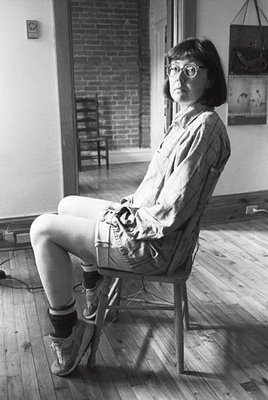 |
| Anne Carson |
Now it hangs on the back of the kitchen chair
where I always sit, as it did
on the back of the kitchen chair where he always sat.
I put it on whenever I come in,
as he did, stamping
the snow from his boots.
I put it on and sit in the dark.
He would not have done this.
Coldness comes paring down from the moonbone in the sky.
His laws were a secret.
But I remember the moment at which I knew
he was going mad inside his laws.
He was standing at the turn of the driveway when I arrived.
He had on the blue cardigan with the buttons done up all the way to the top.
Not only because it was a hot July afternoon
but the look on his face —
as a small child who has been dressed by some aunt early in the morning
for a long trip
on cold trains and windy platforms
will sit very straight at the edge of his seat
while the shadows like long fingers
over the haystacks that sweep past
keep shocking him
because he is riding backwards.

 |
| Anne Carson |
I woke before dawn.
The light was a thin blade of nickel
lying on the edge of the world.
One owns nothing.
Not even this moment of passage,
where the river water becomes sea water,
where the salt begins to bite the sweetness.
Memory is a weariness of the eyes.
It seeks a shape where there is only motion.
It seeks a shore where there is only drift.

 |
| ‘She does not subjugate or manipulate her words. She lets them be’ … Anne Carson. Photograph: TT News Agency |
When her sons died the Book of Goose author turned to Grief Lessons, Carson’s translation of four plays by Euripides. She reflects on the ‘life sustaining’ work of an extraordinary writer
Yiyun Li
Friday 9 October 2026
 |
| Risk and vision … Anne Carson. Photograph: Peter Smith |
The Handmaid’s Tale author is joined by Emily Wilson, Ocean Vuong and Booker-shortlisted writer Rebecca Perry in celebrating the newly announced Nobel laureate
Emma Loffhagen and Leyland Cecco
8 October 2026
Margaret Atwood
Anne Carson’s work has long been admired among poets of many countries. For new readers, I would recommend The Beauty of the Husband – direct and visceral, funny and angry and sad – or Men in the Off Hours. Delights await!
 |
| The academy cited Anne Carson’s ‘bold and inventive oeuvre’ in its awarding of the prize. Photograph: Pontus Lundahl |
Most prestigious literature prize goes to Canadian known for genre-crossing works such as Autobiography of Red
Emma Loffhagen and Leyland Cecco in Toronto
8 October 2026
The Nobel prize in literature has been awarded to the Canadian poet and essayist Anne Carson, the Swedish Academy has announced.
LOVE POEM BEGINNING WITH TWO LINES BY SAMUEL JOHNSON
Time hovers o’er, impatient to destroy,
And shuts up all the passages of joy
Saint Augustine said he only knew
what time was if he didn’t have to explain it.
Lucille Clifton wrote “time is another name for God”
in a poem called “rust.”
I think time zigzags like a violin.
I think time hisses
out of my watch like a gas.
I once read a poem that began “Shut up”
and continued, “to be alone is to be alive.” If time
is the sound of God’s scorched laughing,
then we will wrinkle like eels in Maryland’s great Gunpowder River.
If silence really is a way of knowing, I know I have to start over.
***
THERE IS A PROVERB ABOUT THE THIEF CAUGHT STEALING DURING A FIRE
Kathryn says these are the things that give hope: a white dog in the snow howling at the train gone by
Sei Shonagon says these are the topics of poetry: The capital. The kudzu vine. The water burr. Horses. Hail.
They say a jellyfish once slid down the throat of a famous swimmer
They say if you have things you only worry about them
My father was born in the 59th most polluted city in the world
My mother told me she wished she could go away
In poem XIII, Catullus invites his friend Fabullus over to dinner but requests that Fabullus bring all the food, wine, women, salt, laughter
Catullus cites his poverty, his “little purse filled only with cobwebs”
Sometimes your wolf becomes another wolf
Sometimes your sister, a different sister
I was told to avoid eating certain foods in lonely places
I was told to “carry some metal,” not to step on bone or hair or human ash
There is a proverb about drowning in two inches of water
I, too, have something in me like a gun
I, too, live in the remote wilderness of Antarctica
There is a proverb about the thief caught stealing during a fire
How he will be placed into the fire as well
A. R. Zarif is from Chicago. His work has appeared or is forthcoming in Poetry magazine, The Iowa Review, Harvard Divinity Bulletin, Bennington Review, Chicago Review, The Margins, and other publications. He holds an MFA from Brown University and is currently a PhD candidate in English at the University of Virginia.


We, this people, on a small and lonely planet
Traveling through casual space
Past aloof stars, across the way of indifferent suns
To a destination where all signs tell us
It is possible and imperative that we learn
A brave and startling truth
And when we come to it
To the day of peacemaking
When we release our fingers
From fists of hostility
And allow the pure air to cool our palms
When we come to it
When the curtain falls on the minstrel show of hate
And faces sooted with scorn are scrubbed clean
When battlefields and coliseum
No longer rake our unique and particular sons and daughters
Up with the bruised and bloody grass
To lie in identical plots in foreign soil
When the rapacious storming of the churches
The screaming racket in the temples have ceased
When the pennants are waving gaily
When the banners of the world tremble
Stoutly in the good, clean breeze
When we come to it
When we let the rifles fall from our shoulders
And children dress their dolls in flags of truce
When land mines of death have been removed
And the aged can walk into evenings of peace
When religious ritual is not perfumed
By the incense of burning flesh
And childhood dreams are not kicked awake
By nightmares of abuse
When we come to it
Then we will confess that not the Pyramids
With their stones set in mysterious perfection
Nor the Gardens of Babylon
Hanging as eternal beauty
In our collective memory
Not the Grand Canyon
Kindled into delicious color
By Western sunsets
Nor the Danube, flowing its blue soul into Europe
Not the sacred peak of Mount Fuji
Stretching to the Rising Sun
Neither Father Amazon nor Mother Mississippi who, without favor,
Nurture all creatures in the depths and on the shores
These are not the only wonders of the world
When we come to it
We, this people, on this minuscule and kithless globe
Who reach daily for the bomb, the blade and the dagger
Yet who petition in the dark for tokens of peace
We, this people on this mote of matter
In whose mouths abide cankerous words
Which challenge our very existence
Yet out of those same mouths
Come songs of such exquisite sweetness
That the heart falters in its labor
And the body is quieted into awe
We, this people, on this small and drifting planet
Whose hands can strike with such abandon
That in a twinkling, life is sapped from the living
Yet those same hands can touch with such healing, irresistible tenderness
That the haughty neck is happy to bow
And the proud back is glad to bend
Out of such chaos, of such contradiction
We learn that we are neither devils nor divines
When we come to it
We, this people, on this wayward, floating body
Created on this earth, of this earth
Have the power to fashion for this earth
A climate where every man and every woman
Can live freely without sanctimonious piety
Without crippling fear
When we come to it
We must confess that we are the possible
We are the miraculous, the true wonder of this world
That is when, and only when
We come to it.


Politics and war, science and sports, memoir and biography — there's a great big world of nonfiction books out there just waiting to be read. We picked the 100 best and most influential written in English since 1923, the beginning of TIME ... magazine
The first in a series of autobiographical works, I Know Why the Caged Bird Sings is the most famous and acclaimed book by Maya Angelou, a poet, memoirist and civil rights activist who grew up in the South during the 1930s and California in the 1940s. Published in 1969, the story spans her childhood from age 3 to 17, following young Maya and her older brother Bailey as they bounce from their parents’ care to their grandmother’s and back again. Maya struggles not only with feelings of chronic displacement and insecurity but also a series of heartbreaking challenges: insidious racism, molestation and rape. Caged Bird was nominated for the National Book Award and is still beloved for its revolutionary depiction of what it meant to be young, female and black in America.


