Showing posts with label Aaron MacLean. Show all posts

Friday, September 1, 2023

Robert Graves / Reluctant War Poet


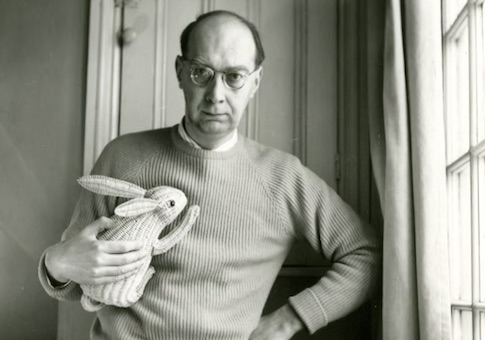
Robert Graves


Robert Graves, Reluctant War Poet

Review: Charles Mundye, ed., 'Robert Graves: War Poems'


Aaron MacLean
February 3, 2017

If it wasn't exactly the book that made him famous, the sales of Goodbye to All That certainly made possible Robert Graves' uncontainable and eccentric maturity—complete with the house in Majorca—and the means by which to ensure that his poetic art consisted not just of a "technical mastery of words" but a "particular way of living and thinking." A century after the events this autobiography depicted, it is still easy to see why it sold so well: it was and is an uncommon book. Narrated throughout in Graves' chiseled, ironic prose, it consists of unequal parts abject horror (the young Lieutenant Graves in a shattered wood robbing dead Germans of their great coats so that his men can have blankets, dodging clouds of undissipated gas as he goes), dishy amusements (T.E. Lawrence conspiring with Graves at Oxford to kidnap the Magdalen College deer), and frank sexuality—scandalous sexuality, at the time of publication in 1929.

What it doesn't contain much of is poetry, or accounts of the writing of poetry. The reader knows that he is scribbling the stuff throughout, but Graves the autobiographer keeps such business off stage. Despite this, moments essential to Graves' poetry and poetic career can't help but attract attention, like his first encounter with Siegfried Sassoon, who in 1915 was serving as another young lieutenant in his regiment, the Royal Welch Fusiliers. Inasmuch as Graves' account of this conversation involves Sassoon criticizing some drafts of poetry Graves shows him as being too "realistic," and showing Graves some embarrassingly sentimental verses in return, the moment falls squarely into the category of "dishy." Indeed, Sassoon was so upset at gossipy elements of the memoir, which he attributed to a bid for sales, that he was able to have the first edition suppressed, and subsequent editions revised.

Sassoon of course then saw heavy combat and began to write the brutally realistic war poetry that, in death, has remained the principal source of his fame, along with his own fictionalized memoirs. The same thing did not happen to Graves, who, despite almost always being counted among "the war poets," did not depend on membership in that club to maintain his reputation. This may be because Graves went on to be, well, Graves: controversial outsider and author of more than a hundred books including novels, translations, historical inquiries into the foundations of myth and religion, and of course poetry, most of which did not take war as its subject.

It may also be due to the fact that Graves actively resisted the status of "war poet." Charles Mundye, editor of a new collection of Graves' war poetry, outlines in a long and worthwhile introduction how Graves went so far as to suppress a fair amount of the writing he did in France, stating in 1941 that such work had been "too obviously written during the war poetry boom." Reading through the new edition, what is most striking is the heterogeneity of this young man's work. There are poems here that could easily be mistaken for something written by any other contributor to said boom—conventional war poems, if you will, combining the genre elements of horror and ironic reversal, and heavily influenced by the prevailing Georgian style. Graves' sonnet "Limbo" opens in the trenches, where "After a week spent under raining skies, / In horror, mud and sleeplessness" and where the dead bodies of fellow soldiers are stacked to build up the parapet,

…then one night relief comes, and we go
Miles back into the sunny cornland where
Babies like tickling, and where tall white horses
Draw the plough leisurely in quiet courses.

There are poems that have principally to do with poetry, like "Free Verse" and "John Skelton." There are also poems that clearly foreshadow Graves' interest in what he would term the "Old Religion"—the folk tales and rituals of England and Wales (Jack the Giant-killer, Lob, and so on) that, along with other European traditions, he came to believe transmitted the remnants of an Indo-European matriarchal ur-cult. Tied to such mystical concerns is the recurring theme of ghosts, as when, in "The Morning Before the Battle," Graves' narrator encounters his own wraith before him in a garden, and finds the fruit he has been eating "to clotted blood / Was transubstantiate…"; or when, enjoying a hearty dinner well behind the lines, a group of fusiliers is surprised to see their dead comrade Corporal Stare swagger up the street,

Just like a live man—Corporal Stare!
Stare! Killed last May at Festubert.
Caught on patrol near the Boche wire,
Torn horribly by machine-gun fire!
He paused, saluted smartly, grinned,
Then passed away like a puff of wind…

This last poem corresponds to the account in Goodbye to All That of a Private Challoner, whose ghost Graves claims to have seen. ("Corporal Stare" is a clear case of poetic license: much easier to work with, rhythmically and metrically, than "Private Challoner.") Having been killed in May at Festubert, Challoner "looked in at the window" where Graves and his fellow soldiers were enjoying a celebratory meal, "saluted, and passed on," leaving as his only trace a smoking cigarette on the street, as in the poem.

Written more than ten years after the fact, one has to wonder what role the act of writing the poem about Stare had distorted the memory of the actual "encounter" with Challoner—memories, especially those born of trauma and stress, are unstable concoctions, and the creative act has a way of looping back and flavoring the well of recollection with its own inventions. One also wonders whether or not a broader version of this concern had something to do with Graves' resistance to being seen as a "war poet," and his skepticism of the "war poetry boom," as he put it. The way that this school—Sassoon, Owen, Thomas, Winters, and so on—interpreted their own condition had quickly become the accepted way to understand the experience of modern war. It is probably fair to say that it remains the accepted way through to the present, even if later generations of war artists lacked much of the cultural equipment that the original set brought to bear. However true—and there was a lot of truth to it—such a dominant interpretation has a way of being a straitjacket, of containing honest impulses, and twisting them to what readers expect in a "war poem." And in life, let alone in poetry, Robert Graves did not intend to be contained.

THE WASHINGTON FREE BACON

Monday, August 7, 2023

Philip Larkin’s Photography


Philip Larkin / Courtesy of the estate of Philip Larkin
CULTURE
Philip Larkin’s Photography

Review: Richard Bradford, ‘The Importance of Elsewhere: Philip Larkin’s Photographs’


November 20, 2015

In a poem he wrote in 1953 about perusing a photo album that belonged to Winifred Arnott—one of the many objects of his frequently anticlimactic erotic pursuits—Philip Larkin had this to say about the art of picture taking:

But o, photography! As no art is,
Faithful and disappointing! That records
Dull days as dull, and hold-it smiles as frauds,
And will not censor blemishes
Like washing-lines, and Hall’s-Distemper boards,
 
But shows a cat as disinclined, and shades
A chin as doubled when it is, what grace
Your candor thus confers upon her face!
How overwhelmingly persuades
That this is a real girl in a real place,
 
In every sense empirically true!

The narrator’s words are nonsense, of course—or at best true only in their most narrow, uninteresting sense. If you frame a photo such that it includes a washing-line and do nothing to manipulate the image, then you’ll indeed get a photo that includes a washing-line. But photography offers manifold opportunities for manipulation, in every sense.

So does poetry. Andrew Motion, Larkin’s first biographer, reported that Winifred provided a fact check for Larkin’s poetic license in a letter she wrote in 1986: "[T]here were in fact two albums not one, there’s not a picture of me wearing a trilby hat (though there is one of me in a beret and moustache for Rag Week). On the other hand, I’m afraid to see, there’s definitely my double chin, he got that right. And there’s also one of me bathing …"

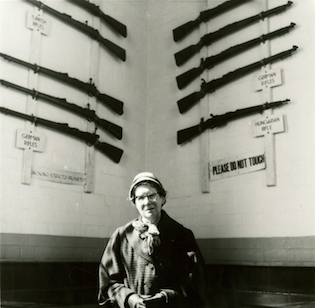
Larkin's mother Eva / Courtesy of the estate of Philip Larkin

That photo—tame by today’s standards, but sufficiently exciting for Larkin to joke sweatily in the poem, "So I am left … To wonder if you’d spot the theft/Of this one of you bathing …"—is included in The Importance of Elsewhere, a selection of Larkin’s photography (the poet was what you could call a "serious amateur") accompanied by biographical material by Richard Bradford. It is no overstatement to say that this selection is dominated by women, from Eva, the mother on whom Larkin doted, to the dizzying series of ladies he chased and occasionally even obtained. Besides Winifred, here we see Ruth and Jane, Patsy—a South African who happened to be married—Judy, Betty (Larkin’s longtime secretary), Maeve, and, of course, Monica Jones.

Larkin photographed them all, and there are some awkward implications conveyed here: Bradford illustrates how Monica, Patsy, and another woman as yet unidentified by scholarship were all snapped by Larkin in the room he rented in Belfast while working at Queen’s—and all in very similar poses. As in life, so in these photos: Monica is a considerable force. The longest serving of Larkin’s girlfriends, she carried on with him from his twenties to his final ambulance ride, despite numerous physical and emotional infidelities.

Loathed by Larkin’s intimate Kingsley Amis, who preferred ditzier girls who didn’t occupy his friend’s best attentions, she found herself cruelly (and unfairly) pilloried in Lucky Jim as the histrionic, louche Margaret Peel. But far from hysterical, Monica—Oxford educated like Phili, and a University lecturer in English—was devoted and possessed considerable character. She was also the only one of Larkin’s women who had the capacity to appreciate just what he was achieving.

It is remarkable that she also had the humanity to stress that none of those achievements were necessary grounds for her admiration. Consider this letter, included by Bradford, written by Monica after she heard Philip reading the bleak, ironic (evergreen commentary on a Larkin poem, that) Mr Bleaney on the BBC in 1955:

Mr Bleaney sounded so very like you – yr catalogue of the room’s shortcomings! Like you & like me – I smiled at the radio as if I were smiling at you as it was read. And I like your poetry better than any that I ever see – oh, I am sure that you are the one of this generation! I am sure you will make yr name! … Oh Philip – I don’t know what to say. You will believe me because you know it doesn’t make any difference to me whether you are or not, I shouldn’t think any less of your value if yr poems seemed to me bad & if everyone said so…

Monica’s presence in these photographs—intelligent, self-possessed, witty, often sad—gives some credit to Larkin’s line about "a real girl in a real place": she looks exactly as you would expect such a woman to look, and here one can see her grow from a young, newly appointed lecturer who has dressed for a date—and who has an obvious crush on her photographer—to a woman at the wrong end of middle age, wearing a house dress and staring out a window (something that comes up from time to time in Larkin’s poems) with a featureless expression.

For all the voyeuristic pleasures of these photographs, I can’t recommend putting too much trust in the commentary. Bradford’s control of detail in his earlier full-dress biography of Larkin was described by one critic at the time as "sketchy," and I cannot report that the situation is different here—nor does Bradford appear to have been much aided by his present editors.

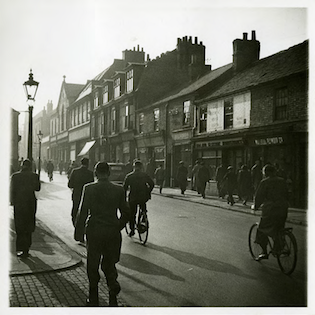
Fans of Leicester City on their way to the club ground / Courtesy of the estate of Philip Larkin

The problems begin when the author of the book’s foreword is alternatively described as Mark Hayworth-Booth or Mark Haworth-Booth, depending on which page you happen to encounter his name. (I believe that the latter is correct.) Turning to the text itself, at one point Bradford says of Larkin, "He wrote in Further Requirements…" This is, at best, embarrassingly imprecise. Further Requirements, a collection of miscellaneous short prose, was published years after Larkin’s death; Bradford is referring to one piece included in that collection.

Such imprecision doesn’t inspire one to allow much benefit of the doubt when one sees, on pages that face one another, two photographs of Monica described as being taken three years apart, even though her hair, jewelry, glasses, and overall presentation appear to be identical. Finally, for a book about photographs taken by someone who, though an amateur, was nonetheless devoted to his hobby, it is nowhere clear that Bradford has anything to say about, well, photography.

The text is at its best when it directly treats the connections between the photographs and Larkin’s literary work, of which there are many: lonely churches and rail lines abound here. But too often the words seem meant to fill space, usually with information one could find in Bradford’s earlier book, or indeed in the more recent (and quite good) biography by James Booth. There is a really fine book to be got out of the relationship between Larkin’s photography and poetry. Someone should write it.


FREEBEACON


Wednesday, July 19, 2023

A New Life of Philip Larkin / Review


Philip Larkin


Review: A New Life of Philip Larkin

Aaron MacLean

November 21, 2014

After taking a bad fall in his downstairs bathroom, the poet Philip Larkin was rushed to the hospital on the night of 29 November 1985. Having actively contemplated death for most of his 63 years, he now felt—accurately—that his moment of expiration was approaching. In the ambulance, he begged his longtime companion Monica Jones, who rode to the hospital with him, to destroy his diaries.After Larkin’s death a few days later, Monica complied, turning the diaries over to his secretary—who happened to be another 'longtime companion' of Larkin's, Betty Mackereth. Mackereth spent an entire afternoon shredding and incinerating their contents.

But Larkin had said nothing about the letters in his possession, nor—of course—was there anything he could have done about the vast amount of correspondence he had mailed to others over the years. Decades earlier, in a poem he had composed on the occasion of his 31st birthday, Larkin had written:

Ends in themselves, my letters plot no change;
They carry nothing dutiable; they won’t
Aspire, astound, establish or estrange.

How wrong he was. When Andrew Motion’s biography of Larkin was published in the early nineties, readers were astounded—even scandalized—by revelations drawn from Larkin’s correspondence, which included a dizzying number of romantic connections, and quite a few of them conducted simultaneously, for a man with such a fusty public image. There was less evidence of much actual sex having occurred, but the letters between Larkin and his circle of literary friends more than made up for that with a generous dose of explicit talk that showed a certain lack of interest in what most would consider conventional behavior.

Consider this passage from a 1949 letter to Larkin from his friend Kingsley Amis, discussing the availability of Amis’ wife for some amateur photography:

I have asked Hilly about your dirty-picture proposal, and obtained a modified assent. She is prepared to do corset-and-black-stocking or holding-up-a-towel stuff, and bare-bosom stuff…but is a bit hesitant about being quite undraped, "though I’ll probably get bolder when I start." Does this give you the hron? It does me, slightly, oddly. Do you want "some of us together"? ("Why you narcissistic—").

The next year, Hilly herself wrote to Larkin while frustrated with her husband’s serial infidelities, musing that, "I’ve got a weekend off in April when I shall be going to London, I dream that I’m meeting you there, & that we’ll have loads to drink & then go to bed together, but alas, only a dream." And Larkin’s correspondence with the Amis’s almost pales in comparison to his letters with the writer Robert Conquest.

In his biography, Motion seemed to enjoy leveraging the angle of scandal for most of what it was worth. To some extent, a hard hit on Larkin was unavoidable, considering the available evidence. What can be said positively, or even neutrally, about a man who, in the aftermath of his married girlfriend’s miscarriage in 1952—the child was likely his—wrote in a letter that, "I fancy you should be thankful…you would have got pretty tired of ‘a lifetime of deceit’, which really is what it would’ve turned out to be." The letter is illustrated by two drawings from Larkin, the first of an adult seal smiling at a baby seal, and the second of the grown-up seal waving good-bye to the baby.

Some things are just not right.

Motion’s approach—as critical reviews noted at the time—lacked balance. For one thing, Motion oddly missed much of Larkin’s irony and humor, much of it self-deprecating, and seemed to assume that the gathering bitterness of Larkin's later years had been the norm throughout his life, despite abundant evidence of altogether healthy relations he maintained with both colleagues and loved ones. (His most frequent correspondent was his widowed mother, to whom he sent more than 4,000 dispatches.)

James Booth’s new biography, Philip Larkin: Life, Art, and Love, sets out explicitly as a corrective. Booth—at one time an English professor at Larkin’s university, Hull, as was Motion, briefly—is the literary adviser to the Philip Larkin Society, and so we readers must settle for a compromise: We know that there is going to be a fannish element to the approach, but can also expect mastery of the material. There appears to be much mastery and also a self-conscious effort on the part of the author to moderate his natural apologetic impulse. The resulting volume is engaging: mostly judicious, light on faults, and heavy on fair, even illuminating, observations.

Booth’s surest terrain is his sense for Larkin’s humor and its role in his complex rhetorical strategies, which differed with every correspondent. Speaking of an interview Larkin gave to the press in his final years, Booth points out that, "Sincerity and irony are blended in an inscrutable mix," but this is an observation that could have applied to virtually everything he wrote, in his poems, his letters, and, for that matter, the letters his literary friends wrote to him. As those familiar with a certain sort of witheringly dry English humor know, there is absolutely no way to be sure just how serious Amis is when, for example, he speaks of the plans to involve his wife in taking dirty pictures for Larkin.

This ambiguity extends to the poetry. It is often a challenge to determine just how serious Larkin is there, or even if he always knew just where he had left the line drawn between sincerity and irony. This applies not only to obviously semi-humorous efforts like 'This Be The Verse,' but also to more ostensibly grand affairs like 'An Arundel Tomb', where the narrator stands before the grave of a medieval wedded pair who are depicted—in an intimate detail wrought by the 14th century sculptor—holding hands. The final stanza concludes with a typically Larkinian crescendo:

Time has transfigured them into
Untruth. The stone fidelity
They hardly meant has come to be
Their final blazon, and to prove
Our almost-instinct almost true:
What will survive of us is love.

Incautious readers have long finished the poem feeling buoyed by that last line, having missed the import of the two almosts that precede it.

Keeping track of his irony must have been only marginally more difficult for Larkin than keeping track of his women. Monica Jones, a brilliant but difficult academic, was the longest serving companion of Larkin’s maturity, and the only one who was his intellectual peer. She was never granted her desire that she and Larkin marry, and had to share him with others—though it seems that he was principally an emotional Lothario rather than a physical one. Monica’s main competition was initially Maeve Brennan, a woman of serious Catholic principles (hence the limited physical dimension to the affair) who worked for Larkin at Hull, where he was the university librarian. Later, both Maeve and Monica had to share time with Betty Mackereth, the secretary who destroyed Larkin’s diaries at Monica’s request.

Booth navigates these unstill waters with care, defending Larkin from the more unbalanced and hypocritical censures of his critics, while presenting the affairs as the record seems to show they were: dishonest and often dishonorable, but also decades-long sources of frequent warmth and purpose to their participants. At times Booth lapses, attempting even to defend Larkin from the poet's own self-criticism when he wrote in a letter of his simultaneous involvement with Monica and Maeve, that

There isn’t any need to make my situation any better-sounding than it is: a self-centered person conducting an affair containing almost no responsibilities with one girl getting mixed up with another, heedless of the feelings of either. Well, not heedless, but not heedful enough to do anything about it, anyway.

This seems about right. Of the poetry, Booth provides thought-provoking and sometimes persuasive readings anchored almost always to the biographical circumstances surrounding the composition of a poem. With Larkin, who asserted that he wrote "poems to preserve things I have seen/thought/felt…both for myself and for others, though I feel that my prime responsibility is to the experience itself," this approach seems particularly appropriate.

When Booth goes wrong it is, usually, at moments of ill-restrained enthusiasm, and there is an unfortunate (though useful, in a sense) tendency towards relying at such moments on unpardonable clichés: noting that the poem 'Days' is a "timeless masterpiece," or that another effort involved Larkin having "pulled out all the organ stops" (at least that "organ" is in there) or otherwise having "cast discretion to the winds," so as better to "let rip," perhaps while "spoiling for a fight." And I will be happy never to encounter the word "Lawrentian" in print again.

But the pleasures of the book are many. One is being reminded of less prominent Larkin poems unpublished in his lifetime and less-frequently mentioned than show-stoppers like 'An Arundel Tomb.' Consider the brief, untitled elegy he wrote shortly after the death of his father in 1948:

An April Sunday brings the snow,
Making the blossom on the plum trees green,
Not white. An hour or two, and it will go.
Strange that I spend that hour moving between 

Cupboard and cupboard, shifting the store
Of jam you made of fruit from these same trees:
Five loads—a hundred pounds or more—
More than enough for all next summer’s teas, 

Which now you will not sit and eat.
Behind the glass, under the cellophane,
Remains your final summer—sweet
And meaningless, and not to come again.

For a work that he considered either too weak—or too personal—to publish, there is so much that is typically Larkin here, from its plainspokenness to the suburban "cellophane," the fascination with death and the threat of nihilism. There is also its gentle Englishness, and it is hard to read it without thinking of the wild poem written by the Welshman Dylan Thomas—whom Larkin admired—at the prospect of his own father’s death, 'Do Not Go Gentle Into That Good Night,' only three years later.

Larkin never married or had a child, and his horror of such possibilities, along with his fascination for those who took such a path, infused much of his poetry. When he died, Monica took charge, and had him buried with a simple headstone identifying him simply as a ‘Writer.’ Booth describes how the complicated ironies of Larkin’s life extended even into the cemetery. When Monica died in 2001, she had herself buried in a plot near Larkin’s. Maeve followed in 2003, and was interred with the man she took up with after Larkin only a few graves away from both Monica and the poet. (At the funeral, Booth reports that Betty Mackereth had "commented wickedly: ‘Now nobody can contradict me.'")

Maeve—a sweeter, simpler woman than Monica, and one who did not catch every implication of Larkin’s work—had the last line of 'An Arundel Tomb' ("What will survive of us is love") inscribed on her own headstone. Booth notes that Maeve had always been earnest that ‘Philip really did mean' what he had written, insisting that there was no irony in the line. One can hear the ghostly less deceived snort across the grass from Monica’s grave…

One wonders if Larkin would have sighed or inwardly chuckled at this—or both.


FREEBACON