One day you finally knew what you had to do, and began, though the voices around you kept shouting their bad advice – though the whole house began to tremble and you felt the old tug at your ankles. "Mend my life!" each voice cried. But you didn't stop. You knew what you had to do, though the wind pried with its stiff fingers at the very foundations – though their melancholy was terrible. It was already late enough, and a wild night, and the road full of fallen branches and stones. But little by little, as you left their voices behind, the stars began to burn through the sheets of clouds, and there was a new voice, which you slowly recognized as your own, that kept you company as you strode deeper and deeper into the world, determined to do the only thing you could do – determined to save the only life you could save.
There are lone cemeteries. tombs full of soundless bones, the heart threading a tunnel, a dark, dark tunnel: like a wreck we die to the very core, as if drowning at the heart or collapsing inwards from skin to soul. There are corpses clammy slabs for feet, there is death in the bones, like a pure sound, a bark without its dog, out of certain bells, tombs swelling in this humidity like lament or rain. I see, when alone at times, coffins under sail setting out with the pale dead, women in their dead braids, bakers as white as angels, thoughtful girls married to notaries, coffins ascending the vertical river of the dead, the wine-dark river to its source, with their sails swollen with the sound of death, filled with the silent noise of death. Death is drawn to sound like a slipper without a foot, a suit without its wearer, comes to knock with a ring, stoneless and fingerless. comes to shout without a mouth, a tongue, without a throat. Nevertheless its footsteps sound, and its clothes echo, hushed like a tree. I do not know, I am ignorant, I hardly see but it seems to me that its song has the colour of wet violets, violets well used to the earth, since the face of death is green, and the gaze of death green with the etched moisture of a violet's leaf and its grave colour of exasperated winter. But death goes about the earth also, riding a broom lapping the ground in search of the dead - death is in the broom, it is the tongue of death looking for the dead, the needle of death looking for thread. Death lies in our cots: in the lazy mattresses, the black blankets, lives at full stretch and then suddenly blows, blows sound unknown filling out the sheets and there are beds sailing into a harbour where death is waiting, dressed as an admiral.
You do not have to be good. You do not have to walk on your knees for a hundred miles through the desert repenting. You only have to let the soft animal of your body love what it loves. Tell me about despair, yours, and I will tell you mine. Meanwhile the world goes on. Meanwhile the sun and the clear pebbles of the rain are moving across the landscapes, over the prairies and the deep trees, the mountains and the rivers. Meanwhile the wild geese, high in the clean blue air, are heading home again. Whoever you are, no matter how lonely, the world offers itself to your imagination, calls to you like the wild geese, harsh and exciting -- over and over announcing your place in the family of things.
Margaret Atwood on grief, poetry and the past four years
In an exclusive new poem and essay Margaret Atwood reflects on the passing of time and how to create lasting art in a rapidly changing world
Saturday 7 November 2020
I can say with a measure of certainty – having consulted my poor excuse for a journal – that my poem “Dearly” was written in the third week of August 2017, on a back street of Stratford, Ontario, Canada, with either a pencil or a rollerball (I’d have to check that) on some piece of paper that may have been anything from an old envelope to a shopping list to a notebook page; I’d have to check that as well, but I’m guessing notebook. The language is early 21st-century Canadian English, which accounts for the phrase “less of a shit”, which would never have been used in, for instance, Tennyson’s “In Memoriam AHH”; though something like it might have appeared in one of Chaucer’s more vernacular tales – “lesse of a shitte”, perhaps. This poem was then taken out of a drawer, its handwriting more or less deciphered by me, and typed as a digital document in December 2017. I know that part from the date and time identifier on the document.
The poem was composed much as described at the beginning of it. I was indeed making my way along the sidewalk, rather slowly. My knees were in poor condition due to my having recently spent five hours in a twisted position in the back seat of a car with a one-and-a-half-year-old, with a bunch of luggage piled on top of me. (Improved now, thanks. Or the knees are.) I was in fact carrying half a cup of coffee in a takeout cup with a regrettable plastic lid. (Better options are available now, thanks to the justifiable uproar over plastic pollution.) Slow walking leads to rumination, which leads to poetry. Park benches are my friends, and it wasn’t raining. Scribbling ensued.
Why was I walking alone, and not with Graeme Gibson – with whom I’d walked many hundreds of miles, ever since 1971, in places as diverse as Scotland, Orkney, Cuba, Norfolk, the mid-north mixed forest Canada, southern France, the Canadian Arctic, and the Northwest Territories? Walking had been one of our chief joys – that and canoeing – until his knees started to go, earlier than mine. So he was at the bed and breakfast in Stratford which we had been going to for some years, and I had hobbled out for supplies, fuelling myself with caffeine along the way.
We were in Stratford on our annual visit to see a mix of Shakespeare, musicals, and surprises. Was I also giving a talk? Probably, since I’d just published Hag-Seed, my modern-novel riff on Shakespeare’s The Tempest, the year before – set, not coincidentally, at a festival that bears more than a passing resemblance to the Stratford, Ontario one. Watching Shakespeare, researching Shakespeare, writing about Shakespeare – it’s a short leap to the contemplation of obsolete words, words that are fading, the malleability of language, all language – “gay” used to mean “happy”, and it once referred to the demimonde – and from that to the slipstream of time itself. We’re caught in time’s current. It moves. It leaves things behind.
Graeme Gibson with Atwood in Italy, December 2017.Photograph: Leonardo Cendamo/Getty Images
That’s the foreground. In the near distance, Graeme had received a diagnosis of dementia in 2012, so we were five years into it. “What’s the prognosis?” he’d asked at the time. “Either it will go slowly, or it will go quickly, or it will stay the same, or we don’t know,” said the doctor. In August of 2017 it was still moving slowly enough, but the clock was ticking. We knew the what, but we didn’t know the when. As it turned out, Graeme was to die in almost exactly two years – in September 2019, two days after the London launch of my novel, The Testaments, he had a massive haemorrhagic stroke, typical of vascular dementia – and bowed out at about the time and in about the way he’d wanted to. Quick, relatively painless, and while he was still himself.
We’d talked about this a lot. We tried not to spend too much time under a pall of gloom.
We managed to do a lot of the things we wanted to do, and squeezed out enough happiness from hour to hour. Graeme was pre-mourned: all the poems about him in the book Dearly were written before he actually died.
At the same time, we were dealing with the MGM-Hulu television series of The Handmaid’s Tale – it had launched in April 2017 – and that in itself had been a blockbusting phenomenon. Its multiple wins at the Emmys were still in the future, as was the launch of the excellent mini-series made of Alias Grace – but both of them were still on my mind. Both were also backlit by the lurid glow cast by the 2016 presidential election, which I’d experienced like those nightmare movies where you’re expecting a girl to jump out of a cake and instead it’s the Joker. Had Clinton won the election, The Handmaid’s Tale TV series would have been framed as a bullet dodged. As things were, the viewership was not only very high but very horrified. However, few expected at this point that the efforts to undermine the foundations of American democracy – an independent, functioning media, a judiciary separate from the executive branch, a respect for the constitution and a military that owes its loyalty to the country as embodied in the constitution, not to some king or junta or dictator – would go as far as they were to go by November 2020.
Alias Grace, based on a real double murder of the mid-19th century, was also about to chime eerily, not only with the pussy-grabber-in-chief but also with the #MeToo uprising. The mini-series launched in September, the Harvey Weinstein allegations surfaced in October. But none of that had happened yet as I was limping along the street, meditating on the fading word, “dearly”.
Sarah Gadon in the TV adaptation of Alias Grace.Photograph: Sabrina Lantos/Netflix
What else was I doing in August 2017? I’d started my novel, The Testaments, about a year before – before the election, but in the lead-up to it. Having said for more than 30 years that I wasn’t going to write a sequel to The Handmaid’s Tale, and having thought that, in the 1990s after the end of the cold war, the world was moving away from dictatorships, I’d watched things turn around again after 9/11. Successful coups are staged at times of chaos, fear and social discontent, and by August 2016, we were already seeing a lot of that, not only in the US but around the world. We already knew, back in 1985, that the world of Gilead came to an end – otherwise it would not have been the subject of an academic symposium some 200 or more years later – but we did not know how. In August, I was in the initial or “mud pie” phase of exploring the possibilities, but I was not to send a one-pager to my publishers until February of 2017.
You can’t work easily on a novel while watching two plays a day. You can, however, scribble poetry. And so I did.
Here, then, is “Dearly”: a poem that’s part of its own zeitgeist, while claiming not to be part of it. It’s not exactly a memento mori; more like a memento vita.
To quote Ursula Le Guin (whose obituary I would shortly write, though that, too, had not yet happened), “Only in dark the light. Only in dying life.”
Poems – like everything else – are created in a particular time. (Two thousand BC, AD800, the 14th century, 1858, the first world war, and so on.) They’re also written in a place (Mesopotamia, Britain, France, Japan, Russia); and beyond that, in a location where the writer happens to be (in a study, on a lawn, in bed, in a trench, in a cafe, on an airplane). They are often composed orally, then written down on a surface (clay, papyrus, vellum, paper, digital screen), with a writing implement of some kind (stylus, brush, quill pen, steel nib, pencil, rollerball, computer), and in a particular language (Ancient Egyptian, Old English, Catalan, Chinese, Spanish, Haida).
Beliefs about what a poem is supposed to be (praising the gods, extolling the charms of a beloved, celebrating warlike heroism, praising dukes and duchesses, tearing strips off the power elite, meditating on nature and its creatures and botany, calling on the commoners to rebel, hailing the Great Leap Forward, saying blunt things about your ex and/or the patriarchy) vary widely. How the poem is supposed to accomplish its task (in exalted language, with musical accompaniment, in rhyming couplets, in free verse, in sonnets, with tropes drawn from the word-hoard, with a judicious number of dialect, slang, and swear words, ex tempore at a slam event) are equally numerous and subject to fashion.
Mesopotamian terracotta plaque of a goddess, known as the Queen of the Night, British Museum.Photograph: Adam Eastland Art + Architecture/Alamy
The intended audience may range from your fellow goddess priestesses, to the king and court of the moment, to your intellectual workers self-criticism group, to your fellow troubadours, to fashionable society, to your fellow beatniks, to your creative writing 101 class, to your online fans, to – as Emily Dickinson put it – your fellow nobodies. Who can get exiled, shot, or censored for saying what has also veered wildly from time to time and from place to place. In a dictatorship, uneasy lies the bard that bears the frown: the wrong words in the wrong place can get you into a heap of trouble.
So it is with every poem: poems are embedded in their time and place. They can’t renounce their roots. But, with luck, they may also transcend them. All that means, however, is that readers who come along later may appreciate them, though doubtless not in the exact way that was first intended. Hymns to the Great and Terrible Mesopotamian Goddess Inanna are fascinating – to me at least – but they don’t cause the marrow to melt in my bones as they might have done for an ancient listener: I don’t think Inanna may appear at any moment and level a few mountains, though I could always be wrong about that.
Despite the way the Romantics went on about timeless fame and writing for the ages, there’s no “forever” in such matters. Reputations and styles rise and fall, books get spurned and burned, then unearthed and recycled, and today’s singer for eternity is likely to end up as the day after tomorrow’s fire starter, just as the day after tomorrow’s fire starter may be snatched from the flames, extolled and embossed on a plinth. There’s a reason the Wheel of Fortune in the tarot pack is, in fact, a wheel. What goes round comes round, at least sometimes. It’s not called the Inevitable Straight Road Pathway to Fortune. There isn’t one.
That advance warning having been issued, I’ll quote the postman in the filmIl Postino, who’s nicked Neruda’s poems and ascribed them to himself in order to serenade his love. “Poetry doesn’t belong to those who write it,” he says. “It belongs to those who need it.” Indeed, after the poem has passed out of the hands of the one who’s written it down, and after that person may have departed from time and space and be wafting around as atoms, who else can a poem belong to?
For whom does the bell toll? For you, dear reader. Who is the poem for? Also for you.
Dearly
By Margaret Atwood
It’s an old word, fading now. Dearly did I wish. Dearly did I long for. I loved him dearly.
I make my way along the sidewalk mindfully, because of my wrecked knees about which I give less of a shit than you may imagine since there are other things, more important – wait for it, you’ll see –
bearing half a coffee in a paper cup with – dearly do I regret it – a plastic lid – trying to remember what words once meant.
Dearly. How was it used? Dearly beloved. Dearly beloved, we are gathered. Dearly beloved, we are gathered here in this forgotten photo album I came across recently.
Fading now, the sepias, the black and whites, the colour prints, everyone so much younger. The Polaroids. What is a Polaroid? asks the newborn. Newborn a decade ago.
How to explain? You took the picture and then it came out the top. The top of what? It’s that baffled look I see a lot. So hard to describe the smallest details of how – all these dearly gathered together – of how we used to live. We wrapped up garbage in newspaper tied with string. What is newspaper? You see what I mean.
String though, we still have string. It links things together. A string of pearls. That’s what they would say.
How to keep track of the days? Each one shining, each one alone, each one then gone. I’ve kept some of them in a drawer on paper, those days, fading now. Beads can be used for counting. As in rosaries. But I don’t like stones around my neck.
Along this street there are many flowers, fading now because it is August and dusty, and heading into fall. Soon the chrysanthemums will bloom, flowers of the dead, in France. Don’t think this is morbid. It’s just reality.
So hard to describe the smallest details of flowers. This is a stamen, nothing to do with men. This is a pistil, nothing to do with guns. It’s the smallest details that foil translators and myself too, trying to describe. See what I mean. You can wander away. You can get lost. Words can do that.
Dearly beloved, gathered here together in this closed drawer, fading now, I miss you. I miss the missing, those who left earlier. I miss even those who are still here. I miss you all dearly. Dearly do I sorrow for you.
Sorrow: that’s another word you don’t hear much any more. I sorrow dearly.
He's a neglected but important modernist poet with an inspiring fidelity to the concrete details of the world
Billy Mills Tue 29 April 2008
News of a collection of essays by Michael Heller on the American poet George Oppen, published this month to mark the centenary of his birth, has sent me back to this key figure in 1930s American modernism.
Oppen was, with Louis Zukofsky, Carl Rakosi, Charles Reznikoff and others, one of the founding participants in what came to be known as Objectivist poetry, although he always denied that they represented a coherent movement. Oppen's first book, Discrete Series, was published in 1934 by the Objectivist Press, a venture he ran with Zukofsky and Reznikoff. Ezra Pound wrote a preface in which he saluted Oppen as "a serious craftsman" with a unique sensibility.
This was a pretty impressive start to a career, but for a long time it seemed like the promise would never be fulfilled. Discrete Series was a response to the political and economic circumstances that prevailed in the United States in the early 1930s. Shortly after its publication, Oppen andhis wife Mary, who was also a poet, abandoned artistic life for political activity and membership of the Communist party. Despite George's active service during the second world war, the Oppens were kept under FBI surveillance and by the end of the 1940s an appearance before the House Un-American Activities Committee was looming.
The Oppens decamped to Mexico, where George co-ran a furniture-making business. Towards the end of the 50s, he began writing again and in 1959 their FBI file was closed, allowing a return to New York. His second book, The Materials, appeared from New Directions[xi] in 1962, quickly followed by This in Which (1965) and Of Being Numerous, which won the Pulitzer prize for poetry in 1969.
Oppen was a compulsive reviser with an unusual method of building up versions of his drafts. Every time a line changed, he wrote or typed the new version on a strip of paper thin enough to be pasted down over the old one. As a result, his manuscripts resemble relief maps of the act of writing and rewriting. His effort, always, was to write what he called, in a poem called Psalm, "The small nouns / Crying faith". In other words, his language and poetry is tied to the concrete world of physical fact, wary of abstraction, and, in a sense that is much wider than the obvious political one, engaged. His poetry does not shun the difficult but is always concerned with clarity of expression, and in later years he fell out with Zukofsky, partly because he felt that the latter's work was veering towards the wilfully difficult for its own sake.
Oppen published three more collections and a Collected Poems during his life. In what was a bitter irony for one who paid such meticulous attention to words, he developed Alzheimer's disease, a condition that was to slowly deprive him of language over the last few years of his life. The posthumous New Collected Poems includes some previously unpublished poems from this difficult period. George Oppen died in a convalescent home in California on July 7, 1983.
"A swift, fleeting sense of the past is as near as I have ever got to a mystical experience," wroteHope Mirrleesin "Listening in to the Past", an essay published in 1926. A little later she describes her interest in creating an "aural kaleidoscope": "disparate fragments of Cockney, Egyptian, Babylonian, Provençal, ever forming into new patterns for the ear".
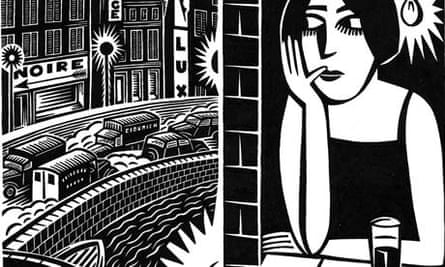
What this "mystical experience" might feel like, and what the "aural kaleidoscope" might look and sound like, can be seen in her long poem "Paris", written in 1919 and published by Virginia Woolf's Hogarth Press in 1920. Woolf called it "indecent, obscure, brilliant", and the poem describes (the word "describes" is inadequate: it dynamically enacts, verbally and with an array of compelling visual and typographical effects) a day in post-first world war Paris.
"Paris" is the product of immersion: not just in Parisian high culture, but in a seamier, more disjointed and immediate kind of metropolitanism. Voices, machine noises and musical notes are caught in mid-air, shreds of advertising, brand names, logos, street signs and even the lettering on monuments, are conveyed in poetry that takes liberties not just with standard verse forms, but with linear writing itself.
It's the Paris of Baudelaire, Rimbaud, Apollinaire, of cubism and surrealism, jazz culture and nightlife. It is a place of many pasts, with its ruins and its dead (there are several allusions to the war, and to the 1919 Paris peace conference), but also of multiple presents. Mirrlees writes from the point of view of the "flâneuse": dreamlike, but retaining the broken edges of urban experience, the almost filmic shifts between slow-motion and speedy blur.
The poem could be disorientating, but it holds together because Mirrlees lets us enter the dream, reassuring us from the start that any disorientation is part of the experience and not a barrier to it. "I wade knee-deep in dreams … the dreams have reached my waist", she writes, and there is a sense of a poetic voice being both crowded out and submerged. At the same time, she notes everything with precision: she sees, reads, hears, smells, tastes and touches, and there's an exhilarating mix of sophistication and rawness in the writing. One minute we're in the Louvre, the next we're catching wafts from the Paris sewers:
It is pleasant to sit on the Grands
Boulevards –
They smell of
Cloacae
Hot indiarubber
Poudre de riz
Algerian tobacco
There's a lot of poetic product-placement going on (usually for food and drink – this is a city to ingest, not just look at) and Mirrlees enjoys the siren song of consumerism, the closeness of advertising to art, of publicity slogans to poetry. In the line "The Scarlet Woman shouting BYRRH and deafening St John of Patmos", Mirrlees invokes a famous apéritif poster featuring a woman in a red dress beating a drum, and yokes it to the "scarlet woman" of the Book of Revelation. As with TS Eliot and other modernists, myth and reality, past and present, are not separated but braided together. The modernist experience, as distinct perhaps from the merely modern one, is grounded in a recognition that our lives today are lived alongside, rather than merely "after", our lives yesterday.
There is also a real engagement with lived reality: war, displacement, poverty, venereal disease, rural depopulation (Paris may be the world's artistic capital but it is also "a huge homesick peasant"), and urban hardship. The poem plays on metaphors of surface and depth: the Métro, the sewers, the shady demi-monde on the one hand, the art works, monuments, galleries on the other. The most ferocious instance of this metaphor comes in the line "Freud has dredged the river and, grinning horribly, / waves his garbage in a glare of electricity", where the unconscious is posited as modernity's own underworld, our own cloacae.
Despite this, the dominant feeling in the poem is of happy excess. There is no sense in Mirrlees, which we find in her friend Eliot, that modern life cheapens and dulls us. On the contrary, there is always more in one minute of modern life – "Little funny things ceaselessly happening" – than there is space for in any book, symphony or canvas. "Paris" predatesThe Waste Landby two years, and though it is less achieved and resonant than Eliot's poem, it is, in an English context, just as experimental and unprecedented. It is also full of wit, freshness and clever bilingual punning – "silence of the grève" for a workers' strike, "an English padre tilt[ing] with the Moulin Rouge", it is a sort of cousin to The Waste Land, and perhaps even its optimistic antidote.
Mirrlees was born in Kent in 1887, and died in 1978. After "Paris", she published no poetry for nearly 50 years, and her poems of the 60s bear no sign of her earlier radicalism, though many are impressively stringent in their thinking.
This edition includes several essays, an introduction by Sandeep Parmar, and a definitive commentary on "Paris" by Julia Briggs, who did more than anybody else to bring Mirrlees out of obscurity. It is a pleasure to see Briggs's careful, elegant advocacy of what she calls Mirrlees's "lost modernist masterpiece" finally bear fruit in this fine edition.
• Patrick McGuinness's Jilted City is published by Carcanet.
Two women with the same claim came to the feet of the wise king. Two women, but only one baby. The king knew someone was lying. What he said was Let the child be cut in half; that way no one will go empty-handed. He drew his sword. Then, of the two women, one renounced her share: this was the sign, the lesson. Suppose you saw your mother torn between two daughters: what could you do to save her but be willing to destroy yourself—she would know who was the rightful child, the one who couldn’t bear to divide the mother.