Sunday, December 12, 2021

Heather Clark’s ‘Red Comet’ is an exhaustively researched, often brilliant biography of Sylvia Plath


Sylvia Plath


Heather Clark’s ‘Red Comet’ is an exhaustively researched, often brilliant biography of Sylvia Plath


By Paul Alexander
October 28, 2020


Almost six decades after her death, Sylvia Plath stands as the most consequential poet of her generation. As a feminine voice, she dominates the 20th century the way Emily Dickinson did the century before. At the time of Plath’s death at age 30, critic A. Alvarez wrote, “The loss to literature is inestimable.” The years have proved him right.

Because of the importance of her work — her “Collected Poems” won the Pulitzer Prize and her novel, “The Bell Jar,” is a coming-of-age classic — and because of the sensational circumstances of her death, an extraordinary amount of attention has been paid to Plath in both the academic and mainstream press. So many biographies have appeared that Janet Malcolm produced “The Silent Woman” (1994), a study of Plath biography, with writers like “Bitter Fame” author Anne Stevenson suffering Malcolm’s brutal hit-and-run treatment.

Now, into the breach, comes Heather Clark’s “Red Comet: The Short Life and Blazing Art of Sylvia Plath,” an exhaustively researched, frequently brilliant masterwork that stretches to 1,072 pages (including notes). It is an impressive achievement representing a prizeworthy contribution to literary scholarship and biographical journalism.

“Red Comet” thoroughly chronicles all stages of Plath’s life. An idyllic childhood on the Massachusetts coast near Boston was shattered by the early death of her father, Otto Plath, a biologist who misdiagnosed himself with cancer only to die of — as Clark reports finding in the death certificate — “diabetes mellitus and bronchial pneumonia, due to gangrene in the left foot.”

Plath’s now-single mother, Aurelia, moved with the children, Sylvia and Warren, to Wellesley, Mass., where Sylvia graduated from high school. Plath’s stellar academic career at Smith College, a school for women in Northampton, Mass, was marred in the summer of 1953 by an unsettling guest editorship at Mademoiselle that led to a nervous breakdown and a suicide attempt. “I swallowed quantities [of sleeping pills] and blissfully succumbed to the whirling blackness,” Plath wrote to a friend. These events later inspired “The Bell Jar.”

Plath’s marriage to poet Ted Hughes, whom she met while on a Fulbright scholarship to Cambridge University, produced two children (Frieda and Nicholas) and two historic bodies of work. But the marriage’s end caused a searingly intense unhappiness that ultimately consumed them both. The unraveling began in May 1962 in Devon, where the Hugheses were living in a thatched-roof country house. Assia Wevill, an aspiring poet, and her husband, David, a Canadian poet, who were subletting the Hugheses’ London flat, came for a visit. “Ted kissed me in the kitchen, and Sylvia saw it,” Clark quotes Assia as telling David. It was the start of an affair.


The following months saw Plath descend into despair as she endured what she viewed as Hughes’s continued betrayal. While still seeing Assia, he began dating Susan Alliston, also an aspiring poet. That Hughes was simultaneously pursuing two women known to Plath was a source of acute humiliation. A breaking point came in early 1963 when Plath learned that Assia was pregnant.

The cacophony of emotions generated by Hughes’s romantic entanglements were made worse by hardships resulting from the weather — the harshest winter to hit London in a century meant frozen pipes and no heat — and her medication, a cocktail of four drugs that made her more, not less, depressed.

Living again in London, her “madness” having returned, Plath decided to end her life. On the morning of Feb. 11, 1963, with her children secured in an upstairs bedroom, she sealed herself in the kitchen, lay on the floor, and turned on the gas in the oven. “As she died,” Clark writes, “the sun rose out the large window to her left, flooding the kitchen with light.”

Portions of “Red Comet” are deeply moving, but a tendency to downplay Hughes’s violence will likely attract critics. In May 1958, when Plath was teaching at Smith, she saw Hughes strolling on campus with a student. The ensuing altercation caused Plath to report in her journal that the fight left her with a strained thumb and Hughes with claw marks on his cheeks. “I remember,” Plath wrote, “hurling a glass with all my force across a dark room; instead of shattering the glass rebounded and remained intact: I got hit and saw stars.” Clark writes of the passage: “Plath’s colon suggests that she ‘got hit’ by the ricocheting glass, not by Hughes” — a conclusion contrary to the one many other readers have reached. Another episode, which Plath described in no uncertain terms, occurred in February 1961, when Hughes beat Plath so severely she suffered a miscarriage. “Red Comet” reviews the evidence but offers an apologia from Frieda Hughes, who contends that “my father was not the wife-beater that some would wish to imagine he was.”

On that point, one central question has loomed since Plath’s death: What role did Hughes play, intentionally or not, in her death? “Red Comet” reports what Hughes said on the matter. “No doubt where the blame lies,” Hughes wrote to a friend. “It doesn’t fall to many men to murder a genius,” Hughes said to Plath’s friend Elizabeth Compton, adding on another occasion, “I feel like a murderer.” To Aurelia Plath, Hughes wrote: “[I]f there is an eternity, I am damned in it. Sylvia was one of the greatest truest spirits alive.”

In a letter to the Observer newspaper (never mailed) that was meant to thank Plath’s friends and neighbors, Aurelia seemed to concur: “Those who systematically and deliberately destroyed her know who they are.”

Plath’s loss continues to resonate. “With each passing decade,” Clark concludes, “Sylvia Plath’s work seems more astonishing, and its achievements harder earned. . . . Let us not desert her.”

Paul Alexander is the author of “Rough Magic,” a biography of Sylvia Plath, and “Edge,” a one-woman play about her. The editor of “Ariel Ascending: Writings About Sylvia Plath,” he teaches at Fordham University and Hunter College.

Red Comet
The Short Life and Blazing Art of Sylvia Plath
By Heather Clark
Knopf. 1,118 pp. $40

Saturday, December 11, 2021

How do we tell the story of Sylvia Plath?


How do we tell the story of Sylvia Plath?

Variously depicted as a victim or a villain, perhaps no other writer has an afterlife more contested than Plath. 

By Anna Leszkiewicz
14 October 2020

Sylvia Plath is standing in her vegetable garden. It’s a warm summer evening in Devon. In her arms she holds a great bundle of loose papers. At her feet, a bonfire blazes. While her mother and her daughter watch from the kitchen, she tears up page after page of writing. Leaning over the bonfire, she sets the papers alight and watches them burn.

As far as we know, this really did happen – in July of 1962, the year that Plath wrote many of her most famous poems. But the details are hazy. Depending on who you believe, the papers she held in her arms that day were either: love letters between Plath’s husband Ted Hughes and another woman; drafts of Hughes’s poems; bits of Hughes’s hair and skin scraped from his office desk; all of Plath’s letters from her mother; the entire manuscript of an unpublished Plath novel – or a combination of all the above.

Biographers argue over whether the burning was an act of jealous hurt, vindictive rage, mourning, or even witchcraft. For some, it is little more than a colourful anecdote, a footnote in one of Plath’s minor poems. For others, this is the turning point of the Plath-Hughes marriage, the moment when it went up in flames.


The fundamental question of biography is one of material. Claire Tomalin based much of her biography of Nelly Ternan, an actress and Charles Dickens’s mistress, on Dickens’s one surviving diary – a “very small booklet – 10 x 5½ centimetres”, which scholars have squeezed “like a tiny sponge for every drop of information it can yield”. Virginia Woolf had the opposite problem: when she sat down to write the life of Roger Fry, she was dismayed by the “thick hedge” of his letters: “three large brown boxes of Fry” and “a whole room full more”. In the case of Sylvia Plath, the question of material is particularly fraught. Though the amount of Plath’s work published in her lifetime was small, far more has become available in the decades since her death: poems, prose, letters and journals. Even more remains unpublished.

When writing about Plath, there is an overwhelming amount of personal, compelling archive material to draw on – but even more provocative are the absences. In his foreword to the 1982 Journals, Ted Hughes explained (in a telling use of the third person) that although Plath wrote two more journals, covering the last three years of her life, “the second of these two books her husband destroyed, because he did not want her children to have to read it… The earlier one disappeared more recently (and may, presumably, still turn up)”. The missing journals, with their promise of insight into Plath’s state of mind in the months before her death, haunt the imaginations of her readers. But the ghosts of other documents stand alongside them – the suicide note she may or may not have written; her unfinished novel, perhaps burned that night in July; and yet more missing letters, manuscripts and papers.

This would be enough to make any biographical work of Plath contentious and tantalising; but the scandal of Plath’s literary estate complicates the picture further. After Plath died intestate, custody of her work fell to Hughes, then her estranged husband; he appointed his sister Olwyn – who had repeatedly and dramatically clashed with Plath while she was alive – agent to the estate. Olwyn became Ted’s fiercest protector.

The Plath scholars Lois Ames and Harriet Rosenstein both began, but never completed, biographies of her. Edward Butscher, Plath’s first published biographer, bemoaned “the malevolent spread of the subterranean battles raging over Plath’s golden remains” and described Olwyn as “a veritable Cerberus unleashed”. Linda Wagner-Martin, whose 1988 biography was vehemently opposed by the estate, claims Olwyn and Ted pressured her to change her perspective, sending her a list of changes “that filled fifteen pages and would have meant a deletion of more than 15,000 words”. In a letter, Ted Hughes wrote Wagner-Martin was “so insensitive that she’s evidently escaped the usual effects of undertaking this particular job – ie, mental breakdown, neurotic collapse, domestic catastrophe”.

Most notorious of all is Anne Stevenson’s Bitter Fame (1989). Having at first secured the Plath estate’s enthusiastic cooperation, Stevenson then had a falling out with Olwyn, which culminated with Stevenson writing pleading, self-pitying letters to her: “Please respect me as the author of this book and cease to persecute me with unpleasant references to my ‘vapours’.” The book was eventually published with a note describing Olwyn’s contributions as so great as to have “made it almost a work of dual authorship” – reviewers described its attitude to Plath as “vengeful” and “harsh and reductive”.

The controversy is documented in detail in Janet Malcolm’s blistering work on Plath biographies, The Silent Woman, republished by Granta in April, which secured the infamy of the Plath estate. Broadly sympathetic to Hughes, The Silent Woman is also an attack on the idea of biography, which Malcolm sees as “voyeurism and busybodyism”; the biographer a “professional burglar, breaking into a house, rifling through certain drawers that he has good reason to think contain the jewellery and money, and triumphantly bearing his loot away”.

Apparently undeterred, half a dozen more biographers followed, mostly unauthorised. Most recently, Jonathan Bate eventually subtitled his 2015 Ted Hughes biography “The Unauthorised Life”, after the poet’s widow, Carol Orchard, withdrew the estate’s cooperation.

Now, into this thorny landscape, comes Heather Clark’s 1,000-page Red Comet: The Short Life and Blazing Art of Sylvia Plath. Sold by the publisher as “balanced, comprehensive and definitive”, it, too, is a reaction against the patronising and pathologising biographies that came before it. Clark entices us with the impossible: an “unbiased”, authorised biography of Sylvia Plath.


The events of Plath’s life will be familiar to many. She was born in Massachusetts in 1932 to an American mother, Aurelia, and a German father, Otto, who died when she was eight. Having excelled at school, she went on to attend the elite Smith College on scholarship, but, in 1953, had to take time out after a depressive episode that culminated in a suicide attempt. Plath was hospitalised for six months and received a traumatic course of electroshock therapy, before returning to Smith. She was awarded a Fulbright scholarship to study at Cambridge, where she met and married Ted Hughes, and began a dedicated effort to get their poetry published in the UK. Plath’s first collection of poetry, The Colossus, was released in 1960. She had two children with Hughes; their marriage ended in the summer of 1962. By October, Plath was writing the Ariel poems – including her best known works, such as “Daddy” and “Lady Lazarus” – at incredible speed. Fame came posthumously: she died in February 1963, having gassed herself in her London flat. This one, final fact overwhelms narratives of her life. The biographer Hermione Lee has said that women writers with mental health problems are “treated, biographically, as victims or psychological case-histories first and as professional writers second”. This is never more true than in the case of Sylvia Plath.

Plath supposedly built that bonfire in 1962 as her marriage was deteriorating. As this is the period covered by the missing journals, no record of it exists in her own words. Except, that is, for “Burning the Letters”, the only poem Plath wrote in August of that year. It opens with a speaker admitting: “I made a fire; being tired/Of the white fists of old/Letters and their death rattle.” Plath describes “spry hooks that bend and cringe” – in his biography, Jonathan Bate sees this as a reference to “the distinctive loops and jags of Ted’s handwriting”. The letters burn. “With the butt of a rake,” the speaker says, “I flake up papers that breathe like people”.

Plath and Hughes’s poems are often read as being in dialogue with one another. They are in conversation on the page, too: many of Plath’s drafts were written on the reverse of Hughes’s own drafts. “Burning the Letters” was composed on the back of, among others, “The Thought-Fox”, in which Hughes explores how an imaginary fox might be forever preserved in poetry. At the end of “Burning the Letters”, a fox is ripped to shreds by dogs. As it dies, the poem ends on a bitterly ironic note: its last howls are spent, “Telling the particles of the clouds, the leaves, the water/What immortality is. That it is immortal.” If Plath’s dying fox is Hughes’s thought-fox, “Burning the Letters” is about Plath’s destruction of Hughes’s work in more ways than one: it’s possible to read “Burning the Letters” as the beginning of Plath’s poetic as well as romantic breakaway from Hughes.

The story of Plath’s bonfire features in most of her biographies. Like people, they argue over the details. In Method and Madness, Butscher – who describes Plath’s late poetic voice in bluntly misogynistic terms – sees this as the moment when “the bitch goddess begins to emerge”. Linda Wagner-Martin, the first biographer to see Plath as a victim, writes that Plath was burning her own unfinished novel, “the book about her great love for Ted”. In Bitter Fame, Stevenson reverses the narrative again. Drawing heavily on the account of Plath’s friend Clarissa Roche, Stevenson writes that Plath “invaded” Ted’s study, stole his work, and “performed whatever rite of witchcraft she thought appropriate”, before a fragment of paper floated out from the flames bearing the name of Hughes’s mistress, Assia, revealing the truth of his affair.

The image of Plath performing “witchcraft” has proved too colourful to resist. Paul Alexander, in his sensational, novelistic Rough Magic writes that as Plath “threw handfuls of letters onto the flames, she began to dance around the bonfire”. Ronald Hayman’s The Death and Life of Sylvia Plath sees the bonfire as the moment that set Plath on the path to her death: “In lighting the bonfire she lit a fuse that would burn slowly towards… suicide.” In the 2004 film Sylvia, a stony-faced Gwyneth Paltrow tends the fire in a woollen jumper, throwing on to it a thick hardback and Hughes’s tweed jacket.

The film, like several biographies, seems to conflate the bonfire and another act of destruction. In February 1961, Plath (supposedly suspecting Hughes of a different, earlier affair) tore his manuscripts and his treasured Complete Works of Shakespeare to shreds. Jonathan Bate writes that Hughes’s “reaction on this occasion is not recorded, but long after Sylvia’s death he admitted to his American editor, Fran McCullough, that sometimes when Sylvia was in a blind rage, all he could do was slap her… A few days later, Sylvia miscarried her second baby


In her book The Haunting of Sylvia Plath, Jacqueline Rose writes, “Like the child caught up in a hideous divorce case between its parents, the writing of the life of Sylvia Plath… forces you – and makes it impossible for you – to take sides.” With Red Comet, Heather Clark hopes to break out of this dynamic. In her prologue, she insists that Plath was “neither fragile ingénue nor femme fatale… Rather, she was a highly disciplined craftswoman.” Clark sets out “to recover Sylvia Plath from cliché”.

Red Comet is the kind of serious literary biography Plath has long deserved but, until now, not received. By drawing on an enormous body of research (including Harriet Rosenstein’s recently rediscovered work, and a fragmentary draft of an unfinished novel discovered by Clark), and layering frequently contradictory accounts, Clark assembles a fuller and more complicated picture of Plath than any biographer, placing her in context, “in the sexist era in which she was trapped”. She avoids diagnosing Plath in detail, but does make persuasive new suggestions that Plath may have suffered from postpartum psychosis, and an unpredictable combination of medications, in the weeks before she died. Clark rejects the reductively psychoanalytic readings of Plath as the product of her parents and her marriage, and offers a more sensitive portrait of a woman shaped by a number of significant relationships (in particular with her high school teacher Wilbury Crockett, her patron Olive Higgins Prouty, and her therapist Ruth Beuscher). Her literary influences, too, are explored in far greater depth.

Clark takes Plath’s juvenilia far more seriously than her predecessors. One poem Plath wrote at 15 about a pastel drawing her grandmother accidentally smudged, gravely titled “I Thought That I Could Not Be Hurt”, is usually singled out for ridicule; for Clark, it “stands out as a creative experiment and an artistic turning point”. Crucially, she sees the poetry, letters and journals as literary projects in their own right, and notes that, in her final months, Plath’s “poetic and epistolary voices had begun to reflect each other”. The role Hughes (and, later, the Observer poetry editor Al Alvarez) had on her work is investigated with similar care. Clark portrays the Plath-Hughes marriage as one between “aesthetic collaborators”, shifting from dialogue to rivalry.

The blurb suggests that Clark is the first feminist biographer to have “clear-eyed sympathy for Hughes”. She is certainly extremely cautious about drawing conclusions from some of her most damning material. This is the first full biography to have been written since the publication of volume two of the Letters, in which Plath writes to her therapist that, in February 1961, two days before her miscarriage, “Ted beat me up physically” and, after Hughes’s affair, that her husband “was furious I didn’t commit suicide” and “told me openly he wished me dead”.

On this, Clark equivocates: “The couple was now at war.” She awkwardly links the incident to “the couple’s erotics of violence”. (Plath bit Hughes when they first met; their work has an understanding of the sexual frisson of violence.) Refusing to take on the role of the child caught up in a divorce, Clark instead passes the opportunity for judgement over to Plath and Hughes’s daughter (and the current executor of the Plath estate) Frieda Hughes, quoting from her introduction to the second volume of Letters. The first time Frieda read Plath’s accusation, she found it “intensely painful”. But Plath’s admission that “I had given him some cause, I had torn up some of his papers in half” provides context that “is vital, and it confirmed in my mind that my father was not the wife-beater that some would wish to imagine he was”. For Frieda, the destruction of “the thing they both knew was most precious – typescripts of their own work” was a crucial mitigating factor. She concludes, understandably, that her parents are “both flawed and impassioned human beings and I love them more for this”.


The image of Plath ripping and burning manuscripts is so vivid, and so unacceptable, that it fundamentally disturbs our understanding of her. It can transform her from a woman to a witch; a victim to a villain. It haunts us: Hughes, in his poem “Last Letter”, published posthumously in the New Statesman in 2010, writes that his final memory of Plath is of her burning a letter: “My last sight of you alive./Burning your letter to me, in the ashtray,/With that strange smile.” Her suicide on 11 February 1963 has a similar hold on our imagination. But Clark hopes we can hold other images of Plath in mind, too.

“It was on a less notorious early February day that I prefer to think of Sylvia Plath as I have come to know her during the eight years I spent writing this book,” Clark writes. She goes on to describe Plath on 10 February 1960, drinking champagne as she signed her first book contract in a London pub, dressed in a black wool maternity suit, a cashmere coat and calfskin gloves. She was, she wrote to her mother, “resplendent”. Other images stand out, too. Fourteen-year-old Plath copying out poems while sat in an apple tree. Plath wearing gloves at her typewriter in her Cambridge bedroom, barely able to move her fingers, ice forming on the windows. Plath on her 24th birthday, in a sleeveless velvet dress, eating smoked salmon and duck, drinking Chablis, and receiving a pack of tarot cards as a present. Plath and Hughes, strolling around London Zoo with Frieda in a pram.

In the last months of her life, Plath wrote for the New Statesman as a freelance critic. She reviewed a handful of biographies, including one of Isabella II of Spain, which she described as “a sustained barrage of broad facts, potted personalities and headline events, under which, like a sleight-of-hand phantom, Isabella flickers and fades”. Plath is vivid to us in her letters and journals; Frieda Hughes, on reading the letters, claims: “I was struck by the sensation of standing in the room with my mother; I could almost smell her.” But in biography, like a phantom, Plath can fade: always present, but never really there.

There are rare, shimmering moments where Clark succeeds in capturing Sylvia Plath. But she flickers. It’s only in Plath’s own work that we really see her; her presence radiating from the page, uneclipsed by her own myth. “Some girl a hundred years ago lived as I do. And she is dead,” Plath wrote, aged 17, in one of her earliest journal entries. “I am the present, but I know I, too, will pass. The high moment, the burning flash, come and are gone, continuous quicksand. And I don’t want to die.”

Red Comet: The Short Life and Blazing Art of Sylvia Plath
Heather Clark
Jonathan Cape, 1,152pp, £30

THE NEW STATESMAN


Friday, December 10, 2021

The art of Sylvia Plath


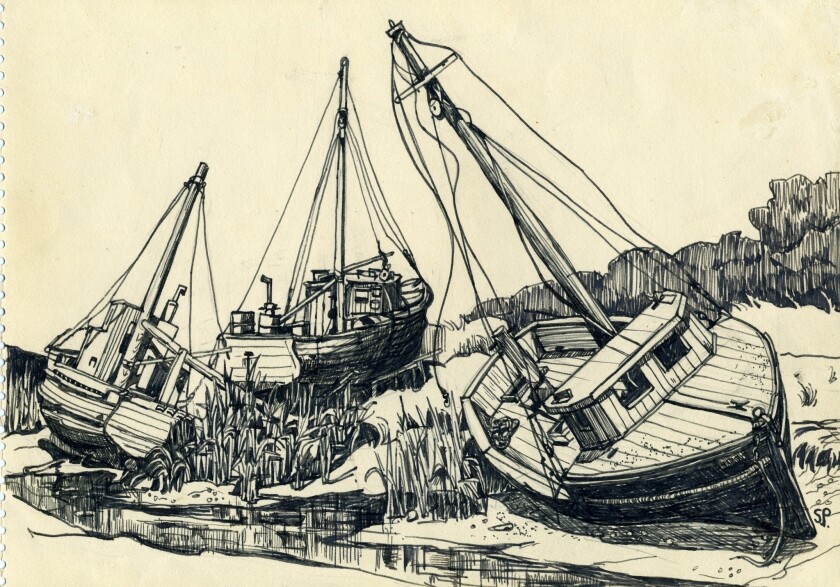
Sylvia Plath's pen and ink drawing, "Boat off Rock Harbour, Cape Cod."
(Estate of Sylvia Plath)

The art of Sylvia Plath


BY DAVID L. ULIN
DEC. 12, 2013 12 AM PT
LOS ANGELES TIMES BOOK CRITIC

Produced during the two years the poet spent on a Fulbright fellowship at Cambridge — the same period in which she met and married (secretly, at first) Ted Hughes — this material evokes a world bound almost entirely by objects: boats, shoes, rooftops, all of it detailed, shadowed, but at the same time more than a little bit removed.

That’s not entirely unexpected. Plath, who gassed herself to death on Feb. 11, 1963, at the age of 30, was a poet of nuance, gesture; “Dead hands, dead stringencies,” she wrote in “Ariel.”

Such a line might be a fitting epigraph for “Drawings,” with its silent churches and solitary flowers, its boats left empty by the shore. Among the most evocative images here is that of a citronnade stand in the Tuilleries of Paris — one of the few drawings to include people, although they are abstracted, rendered at a distance, more geometric shapes than human beings.

Plath took her drawings seriously; four of them, which she called “the best sketches in pen-and-ink I’ve ever done,” were published, with a brief prose recollection called “Sketchbook of a Spanish Summer,” in the Christian Science Monitor in 1956.

Even more, her daughter Frieda Hughes suggests in a brief introduction, drawing was part of her process, a way to settle down. “In his poem ‘Drawing,’” Hughes writes of her father, “he describes how the very act calmed my mother, and how she became focused and still.”

In another poem, Hughes presents Plath recreating “the Paris roofs, a traffic bollard, a bottle, and him too.”

Those drawings — or ones very much like them — appear in “Drawings,” including a brooding portrait of Hughes in pen and ink. It’s the only piece in the book to record a face, albeit in profile, evoking Plath’s husband in a telling posture of disconnection, with even the most glancing contact more than either of them can bear.

Such an image stands in contrast to Plath’s own words here about the relationship, which are recorded in a small sampling of letters, one to Hughes and a couple to her mother. In October 1956, she enthuses, “I write and think and study perfectly when with him; apart, I’m split and only can work properly in brief, stoic spells …”

Plath and Hughes, of course, would come apart spectacularly, and she would commit suicide, after writing the astonishing poems of “Ariel.” This was still some years off when she produced these drawings, but in their distance, in their isolation, we see a glimmer, perhaps, of that empty, farther shore.

LOS ANGELES TIMES

Thursday, December 9, 2021

Food Feelings / Small Bursts


FOOD FEELINGS

Small Bursts


I am determined to give a name to my most treasured gustatory experience.

This is an effort to get what I want. My problem is that I know what I want, but there isn’t an adequate, efficient way to explain it. It’s a food texture and the most exemplary source is the blackberry. It involves a tension-pop and a gush. There is detonation of structure and then juice. It’s really the collision of two different moments: first a small round smoothness, second a rush of liquid. It’s more of a sensation than a texture.

The sensation is characteristic of: pomegranate seeds, tapioca balls in bubble tea, passionfruit, caviar (ughh/sorry), salmon roe, most roe though not masago roe, the smallest individual sections of citrus fruit which I once saw described as “juice-filled hairs,” quinoa, and chia seeds when I can manage to isolate one. Isolating a chia seed is like trying to catch a piece of confetti. So many, and so evasive!

For a moment, I thought alien eggs was the answer. As you may have already understood, alien eggs is gross. “No,” my friend Sophie said. Her judgment is to be trusted; she described “The Shape of You” as “icky” within a minute of hearing it for the first time. I did not tell her, but I will tell you that I first considered alien pimples, which is much worse, though still not as awful as “juice-filled hairs.”

There aren’t nearly enough words to describe the expansive and joyful experience of eating. We need to squeeze and eke words that exist for sufficient accuracy. Deciding whether or not to separate the broth and noodles for leftover ramen storage, my crush asked, “smooshie or not-so-smooshie?” Regarding the limits of language and sustenance, I still can’t believe we never solved the hot-spicy-hot-warm ordeal. But I’m onto new and weirder things.

Mining another language felt potentially fruitful. The word boba for bubble tea is a Chinese transliteration, not concerned with sounds but spelling. As a texture-eater, I am very concerned with the sounds of words, but not the spelling. I bet flavor-eaters are into spelling. Anyway, I looked up bubble in other languages. The Hausa word kumfa for bubble almost gets it. Same for the Finnish kupla. Kupla has the good hard pressure of the k, the dip of the u, the ascent of the up, the fall of the la. The Latvian word for gush, izplūst is tempting.

Another tempting word has already been hoisted by the trademarked language of American snackables: gusher. Though Gushers™ don’t have the right feeling. There isn’t quite a pop. (Popper, also could be a contender, had it not already also been claimed for other purposes.)

The blackberry vs. raspberry texture is helpful as a model. Raspberry sections aren’t as plump or divided. This doesn’t let raspberries burst quite dramatically enough. Blackberry sections are burst-ready! A blackberry is not a berry, botanically, for this very reason: it’s an aggregate fruit that is composed of many small drupelets.

Drupelets! My beloved. Aggregates of drupelets. My heart bursts. Drupaceous is a word, but unfortunately, it is a bland reference to any old drupe (peach, plum, cherry).

A suddenness is crucial. It’s the satisfaction of popping bubble wrap but edible; resistance and then not. It’s a release of tension. I saved a draft of this as “bursties” but I knew it wasn’t right. It’s too explosive, it implies a rupture and a violence. There is a softness to the feeling, though it is clearly delineated. It’s bubble-ish, though juicy, not airy.

The threshold of the sensation is the best part, the tense promise of juiciness. It’s a boundary-crosser, whole then collapsed, and effusive. Pomegranates, which each contain exactly 840 seeds, are particularly satisfying regarding this withholding promise. This is due to the strength of the membrane of pomegranate’s arils. Arils are the fleshy appendage of a seed. On the pomegranate, arils are shiny, tough ruby-colored membranes filled with juice. I’ve seen them described as having a “squirting texture,” which is not wrong.

Figuring this out has mostly tended to veer towards the erotic/porny. It keeps reminding me of Allison Janney’s character in 10 Things I Hate About You describing an arousal as “engorged,” “tumescent.” In Sophie’s words: “icky.”

We can try to make it clinical. What we’re talking about, scientifically, is similar to turgor pressure. Turgor pressure is the force within a cell that pushes against the membrane of the cell wall. I like a high turgor pressure. The feel of “containment by an expansive force”! Sometimes a growing root plant cell can have a pressure that’s three times that of a car tire! It’s how they can push through asphalt. But if you think for one moment I could call this whole thing “turgid,” I wonder if you have even adequately loved the submissive squish of a salmon roe droplet.

This poem I have affection for, “Eating the Avocado” by Carrie Fountain, presses on language’s failures to describe anything and discusses a baby’s first food. It ends with this line: “My heart did burst.” We might not get to the accuracy of describing things, but we are tasting them. I haven’t figured out my word, but I feel on the edge of it, the anticipatory pre-release part. It’s on the tip of my tongue, I’m not quite ready or able to say it, still holding onto the juiciness.

Now I know that I’ve never described
anything, not one single thing, not
the flesh of the avocado which darkens
so quickly, though if you scrape
what’s been exposed to the air it’s new-green
beneath like nothing ever happened.
I want to describe this evening, though
it’s not spectacular. The baby babbling
in the other room over the din
and whistle of a football game, and now
the dog just outside the door, scratching,
rattling the tags on her collar, the car
going by, far away but loud, a car without
a muffler, and the sound of the baby
returning again, pleasure and weight.
I want to describe the baby. I want to describe
the baby for many hours to anyone
who wishes to hear me. My feelings for her
take me so far inside myself I can see the pure
holiness in motherhood, and it makes me
burn with success and fear, the hole her
coming has left open, widening. Last night
we fed her some of the avocado I’ve just
finished eating while writing this poem.
Her first food. I thought my heart might burst,
knowing she would no longer be made
entirely of me, flesh of my flesh. Startled
in her amusing way by the idea of eating,
she tried to take it in, but her mouth
pushed it out. And my heart did burst.


THE AWL


Wednesday, December 8, 2021

A poem for Venus


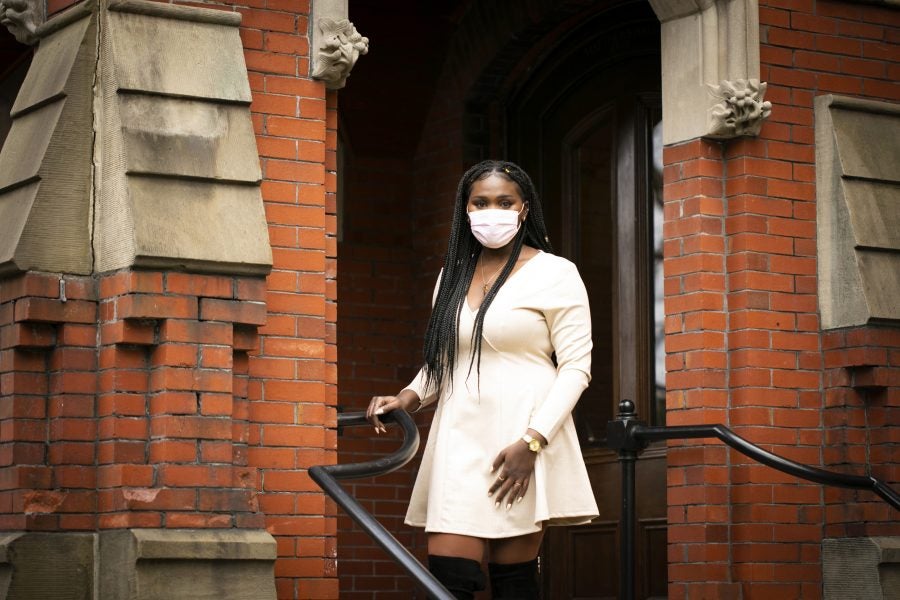
Photo by Stephanie Mitchell/Harvard Staff
Divinity School student Suzannah Omonuk wrote a poem imagining what life
was like for an enslaved woman who lived and worked on campus in the 18th century.


ARTS & HUMANITIES

A poem for Venus


Divinity School student gives voice to an enslaved young woman on campus in the 18th century

BY Colleen Walsh
Harvard Staff Writer
April 15, 2021

Suzannah Omonuk learned about slavery as a child growing up in Uganda. But her history books were “whitewashed,” she said, sheltering her “from the true horrors” and ignoring the ways slavery’s toxic effects rippled throughout the U.S. and beyond.

“In Uganda it was different because it almost felt like this was a terrible thing that happened in the world, but it’s over now, like we all can breathe a sigh of relief,” said Omonuk, a master’s candidate at Harvard Divinity School. “But coming here I realized: No, it’s still continuing, albeit in a different manner.”

At Harvard, Omonuk is giving voice to that history and its lasting impacts. Her poem “The Story of Venus,” takes an unflinching look at what life may have been like for the young woman known only by the name Venus, an enslaved person who lived and worked on Harvard’s campus in the 18th century. The project was supported by a student grant funded by a presidential initiative anchored at the Harvard Radcliffe Institute and inspired in part by Omonuk’s own journey to the U.S. to study first in Louisiana, and later in Cambridge.

“I couldn’t help but think about the fact that I’m on this University campus, and how other people who looked like me, sounded like me, came from the same place as me, arrived here but under completely different circumstances,” she said.

“The Story of Venus” (excerpt)

Oh, daughters of the great green savannah,
Weep for me.
I have been uprooted from among you where I grew and have been carried into a diabolic land where ashes fall from a raging heaven
Bitter.cold.beautiful
Weep for me, for I will never again dance on dewy grass on a moonlit night, surrounded by the song of a tribe.
No more shall I be burnt by the black desire of a warrior’s lust, and in a wild daze wonder to myself how a man whose very hands had torn apart bears and lions could yet hold me softer than an early morning rain.
Weep for me
For the way I shall slowly be forgotten, because little slave girls with sad eyes do not get invited into history
How shall you remember me?
By the men that made me an orphan
How shall you remember me?
By a tablet of stone that bears the name that I received in a baptism of chains
How shall you remember me?
Shall you remember me?

Omunuk’s creative work is one of several grant-funded projects supported by the Harvard and the Legacy of Slavery Initiative, a presidential program announced by Harvard President Larry Bacow in 2019 and housed at the Harvard Radcliffe Institute that is exploring Harvard’s connections to slavery through ongoing discussions, conferences, public events, and student and faculty research. The initiative’s steering committee is planning to release a public report during the 2021–22 academic year outlining its historical findings, along with a list of recommendations.

“Student engagement is a vital component of the initiative on Harvard and the Legacy of Slavery,” said Tomiko Brown-Nagin, dean of Harvard Radcliffe Institute and chair of the Presidential Committee on Harvard and the Legacy of Slavery. “Our work is grounded in history, but our charge is also to reckon with the ways that history shapes our present — in the world, and here at Harvard. Students bring an invaluable perspective to this effort, and we are proud to offer grants that support both student research and creative work, allowing recipients to engage with legacies of slavery in the ways most meaningful to them as individuals, and as members of our community.”

Omonuk said her use of poetry was a nod to the way “the Black and African American community immortalizes themselves.”

“White slave masters who knew how to read and write kept journals and diaries, but those who were enslaved passed their stories down often through art and song or through storytelling,” she said. “Also, I’ve just always loved poetry and rhythm, and I just thought there was just something special about telling a story in that way.”

Not much is known about Venus, one of four enslaved people owned by Harvard presidents Benjamin Wadsworth and Edward Holyoke and who lived and worked in Wadsworth House in the 1700s. (In 2016, Harvard President Drew Faust and Congressman and Civil Rights pioneer John Lewis placed a plaque on the front of Wadsworth House, now a University administrative office, in their honor.) During her research, Omonuk found that Venus was baptized at Cambridge’s First Church, and that she was young when she was purchased, but little else. With her words she sketches in some of those lost details.


“I kept wondering what Venus as an enslaved person would be?” she said. “Would she have ever imagined a future in which someone like me attending Harvard was possible? Did she like art? Did she like poetry? I was also realizing with a sadness that there’s no way for us to know any of these things because there’s nothing written there.”

Omonuk admitted that it feels uncomfortable to “disturb something as cemented as history, but I just realized it’s within my joy to try anyway,” adding that the work of other established writers has helped guide her process. “I’ve been taking lots of inspiration from poets like Phillis Wheatley and authors Toni Morrison and Maya Angelou, these very strong Black women who use their voice and use the power of writing to make history.”

Omonuk said her early experience in America exposed to her the nation’s lasting racial tensions. She called her arrival in the U.S. and her years studying at Southern University and A&M College, a historically Black university, “illuminating.”

“I was able to learn about aspects of Black culture that I hadn’t really learned in Uganda, where I never actually saw myself as Black. I was just always African or Ugandan or a member of my tribe. So just being Black in America for the first time, there was just a lot to process.”

THE HARVARD GAZETTE


Tuesday, December 7, 2021

Tove Ditlevsen / New Translation Shares The Voice Of A Poet Who Wrote As Intensely As She Lived


Tove Ditlevsen


New Translation Shares The Voice Of A Poet Who Wrote As Intensely As She Lived


John Powers
February 3, 2021

We're living in a golden age for women's writing. The wheels of literary justice are finally giving due process to great women writers whose work has been forgotten, ignored or insufficiently appreciated.

The latest revelation is Tove Ditlevsen, a Danish poet and fiction writer who I'd never even heard of until a few months ago. In her native Denmark, Ditlevsen, who killed herself in 1976, is a renowned author whose popularity survived the condescension of the male establishment.

Ditlevsen's brilliance is evident when you read her confessional memoir, The Copenhagen Trilogy, which is newly available in a crisp translation by Tiina Nunnally and Michael Favala Goldman. Told in a sneakily plain, highly addictive voice, it's the portrait of the artist as a young woman who wrote as hard as she lived.

When we first meet Tove, she's a girl living in the Vesterbro district of Copenhagen, a place of reeking streets, prostitution and endemic unemployment. While her father is principled, his progressive politics have limits — he insists that girls can't become poets. Her mother is an indolent beauty whose shifting moods Tove must constantly assess with the care of a lion tamer entering a cage.

In love with words, Tove dreams of being a poet and writing her way to freedom — not an easy task for a low-born girl in early 1930s Denmark. She starts working at 14, taking jobs as a housekeeper, scullery maid and office clerk. By night, she writes the poetry that sustains her — but that she fears will never see print.

In fact, her writing does carry her away from Vesterbro, making her a success by her early 20s — she's even invited to dine with Evelyn Waugh. Yet for all her literary talent, she has little gift for daily living. Easily bored and fearing entrapment, Tove lurches through life. She goes on drunken revels with freedom-seeking girlfriends. She quickly racks up four husbands. She raises three kids, has a Christmastime abortion that haunts her, and finally, after an unnecessary surgery, gets hooked on the one thing she loves as much as writing: drugs.

Such a summary may make the book sound harsh or depressing, but oddly, it's the opposite. Many of Tove's escapades are amusing, especially in volume two, and even the account of her Demerol addiction has a clear-eyed briskness that sucks us in with its immediacy.

Perhaps because she was a poet, Ditlevsen knows the eloquence of leaving things out. The Copenhagen Trilogy lies at the opposite end from Karl Ove Knausgård's My Struggle whose six volumes try to tell us everything about his life no matter how pedestrian. Her entire trilogy clicks in at a cool 367 pages — 100 fewer than the shortest volume of My Struggle, though her struggle was far greater than his.

Like Grace Paley and Alice Munro, Ditlevsen's a master of compression who can capture the whole story of a marriage in a couple of pages. With a born writer's killer instinct, she likes to pounce on us with arresting chapter openings, such as this first sentence about her second husband, Ebbe: "Whenever I try to recall his face, I always see him the way he looked that day I told him there was someone else."

The Copenhagen Trilogy is a story about escape — escape from menial work, escape from traditional female roles, escape from boredom, escape from reality, and escape from the heavy weight of a self that was shaped in her childhood, a time, she writes, that's "long and narrow like a coffin." She has a self exploding with so many contradictions that she's like both heroines of Elena Ferrante's Neapolitan Quartet merged into one.

Tove says she hates change, then invariably flees whatever life she's settled in. She insists she wants to be normal, but chooses a painfully unconventional path. She keeps telling us that she's passive and powerless, yet what makes the book hopeful is that she's anything but. Even if writing couldn't save her from herself, it lets her soar above the world's expectations and seek the truth on her own terms.

NPR