 |
| Photo by Ren Hang |
Gift
by Ren Hang
Life is really one
Precious gift
But sometimes I feel that
It has been given to the wrong person


|
| Photo by Ren Hang |
Gift
by Ren Hang
Life is really one
Precious gift
But sometimes I feel that
It has been given to the wrong person

Love Poem
by Louise Glück
There is always something to be made of pain.
Your mother knits.
She turns out scarves in every shade of red.
They were for Christmas, and they kept you warm
while she married over and over, taking you
along. How could it work,
when all those years she stored her widowed heart
as though the dead come back.
No wonder you are the way you are,
afraid of blood, your women
like one brick wall after another.


.
.
.

Gretel in Darkness
by Louise Glück
This is the world we wanted.
All who would have seen us dead
are dead. I hear the witch’s cry
break in the moonlight through a sheet
of sugar: God rewards.
Her tongue shrivels into gas . . .
Now, far from women’s arms
and memory of women, in our father’s hut
we sleep, are never hungry.
Why do I not forget?
My father bars the door, bars harm
from this house, and it is years.
No one remembers. Even you, my brother,
summer afternoons you look at me as though
you meant to leave,
as though it never happened.
But I killed for you. I see armed firs,
the spires of that gleaming kiln–
Nights I turn to you to hold me
but you are not there.
Am I alone? Spies
hiss in the stillness, Hansel,
we are there still and it is real, real,
that black forest and the fire in earnest.

 |
| Illustration by Triunfo Arciniegas |
All Hallows
by Louise Glück
Louise Glück / Todos los Santos
Even now this landscape is assembling.
The hills darken. The oxen
sleep in their blue yoke,
the fields having been
picked clean, the sheaves
bound evenly and piled at the roadside
among cinquefoil, as the toothed moon rises:
This is the barrenness
of harvest or pestilence.
And the wife leaning out the window
with her hand extended, as in payment,
and the seeds
distinct, gold, calling
Come here
Come here, little one
And the soul creeps out of the tree.

.
.
.
 |
| Alex Colville |
THE EDGE
By Louise Glück
Time and again, time and again I tie
My heart to that headboard
While my quilted cries
Harden against his hand. He’s bored-
I see it. Don’t I lick his bribes, set his bouquets
In water? Over Mother’s lace I watch him drive into the gored
Roasts, deal slivers in his mercy… I can feel his thights
Against me for the children’s sakes. Reward?
Mornings, crippled with this house,
I see him toast his toast and test
His coffee, hedgingly. The waste’s my breakfast.


THE MIRROR
by Louise Glück
Watching you in the mirror I wonder
what it is like to be so beautiful
and why you do not love
but cut yourself, shaving
like a blind man. I think you let me stare
so you can turn against violence,
needing to show me how you scrape the flesh away
scornfully and without hesitation
until I see you correctly,
as a man bleeding, not
the reflection I desire.

 |
| Louise Glück |
April
by Louise Glück
No one's despair is like my despair--
You have no place in this garden
thinking such things, producing
the tiresome outward signs; the man
pointedly weeding an entire forest,
the woman limping, refusing to change clothes
or wash her hair.
Do you suppose I care
if you speak to one another?
But I mean you to know
I expected better of two creatures
who were given minds: if not
that you would actually care for each other
at least that you would understand
grief is distributed
between you, among all your kind, for me
to know you, as deep blue
marks the wild scilla, white
the wood violet.

 |
| Louise Glück |


I went on a kick of reading everything Penelope-related. Anything that played with the Odyssey, I read it. Penelopiad by Margaret Atwood? check. Collection of modern Greek poetry by Katerina Anghelaki-Rooke? check.
HOW I missed Meadowlands by Louise Gluck is beyond me. 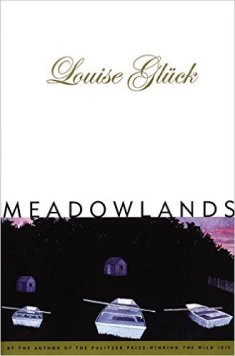 The book of poetry uses the Odyssey, and Penelope and Odysseus’s relationship, as a springboard for exploring power dynamics in relationships, love loss distance and growing apart, etc. They’re contrasted with a modern couple bogged down with the bitterness minutiae breeds. Ancient and modern, mythical and real, it’s all the same heart, so it’s all the same shit.
But of course the poems I liked the best were the ones that directly talked about the Odyssey. I thought “Siren” was a nice in-between. The siren is the woman who lures Odysseus in during his journey home, but in Gluck’s poem, she’s a distinctly modern woman. We’re not sure if this is a woman that Odysseus meets, or the unnamed male in the modern couple. Either way, though, it’s the voice of the siren that sticks with you. The humanizing of the “other woman.”
Siren
I became a criminal when I fell in love.
Before that I was a waitress.
I didn’t want to go to Chicago with you.
I wanted to marry you, I wanted
Your wife to suffer.
I wanted her life to be like a play
In which all the parts are sad parts.
Does a good person
Think this way? I deserve
Credit for my courage–
I sat in the dark on your front porch.
Everything was clear to me:
If your wife wouldn’t let you go
That proved she didn’t love you.
If she loved you
Wouldn’t she want you to be happy?
I think now
If I felt less I would be
A better person. I was
A good waitress.
I could carry eight drinks.
I used to tell you my dreams.
Last night I saw a woman sitting in a dark bus–
In the dream, she’s weeping, the bus she’s on
Is moving away. With one hand
She’s waving; the other strokes
An egg carton full of babies.
The dream doesn’t rescue the maiden.
***
Here’s a Penelope-centric one.
Penelope’s Stubbornness
A bird comes to the window. It’s a mistake
to think of them
as birds, they are so often
messengers. That is why, once they
plummet to the sill, they sit
so perfectly still, to mock
patience, lifting their heads to sing
poor lady, poor lady, their three-note
warning, later flying
like a dark cloud from the sill to the olive grove.
But who would send such a weightless being
to judge my life? My thoughts are deep
and my memory long; why would I envy such freedom
when I have humanity? Those
with the smallest hearts
have the greatest freedom.
I’m still thinking these poems through–poems where, as one reviewer said, “the ordinary becomes heroic”–but I loved these two in particular.


