Wednesday, May 16, 2012

Reckless Endangerment / The making and unmaking of Dylan Thomas.

Dylan Thomas


Reckless Endangerment

The making and unmaking of Dylan Thomas.


By Adam Kirsch
June 27, 2004

To begin at the beginning: In October, 1914, when the Swansea schoolmaster David John Thomas decided to call his newborn son Dylan, the name was virtually unknown, even in Wales. D.J., as he was called, had found it in the Mabinogion, the collection of medieval Welsh tales, where it is the name of a minor character—“a fine boy-child with rich yellow hair.” Florence, the boy’s mother, had her doubts about the odd name: the correct Welsh pronunciation, which the family used, is “Dullan,” and she worried that other children would tease him by calling him “dull one.” Later, when broadcasting on the Welsh service of the BBC, Dylan Thomas had to instruct the announcers to say “Dillan,” the way he himself pronounced it.
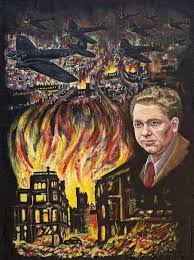

Dylan Thomas

By 2003, according to Social Security records, “Dylan” had become the nineteenth most popular boy’s name in the United States—just below “James.” For the parents of many of those American Dylans, the name probably evokes the teen heartthrob on the TV series “Beverly Hills 90210”; for their grandparents, it will always recall the singer formerly known as Robert Zimmerman. But those later Dylans only borrowed its aura of brooding, youthful rebellion; in the most literal sense, Dylan Thomas made his name.

To achieve that level of fame as a poet demands more than talent, or even genius. From Byron to Sylvia Plath, it has also required scandal, tragedy, and early death. And the glamour of Dylan Thomas has always been peculiarly potent in the United States, because the last acts of his tragedy were played out here, in Manhattan. His Stations of the Cross are the Chelsea Hotel and the Ninety-second Street Y, the White Horse Tavern and St. Vincent’s Hospital—where he died of alcohol poisoning on November 9, 1953, just after his thirty-ninth birthday. Wales was Thomas’s great subject, and England made his reputation; but it was America that created his legend.

The question, raised by many at the time and fiercely debated ever since, is whether America also killed him. During his four American tours, between 1950 and 1953, Thomas put on a better show than any visiting writer since Dickens. His rich, honeyed baritone, and a dramatic instinct honed by years of broadcasting, made him a powerful reader of his own and others’ poems. But what drew crowds from New York to San Francisco, and on every college campus in between, was not just the performance; it was the possibility that Thomas would finally, irreparably, crack up. Elizabeth Hardwick remembered how professors and students alike were mesmerized by his alcoholic high-wire act: “Would he arrive only to break down on the stage? Would some dismaying scene take place at the faculty party? Would he be offensive, violent, obscene? These were alarming and yet exciting possibilities.” As Andrew Lycett writes in his new biography, “Dylan Thomas: A New Life” (Overlook; $35), Thomas “exhibited the excesses and experienced the adulation which would later be associated with rock stars.”


What drew crowds to Thomas’s readings wasn’t just the performance; it was the possibility that he would finally crack up.Illustration by Richard Merkin


What makes him unique among poets, even famous poets, is this distinctly modern and American cast of his celebrity. He took part in the savage transaction of stardom: his reckless self-indulgence satisfied his audiences’ fantasies, and his destruction satisfied their moralistic envy. Many people shared an obscure sense of gratification that Thomas had died young, as a poet should. That way, he could be mourned in the grand style, like Adonais: “. . . the loveliest and the last, / The bloom, whose petals nipped before they blew.” Or, as the critic Alfred Kazin wrote in his journal when he heard the news, “Dylan. How much light goes out with the passing of our wizard . . . he embodied the deepest cry of poetry, he was our young singer!” The death of an old singer—a Yeats or a Frost—offers less scope for plangency.

Those closest to Thomas worried about this loving American vampirism. Caitlin, his wife, complained about many things he did—Caitlin’s volcanic temper, and the battles it provoked, is no small part of the Thomas legend—but she complained most loudly, and with most justification, about his visits to America. When he came back from his third trip, in the spring of 1953, she vowed not to let him return. As Thomas wrote ruefully to John Malcolm Brinnin, his American host and lecture agent, Caitlin told him, “ ‘You want to go to the States again only for flattery, idleness, and infidelity.’ This hurt me terribly. The right words were: appreciation, dramatic work, and friends.” But Caitlin was more right than either of them knew: the next trip turned out to be the fatal one. As she wrote in her memoir, “Leftover Life to Kill,” “Nobody ever needed encouragement less, and he was drowned in it.”

“Don’t encourage him,” of course, is what we say about a child who misbehaves; and, while Thomas’s misbehavior took lethally adult forms, it was unmistakably a kind of childishness, a testing of boundaries. Lycett’s thorough and well-written biography—rich in anecdote, if short on psychological and literary penetration—shows that Thomas’s entire life was an experiment in how much he could get away with. Probably the most dramatic example—missing from Lycett’s account, it can be found in Paul Ferris’s 1977 biography—concerns a dinner party at the house of a psychiatrist, to which Thomas was invited by a mutual friend. When Thomas arrived, he told the host’s wife that he wanted to wash up, and was shown upstairs. When he came back down, he had taken off his own clothes and was wearing his host’s suit, tie, socks, and shoes. But what makes the story really astonishing is that no one said a word about it. As Hardwick observed, “Thomas was acknowledged, unconsciously perhaps, to be beyond judgment.”

Most people, especially women, readily granted him this immunity; a few bystanders, almost all of them men, found it infuriating. One story Lycett does tell involves John Veale, a young composer, who lent Thomas some money for a taxi. Two weeks later, Veale made the mistake of asking for it back; Thomas gave him “a look as if I’d delivered an unforgivable insult.” Veale’s loss was only three shillings and sixpence—many agents, publishers, friends, and total strangers were stung for hundreds of pounds—but it showed him an important truth about Thomas: “Dylan was accustomed to being trailed around by people in whose eyes he could do no wrong. He was allowed to get away with anything.” Under the circumstances, Thomas could hardly avoid becoming ruthless and even contemptuous in his exploitation, feeling that—as Lycett writes—“anyone who made a fuss of him was a fool and to be treated with disdain.” As the historian A. J. P. Taylor—whose wife, Margaret, was Thomas’s most generous sponsor—put it quite bluntly, “I disliked Dylan Thomas intensely. He was cruel.”

The virtue of Lycett’s biography is that although he does not fall under Thomas’s spell, he also resists such summary assessments. Paul Ferris, whose “Dylan Thomas: The Biography” was issued in a revised edition in 2000, remains Thomas’s best and most comprehensive biographer; but half a lifetime spent with Thomas—he also edited the poet’s letters, and wrote a life of Caitlin—clearly sapped his patience. (His index to the “Collected Letters” contains, under the heading “Finances,” the entry: “needs money, passim ad infinitum.”) Ferris takes an unmistakable satisfaction in exposing Thomas’s lies and outrages; Lycett, a journalist and biographer whose past subjects include Muammar Qaddafi and Ian Fleming, simply shares with the reader his pleasure in the whole gossipy spectacle. When Lycett differs from Ferris about a particular episode, his interpretation is usually more charitable.

The affair of Vernon Watkins’s wedding is a good example. In October, 1944, Thomas was to serve as best man at Watkins’s wedding in London, but he did not appear. Lycett writes that Watkins “then received an envelope from Dylan containing two fawning letters, one apologising for having failed to post the other; and the other claiming that, in a confusion of missed trains, Dylan had forgotten the name of the church.” This would be bad enough, but Ferris’s version is worse. He reports the suspicion of Watkins’s wife that the letter Thomas allegedly failed to post on the day of the wedding was a fake, deliberately creased and grimed to make it look as though he had accidentally been carrying it around in his pocket. In any case, the sequel was as usual: Watkins vowed, “That’s the end of Dylan as far as I’m concerned,” and then forgave him.


It was natural for people to indulge Thomas as though he were a child, since he was barely out of childhood when he became famous. By the age of nineteen, Thomas had already written many of his major poems: “And Death Shall Have No Dominion,” “Before I Knocked,” “The Force That Through the Green Fuse Drives the Flower.” The world got a glimpse of what Thomas was up to in his “bedroom by the boiler” in March, 1934, when “Light Breaks Where No Sun Shines” was published in The Listener. Its completely assured voice drew the notice of T. S. Eliot and Stephen Spender, among others, and its suggestive imagery brought angry letters from subscribers:

Dawn breaks behind the eyes; From poles of skull and toe the windy blood Slides like a sea; Nor fenced, nor staked, the gushers of the sky Spout to the rod Divining in a smile the oil of tears.


That December, when Thomas’s “18 Poems” was published as the winner of a contest sponsored by the newspaper Sunday Referee, it created a minor sensation in literary London. The book was far from a commercial success—it took two years for the edition of five hundred copies to sell out—but it was widely reviewed, and gained Thomas some important champions. The critic Desmond Hawkins called it “the sort of bomb that bursts no more than once in three years”; the influential man of letters Cyril Connolly declared himself “completely ensnared.”

A début like “18 Poems” would have attracted attention at any time, but in the mid-nineteen-thirties a poet of Thomas’s particular gifts was especially welcome. Ever since W. H. Auden’s “Poems” appeared, in 1930, British poetry had been dominated by his cool, intellectual, ominous music; along with such disciples as Spender and Cecil Day-Lewis, Auden created what sounded like the inevitable idiom for a decade of crisis. After five years of the “pylon poets,” as they were sometimes called, Thomas’s intoxicated lyricism was greeted like a rainstorm in a dry climate. Thomas could be as hermetic as any modernist, but his passionate incantations seemed to come out of an older Romantic tradition; it was not long before he was being hailed as a bard. Hawkins announced, “The Audenesque convention is nearly ended; and I credit Dylan Thomas with being the first considerable poet to break through fashionable limitation and speak an unborrowed language.” The editor Geoffrey Grigson, whose early friendship with Thomas was ruined, predictably, over money matters, put it more snidely: Thomas was “a Young Poet untainted with Eliot or with Auden . . . whose poems, though a bit unintelligible, sounded at least familiar in an old grandiloquent way.”

Thomas was alert to the danger of becoming merely a prodigy—like the surrealist poet David Gascoyne, who published his first book in 1932, at the age of sixteen—and insisted that his work be judged without reference to his age. But at the same time he played up his boyishness for comic or pathetic effect: at age twenty-three, he was still joking about his “particular baby bulbousness . . . like an Aryan Harpo bitten by wasps.” In her memoir, Caitlin recalled that when they first met “Dylan may have been a skinny, springy lambkin, but I was more like its buxom mother then, and distinctly recollect carrying him across streams under one arm.” And his early love letters try to enlist her in a conspiracy of Peter Pans: “You mustn’t look too grown-up, because you’d look older than me; and you’ll never, I’ll never let you, grow wise, and I’ll never, you shall never let me, grow wise, and we’ll always be young and unwise together.”

This hope—like Thomas’s assurance, in a letter to his sister just before his marriage, that Caitlin cared “absolutely nothing for the responsibilities of husbandly provision”—was inevitably disappointed. For it was Caitlin who had to bear the full brunt of Thomas’s womanizing, drunkenness, unemployment, and simple domestic helplessness. (On one occasion, Lycett writes, Caitlin asked her husband to make a cup of tea, and “he came back with a curious greasy concoction, explaining he could not find a top for the pot, so had covered it with half a pound of cheese.”) Not unnaturally, she grew bitter, to the point of becoming, by most accounts, a monster. Lycett tells the story of how, when she suspected Thomas of flirting with a woman at a party, “she came up behind her supposed rival and, without saying a word, stubbed her cigarette down hard on the back of [her] hand. Then she said, ‘Hullo’ and walked calmly away to talk to someone else.” Lycett acknowledges the extent of Caitlin’s infidelities, but does not mention her nonchalant admission to Ferris, in the late nineteen-seventies, that “only a miracle had saved” her three children by Thomas “from being somebody else’s.”

The only person more revolted by his weakness than Caitlin was Thomas himself. Philip Larkin, the leading British poet of the generation after Thomas’s, claimed to have read his published correspondence “with almost supernatural boredom, scrounging, apologising, promising, apologising again, fixing up appointments, apologising for not keeping them.” But Thomas was well aware of the impression he made, writing to one editor that “nobody, one might think, could say that he was sincerely sorry so many times and still be sincere about it.” Thomas, however, was sincere, every time; he just wasn’t able to change, and his helplessness left him prey to a venomous self-loathing. “The selfish trouble,” he explained to the poet and critic Henry Treece, “is that I myself have had to put up with these seriously annoying faults for so long that I’ve almost come to think other people can bear them. I am the one who wakes up nearest to myself, and the continual horror that comes from the realisation of this individuality has made me almost to believe that the reactions of others to my horrible self . . . are small enough, in comparison.” Two years before his death, in a letter written to Princess Marguerite Caetani—the American-born editor of the international literary magazine Botteghe Oscure—he offered a more damning self-portrait than any enemy could: “I’m sick of my always hurdygurdying these little griefs out and me like a monkey on the top of it all with my beggar’s cap.”

The many people who tolerated and encouraged Thomas’s vices used his genius as an excuse. More accurately, his vices were seen as an indispensable part of his genius; he fit the vulgar stereotype of the poet whose head was in the clouds, what he himself derided as the “Dreamy Poet Type B classified by Punch.” And when Thomas’s life of helplessness was consummated in a helpless death, brought on by weeks of hard drinking and a doctor’s morphine injection, there was a widespread, if disguised, satisfaction at this perfection of the stereotype. Thomas’s end could be appreciated on the terms Saul Bellow described in “Humboldt’s Gift”: “For some reason this awfulness is peculiarly appreciated by business and technological America. . . . The weakness of the spiritual powers is proved in the childishness, madness, drunkenness, and despair of these martyrs. . . . So poets are loved, but loved because they just can’t make it here.”


Indeed, Thomas’s death was at least a dress rehearsal, and possibly a direct inspiration, for the fates of a generation of American poets. Delmore Schwartz, in the psychotic and alcoholic haze of his last years, began to haunt the White Horse Tavern, the famous site of Thomas’s dissipations. Elizabeth Bishop, whose reticent, lucid poetry could not be more different from Thomas’s, felt an “instantaneous sympathy” when they met in 1950, during her tenure as Poetry Consultant to the Library of Congress. Writing to Pearl Kazin—whose affair with Thomas was by far the most serious of his American romances—just after his death, Bishop claimed her own kinship with Thomas: “In my own minor way I know enough about drink & destruction.”

Most possessive of all was John Berryman, who was a graduate student at Cambridge when he first met Thomas, in the late nineteen-thirties. Berryman—who was born just two days before Thomas—was staying at the Chelsea when Thomas had his final collapse there, and was the only person at his bedside when he stopped breathing. As Pearl Kazin recalled, she and Berryman both attended a conference at Bard College during Thomas’s last, comatose weekend; on one country walk, Berryman “kept saying, as he took long gulps of air: ‘I’m breathing for Dylan, if I breathe for him perhaps he will remain alive.’ ” Months before Berryman’s suicide, in 1972, following his own battle with alcoholism, he wrote “In Memoriam (1914-53),” an elegy for Thomas:

His talk, one told me, clung latterly to Eden, again & again of the Garden & the Garden’s flowers, not ever the Creator, only of that creation with a radiant will to go there.

Although Thomas stood at the head of what Berryman called a “wrecked” generation of poets, he himself never blamed poetry for what befell him. The bitterest part of his shame was that, while he profited from the popular equation of poetry with weakness, he knew that it was in poetry alone that he was strong. “My selfish carelessness and unpunctuality,” he wrote Treece, “I do not try to excuse as poet’s properties. They are a bugbear & a humbug.”


In fact, with a strange symmetry, Thomas’s poetry takes the very things that cursed his life and turns them into blessings. In his verse, self-absorption becomes intense awareness; childishness becomes freshness of perception; and heedlessness becomes verbal daring. These are the virtues of youth, and it remains astonishing how very young Thomas was when he began to write his great poems; his precocity rivals that of Keats and Rimbaud.

Unlike Keats’s, however, Thomas’s poems reflect their creator’s rawness. His thought is rudimentary—as Randall Jarrell noted in an early review, “the best and most brilliantly written pieces usually say less than the worst”—and much of his verbal tumult seems willfully obscure. Confronted with lines like “The atlas-eater with a jaw for news, / Bit out the mandrake with tomorrow’s scream,” many early readers grouped Thomas with the surrealists as a deliberate maker of nonsense. But Thomas passionately, and rightly, refused this label. “I agree,” he wrote, “that much of the poetry is impossibly difficult; I’ve asked, or rather told, words to do too much; it isn’t theories that choke some of the wilder and worser lines, but sheer greed.” His difficulty is not the cool provocation of the avant-garde but the heat of the teen-age poet writing for no ear save his own.

Isolation and appetite, in any teen-ager, naturally find release in self-gratification; in that sense, Thomas’s poetry can fairly, and without insult, be called masturbatory. It is also frequently masturbatory in a more literal sense: he writes of being “tickled by the rub of love,” “rehearsing heat upon a raw-edged nerve,” “the scalding veins that hold love’s drop.” The last line of “My Hero Bares His Nerves” quickly became notorious: “He pulls the chain, the cistern moves.” Like Whitman, another great poet of onanism, Thomas sees his body from a certain remove, awed and even frightened by its capacity for sensation: “Ears in the turrets hear / Hands grumble on the door, / Eyes in the gables see / The fingers at the locks.”

The same tendency, carried to its extreme, is what allows Thomas to see his entire existence as something that essentially does not belong to him. In his seething, pantheistic poems, his own life becomes just one moment of a universal process, a temporary habitation of the life force. At times, this can sound like narcissism—“My holy lucky body,” Thomas writes in one poem—but in a deeper sense it is a shocking denial of the self. “The force that through the green fuse drives the flower / Drives my green age; that blasts the roots of trees / Is my destroyer”: death is the implicit, inescapable end of growth. At his best, Thomas has a nearly metaphysical ability to make us see all the moments of a life, from birth to death, in a single instant: “The oak is felled in the acorn / And the hawk in the egg kills the wren.” And when the Second World War came it was this power simultaneously to see death and to see through death that produced his great war poems: “Ceremony After a Fire Raid,” “Among Those Killed in the Dawn Raid Was a Man Aged a Hundred,” and—the most significant title of all—“A Refusal to Mourn the Death, by Fire, of a Child in London.”

But that poem, which beautifully imagines the child’s death as a homecoming to Nature—“Robed in the long friends, / The grains beyond age, the dark veins of her mother”—also reveals the limitations of Thomas’s vision. It is not, finally, a truly consoling poem; in his haste to adopt a cosmic view of the tragedy, Thomas seems indifferent to its human meaning. The refusal to mourn is a refusal to love the dead child as an individual, the way those who knew her might have; it turns her immediately into a symbol. “After the first death, there is no other,” Thomas writes in one of his many unforgettable lines. But first there is the first death, in all its irredeemable particularity; and Thomas’s language, with its totem words and sorcerer’s rhythms, is not scaled to the particular. His poetry, as Elizabeth Bishop noted, has a “desperate win-or-lose-all quality,” which “eliminates everything from life except something almost beyond human supportability after a while.”

This insupportable intensity was, perhaps, the price of Thomas’s adolescent genius. In some ways, Thomas resembles Wordsworth, whose lament for lost childhood, the “Immortality Ode,” haunts several of Thomas’s later poems. What makes Wordsworth the larger poet is the experience he captured in a line from “Elegiac Stanzas”: “a deep distress hath humanised my Soul.” Thomas’s sorrows, terrible though they became, never had that effect; instead of broadening and renewing his gift, they eroded its early momentum. At the age of twenty-six, Lycett points out, “Dylan had already written more than eighty percent of his published verse.” In the last eight years of his life, he wrote only six poems. And the self-inflicted decay of his final years, though accelerated by his American tours, was surely rooted in this loss of inspiration. Being treated as a poet, with all the indulgence and condescension that entailed, was always bad for Dylan Thomas. Writing poems was what allowed him to survive it, as he gratefully acknowledged: “To take to give is all, return what is hungrily given / Puffing the pounds of manna up through the dew to heaven.”


Published in the print edition of the July 5, 2004, issue.

Adam Kirsch is a poet, a critic, and the author of, most recently, “Who Wants to Be a Jewish Writer?”


THE NEW YORKER


Monday, May 14, 2012

Get Happy / Richard Wilbur and the poetry of profusion

Richard Wilbur

Get Happy

Richard Wilbur and the poetry of profusion

By Adam Kirsch
November 14, 2004

In 1953, literary history—acting through the good offices of Edna Ward, of Wellesley, Massachusetts—brought together two of the most gifted, and least similar, American poets of the postwar era. Mrs. Ward was the mother-in-law of Richard Wilbur—at the age of thirty-two, the author of two acclaimed books of verse—and a friend of Aurelia Plath, whose twenty-year-old daughter, Sylvia, had just endured the hellish summer she later chronicled in “The Bell Jar.” Wilbur was invited, as he wryly recalls in his poem “Cottage Street, 1953,” “to exemplify / The published poet in his happiness, / Thus cheering Sylvia, who has wished to die.” Of course, Wilbur’s good will could not make a dent in Plath’s misery: he describes himself as “a stupid lifeguard” who finds “a girl … immensely drowned.” But the meeting was productive in another way: decades later, after Plath had written, died, and become a myth, it offered Wilbur a test and an emblem of his own, very different poetic calling.

In his poem, Wilbur slyly turns Mrs. Ward’s polite inquiry about tea—“if we would prefer it weak or strong”—into a literary and moral question. Plath, of course, preferred it strong, in art and in life; she would go on, in Wilbur’s words, “to state at last her brilliant negative / In poems free and helpless and unjust.” But where does this leave Wilbur, whose poems are brilliantly affirmative, and who has enjoyed all the blessings Plath did not—longevity, reputation, worldly success? Does the fact that he was destined for happiness condemn his poetry to be weak, the tepid milk to Plath’s acrid lemon?

The question Wilbur asks in “Cottage Street, 1953” has been posed by critics since the beginning of his career—starting with Randall Jarrell, whose review of Wilbur’s second book, “Ceremony,” complained that Wilbur “never goes too far, but he never goes far enough.” And it echoes from beginning to end of the “Collected Poems 1943-2004” (Harcourt; $35), which will be Wilbur’s monument. How does a poet who feels himself, in the words of an early poem, “Obscurely yet most surely called to praise” practice that calling in an age when poetry is overwhelmingly drawn to crisis, confession, and complaint?

This is more than just a matter of literary fashion, though in Wilbur’s public statements one can often sense his impatience at being typecast as the placid straight man to his wilder contemporaries—above all, Robert Lowell. Lowell and Wilbur made their poetic débuts in the same postwar moment; Lowell’s “Lord Weary’s Castle” won the Pulitzer Prize in 1947, the year that Wilbur’s “The Beautiful Changes” appeared. And it was Lowell, much more than Plath, whom critics perpetually used as a foil when describing Wilbur. In a 1964 interview, Wilbur ruefully recited the standard contrast: “I’m all grace and charm and short gains, and he’s all violence and … Well, he’s Apollo and Dionysus locked in a death grip.”

Lowell, like Plath, John Berryman, and countless lesser poets, wrote about and out of a spiritual turmoil that amounted to, or resulted in, madness. Writing about his experience in a psychiatric ward in “Waking in the Blue,” from his hugely influential 1959 book “Life Studies,” Lowell insisted on the dangerous and pathetic majesty of the mad: he writes of Stanley with his “kingly granite profile,” of Bobbie, “a replica of Louis XVI / without the wig.” Wilbur’s poem “Driftwood,” by contrast, declares his own allegiance to “emblems / Royally sane,”

Which have ridden to homeless wreck, and long revolved In the lathe of all the seas, But have saved in spite of it all their dense Ingenerate grain. 

Wilbur has always been conscious that his particular poetic gifts and spiritual resilience were untimely. He started writing, as he later recalled, “for earnest therapeutic reasons during World War II,” in an effort to bring the sanity of art to bear on “a personal and an objective world in disorder.” (Wilbur served as a front-line infantryman in Europe, after his reputed radicalism got him kicked out of Army cryptography training.) The poems of his first book treat his war experiences in a style so elaborately formal that the most awful subjects are sublimated into irony, or even black comedy. There is something deliberately, monstrously cartoonish about “Mined Country,” where “Cows in mid-munch go splattered over the sky.” The persistence of the mines—“Danger is sunk in the pastures … / Ingenuity’s covered with flowers!”—is Wilbur’s way of writing about the persistence of the war itself, with all its psychic casualties: “it’s going to be long before / Their war’s gone for good,” he soberly predicts.

But in this poem, as throughout “The Beautiful Changes,” Wilbur’s style, influenced by the estranging precision of Marianne Moore and the courtly ironies of John Crowe Ransom, makes disorder almost parodically articulate. Surely there has never been a more aestheticized vision of K.P. than Wilbur’s in “Potato”:

Scrubbed under faucet water the planet skin Polishes yellow, but tears to the plain insides; Parching, the white’s blue-hearted like hungry hands. All of the cold dark kitchens, and war-frozen gray Evening at window; I remember so many Peeling potatoes quietly into chipt pails. 

Randall Jarrell, whose experience of military life was much milder than Wilbur’s (he served at a Stateside airbase), was far more willing to admit the sorrow and pity of war into his poetry. There is nothing in Wilbur that resembles Jarrell’s defiant matter-of-factness in “The Death of the Ball Turret Gunner”: “When I died they washed me out of the turret with a hose.”

But then, as Jarrell wrote, “The real war poets are always war poets, peace or any time”; and the same holds true of peace poets, in whose company Wilbur confessedly belongs. In “Up, Jack,” Wilbur looks to Falstaff as a tutelary spirit for the postwar world, “a god / To our short summer days and the world’s wine.” Wilbur’s refined epicureanism is far removed from Falstaff’s grossness, but the poet dares, like the fat knight, to make an ethic of enjoyment. There is something quietly polemical about Wilbur’s proud adoption-by-translation, in “Ceremony,” of La Fontaine’s “Ode to Pleasure”:

For games I love, and love, and every art, Country, and town, and all; there’s nought my mood May not convert to sovereign good, Even to the gloom of melancholy heart. Then come; and wouldst thou know, O sweetest Pleasure, What measure of these goods must me befall? Enough to fill a hundred years of leisure; For thirty were no good at all. 

Such praise of mundane joys defies the predominant trend of English and American poetry since Eliot, if not since Wordsworth. Against the potent myth of the Romantic poète maudit—the glamorous lineage of Chatterton, Shelley, Keats, Rimbaud, and Hart Crane, fatally revived in Wilbur’s own time by Plath, Lowell, and Berryman, among others—Wilbur sets the unfamiliar ideal of the poète bénit. In a 1977 Paris Review interview, he specifically rejected the tragic glamour of a Berryman, who had compared writing to surgery: “I am obliged to perform in complete darkness / operations of great delicacy / on myself.” Berryman, Wilbur said, “was such a very hard worker that he lived almost entirely within his profession… . The impression one is left with is of a man who is working desperately hard at his job. Well, I admire that, but I think it can break your health and destroy your joy in life and art.”

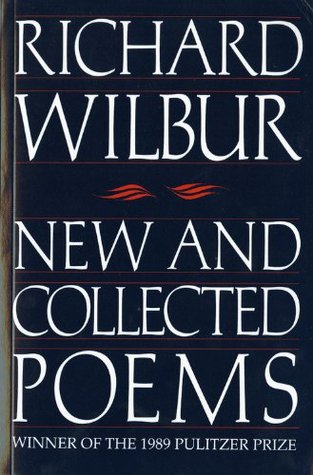
Throughout his long career, Wilbur has remained committed to that ideal of “joy in life and art,” and has been amply rewarded with achievement and honors in both spheres. After the Army and a stint in graduate school, Wilbur—like most poets of his generation—earned his living as a college professor. Unlike the teaching careers of many poets, though, his was marked by long and steady tenures: twenty years at Wesleyan University, then a further ten at Smith College. He was just as warmly embraced by the institutions of literary life. Born in 1921, he won the Pulitzer Prize and the National Book Award in 1957 (for his collection “Things of This World”), received the first of many honorary doctorates in 1960, and in 1987 was appointed United States poet laureate; he received a second Pulitzer in 1989 for his “New and Collected Poems,” which this “Collected Poems” supersedes. He has also enjoyed success in the theatre, as a translator of the plays of Molière and as the lyricist for Leonard Bernstein’s operetta “Candide.” All this seems highly becoming to a poet of fruitful activity, not barren speculation.

Wilbur’s position was often a lonely one, however, in a period that tended to view all affirmation as mere bourgeois complacency. One can get a good idea of the literary climate in which Wilbur began to write from Lionel Trilling’s great study “Sincerity and Authenticity,” published in 1972. Trilling suggests that English literature from Shakespeare to Henry James had agreed on an ideal of earthly life, on the reward that awaits characters who live “happily ever after.” This is the worldly felicity promised by the goddess Juno in “The Tempest”: “Honour, riches, marriage blessing, / Long continuance and increasing.” “It has to do,” as Trilling says, “with good harvests and full barns and … affluent decorum.” But “in the literature of our own day,” Trilling goes on to argue, “the visionary norm of order, peace, honour, and beauty has no place.” Both writers and readers instinctively meet it with “bitter contemptuous rejection,” whether out of “despair over the impossibility of realizing the vision” or out of a profoundly modern disbelief that any earthly happiness could satisfy the needs of the spirit. Rather than worldly completeness, the twentieth-century mind seeks in literature “the disintegration which is essential if it is to develop its true, its entire, freedom.”

Strangely enough, the whole course of Trilling’s argument—right down to the image of “good harvests and full barns”—was anticipated, and disputed, by Wilbur in a poem from his 1956 collection, “Things of This World.” In “Sonnet,” Wilbur offers a characteristic response to the problem of the “happily ever after”:

The winter deepening, the hay all in, The barn fat with cattle, the apple-crop Conveyed to market or the fragrant bin, He thinks the time has come to make a stop, And sinks half-grudging in his firelit seat, Though with his heavy body’s full consent, In what would be the posture of defeat, But for that look of rigorous content. 

Worldly satisfaction, Wilbur acknowledges, can have the look of defeat, because it means that there is nothing more to aspire to. He insists, though, that what looks like defeat should really be understood as contentment, the only contentment available in this world: of labor completed, tasks achieved, the future secured. Still, in the last lines of “Sonnet,” he acknowledges that the weary, satisfied farmer always remains haunted, even reproached, by another figure—the scarecrow that stands in the field, “floating skyward its abandoned hands / In gestures of invincible desire.”

Wilbur is too honest a poet to deny the persistent glamour of the scarecrow’s yearnings; but his instincts are all on the side of the farmer’s contentment. And throughout his “Collected Poems” Wilbur is generally uncomfortable when he tries to imagine discontent, or what Trilling called “disintegration.” From time to time over his long career, Wilbur has attempted poems of comprehensive moral statement, which aim to do justice to the horror of the modern world. But these poems are among his least convincing, because his invocations of evil seldom avoid seeming merely dutiful. Certainly, this is the case in “On the Marginal Way,” from his 1969 collection “Walking to Sleep.” The poem begins with a walk on a beach that becomes a scene of horror:

The rocks flush rose and have the melting shape Of bodies fallen anyhow. It is a Géricault of blood and rape, Some desert town despoiled, some caravan Pillaged, its people murdered to a man. 

It is typical of Wilbur that this murderous vision should be, precisely, a vision, a mirage. Indeed, what Wilbur sees is twice removed from reality: the rocks remind him not of “blood and rape” themselves but of “a Géricault,” an already aestheticized violence. And while Wilbur goes on to invoke “Auschwitz’ final kill,” the poem does not take account of that evil in such a way that the memory of evil would affect the imagination of good. Instead, in its last stanzas, “On the Marginal Way” turns away from evil altogether, in order to receive an unaccountable consolation:

And like a breaking thought Joy for a moment floods into the mind, Blurting that all things shall be brought To the full state and stature of their kind. 

This sort of joy is not so much the conclusion to an argument as a complexion of the mind. As he explained in the Paris Review interview, “To put it simply, I feel that the universe is full of glorious energy, that the energy tends to take pattern and shape, and that the ultimate character of things is comely and good. I am perfectly aware that I say this in the teeth of all sorts of contrary evidence, and that I must be basing it partly on temperament and partly on faith, but that is my attitude.”

If Wilbur’s essentially hopeful temperament leaves him ill-equipped for certain kinds of moral inquiry, however, it is also the source of his enormous poetic gifts. No other twentieth-century American poet, with the possible exception of James Merrill, demonstrates such a Mozartean felicity in the writing of verse. This is partly a matter of formal mastery: Wilbur has written the best blank verse of any American poet since Frost. Yet Wilbur’s formal poetry never has the slightly defensive tone that afflicts many writers of formal verse in this era of free verse. Just as his spirit takes naturally to “rigorous content,” so his musical imagination takes naturally to contented rigor. “I have no quarrel at all with Emerson,” he has remarked. “He said, ‘not meter, but a meter-making argument makes poetry,’ and I think that’s true. I simply write a kind of free verse that ends by rhyming much of the time.”

This seeming paradox is actually a key truth about Wilbur’s genius: for him, the conventional is organic. More than a matter of verse technique, this is the theme and argument of some of his best poems. In “A Baroque Wall-Fountain in the Villa Sciarra,” Wilbur contrasts two Italian fountains that are also two ways of being in the world. The Baroque fountain of the title is a triumph of fantastic ingenuity, all shells and fauns and cherubs: “More addling to the eye than wine, and more / Interminable to thought / Than pleasure’s calculus.” But the poet cannot quite dismiss the suspicion that art should be more than just delightful: “Yet since this all / Is pleasure, flash, and waterfall, / Must it not be too simple?” Maybe, he wonders, there is more truth and more honesty in “the plain fountains that Maderna set, / Before St. Peter’s,” whose simple aspiring jet is a legible emblem of Romantic yearning and disappointment: “the main jet / Struggling aloft until it seems at rest / In the act of rising, until / The very wish of water is reversed.”

There is no doubt which of these two fountains appears more “modern,” in Trilling’s sense. But Wilbur finally declares his preference for the Baroque fountain, whose fauns, “at rest in fulness of desire / For what is given,” seem to promise that a complete happiness is possible on earth. And in poem after poem Wilbur finds new metaphors with which to assert that—to quote the title of his best-known poem—“Love Calls Us to the Things of This World.” In “A Black November Turkey,” he praises “the cocks that one by one, / Dawn after mortal dawn, with vulgar joy / Acclaim the sun”; in “After the Last Bulletins” the garbage-collectors, “saintlike men, / White and absorbed, with stick and bag remove / The litter of the night.” The most famous of these emblems is the clean laundry of “Love Calls Us,” in which the sight of sheets and smocks calls forth a secular prayer: “Oh, let there be nothing on earth but laundry, / Nothing but rosy hands in the rising steam / And clear dances done in the sight of heaven.”

The profusion of such emblems in Wilbur’s “Collected Poems” is more than just a proof of his talent for metaphor. It is the poetic fruit of his distinctive metaphysics, which deserves the old-fashioned name of Transcendentalist. The condition of metaphor is the capacity of things to be likened to one another; and for Wilbur this very capacity suggests that all things share the same essential nature. “I think that all poets are sending religious messages,” he once declared, “because poetry is, in such great part, the comparison of one thing to another; or the saying, as in metaphor, that one thing is another. And to insist, as all poets do, that all things are related to each other, comparable to each other, is to go toward making an assertion of the unity of all things.” This faith in what he calls, in a late poem, “the dove-tailed world” is clearly inspired by Emerson, who wrote in “The Poet,” “Things admit of being used as symbols because nature is a symbol, in the whole, and in every part.”

This intuition provides Wilbur with his motive for metaphor: “What should we be without / The dolphin’s arc, the dove’s return, / These things in which we have seen ourselves and spoken?” And the happiest of Wilbur’s many happy gifts is his confidence that we do, indeed, see ourselves in nature, that the human being is profoundly at home in this world. That confidence is what makes possible the hundreds upon hundreds of brilliant images and observations that light up Wilbur’s “Collected Poems”: “a still crepitant sound / Of the earth in the garden drinking / The late rain”; “Slow vultures kettling in the lofts of air”; “the shucked tunic of an onion, brushed / To one side on a backlit chopping-board / And rocked by trifling currents, prints and prints / Its bright, ribbed shadow like a flapping sail.”

It is up to the “temperament and faith” of each reader to decide whether the golden world of Richard Wilbur’s poetry is the real world. What is certain is that Wilbur has given his vision the permanence, the immediacy, and the conviction of major poetry. His “Collected Poems” has the same moving and ambiguous power that he ascribed, in an early poem, to yet another fountain, this one in “Caserta Garden”:

A childhood by this fountain wondering Would leave impress of circle-mysteries: One would have faith that the unjustest thing Had geometric grace past what one sees.


Published in the print edition of the November 22, 2004, issue.

Adam Kirsch is a poet, a critic, and the author of, most recently, “Who Wants to Be a Jewish Writer?”

THE NEW YORKER


Saturday, May 12, 2012

Pablo Neruda / America, I Do Not Invoke Your Name in Vain


AMERICA, I DO NOT INVOKE
YOUR NAME IN VAIN
by Pablo Neruda
BIOGRAPHY
Translated by Jack Schmitt

America, I do not invoke your name in vain.
When I hold the sword to my heart,
when I endure the leaks in my soul,
when your new day
penetrates me thorough the windows,
I´m of and I´m in the light that produces me,
I live in the shade that determines me,
I sleep and rise in your essential dawn,
soaked in the sperm of your species,
nursed on the blood of your legacy.


Sunday, May 6, 2012

Pablo Neruda / I Will Come Back


Isla Negra
Photo by Triunfo Arciniegas
I WILL COME BACK
By Pablo Neruda
BIOGRAPHY
Translated by Alaistar Reid

Some time, man o woman, traveler,
afterwards, when I am not alive,
look here, look for me here
between the stonesw and the ocean,
in the light storming
in the foam.
Look here, look for me here,
for here is where I shall come, saying nothing,
no voice, no mounth, pure,
here I shall be again the movement
of the water, of
it’s wild heart
were is shall be both bost and found -
here I shall be perhaps both stone and silence.


Wednesday, April 25, 2012

e.e.cummings / If You Like My Poems Let Them


Think big
Times Square, New York, 2012
Photo by Triunfo Arciniegas


IF YOU LIKE MY POEMS LET THEM…
by e.e. cummings

if you like my poems let them
walk in the evening,
a little behind you
then people will say
“Along this road i saw a princess pass
on her way to meet her lover (it was
toward nightfall) with tall and ignorant servants.”


Poems Left with Elaine Orr, 1918-19, The Unpublished Poems (1983).


Monday, April 23, 2012

Federico García Lorca / Returning to the ravine of death


FEDERICO GARCÍA LORCA

Returning to the ravine of death

Claude Couffon was the first historian to investigate Lorca's 1936 execution


CLAUDE COUFFON
Granada, 16 de junio de 2011

Around six men made up the death squad. Dawn had not broken yet, and the headlights of a car lit up the Víznar ravine. A priest administered the last rites to the prisoners about to be executed. That is how the poet and playwright Federico García Lorca died, together with three other men, on August 19, 1936, at the onset of the Spanish Civil War.


Claude Couffon, the French Hispanist and renowned Lorca researcher, was the first person who had the guts, or the nerve, to travel to post-war Spain and ask what had happened to the poet. "At age 22 I was pretty daring. Nobody in Granada wanted to talk about what had happened. It was dangerous to ask questions and it was impossible to enter Víznar," recalls Couffon, now 86, about his visit to the Andalusian city in 1948, just 12 years after the writer's assassination by a Nationalist death squad.


"At age 22 I was pretty daring. Nobody in Granada wanted to talk"
So why did the young man lie to Ian Gibson about having buried the poet? "
Nobody in either Víznar had ever seen or heard about the poet at that time"

But Couffon returned to Granada with the Franco dictatorship fully consolidated in 1949 and decided not to leave again until he had some answers.
"That time I met the right people. I made friends in the city and one of them was from Víznar, so I was able to enter the village," he says, standing at Granada's city limits in what is possibly his "last visit "here.
The Frenchman, born in Caen in 1926, has decided to return to the scene of the crime with a journalist from EL PAÍS to talk about his own vision of what happened on August 19, 1936 and to appraise what has been said and written about it since.
"Things are very different today. There used to be a police checkpoint right here. They kept tabs on everyone's movements in the area. Only the villagers could go in," he says. The Couffon of today complains of pain in his legs and he walks with difficulty, but his mind remains agile like that of the young man who once followed the trail of Lorca. He proudly recalls that he was the first person to reveal the dramatist's exact birth date.
Claude Couffon and his wife in the ravine at Víznar, where he says Lorca is buried.

"In an interview he'd said that he was born in 1899, maybe to appear a year younger, but I think he did it so he wouldn't seem so much like part of the Generation of '98." Lorca himself espoused the more modern Generation of '27 literary group which included poets such as Rafael Alberti and Nobel laureate Vicente Aleixandre.
For decades, Couffon has been living in a tranquil corner of Normandy and stopped working on the subject of Lorca for a simple reason. "I had access to the right people. As far as I was concerned, the case was closed. Once I published my first conclusions, there was so much speculation. Everyone had a different version of events. There were many legends and many lies."
The researcher says he followed the story of the 2009 search for his grave, which was unsuccessful. "Of course I knew about the search, but nobody asked me where to dig," he says. "I always knew they would not find him there. That made no sense. They were very far away."
Couffon believes that Ian Gibson, the other great living Hispanist and Lorca researcher, was wrong to have believed the testimony "of a boy who could not possibly have buried García Lorca, and if he had he would not have recognized him." How could the young Manolillo el comunista, who had never been outside his native village of Alfacar, remember having buried Lorca at night?
"It's impossible for many reasons, but essentially because nobody in either Víznar or Alfacar had ever seen or heard about the poet," the French historian states. So why did the young man lie to Gibson when the latter visited the area on his own research? "Only he would know that."
"At first the graves were not deep. I was able to see them and even touch them," Couffon continues. "There were about 20 of them. Federico was not in the central grave. He was in a smaller one, possibly in that area [he points at the entrance to the ravine]. It was a steep place, all rocks and no trees. Today it's full of pine trees. Did nobody think of that?"
"There were no trees, not so much as a flower. There were open wells and the graveyard. The graves were small mounds of reddish earth," he continues.
A few months after Couffon's photographs of the area appeared in print, the Franco regime had the area planted with pines, which grow very fast. "At the bottom of the wells, the bodies ended up decomposing and sank underground," he wrote in his book. Couffon takes his leave from this place with no signs of melancholy. "It is easy to leave this behind - it represents all of human evil."


Saturday, April 21, 2012

Federico García Lorca / Romance sonámbulo


Romance Sonámbulo
by Federico García Lorca
Green, how I want you green.
Green wind. Green branches.
The ship out on the sea
and the horse on the mountain.
With the shade around her waist
she dreams on her balcony,
green flesh, her hair green,
with eyes of cold silver.
Green, how I want you green.
Under the gypsy moon,
all things are watching her
and she cannot see them.

Green, how I want you green.
Big hoarfrost stars
come with the fish of shadow
that opens the road of dawn.
The fig tree rubs its wind
with the sandpaper of its branches,
and the forest, cunning cat,
bristles its brittle fibers.
But who will come? And from where?
She is still on her balcony
green flesh, her hair green,
dreaming in the bitter sea.

— My friend, I want to trade
my horse for her house,
my saddle for her mirror,
my knife for her blanket.
My friend, I come bleeding
from the gates of Cabra.
— If it were possible, my boy,
I'd help you fix that trade.
But now I am not I,
nor is my house now my house.

— My friend, I want to die
decently in my bed.
Of iron, if that's possible,
with blankets of fine chambray.
Don't you see the wound I have
from my chest up to my throat?
— Your white shirt has grown
thirsy dark brown roses.
Your blood oozes and flees a
round the corners of your sash.
But now I am not I,
nor is my house now my house.
— Let me climb up, at least,
up to the high balconies;
Let me climb up! Let me,
up to the green balconies.
Railings of the moon
through which the water rumbles.

Now the two friends climb up,
up to the high balconies.
Leaving a trail of blood.
Leaving a trail of teardrops.
Tin bell vines
were trembling on the roofs.
A thousand crystal tambourines
struck at the dawn light.

Green, how I want you green,
green wind, green branches.
The two friends climbed up.
The stiff wind left
in their mouths, a strange taste
of bile, of mint, and of basil
My friend, where is she— tell me—
where is your bitter girl?
How many times she waited for you!
How many times would she wait for you,
cool face, black hair,
on this green balcony!

Over the mouth of the cistern
the gypsy girl was swinging,
green flesh, her hair green,
with eyes of cold silver.
An icicle of moon
holds her up above the water.
The night became intimate
like a little plaza.
Drunken Guardias Civiles
were pounding on the door. 


Green, how I want you green.
Green wind. Green branches.
The ship out on the sea.
And the horse on the mountain.


Friday, April 20, 2012

Leonard Cohen / Thousands

Leonard Cohen by Shayc


THOUSANDS
by Leonard Cohen


Leonard Cohen / Miles

Out of the thousands
who are known,
or who want to be known
as poets,
maybe one or two
are genuine
and the rest are fakes,
hanging around the sacred
precincts
trying to look like the real thing.
Needless to say
I am one of the fakes,
and this is my story

Book of Longing, 2006.


Monday, April 16, 2012

Leonard Cohen / The Reason I Write

Red Shoes
Fifth Avenue, NY, 2012
Photo by Triunfo Arciniegas
THE REASON I WRITE
by Leonard Cohen

The reason I write
is to make something
as beautiful as you are
When I’m with you
I want to be the kind of hero
I wanted to be
when I was seven years old
a perfect man
who kills