Once the love letter dominated the scene for writing your lover. But these days, nothing gets the blood pumping like a good sext. Like "Come over baby" ... or "I need you tonight" ... or "I am a living male turtleneck..." (Don't you dare judge us!)
Poet Patricia Lockwood, whose work has been published in the New Yorker and The Awl creates poems that operate with the shocking and true bizzarre revelations of a genius joke.
And then she discovered Twitter. As you will soon see, magic happened as a result of this fortuitous encounter. Her 'sexts' are X-rated scenarios that bring cartoon characters, inanimate objects, rappers and politicians into the love den. If you were looking for an entertaining entrance into the realm of sweet prose, we urge you to start here.
via Rhizome, who has a whole different but equally LOLworthy collection of sexy and weird texts.
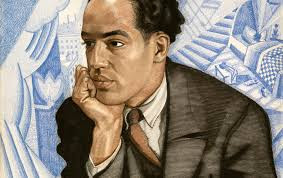
African-American poet, novelist, and playwright, who became one of the foremost interpreters of racial relationships in the United States. Influenced by the Bible, W. E. B. Du Bois, and Walt Whitman, Hughes depicted realistically the ordinary lives of black people. Many of his poems, written in rhythmical language, have been set to music. Hughes's poems were meant "to be read aloud, crooned, shouted and sung."
"Rest at pale evening...
A tall slim tree...
Night coming tendrerly
Black like me.
(from Dream Variations, 1926)
James Langston Hughes was born in Joplin, Missouri. His mother was a school teacher, she also wrote poetry. His father, James Nathaniel Hughes, was a storekeeper. He had wanted to become a lawyer, but he had been denied to take the bar exam. Hughes's parents separated and his mother moved from city to city in search of work.
In his rootless childhood, Hughes lived in Mexico, Topeka, Kansas, Colorado, Indiana and Buffalo. Part of his childhood Hughes lived with his grandmother. At the age of 13 he moved back with his mother and her second husband. Later the family settled in Cleveland, Ohio, where Hughes's stepfather worked in the steel mills. During this period Hughes found the poems of Carl Sandburg, whose unrhymed free verse influenced him deeply.
Langston Hughes
After graduating from a high school in Cleveland, Hughes spent a year in Mexico with his light-skinned father, who had found there a release as a successful cattle rancher from racism of the North. On the train, when he returned to the north, Hughes wrote one of his most famous poems, 'The Negro Speaks of Rivers.' It appeared in the African-American journal Crisis (1921). As an adolescent in Cleveland he participated in the activity of Karamu Players, and published in 1921 his first play, The Golden Piece.
Supported by his father, Hughes entered in the early 1920s the Columbia University, New York. For the disappointment of his family, Hughes soon abandoned his studies, and participated in more entertaining jazz and blues activities in nearby Harlem. Disgusted with life at the university and to see the world, he enlisted as a steward on a freighter bound to West Africa. He traveled to Paris, worked as a doorman and a bouncer of a night club, and continued to Italy.
After his return to the United States, Hughes worked in menial jobs and wrote poems, which earned him scholarship to Lincoln University in Pennsylvania. His first play, The Gold Piece (1921) was published in the children's magazine The Brownies' Book. According an anecdote, Hughes was "discovered" by the poet Vachel Lindsay in Washington. Lindsay was dining at the Wardman Park Hotel, where Hughes worked as a busboy, and dropped his poems beside the Lindsay's dinner plate. Lindsay included several of them in his poetry reading. It prompted interviews of the "busboy poet." Hughes quit his job and moved to New York City.
In 1929 Hughes received his bachelor's degree. He was celebrated as a young promising poet of the generation, publishing his poetry in Crisis (1923-24) and in Alain Locke's anthology The New Negro (1925). His first book of verse, The Weary Blues, supported by Carl Van Vechten, came out in 1926. "My news is this: that I handed The Weary Blues to Knopf yesterday with the proper incantations. I do not feel particularly dubious about the outcome: your poems are too beautiful to escape appreciation. I find they have a subtle haunting quality which lingers in the memory and an extraordinary sensitivity to all that is kind and lovely." (from Van Vechten's letter to Hughes in Remember me to Harlem, ed. by Emily Bernard, 2001)
Hughes valued Van Vechten's criticism and dedicated him his second collection of poetry, Fine Clothes to the Jew (1927). Their correspondence, which lasted until Van Vechten's death in 1964, was published in 2001. The Weary Blues assimilated techniques associated with the secular music with verse, while its content reflected the lives of African-Americans. "Drowning a drowsy syncopated tune, / Rocking back and forth to a mellow croon, / I heard a Negro play. / By the pale dull pallor of an old gas light / He did a lazy sway... / He did a lazy sway..."(from 'The Weary Blues,' the title poem of the collection)
Hughes was considered one of the leading voices in the Harlem Renaissance of the 1920s Not Without Laughter (1930), his first novel, Hughes wrote with the financial support of Charlotte Mason, a wealthy white woman. The book had a cordial reception and Hughes bought a Ford. He toured the colleges of southern America as a teacher and poet.
Noteworthy, Hughes was one of the first black authors, who could support himself by his writings. In the 1930s Hughes traveled in the Soviet Union, Haiti, and Japan. During his visit in the Soviet Union, to write the English dialogue for a film about black American workers, he had also an affair with an Afro-Chinese ballerina, Sylvia Chen, whose father Eugene Chen had served as a secretary to Sun Yat-Sen, the founder of the Chinese republic and then worked as foreign minister of China. "He was such a jolly person and so natural," Sylvia recalled. "Langston had been a sailor and he walked like one; I remember him sloshing around in white corduroy pants in the middle of a Russian winter." While in Moscow, Hughes completed his translations of Vladimir Mayakovsky's poems 'Black and White' and 'Syphilis' with the help of the critic Lydia Filatova. He also met Boris Pasternak and translated some of his poems.
'Goodbye, Christ,' a poem written during his world tour, was attacked by a right-wing religious group in the 1940s. Although Hughes decided to repudiate the work publicly, he also embraced radical politics, publishing a collection of satiric short stories, The Ways of White Folks (1943), and returned to satire and racial prejudices later in Laughing to Keep from Crying (1952) and Something in Common (1963). Hughes emphasized the importance of African culture and shared Du Bois's belief that renewal could only come from an understanding of African roots.
"My old man died in a fine big house.
My ma died in a shack.
I wonder where I'm gonna die,
Being neither white nor black?"
(from 'Cross')
Hughes's play The Mulatto (1935) premiered in 1935 with great success on Broadway at the Vanderbilt Theatre. To maximize sex and violence in the drama, the producer Martin Jones had added a scene in which a white overseer rapes the hero's sister. Alterations were made without Hughes's knowledge, but the fact that his first professionally developed play had opened on Broadway made him feel less disappointed with the production. Moreover, the same year Hughes won a Guggenheim Fellowship, which gave him some financial security for a period of time.
During the Spanish Civil War (1937) Hughes served as a newspaper correspondent for the Baltimore Afro-American, reporting on the African American volunteers fighting for the Loyalists in the International Brigades. While in Madrid, he became a friend of Ernest Hemingway, with whom he attended bullfights. From circa 1942 onwards, Hughes made Harlem his permanent home, but continued lecturing at universities around the country.
Hughes wrote children's stories, non-fiction, and numerous works for the stage, including lyrics for Kurt Weill's and Elmer Rice's opera Street Scene, which opened at the Delphi Theatre on January 9, 1947, screenplay for the Hollywood film Way Down South with the actor Clarence Muse, and translated the poetry of Federico García Lorca and Gabriela Mistral. Hughes's Christmas play, Black Nativity, has been produced every year by major black theaters. Street Scene was Rice's drama of tenement life in the lower east side of Manhattan. Chicago Daily News compared the Broadway musical adaptation to the Gershwin classic Porgy and Bess. Hughes also founded black theatre groups in Harlem, Chicago, and Los Angeles.
When the Cultural and Scientific Conference for World Peace was arranged in March 1949, at the Waldorf-Astoria Hotel in New York, Hughes was one of the attendees. The event gathered left-leaning American artists of all disciples to meet their Soviet counterparts. On the final night of the conference, Dmitri Shostakovich played a piano arrangement of the Scherzo of his Fifth Symphony at Madison Square Garden. Several days later Life magazine published a photo essay headlined "RED VISITORS CAUSE RUMPUS: DUPES AND FELLOW TRAVELERS DRESS UP COMMUNIST FRONTS," in which the attendees were said to be aiding the Communist cause. Hughes, who was a member-at-large of the National Council and one of the sponsors of the conference, appeared as a "fellow traveler" alongside Charles Chaplin, Aaron Copland, Albert Einstein, Lillian Hellman, Norman Mailer, Arthur Miller, Clifford Odets, Dorothy Parker, and a number of other delegates.
Hughes's inaccurate reputation for being a Communist dates from his poems in the 1930s. Lines from 'Goodbye, Christ' were presented as proof that he was a professed Communist: Goodbye, / Christ Jesus Lord God Jehovah, / Beat it on away from here now. / Make way for a new guy with no religion at all— / A real guy named / Marx Communist Lenin Peasant Stalin worker ME . . . ."In 1953, during the era of McCarthyism, Hughes tested to the Senate committee that he was not, and never had been, a Communist. He named no names, well aware of blacklisting and its effects on such radicals as Paul Robeson. In several of his poems, Hughes had expressed with ardent voice sociopolitical protests. He portrayed people, whose lives were impacted by racism and sexual conflicts, he wrote about southern violence, Harlem street life, poverty, prejudice, hunger, hopelessness. But basically he was a conscientious artist, kept his middle-of-the road stance and worked hard to chronicle the black American experience, contrasting the beauty of the soul with the oppressive circumstance.
"Wear it
Like a banner
For the proud –
Not like a shroud."
(from Color, 1943)
In the 1950s Hughes published among others Montage of a Dream Deferred (1951), which included his famous poem 'Harlem,' A Pictorial History of the Negro in America (1956), and edited The Book of Negro Folklore (1958) with Arna Bontemps. Hughes's autobiographicals books include The Big Sea (1940) and I Wonder as I Wander (1956). For juveniles he did a series of biographies, beginning with Famous American Negroes (1954). His popular comic character Jesse B. Semple, or "Simple," appeared in columns for the Chicago Defender and the New York Post. Hughes had met the prototype of the character in a bar. The ironic comments of the street-wise Harlem dweller were first collected into Simple Speaks His Mind (1950). In the last Simple collection, Simple's Uncle Sam (1965), Hughes wrote: "My mama should have named me Job instead of Jesse B. Semple. I have been underfed, underpaid, undernourished, and everything but undertaken – yet I am still here. The only thing I am afraid of now – is that I will die before my time."
In his later years Hughes held posts at the Universities of Chicago and Atlanta. The poet also witnessed that doctoral dissertations already begun to be written about him – the earliest book on his work appeared already in the 1930s. At a White House lunch in 1961, hosted by President John F. Kennedy in honor of Leopold Sédar Senghor, the poet and president of Senegal specially mentioned Hughes as a major early source of inspiration. A Tennessee newspaper spoke about his presence in the White House as "an affront to every man and woman in this country, of all creeds." Hughes, with his gift of good humour, was an excellent dinner guest. Once when he sat next to the bored Carson McCullers, they had fun translating the French menu into jive English.
Hughes never married and there has been unrelevant speculations about his sexuality. Several of his friends were homosexual, among them Carl Van Vechten, who wrote the controversial novel Nigger Heaven (1926) – Hughes had recommended the choice of the title – but several were not. When the actress and playwright Elsie Roxborough had proposed Hughes in 1936, he pleaded poverty as his reason for bachelorhood. After black papers began to report that they were about to marry, Hughes stated in the Baltimore Afro-American, that "I am a professional poet and while poetry is so frequently associated with romance, there seems to be little compatibility between poetry and marriage, especially where one must depend on it to support a wife."
Langston Hughes died in Polyclinic Hospital in New York, on May 22, 1967, of complications after surgery. His collection of political poems, The Panther and the Lash (1967), reflected the anger and militancy of the 1960s. The book had been rejected first by Knopf in 1964 as too risky. Hughes's own history of NAACP came out in 1962; he had received a few year's earlier the NAACP'S Spingarn Medal.
Hughes published more than 35 books, he was a versatile writer, but he hated "long novels, narrative poems," as he once said. Although the Harlem Renaissance faded away during the Great Depression, its influence is seen in the writings of later authors, such as James Baldwin, who, however, criticized Hughes's poetic achievement. From the late 1940's through the 1950's Hughes revised under pressure his poems – many of them became less tough.
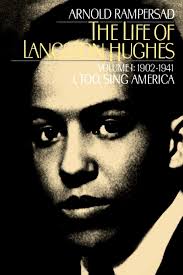
For further reading:To Make a Black Poet by S. Redding (1939); Langston Hughes by J. Emanuel (1967); Black Genius: A Critical Evaluation, ed. by T. O'Daniel (1971); A Biobibliography of Langston Hughes 1902-1967 by D.C. Dickinson (1972); Langston Hughes: The Poet and His Critics by R.K. Barksdale (1977); The Life of Langston Hughes: 1902-1941: I, Too, Sing America by Arnold Rampersad (1986); The Life of Langston Hughes, 1941-1967: I Dream a World by Arnold Rampersad (1988); The Art and Imagination of Langston Hughes by R. Baxter Miller (1990); Langston Hughes: Critical Perspectives Past and Present, ed. by Henry Louis Gates (1993); Langston Hughes: A Study of the Short Fiction by Hans Ostrom (1993); Coming Home: From the Life of Langston Hughes by Floyd Cooper (1994; note: for ages 4-8); Free to Dream by Audrey Osofsky (1996; note: for ages 9-12); Langston Hughes by Joseph McLaren et al. (1997); Langston Hughes: Poet of the Harlem Renaissance by Christine M. Hill (1997); Langston Hughes: Comprehensive Reserach and Study Guide, ed. by Harold Bloom (1999); Remember me to Harlem: The Letters of Langston Hughes and Carl Van Vechten, 1925-1964, edited by Emily Bernard (2001); The Life of Langston Hughes: Volume I: 1902-1941, I, Too, Sing America by Arnold Rampersad (2002); The Life of Langston Hughes: Volume II: 1914-1967, I Dream a World by Arnold Rampersad (2002); Langston Hughes and American Lynching Culture by W. Jason Miller (2010); Langston Hughes, edited by R. Baxter Miller (2013); Race in the Poetry of Langston Hughes, edited by Claudia Durst Johnson (2014); Red Modernism: American Poetry and the Spirit of Communism by Mark Steven (2017) - See also: Countee Cullen. Harlem literature: (novels) Jean Toomer's experimental Cane (1923), Claude McKay's Home to Harlem (1928); Countee Cullen's One Way to Heaven (1932), Anna Bontemps's Black Thunder (1936); (poems and plays) Abraham Hill's On Striver's Row (1933), Langston Hughes's Shakespeare in Harlem (1942). Harlem Renaissance, see This Was Harlem by Jervase Anderson (1981), Modernism and the Harlem Renaissance by Houston A. Baker Jr (1987). Note 1: Hughes's 'The Negro Speaks of Rivers,' written on a train taking him to Mexico, has been among the most quoted of all poems by black poets. Note 2: According to the Kansas poet Eric McHenry, Hughes was born a year earlier than generally assumed. (The Guardian, 10 Aug 2018)
Selected works:
The Negro Speaks of Rivers, 1921 (poem published in the journal Crisis)
The Gold Piece, 1921 (play; publ. in The Brownies' Book)
The Weary Blues, 1926 (incl. the poem Dream Variation; with an introduction by Carl Van Vechten, 1929)
Fine Clothes to the Jew, 1927
Not Without Laughter, 1930
Dear Lovely Death, 1931
The Negro Mother, and Other Dramatic Recitations, 1931 (with decorations by Prentiss Taylor)
Mule Bone, 1931 (with Zora Neale Hurston)
Dear Lovely Death, 1931
The Dream Keeper and Other Poems, 1932 (with illustrations by Helen Sewell)
Scottsboro Limited: Four Poems and a Play in Verse, 1932 (with illustrations by Prentiss Taylor)
Popo and Fifina, Children of Haiti, 1932 (with Arna Bontemps, illustrations by E. Simms Campbell)
The Ways of White Folks, 1934
Little Ham, 1935 (play)
The Mulatto, 1935 (play)
Emperor of Haiti, 1936 (play)
Troubled Island, 1936 (play, with William Grant Still)
When the Jack Hollers, 1936 (play)
Front Porch, 1937 (play)
Joy to My Soul, 1937 (play)
Soul Gone Home, 1937 (play)
Don't You Want to be Free?, 1938 (play)
A New Song, 1938 (introd. by Michael Gold; frontispiece by Joe Jones)
The Em-Fuehrer Jones, 1938 (play)
Limitations of Life, 1938 (play)
Little Eva's End, 1938 (play)
The Organizer, 1939 (musical play, with James P. Johnson)
The Big Sea: An Autobiography, 1940
Shakespeare in Harlem, 1941 (with drawings by E. McKnight Kauffer)
The Sun Do Move, 1942 (play)
Way Down South, 1942 (screenplay)
For This We Fight, 1943 (play)
Freedom's Plow, 1943
Jim Crow's Last Stand, 1943
Laments for Dark Peoples, 1944
Street Scene, 1946 (musical; lyrics by Langston Hughes, music by Kurt Weill, based on a book by Elmer Rice)
Fields of Wonder, 1947
Masters of Dew / Jacques Roumain, 1947 (translator, with M. Cook)
Cuba Libre / Nicholas Guillen, 1948 (translator, with F. Carruthers)
One-Way Ticket, 1949 (illustrated by Jacob Lawrence)
The Poetry of the Negro, 1949 (ed.)
Simple Speaks His Mind, 1950
The Barries, 1950 (play)
Montage of a Dream Deferred, 1951 (incl. poem Harlem)
Laughing to Keep from Crying, 1952
The First Book of Negroes, 1952 (pictures by Ursula Koering)
Simple Takes a Wife, 1953
Famous American Negroes, 1954
The First Book of Rhythms, 1954 (pictures by Robin King)
Famous Negro Music Makers, 1955
The First Book of Jazz, 1955 (pictures by Cliff Roberts, music selected by David Martin)
Sweet Flypaper of Life, 1955 (photographs by Roy DeCarava)
I Wonder as I Wander: An Autobiographical Journey, 1956
The First Book of the West Indies, 1956 (pictures by Robert Bruce)
A Pictorial History of the Negro in America, 1956 (with Milton Meltzer)
Selected Poems of Gabriel Mistral, 1957 (translator)
Simple Takes a Claim, 1957
Simply Heavenly, 1957 (play)
Tambourines to Glory: A Novel, 1958
Famous Negro Heroes of America, 1958 (illustrated by Gerald McCann)
The Book of Negro Folklore, 1958 (ed. with Arna Bontemps)
The Langston Hughes Reader, 1958
Selected Poems, 1959 (drawings by E. McKnight Kauffer)
The First Book of Africa, 1960
The Best of Simple, 1961 (illustrated by Bernhard Nast)
Ask Your Mama, 1961
The Prodigal Son: A Gospel Song-Play, 1961
Black Nativity, 1961 (play)
Gospel Glory, 1962
Fight for Freedom: The Story of the NAACP, 1962
Five Plays, 1963 (plays, edited with an introd. by Webster Smalley)
Jericho-Jim-Crow-Jericho: A Song-Play, 1963
Something in Common, and Other Stories, 1963
New Negro poets, U.S.A., 1964 (edited by Langston Hughes, foreword by Gwendolyn Brooks)
Simple's Uncle Sam, 1965
Soul Yesterday and Today, 1965 (play)
The Book of Negro Humor, 1966 (selected and edited by Langston Hughes)
Angelo Herdnon-Jones, 1966 (play)
Mother and Child, 1966 (play)
Outshines the Sun, 1966 (play)
Trouble with Angels, 1966 (play)
The Panther and the Lash: Poems of Our Times, 1967
The Best Short Stories by Negro Writers: An Anthology from 1899 to the Present, 1967 (ed.)
Black Magic: A Pictorial History of the Negro in American Entertainment, 1967 (with Milton Meltzer)
Black Misery, 1969 (illus. by Arouni)
Three Negro Plays, 1969 (with an introduction by C. W. E. Bigsby)
Don’t You Turn Back: Poems, 1969 (selected by Lee Bennett Hopkins, woodcuts by Ann Grifalconi)
Good Morning Revolution: Uncollected Social Protest Writings, 1973 (edited and with an introd. by Faith Berry, foreword by Saunders Redding)
Langston Hughes in the Hispanic World and Haiti, 1977 (edited by Edward J. Mullen)
Jazz, 1982 (3rd ed., updated and expanded by Sandford Brown)
Arna Bontemps-Langston Hughes Letters, 1925-1967, 1990 (selected and edited by Charles H. Nichols)
The Collected Poems of Langston Hughes, 1994 (edited by Arnold Rampersad)
The Return of Simple, 1994 (edited by Akiba Sullivan Harper, introduction by Arnold Rampersad)
Langston Hughes and the Chicago Defender: Essays on Race, Politics, and Culture, 1942-62, 1995 (edited by Christopher C. De Santis)
Short stories, 1996 (edited by Akiba Sullivan Harper, with an introduction by Arnold Rampersad)
The Pasteboard Bandit, 1997 (illustrated by Peggy Turley)
Carol of the Brown King: Nativity Poems, 1998 (illustrated by Ashley Bryan)
Sunrise Is Coming after While, 1998 (poems selected by Maya Angelou, silkscreens by Phoebe Beasley)
Poems, 1999 (selected and edited by David Roessel)
The Political Plays of Langston Hughes, 2000 (with introductions and analyses by Susan Duffy)
Remember Me to Harlem: The Letters of Langston Hughes and Carl Van Vechten, 1925-1964, 2001 (edited by Emily Bernard)
Collected Works of Langston Hughes, 2001-2004 (v. 1-6, 8-16, edited with an introduction by Arnold Rampersad)
Let America be America again and Other Poems, 2004 (preface by John Kerry)
My People, 2009 (photographs by Charles R. Smith Jr.)
Langston Hughes and the South African Drum Generation: The Correspondence, 2010 (edited by Shane Graham and John Walters, introduction by Shane Graham)
I, too, Am America, 2012 (illustrated by Bryan Collier)
Selected Letters of Langston Hughes Hardcover, 2015 (edited by Arnold Rampersad, David Roessel, Christa Fratantoro)
Letters from Langston: From the Harlem Renaissance to the Red Scare and Beyond, 2016 (edited by Evelyn Louise Crawford and MaryLouise Patterson; with a foreword by Robin D.G. Kelley)
So far the great painter is the wind, says my mother, while she drags with one foot a yellow spot of leaves falling on the unknown park. So far the great painter (the wind, says she) is drawing us separated as we are by a tree, an immense trunk ah, how much would we love to join our hands dance around it lay a cheek on the frozen bark. But we are separated by the immense trunk of a tree in the unknown park.
I was washing clothes while many people disappeared not just because hid suffered there were blows* and now they’re no longer not just because and while sirens and shots passed, dry noise, I was washing clothes, cuddling, sang and the blinds in darkness.
*Translator’s note: The translation of the original Spanish “golpes” (blows, military coup(s), hits) poses a challenge, since the double reference inherent to “golpes”—both to tortures/violence and to the Argentine military coup of 1976—gets lost in the English “blows” or “hits.” “Blows” was chosen because it expresses better the reference to torture and violence in general, its musical reso- nance is more in accord with the tone of the verses, and also because it opens up a more universal projection of the poem that adds to its poignancy and meaningfulness today: it points toward the fate of so many mothers all over the world who carry on with their dislocated lives in the midst of wars and violence.
The reverse of the world plagued with daisies, undulating, illuminated. The world as it is may hardly complete the arrival to the undulating daisies. Who needs those flowers, who falls short by describing them as they are, there? Who may know how those flowers are? And if they are not daisies? If one does not arrive, if the world doesn’t complete itself?
for instance, Sereina is starting a painting. I drop in.
**
(In Zürich. It’s covered in snow in November already because this is Switzerland we’re talking about.)
**
I drop in. “You have SPAM BACON in it.” “Yes, do you know that band?” She plays a song. I listen; we listen.
**
I drop in. “I found you some pictures of clocks,” I say. She paints a clock-face which looks like the moon and a moon which looks like a clock.
**
I drop in.
(In her red studio. Just this once, we eat from the beautiful plate with the blue nude. It doesn’t break but our hands shake, nervous.)
**
I drop in. “My shoes are full of paint,” she says. Tips them out, makes a shape on the paper, like a foot. “Is that what painters do all day?” (It looks easier than writing.) She frowns. “I’m just cleaning my shoes.”
**
(In Bern. It’s summer and the river is so cold and most of the boys are called Heidi and most of the girls are called (Peter??) because this is Switzerland I’m writing about, it is even chli queer, I am a real poet.)
**
I drop in. Why? I think I would rather she dropped in on me. I often write in bed, in my pajamas, with the remains of breakfast, cold tea, and a good view of the walnut tree waving at me, complaining: “You haven’t even mentioned orange yet.” (The walnut tree harbors a strong desire to be an orange tree, just like I’d rather be a painter, but I’m not. Well.)
**
I drop in. She shows me the book: “After the palm, the bird.” (Really? Painters make books?) “Before the palm, the hand,” I correct her. She laughs. “Sit down and have a drink,” she says. I drink; we drink. She calls Kyra. “Come here, quick. That poet dropped in, you know the one. The title was wrong, we have to reprint your book.”
**
(In Berlin. It’s spring and you know, you know, you know spring in Berlin, ev- eryone sitting out on bridges and moaning about the gentry and lounging on the Feld in their trendy denim jackets, and talking about all the art they’re going to do tomorrow and the next day and the next day, you know, there should be so much more, not of Berlin, of words, of how terrible Berlin is in the spring. This is even in prose. It’s twelve poems, I call it LIFE.)
**
I drop in. She’s lying on the floor, doodling alphabets in her notebook. I look up. “You have my booklet in it.” “Yes, it needed something there.” “Oh.” I go and the days go by.
**
I’m in the garden, pinching the yellow flowers off the tomato plants beside the barn. Will she paint a tomato too, is there no end to what painters paint? I want to avoid the walnut tree, which keeps berating me, so I drop in again. The painting is going on, she’s wearing her cap, the D is orange, the paint is orange. “Would you do me a favor when you have time? Would you paint the walnut tree as an orange tree?” She looks at me (is that what painters do, they look at people like that, skeptical, from under their caps?) and I go, and the days go by.
**
(In Mesendorf. It’s autumn. She paints in the barn.)
**
I drop in. She’s inventing new letters. She shows me, pleased. “This one sounds like ‘chli.’” It looks like a cricket.
But me? I invented a color: “strange.” I write a line about “strange.” It’s like orange but spelled differently, and it looks different too, more like a very fresh walnut.
**
One day I am thinking of calendars and seasons. “Spill Simmer Falter Wither” I heard recently. New names. For quarters of the year, the clock, the moon. Bring Glimmer Shorten Splinter. Sprint Comma Lantern Lintel. Fling Summon Pattern Wonder. Song Salmon Caution Glinting. Days go by. I drop in. “It was too much,” she says. “The alphabet only needs twenty-six letters.” (But one day in a gallery I know I’ll see her alphabet, all different but still legible: horseshoe, cricket, pomelo, telescope.)
**
I drop in. All that’s left is just letters: I am out. Her painting of the newspaper is here, Final Edition. I reach out to touch it—is it a collage or did she paint those letters? Then I see a note on the table: Do not touch this painting. I sit down, I write a line about lack. Pretty soon it is a whole page of words, not lines. I go to make a coffee. Another note: There’s no coffee, that’s why I’m out.
Twice per week I’ve been visiting a physical therapist who puts his fingers in my mouth to stretch my misaligned jaw. I think of all sorts of things when his hand is in there. Salmon, of course, come to mind, driving their sex-dumb bodies upstream. I saw them myself once on a day that felt like summer except for the piscine death ritual. Could we please read more about the Hindenburg, my son asks, chin-high in cotton blanket. Some kids like disaster because they don’t know it in their bodies. We live in a river town. Things pass us by. If they stop, as sometimes do trees or dams of ice, it isn’t a good thing. Oprah came to town once to talk to us because we are remarkable for being neither one way nor another, politically. She passed through and we were unchanged. Even though the physical therapist wears gloves I smell onions, but to say so would call up intimacy beyond the obvious, so I’m quiet like a fish and do not struggle.
A young man was standing among six Ponderosas smoking a cigarette on the edge of campus after he left I stood in that spot and finished my cigarette why do the students on the chemistry side look more radical than liberal arts? a black pick-up I liked pulled out of the parking lot but I couldn’t see the make I worry about my vision but I would rather grow half blind than 100 percent in dread which is what not trusting anyone amounts to I convince myself of the Buddhist mantra NO BIG DEAL noting the tarot astrologists all say my Knight is the slowest moving in the deck look that horse is . . . scuffing his toes! spending so much time alone is not made easier by the intimacy of Missoula customer service but it’s preferable to feeling like a paper bag for communal hyperventilation I know I’m merely adequate too while poems can be astonishing and sometimes I through them can be it’s true the deer here will approach anyone they are tenderness tempered with strength I saw seven does on my walk home and for once thought my death might not be so violent having made my last payment for the sins of men with pride in my morphology sure bad things happened to Rome even under Pagan watch what city is defendable? I dutifully looked for the nearest plastic tower filled with sand to dispose my cigarette butt lest I start a fire how carefully we try to live! even with the boot in the face and the brute brute heart of brutes like them
Anna Akhmatova (1889-1966) Pseudonym of Anna Andreyevna Gorenko
One of the greatest Ukrainian poets of the 20th-century, who became a legend in her own time as a poet and symbol of artistic integrity. Anna Akhmatova's work is characterized by precision, clarity, and economy. She wrote with apparent simplicity and naturalness and her rhyming was classical compared to such radical contemporary writers as Marina Tsvetaeva and Vladimir Mayakovsky.
No foreign sky protected me,
no stranger's wing shielded my face.
I stand as witness to the common lot,
survivor of that time, that place.
(in Requiem)
Anna Akhmatova was born Anna Gorenko in Bolshoy Fontan, near Odessa, Ukraine, the daughter of a naval engineer. She began writing poetry at the age of 11, and adopted a pseudonym to allay her father's fears that as a"decadent poetress" she would dishonour the family. The pseudonym was the Tatar name of Akhmatova's great-grandmother. When she was sixteen, her father abandoned his family. Akhmatova attended a girls' gymnasium in Tsarskoe Selo and the famous Smolnyi Institute in St. Petersburg. She continued her studies in Kiev in Fundukleevskaia gymnasium (1906) and in a law school (1907) before moving to St. Petersburg to study literature. Among her teachers were the poet, dramatist and essayist Innokenty Annensky (1856-1909), who influenced her deeply.
Anna Akhmatova
At the age of 21 Akhmatova became a member of the Acmeist group of poets, whose leader, the poet and literature critic Nikolai Gumilyov she married in April 1910, in a church near Kiev. Nikolai was also friend of Annensky, and from Tsarskoe Selo. Nikolai, three years her senior, had fallen in love with Akhmatova when she was just fourteen. Akhmatova become "Gumi-lvitsa" (Gumi-lioness) and her husband was "Gumi-lev" (Gumi-lion).
The Story of Rabia Balkhi, Afghanistan’s Most Famous Female Poet
POSTED ON
The following is a guest post by Munazza Ebtikar,a Ph.D. Candidate at the University of Oxford and a native of Balkh and Panjshir, Afghanistan. She tweets at @mebtikar.
سر انگشت در خون میزد آن ماه ز خون خود همه دیوار بنوشت The moon-faced beauty struck blood with her fingertip With her blood she covered the walls
بدرد دل بسی اشعار بنوشت چو در گرمابه دیواری نماندش Many poems stemmed from her agonized heart When no walls remained in the hamam
ز خون هم نیز بسیاری نماندش همه دیوار چون پر کرد ز اشعار So, too, a few drops of blood remained As she covered the walls with poetry
فرو افتاد چون یک پاره دیوار میان خون و عشق و آتش و اشک She collapsed like a fragment of a wall Amid blood, love, fire and tears
بر آمد جان شیرینش بصد رشک Her sweet soul swiftly left her body with a hundred desires.
-Sufi poet Farid al-Din Attar in the Ilahi-Nama
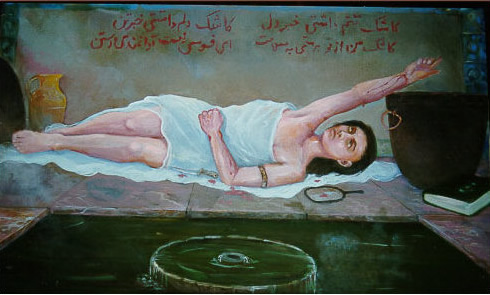
Painting of Rabia Balkhi in the hamam, walls adorned with poetry she wrote with her blood. Source: Lemar Aftaab, 2000.
“Rabia slits her wrists so she can write her final love poem on the walls of the hamam with her blood,” narrates my aunt, sitting cross-legged on a red Afghan rug, designed with repeated octagonal patterns. We are in her daughter Rahima’s house in Khair Khana, a neighborhood in the north of Kabul. The sun rays cast a halo on her braided white-peppered brown hair. She balances a glass filled with steaming green tea in one hand, while the other raises a pink fly swatter in the air. Her eyes search for the buzzing menace and shift to mine, anticipating a reaction. I give her a knowing look of acknowledgment at the story’s tragic end. Her eyes search around the room as she explains the final act in a raised voice. “It must be understood: Rabia did not kill herself for Baktash.” She looked at me again. “She found love in God through Baktash; her heart was too pure in the face of injustice, you see.”
My aunt is narrating the tragic love story of Rabia Balkhi, a medieval poetess from Balkh, located in present-day northern Afghanistan. Rabia is one of the most venerated female figures in the Afghan imaginary. She is credited with having been among the first practitioners of New Persian or Parsi-ye Dari (tr. Persian of the Court). The language flourished in the 10th century after two centuries during which the Islamic conquest transformed the region’s cultural and linguistic composition, infusing Middle Persian (Pahlavi) with new vocabulary and a new script. Rabia was a poet princess in the Balkh court where her father served as Emir. She fell in love with her brother’s Turkish slave, Baktash, and would write poetry to him. Because of her brother’s jealousy and wickedness, he cast Rabia into the hamam and Baktash into a well. In the hamam, Rabia slit her wrists and with her blood she wrote her last love poems until her death.
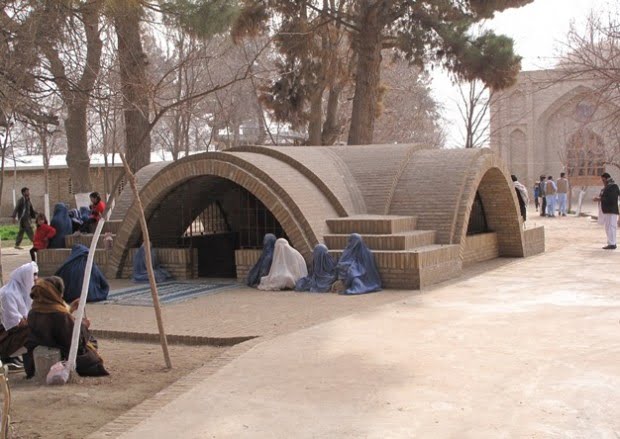
The mausoleum of Rabia Balkhi. Source: Bakhtar News.
“You see they don’t tell you, her love for Baktash is not like what you see in these TV shows.” We both glance at the Persian-dubbed Turkish show playing on the TV screen. The picture is blurry, but one can make out a man gazing into the hazel eyes of a beautiful Turkish woman. “She was a pure woman. Her burial site is a sacred shrine. I’ve been there,” my aunt says, nodding her head. My aunt narrates Rabia’s love story by adding her own emphasis on what she finds significant, providing her own interpretation of the story. For my aunt, Baktash was the means by which Rabia could reach the divine. It is common to hear Afghans tell and retell her love story with different emphases, reflecting on the world around them to make sense of themselves and their lives in a specific time and place. Rabia is depicted as a feminist icon who spoke truth to power, a martyr for sacred love, or even a victim of honor within a patriarchal order.
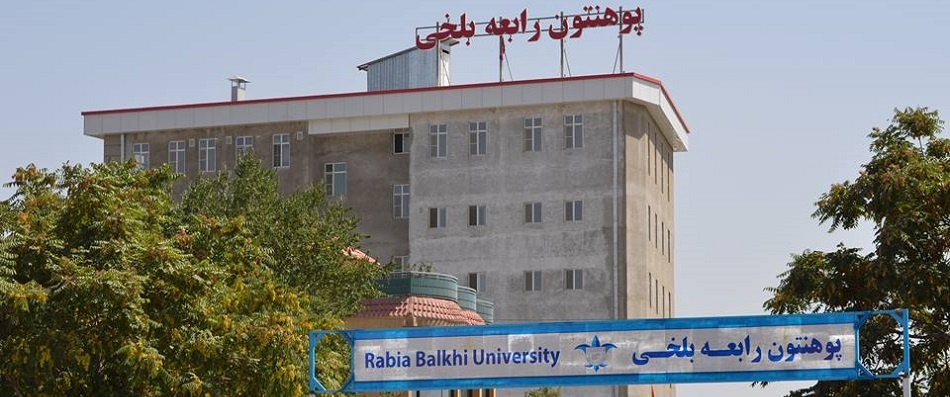
Today, Afghans name their daughters and institutions – from schools to hospitals – after her. Monuments were built in her honor and her story became a part of Afghanistan’s national culture through theater performances and film productions such as the historic epic Rabia Balkhi (1974). More than a thousand years after her death, Rabia continues to figure strongly in the Afghan cultural imaginary.
Rabia Balkhi University in Kabul. Source: rbu.edu.af
Although Rabia remains prominent in Afghan popular memory, her life and poetry have not been subject to much scholarly inquiry. In fact, there are scant references and illustrations of her life in literature on Persian poetry in most languages, even in Persian. Scouring through bookshops and libraries in Kabul in 2019, I was able to find only a few works on Rabia. There were some illustrations of her love story in some books and some collections of excerpts of her poetry or, perhaps, poetry attributed to her. How then, do we know about Rabia’s poetry and love story? Why does the afterlife of her love story remain prominent in the Afghan oral tradition? And what do the differing accounts of her love story tell us about the ways in which Afghans imagine themselves?
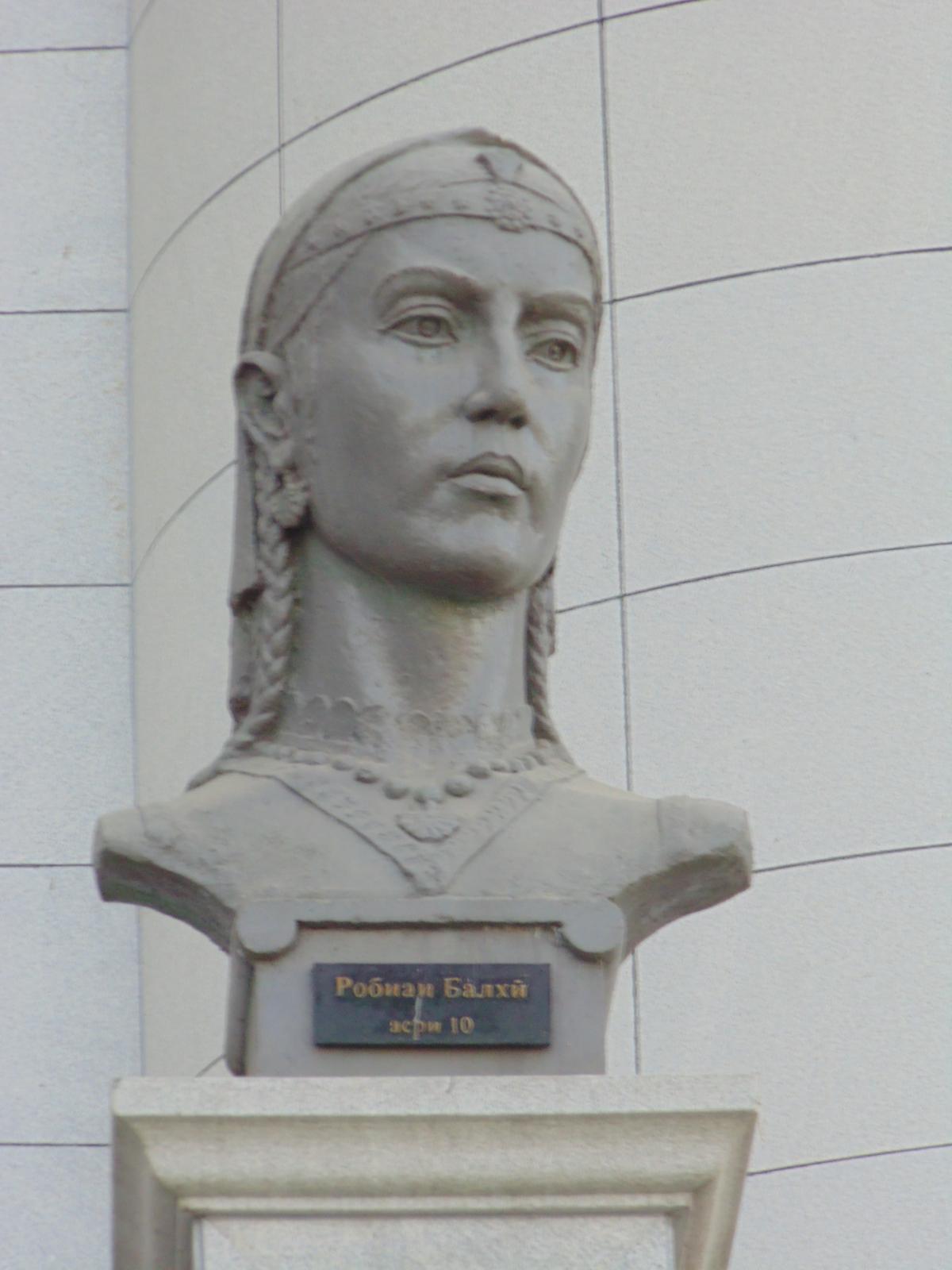
Statue of Rabia Balkhi in Central Asia, her name written in Cyrillic.
Although no divan of Rabia’s work exists, Rabia’s story and her poetic verses appear prominently in the narrations of influential male Persian poets and biographical dictionaries (tazkirahs). The earliest biographical work of Persian poets, titled Lubab al-albab (tr. The Essence of Essences) written by Muhammad ‘Awfi (1171-1242 CE) in 1220, briefly mentions Rabia, her skill in Persian poetry and her intellect under the title Rabia bint Ka‘b al-Quzdari. The longest narration of Rabia’s life and poetry is in the lyrical poem of the Ilahi-Nama (tr. Book of the Divine) by the Sufi poet and hagiographer, Farid al-Din Attar (1145-1221 CE).
One of the mystical stories in the Ilahi-Nama is of the life and poetry of Rabia titled Hikayate Amir-e Balkh wa āsheq shudan-e dukhtar-e ō (tr. the story of the Emir of Balkh and his daughter falling in love).As the longest narration of her story and poetry, Attar narrates her story and poetry as a mystic, a common trend among Sufi poets after her time. Her love for Baktash, her brothers’ Turkish slave, is depicted as sacred and divine love, as it is through seeing him that she starts writing her love poetry and only through him that she experiences this love for the divine.
Attar claims that it was the Persian Sufi poet Abu Sa‘id Abul Khayr (967-1049 CE) who had informed him that Rabia became a mystic and that her poetry was for God. This story of love and sacrifice has parallels to that of Rabi‘a al-Adawiyya (714-801 CE) from Basra, one of the most prominent female saintly figures in Islamic history, renowned for her unwavering devotion to God. About 270 years after this narration, Nur al-Din Abd al-Rahman Jami (1414-1492 CE), the 15th century Persian Sufi writer and poet, mentions Rabia in the hagiography titled Nafahat al-Uns (tr. Breezes of Intimacy), mentions Rabiaamong thirty-three other female saints under the title Dukhtar-e Ka’b, Rahmat-ullah alayh (tr. The Daughter of Ka’b, May God Have Mercy on Her). In this passage, Jami also references Abu Sa’id Abul Khayr’s story, writing that the daughter of Ka’b was in love with the slave but her love was not for him. Building on the same tradition as Attar, he writes that when Baktash saw Rabia close to him, he laid a hand on her sleeve. In response, she scorned him and said, “Is it not enough for you to understand that this love is for God? Have I given you the occasion to enjoy me?”
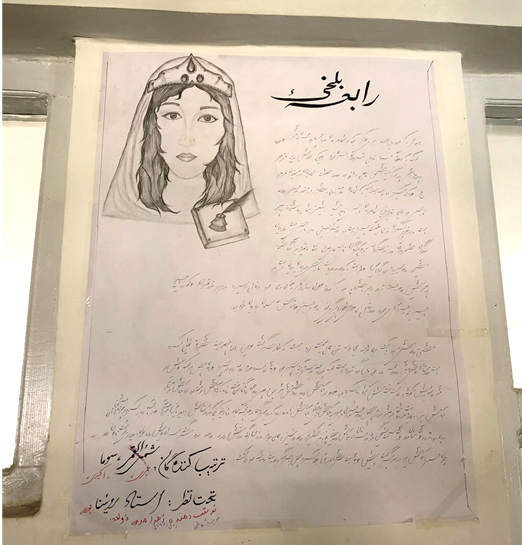
A poster on Rabia Balkhi’s life made and hung by schoolgirls in Bibi Amina high school in Bazarak, Panjshir. Photo taken by author in 2019.
From these textual accounts, we can infer that Rabia lived during the Samanid Empire, which stretched from Transoxiana to Khorasan in the 9th and 10th centuries. At the time, Balkh served as one of the empire’s main cultural centers and as the epicenter of Islamic scholarship and mysticism. It was home to great poets and Sufi masters, gaining epithets such as umm al-bilad (tr. the mother of cities) or qubbat al-Islam (tr. the dome of Islam). Rabia was the daughter of Ka‘b, a local Emir, and of Arab lineage. As an outcome of the Islamic expansion eastward, Balkh had become an important center of Arab settlement in the 8th century. As the daughter of an Emir, Rabia occupied an elite position as a member of the nobility and was educated and wrote poetry.
Unlike male poets, such as her contemporary Abu ‘Abd Allah Ja‘far ibn Muhammad Rudaki, who served as poet laureates in the court and were compensated for their literary services, female poets wrote more for individual desire. Rabia wrote in both Persian and Arabic. Her poetry has served a crucial and decisive role in the revival of Persian poetry as we know it today: it alludes to pre-Islamic kings and religions, and uses tropes and metaphors which recur in later Persian poetry. It is for this reason that Rabia remains a central figure in the making of the Persian literary tradition. Born three centuries before Jalal ad-Din Mohammad Balkhi (commonly known as Rumi), Rabia was a major contributor to the foundation of the Persianate literary canon.
What we know of Rabia’s poetry and life in textual accounts has been passed down by Sufi chains of transmission, all of which emphasize her sainthood. In circumstances where oral transmission is broken or a divān is lost, tazkirahs become the “sole repositories of memory about some individuals and fragments of their verses.”Tazkirahs, according to Zuzanna Olszewska, “offer useful insights into the changing ways in which public narratives of distinction, or the distinctiveness of literary personalities, could be constructed and the types of people whose distinctiveness could be claimed.” Perhaps it is this emphasis on her sainthood that may explain why her mausoleum today, located in Nawbahar in Balkh, is one of the most frequently visited sites by pilgrims, tourists, and locals alike. Nawbahar itself is a famous pilgrimage site comprising tombs of pious men and women. This site holds a sanctity that predates Islam as it was also a spiritual site for Buddhism and Zoroastrianism.
Afghans tell and retell Rabia’s story and poetry through diverse avenues, and in diverse social and political contexts. Rabia is memorialized and immortalized by her narrators. Olszewska describes composing and writing poetry in Afghanistan to be “the most highly prized and widely practiced art form among Afghans of all walks of life, both literate and illiterate.” In one sense, Rabia’s popularity in Afghanistan is like Ferdowsi’s in Iran, which, as Aria Fani writes, was “the product of intellectual and architectural labor sponsored by the state.”
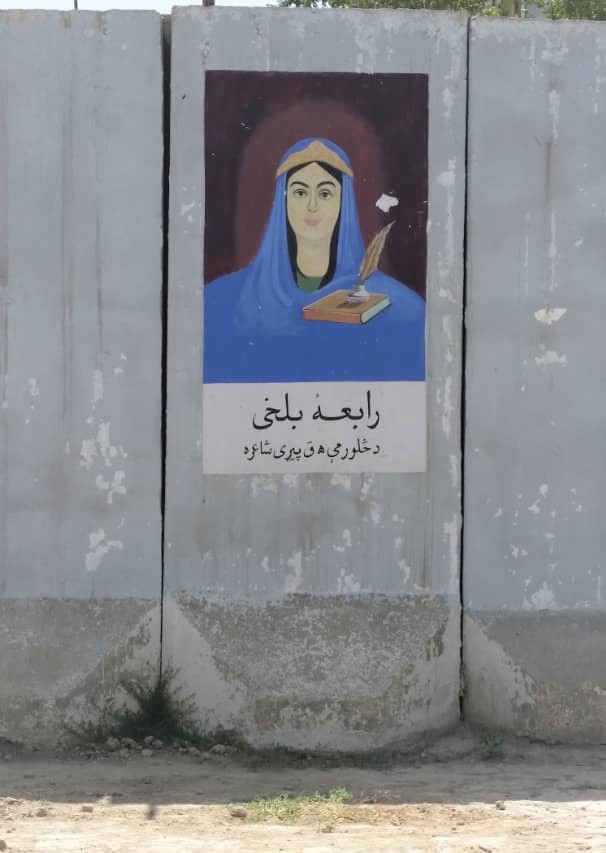
A poster of Rabia Balkhi plastered on a protective wall of Afghanistan’s Supreme Court. Pashto text underneath reads, “Rabia Balkhi 4th hijri century poet.” Source: Farhat Chira, 2021.
Afghan nationalists in the 20th century worked to create and promote a distinctive “Afghan” national and historical identity, privileging their own canon of writers whose birth fell within the borders of the nation-state. This explains why one of the first government-sponsored Afghan films was on Rabia and why many all-women institutions, such as schools and hospitals, were named after her. But, in another sense, Rabia’s love story with Baktash resembles the great tragic love stories of Persian literature – such as Leili and Majnun or Khosrow and Shirin – allowing it to be easily narrated and passed down from one generation to the next.
My aunt in Khair Khana retold Rabia’s story to make her own point about the power of love and God. For my aunt, Rabia’s love contrasted with the modern-day love portrayed in the Turkish serial drama airing on the small TV set in front of her. Yet, hers is only one version of Rabia’s love and life represented in the Afghan popular imaginary. In her exhibition of notable women in Afghanistan and the region “Abarzanan” (tr. Superwoman), held in Kabul in 2018, Afghan artist and photographer Rada Akbar displayed a red dress to represent Rabia. She described Rabia as “a symbol of defiance against patriarchy and a continued harsh reminder of the price we’ve [Afghan women] been forced to pay for freedom of speech and love.”
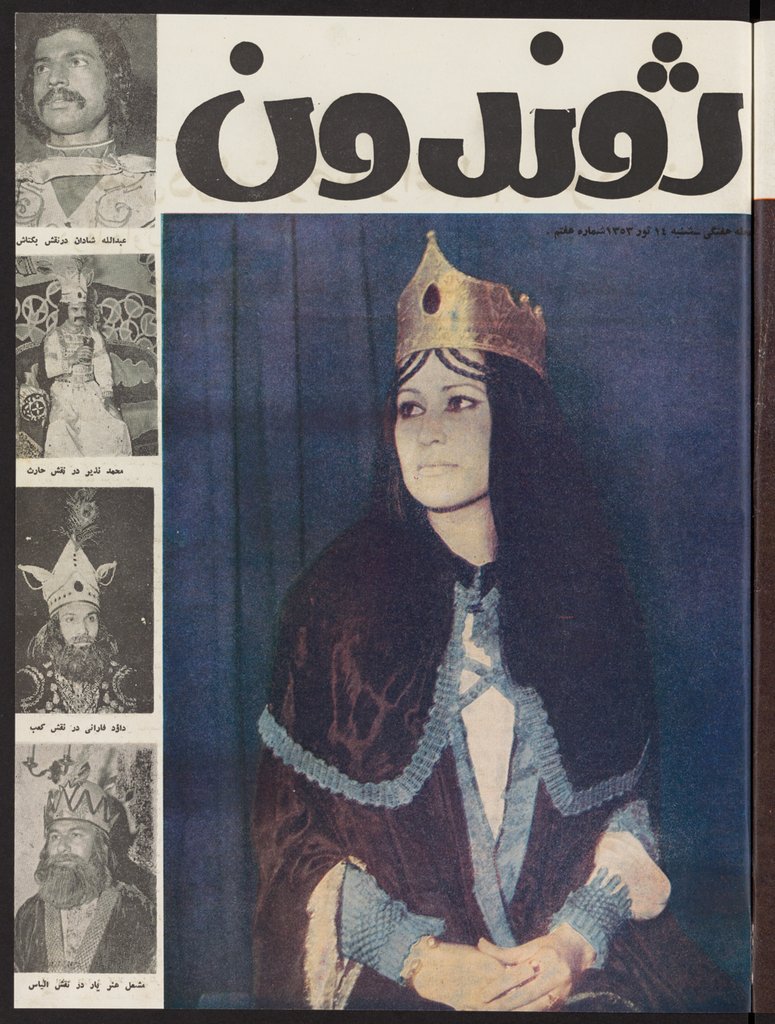
This has parallels to an article written on Rabia published in the popular magazine, Zhvandun, more than 40 years prior in 1974. The first line of this article reads, “the story of Rabia is the story of a cry in the strangled throat of the women in our society in her time and other times that have passed.” Although 40 years apart, both interpretations reflect on the dire place of Afghan women within a patriarchal society – as well as how Afghan women have claimed Rabia’s legacy as a means of resistance.
The film Rabia Balkhi featured in Zhvandun, a popular Afghan magazine published on May 4, 1974. Source: World Digital Library, Library of Congress.
Julie Billaud, in her ethnography titledKabul Carnival: Gender Politics in Postwar Afghanistan, notes the popularity of Rabia among female students at Kabul University. They admired Rabia’s heroism in choosing self-sacrifice and death to defend greater ideals. Self-sacrifice, according to Billaud, is part of these Afghan women’s broad repertoire of emotional performance. Comparingly, when I visited all-girls schools in Kabul and Panjshir in 2019, descriptions or drawings of Rabia adorning hallway walls (See Figure 6) was a common sight. Rabia’s legacy inspires young women to defy and transcend the unjust limitations placed – and worldviews held – within their society. As such, Rabia’s defiance and bravery to reach her earthly love, Baktash, the divine, or both, in her life and her poetry remain central in the Afghan cultural imagination one thousand years after her death.
Although Rabia’s story takes many forms, her story which I heard told and retold in Afghanistan has a common version, and it goes as such.
In the sacred land of Balkh with its one thousand mosques, Rabia, the daughter of the Emir of Balkh, is born. She is bathed in rose water, adorned in silk, and placed in a carriage made of gold. The day of her birth is celebrated by the people of Balkh, and they rejoice as they pray and read poetry on this auspicious day.
Rabia is raised in the palace where she is taught arts and literature, hunting and archery, until she reaches the age of wisdom. She was enchanting, both in her beauty and her words. She moved and spoke with an eloquence that left her with many admirers. When Rabia recited her poetry, it would bewilder the poets and literati of her time. She captured not only the hearts of her mother and father, but the people of Balkh themselves nicknamed her Zain al-Arab (the beauty of the Arabs, or the most beautiful one of the Arabs), Iqbal (the auspicious), and Tela-ye Ka‘b (the gold of Ka‘b). Her youth and charm would illuminate the eyes of her aging father.
One day, a famous astrologer of Balkh named Atrosh tells her that although she is an irradiating star and will set the world aflame with her passion, she may fall into bad omen.
Rabia’s mother passes away and this shatters her delicate being. The women of her court took Rabia to places of worship so that her soul was soothed by the sermons and verses of the great scholars and men of wisdom from Balkh.
Meanwhile, her brother Haris was jealous and envious of Rabia’s skill, eloquence, and the admiration she received from her father and the people of Balkh. When their father is on his deathbed, he calls them both to him. He tells Haris that he will be his successor and advises him to be just and generous with all of God’s creations, and to ensure that he will look after Rabia.
∙∙∙
One day as Rabia stands on her balcony overlooking a garden, she catches sight of a beautiful man serving wine to Haris. Baktash, Haris’s Turkish slave and a guard of the treasury, captures Rabia’s heart. This moment marks the beginning of Rabia’s love story and poetry, and her tragic fate.
Rabia would compose love letters to Baktash in verse, longing for him. These would be delivered by her loyal court maiden and friend, Ra‘na. Her love for Baktash was an affliction that no doctor of Balkh was able to cure.
Rabia writes:
الا ای غائب حاضر کجائی Oh the absent and present one where are you به پیش من نهٔ آخر کجائی If you are not with me then where are you دو چشمم روشنائی از تو دارد My eyes are illuminated by you دلم نیز آشنائی از تو دارد My heart is acquainted by you بیا و چشم و دل را میهمان کن Come and invite my eyes and soul وگرنه تیغ گیر وقصد جان کن Otherwise take a sword and end my life
Baktash, in response, says:
ندارم دیدهٔ روی تودیدن I don’t have the sight to see you ندارم صبر بی تو آرمیدن I don’t have patience and rest without you مرا اکنون چه باید کرد بی تو What am I going to do with you now که نتوان برد چندین درد بی تو How can I carry this pain without you چو زلف تو دریده پردهام من Your hair has pierced my veil که بر روی تو عشق آوردهام من With your face I have fallen in love ازان زلف توام زیر و زبر کرد From your hair I have become under and over که با زلف تو عمرم سر به سر کرد Because from your hair my life has been destroyed
∙∙∙
During this time, Asher al-din, the ruler of Kandahar, sought to attack Balkh and subject it to his rule. Haris, who had claimed his throne, was fearful and prepared to stand in opposition. With the consultation of his advisors, he knew that without the help of Baktash, he was unable to defeat his enemy.
Haris tells Baktash that if he kills Asher al-din, he will reward him with what he pleases. In the battlefield Baktash was victorious but at a dear price. As he nearly lost his life, a soldier with a covered face came galloping into the battlefield to save him and win the war. This soldier was none other than Rabia.
∙∙∙
Balkh was the epicenter of literary events, but it was unmatched by Bukhara. Amir Nasr, the king of the Samanids, was a lover of poetry and organized grand literary events in Bukhara, the home of the great poet, Rudaki. One day, Haris was invited, together with the newly defeated Asher al-din of Kandahar, the ruler of Herat, and other notables, to witness Rudaki recite his poetry.
When Rudaki recited his poetry, he dazzled his audience. One of his poems was Rabia’s, whom he would join in the Balkh court. After he recites her poem, he attributes it to her and says that although Rabia is a sacred woman, she fell in metaphorical love with her slave Baktash, the inspiration behind this poem. When Haris hears this, he coils like an injured snake. The event comes to an end and Haris takes towards Balkh, thirsty for the blood of Rabia and Baktash who had brought shame to his name.
Upon his arrival to Balkh, Haris orders that Rabia be thrown in the hamam and Baktash in a well. In the hamam, she slashed her wrists, and writes the last few lines of poetry for Baktash with her blood on its walls. After days of being in the well, Baktash is saved with the help of Ra‘na. He first takes Haris’s head and goes to the hamam, only to find Rabia’s beautiful lifeless body on the ground covered with her blood and the walls of the hamam adorned with her last love poems for Baktash. He falls to the ground and takes his life next to his beloved.
One of the poems that are on the wall reads: کاشک تنم يافتي خبر دل I wish my body was aware of my heart کاشک دلم داشتی خبر تن I wish my heart was aware of my body کاشک من از تو برستی به سلامت I wish I could escape from you in peace آی فسوسا کجا توانم رستن Where can I go regretfully
References
Azad, Arezou. Sacred Landscape in Medieval Afghanistan: Revisiting the Faḍa’il-i Balkh. Oxford University Press, 2014.
Billaud, Julie. Kabul Carnival: Gender Politics in Postwar Afghanistan. University of Pennsylvania Press, 2015.
Davis, Dick. The Mirror of My Heart: A Thousand Years of Persian Poetry by Women. Penguin Books, 2019.
Olszewska, Zuzanna. “‘A Desolate Voice’: Poetry and Identity among Young Afghan Refugees in Iran,1.” Iranian Studies, vol. 40, no. 2, 2007, pp. 203–224.
Olszewska, Zuzanna. “Claiming an Individual Name: Revisiting the Personhood Debate with Afghan Poets in Iran.” The Scandal of Continuity in Middle East Anthropology: Form, Duration, Difference, edited by Judith Scheele and Andrew Shryock, Indiana University Press, 2019.