|
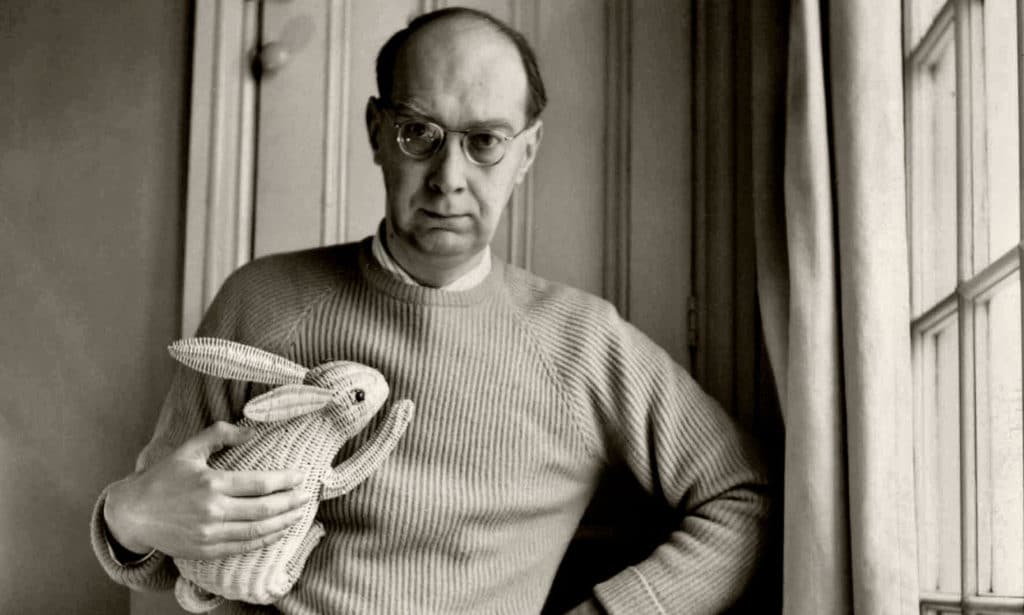
| Philip Larkin |
Philip Larkin, the Impossible Man
How the most exasperating of poets met his match
IN MAY 1941, Philip Larkin was the treasurer of the Oxford University English Club and in that capacity had to take the visiting speaker George Orwell out to dinner after he had addressed the membership on the subject of “Literature and Totalitarianism.” Larkin’s main recollection: “We took Dylan Thomas to the Randolph and George Orwell to the not-so-good hotel. I suppose it was my first essay in practical criticism.”
Nudged and intrigued by this potential meeting of minds, I once attempted a comparison and contrast between Larkin and Orwell, as exemplars of a certain style of “Englishness.” Both men had an abiding love for the English countryside and a haunting fear of its obliteration at the hands of “developers.” (Here I would cite Larkin’s poem “Going, Going” and Orwell’s novel Coming Up for Air.) Both were openly scornful of Christianity but maintained a profound respect for the scripture and the Anglican liturgy, as well as for the masterpieces of English ecclesiastical architecture. (See Larkin’s poem “Church Going” and the same Orwell novel, as well as numberless letters and reviews.) They each cherished the famous English affection for animals and were revolted by any instances of human cruelty to them. (Here consult Larkin’s poem “Myxomatosis,” about the extermination of the country’s rabbit population, as well as at least one Orwell work that’s too obvious to require mentioning.)
In somewhat different ways, Orwell and Larkin were phlegmatically pessimistic and at times almost misanthropic, not to say misogynistic. Both also originated from dire family backgrounds that inculcated prejudice against Jews, the colored subjects of the British Empire, and the working class. Orwell’s detested father was a servant of the Empire who specialized in the exceptionally nasty subdivision that traded opium between India and China, and Larkin’s detested father was a professional civil servant who came to admire the “New Germany” of the 1930s, attended Nuremberg rallies, and displayed Nazi regalia in his office. But these similarities in trait and background produced radically different conclusions. Orwell educated himself, not without difficulty, out of racial prejudice and took a stalwart position on the side of the workers. Larkin energetically hated the labour movement and was appalled at the arrival of immigrants from the Caribbean and Asia. Orwell traveled as widely as his health permitted and learned several foreign languages, while Larkin’s insularity and loathing for “abroad” were almost parodic. In consequence, Orwell has left us a memory that elevates English decency to one of humanity’s versions of grace under pressure, whereas the publication of Larkin’s Selected Letters in 1992, and a biography by Andrew Motion in 1993, posthumously drenched the poet in a tide of cloacal filth and petty bigotry that was at least somewhat self-generated.
I now wish I had understood enough to push my earlier comparison a little further. For there is another aspect of “Englishness,” netted in discrepant ways by Harold Pinter and Monty Python, in which both men had a share. This is the world of wretched, tasteless food and watery drinks, dreary and crowded lodgings, outrageous plumbing, surly cynicism, long queues, shocking hygiene, and dismal, rain-lashed holidays, continually punctuated by rudeness and philistinism. In Orwell’s early fiction, all this is most graphically distilled in Keep the Aspidistra Flying, but it is an essential element of the texture of Nineteen Eighty-Four, and was quarried from the “down and out” journalism of which he produced so much. A neglected aspect of the general misery, but very central once you come to notice it, is this: we are in a mean and chilly and cheerless place, where it is extraordinarily difficult to have sex, let alone to feel yourself in love. Orwell’s best shorthand for it was “the W.C. and dirty-handkerchief side of life.”
Larkin’s own summary was, if anything, even more dank: he once described the sexual act as a futile attempt to get “someone else to blow your own nose for you.” These collected letters reflect his contribution to a distraught and barren four-decade relationship with Monica Jones, an evidently insufferable yet gifted woman who was a constant friend and intermittent partner (one can barely rise to saying mistress, let alone lover) until Larkin’s death in 1985. During that time, he strove to keep her to himself while denying her the marriage that she so anxiously wanted, betrayed her with other women sexually, and eagerly helped Kingsley Amis to employ her as the model for the frigid, drab, and hysterical Margaret Peel in Lucky Jim.
On an initial scrutiny, Letters to Monica struck me as rather thickening the squalid atmosphere of some of the preceding accounts. But so unalleviated—I almost wrote artless—is its tone that the material takes on a certain integrity and consistency. Not unlike Larkin’s paradoxical infatuation with jazz, it helps furnish a key to his muse. The key in both cases—which is why artless would be such a mistake—is that about suffering, he was seldom wrong. The dismal paltriness of the suffering doesn’t really qualify this verdict.
One of his ways of keeping Monica while keeping her at bay—they did not cohabit until very near the end, finally forced into mutual dependence by decrepitude on his part and dementia on hers: perhaps the least romantic story ever told—was to make an over-full confession of his own inadequacies as a male. “I’m sorry our lovemaking fizzled out,” he writes after a disappointing provincial vacation in 1958. “I am not a highly-sexed person.” This comes after a letter in which he invites her to consider their affair in the light of “a kind of homosexual relation, disguised: it wdn’t surprise me at all if someone else said so.” And even earlier—it is not as if this is the record of a hot thing cooling—he writes, in December 1954, “If it were announced that all sex wd cease as from midnight on 31 December, my way of life wouldn’t change at all.” This naturally prompts one to review one of his best-known poems, “Annus Mirabilis”:
Sexual intercourse began
In nineteen sixty-three
(Which was rather late for me) -
Between the end of the Chatterley ban
And the Beatles’ first LP.
The lines can easily be read as a non-literal satire on the exuberant 1960s in general. The less-quoted succeeding verse is arguably more revealing:
Up till then there’d only been
A sort of bargaining,
A wrangle for a ring,
A shame that started at sixteen
And spread to everything.
In Larkin’s mind, marriage was invariably a trap set by females: a ring in exchange for some perfunctory sex and then a lifetime of domestic servitude and—even more appalling—the rearing of children. Once again the poetry is unambiguous. “The Life With a Hole in It” conveys the cringe with greater complexity, but “Self’s the Man” is not unrepresentative:
He married a woman to stop her getting away
Now she’s there all day.
And the money he gets for wasting his life on work
She takes as her perk
To pay for the kiddies’ clobber and the drier …
Even “The Whitsun Weddings,” in which he manages to write with some tendresse about a famous northern-English nuptial tradition, closes with an extremely melancholy metaphor of energy mutated into futility, or possibly potency into liquefaction: “A sense of falling, like an arrow-shower / Sent out of sight, somewhere becoming rain.” And as for the thought of parenthood, not just by or from oneself, but even of oneself, we need look no further than the celebrated poem that probably convinced his admirer Margaret Thatcher that he wasn’t the family-values type. “This Be the Verse” opens by saying, “They fuck you up, your mum and dad / They may not mean to, but they do”; and it closes by advising, “Get out as early as you can / And don’t have any kids yourself.” There are virtually no references to children in Larkin that are not vivid with revulsion, the word kiddies being the customary form the automatic shudder takes.
No keen analyst is required to unravel this. Larkin had not only a bombastic fascist for a father, but a simpering weakling for a mother. Sydney Larkin had the grace to die early but his widow, Eva, lingered on, querulous, demanding, and hypochondriacal (and extremely unwell), for decades. She may not have meant to make her son’s life a nightmare of guilt and annoyance, but she did. This resulted in Monica Jones’s winning at least one round. On no account, she told her man, should he be blackmailed into living with Eva. “Don’t be robbed!” she beseeched him. “Don’t be robbed of your soul.” If she couldn’t have him, she at least wouldn’t surrender him to that form of “the other woman.”
To have read Larkin’s Letters and Motion’s biography is to be in on a rather dirty joke that surreptitiously permeates these pages. Larkin may not have been highly sexed in the conventional sense, but he was a heroic consumer of pornography and an amateur composer of sadomasochistic reveries, which he often shared with his worldly friends Robert Conquest and Kingsley Amis. He didn’t much like the capital city, but would never visit London without spending good money, or paying through the nose, as one might say, with the vendors of semi-licit glossies in the Soho quarter. Why Andrew Motion maintains that Larkin didn’t have specialized tastes, I cannot think: he was in constant search of material featuring schoolgirls, flagellation, and sodomy. (In 1958 to Conquest: “I agree Bamboo & Frolic are the tops, or rather bottoms: do pass on any that have ceased to stimulate.”) This celebrated fixation is also thought by some to be “quintessentially English.” At his death, along with many other private papers, the vast library of a hectically devoted masturbator had to be hastily destroyed. (He obviously had not mistaken his calling as an archivist.) Once one knows this, many of the letters to Monica become instantly intelligible. He comments slyly but learnedly on the buggery implications of the D. H. Lawrence novel that was then on trial in the courts. “You and your bottom,” he elsewhere writes fervently.
I lay in bed one morning last week remembering one after-breakfast time when you were looking out of my kitchen window … You were wearing the black nylon panties with the small hole in!
Or
You must look a wonderful sight in fur hat & boots—nothing else? Holding a rawhide whip? (You see how naturally my imagination composes aesthetic montages for you.)
On and on his plaintively suggestive appeals recur, and—this is somehow impressive—she never seems to take the hint. What Larkin wanted was a Nora Barnacle, and what he got was—Margaret Peel. The sole exception seems to prove my rule: in late 1958, he plumbs the depth of abjectness by writing to her in apology for what clearly must have been a bungled episode of anal penetration:
I’m sorry too that our encounter had such unhappy results for you! I really didn’t expect such a thing, though I suppose it might have been predicted. I am sorry. It does rather spoil the incident, even at best, which was very exciting for me anyway. Let’s hope all rights itself soon.
Not since Hemingway so overdid the lapine pillow-talk in For Whom the Bell Tolls has any man referred to a woman as a rabbit with such regularity and intensity. Most of the letters are addressed to either “Bun” or “Bunny,” and not a few are illustrated with drawings of rabbits, references to rabbits in literature, or condemnations of British government policy toward rabbits. The obsession did yield the fine poem “Myxomatosis,” which I mentioned earlier, but Larkin’s attempt to make a Beatrix Potter nursery story out of the standoff is often in jarring contrast to the content. The sad grovel I quoted from above is concluded by the sentence: “You sound as if you want comforting Fat rabbit lovely pretty rabbit,” which is a lot to bear for those of us who respect Larkin for his lack of sentimentality. And rabbits are, above all, philoprogenitive … Incidentally, all resemblances to Orwell break off at this point: the author of Animal Farm had a tough enough time with women but was eager for marriage and anxious for children, preferring to adopt rather than go without.
This collection is an accidental success as a period piece. The Britain of the immediate post-war era was in many ways even more austere and impoverished than the Britain of the Depression, with bad and scarce housing, for example, made very much worse by the recent aerial bombardment. Larkin, who once told an interviewer, “Deprivation is for me what daffodils were for Wordsworth,” found his poetic promptings in the overcrowded, overworked, underfed society that he so much purported to resent. Not only that, but his chosen career as a librarian led him to live in Belfast, Ireland’s (and Britain’s) most immiserated and forbidding city, at the cusp of the 1940s and ’50s. His political sympathies can scarcely have been Republican, but a description of an Orange Day rally is one of the best short evocations of massed boorish fanaticism I have ever read. “It was a parade of staggering dullness (every face wore the same ‘taking-himself-seriously’ expression) & stupefying hypocrisy.”Indeed, those of the Terry Eagleton crew, who have become so righteously fixated on the later “revelations” of Larkin’s racism and xenophobia, might be surprised at the absence of jingoism and nastiness in these letters. He is very strict with Kipling’s excesses, for example, accusing him of betraying his talent in order to be a crowd-pleaser (“hunts with the pack”). Perhaps the uneasy memory of parental Nazism is too close, even though this makes it the more eerie to notice that he never, ever alludes to the then-recent horror of the Third Reich, either in these pages or in any others. Alternative diagnoses include Motion’s opinion that he didn’t quite surrender to reactionary impulses until he became much older, and the high likelihood that much of what he did write in that vein was designed to amuse friends in private letters, by way of outraging the new forms of correctness. A thwarted and furtive sex life, one may speculate, would have been no obstacle in the formation of a carapace of contempt for modernity and its hedonistic outriders.
And this returns us to the luckless Monica, whose possibly Aspergerish manners he strove in vain to correct. “I do want to urge you, with all love & kindness, to think about how much you say & how you say it …” Deploying—in a different but surely conscious declension—the most deadly word in the English vernacular, he warned her: “You’re getting a habit of boring your face up or round into the features of your listener.” That was in 1952, with almost 30 years of on-again, off-again stretching still before the pair of them. But he must have caught something of value in her opinions, because he took seriously her part-grammatical objection to line four of the closing stanza of “Church Going,” which is today perhaps his best-loved poem. Ought it to have been “And so much never can be obsolete,” instead of “that much”? Look and see. Even if, like me, you cannot imagine changing a word, you notice that she was a shrewd and attentive reader. (Here might be the place to say that Anthony Thwaite’s meticulous footnoting and cross-referencing have made this book much more capacious and lively than it might have been, as well as affording us a unique view of some of Larkin’s most lapidary poems when they were still fluid and in formation.)
Rising above the low-level rancor and tedium that can make the scrutiny of private anomie so lowering to the spirit, Letters to Monica obliquely shows the civilizing effect that even the most trying woman can exert on even the most impossible man. With the exception of the occasional rather weak joke in passing, Larkin respected Miss Jones too much, it seems, to try any of his vulgar prejudices or cheaper doggerel on her. Most impressive of all, I found, was that even his anti-libidinous propaganda could yield its warm and poetic aspect. Take this stern epistle from 1951:
I think—though of course I am all for free love, advanced schools, & so on—someone might do a little research on some of the inherent qualities of sex—its cruelty, its bullyingness, for instance. It seems to me that bending someone else to your will is the very stuff of sex, by force or neglect if you are male, by spitefulness or nagging or scenes if you are female. And what’s more, both sides would sooner have it that way than not at all. I wouldn’t.
Such an ostensibly repressive and limited view, with its unimaginative image of “both sides,” had been given the most starkly beautiful expression by a poem that Larkin wrote the preceding year. “Deceptions,” suggested by a harrowing anecdote of forced prostitution from Henry Mayhew’s history of the London poor, implicitly vindicated the ruined female victim by pleading indirectly that her foul client was also a pathetic loser and that she, the innocent sufferer, might even turn out to have been “the less deceived.” He by no means omitted to picture the raw, latent violence of her own trauma. (“All the unhurried day / Your mind lay open like a drawer of knives.”) Gem-hard, it is also an immediately striking piece of imaginative sympathy. Reviewing it, D. J. Enright gave Larkin a rare moment of (almost) unmixed pleasure by saying, as Larkin proudly reported to Monica, that “I persuade words into being poetry & don’t bully them.” A critic could not have approached more nearly to the core of Larkin’s gift.
It is inescapable that we should wonder how and why poetry manages to transmute the dross of existence into magic or gold, and the contrast in Larkin’s case is a specially acute one. Having quit Belfast, he removed himself forever to Hull, a rugged coastal city facing toward Scandinavia that, even if it was once represented in Parliament by Andrew Marvell, in point of warmth and amenity runs Belfast a pretty close second. Here he brooded biliously and even spitefully on his lack of privacy, the success of his happier friends Amis and Conquest, the decline of standards at the university he served, the general bloodiness of pub lunches and academic sherry parties, the frumpy manipulativeness of womenfolk, and the petrifying imminence of death. (Might one say that Hull was other people?) He may have taken a sidelong swipe at the daffodils, but he did evolve his own sour strain and syncopation of Wordsworth’s “still, sad music of humanity.” And without that synthesis of gloom and angst, we could never have had his “Aubade,” a waking meditation on extinction that unstrenuously contrives a tense, brilliant counterpoise between the stoic philosophies of Lucretius and David Hume, and his own frank terror of oblivion. Many of Larkin’s expeditions to churches were in fact an excuse to visit cemeteries or memorials, in spite of his repudiation of the fantasy of immortality, and with another of the finest poetic results of these—“An Arundel Tomb”—it turns out he had taken Monica along as a companion and later accepted some of her thoughtful proposals concerning its final form. We might agree to find it heartening that, in consequence of a dead-average middle-English Sunday stroll, as the other half of an almost passionless relationship, Philip Larkin should notice the awkwardly conjoined couple on an ancient stone coffin lid and, without forcing, let alone bullying, the language, still tentatively be able to find:
Our almost-instinct almost true:
What will survive of us is love.
https://www.theatlantic.com/magazine/archive/2011/05/philip-larkin-the-impossible-man/308439/
Christopher Hitchens was an Atlantic contributing editor and a Vanity Fair columnist.
THE ATLANTIC