Friday, August 9, 2019

Tóroddur Poulsen / Five Poems


Five Poems From Fjalir 

August 28, 2014

(Planks) 

By Tóroddur Poulsen


Translation from the Faroese by Randi Ward
Collar by Toroddur Poulsen
Collar
your collar sayswho you
are
but i’m not
turning my nose
up at you
i just
don’t want
to wear a collar
you’ll never
get to know
me

Kragin
kragin sigurhvør tú
ert
men egfísi ikkieftir tær
eg vilbara ikkihava kraga
meg fert túongantíðat kenna
Catch
Catch
i puta new
hook
on the line
and strum
for
the fish
that bite
notes silent

Fongur
setinýggjan
húk
á streingin
spælifyrifiskinumsum bítur áso tónarnir tagna
Grass, by Poulsen
Grass
the grassalways grows
back but
the woman
who lay
beside me
in the grass
all those years
ago
and promised
we’d see
each other
again
does not

Grasið
grasið kemuraltíð aftur
men tað gjørdi
hon ikki sum
eg fyri nógvum
árum síðani
lá saman við
í grasinum og
sum aftaná
lovaði mær
at vit skuldu
síggjast aftur
Attitude, by Poulsen
Attitude
a bucketfull of
sleep
sits on
the floor
of the community
center swearing
i’m the most
uneducated
person who hasn’t
mopped the floor there

Støða
ein spannfull av
svøvni
stendur á
gólvinum
í bygdarhúsinum
og svørjir uppá
at eg
eri tað mest ómentaða
sum ikki hevur
vaskað gólv har inni
Salvation, by Poulsen
Salvation
the angelgot tangled
in the spider web
while trying
to help me
get free
but then
a butterfly
came along
and saved us
with some choice wordsabout approaching rain

Frelsa
eingilinbleiv sjálvur
fastur
í lokkanetinum
tá hann
skuldi hjálpa
mær leysum
men so kom
ein firvaldur
og frelsti okkum
við nøkrum góðum orðum
um tað komandi regnið
Tóroddur Poulsen is a pioneering Faroese poet, graphic artist, and musician. He was born in Tórshavn, the capital of the Faroe Islands, in 1957. Over the course of his thirty-year career, Poulsen has published forty books and become an inimitable force in Nordic literature. His avant-garde reading style and rebellious alter ego, Garage God Tóroddsson, have long since earned him a reputation as a pugnacious punk poet. Poulsen’s work combines graphic and literary expression to generate fresh, often satirical, reflections on contemporary society and cultural norms. Katrin Ottarsdóttir’s 2008 film, A line a day must be enough!, documents the day-to-day life of Tóroddur Poulsen as well as his complicated relationship with his native archipelago.
Tóroddur Poulsen has twice received the M.A. Jacobsen Literature Award, and he was awarded the Faroe Islands’ most prestigious cultural prize, Mentanarvirðisløn Landsins, in 2012.
With Fjalir (Planks, 2013), a collection of poetry and woodcut prints, Poulsen earned the Faroese nomination for the Nordic Council Literature Prize in 2014. An English translation of Fjalir is forthcoming from Forlagið í Støplum in the autumn of 2014.
Randi Ward is a writer, translator, lyricist, and photographer from West Virginia. She earned her MA in Cultural Studies from the University of the Faroe Islands and is a recipient of The American-Scandinavian Foundation’s Nadia Christensen Prize. Ward is a Pushcart Prize and Best of the Net nominee whose work has appeared in AsymptoteBeloit Poetry JournalCimarron ReviewWorld Literature TodayAnthology of Appalachian WritersVencil: Anthology of Contemporary Faroese Literature, and other publications. For more information, visit: www.randiward.com/about
The poems “Collar,” “Grass,” and “Catch” were first published by Scandinavian Review.
The poems “Salvation” and “Attitude” originally appeared in Fjords Review.
The woodcut images are reproduced courtesy of the publisher, Forlagið í Støplum.


Thursday, August 8, 2019

Lynyrd Skynyrd / Free Bird


Lynyrd Skynyrd

Free Bird 


Southern rock legends Lynyrd Skynyrd recorded "Free Bird" in 1973 and it featured on their debut album "(Pronounced 'lĕh-'nérd 'skin-'nérd)". Released as a single in November 1974, "Free Bird" became the band's second Top 40 hit on the Billboard Hot 100 chart in early 1975, where it peaked at No. 19. A live version of the song also reached the Billboard Hot 100 chart in 1977, peaking at No. 38.

(Live August 21st, 1976)


... well just found that clip on a hard disk - not sure about the location and when it was recorded (@edit: Knebworth fair show in Hertfordshire England August 21st, 1976) - but nearly the original Skynyrd lineup from 1976 with Ronnie van Zandt, Allen Collins, Gary Rossington, Leon Wilkenson, Artimus Pyle, Steve Gaines (plus Billy Powell) - most of them are in Heaven - RIP all, you guys were so great!


Wednesday, August 7, 2019

Poem of the week / 'On the Eastern Front' by Georg Trakl


Georg Trakl
Illutration by T.A.

Poem of the week: 'On the Eastern Front' by Georg Trakl

John Greening's translation of a German poet's experience in the first world war sets the raw colour of combat against the ghostly shadows that followed

Carol Rummens
Monday 18 November 2013
This week's poem is John Greening's translation of "On the Eastern Front" by Georg Trakl. The original poem "Im Osten" (which follows the English here) was probably written in the aftermath of the Battle of Grodek. Trakl, a pharmacist with the medical corps, had been left alone with a barn full of wounded soldiers and few medical supplies. The line "ghost casualties heave" conveys some sense of that ghastly scene.
"On the Eastern Front" appears in John Greening's newly-published collection To the War Poets, an interesting fusion of original poems, including a series of verse-letters to assorted Britsh first world war poets, and translations from the work of four of their German counterparts. The Trakl translations in particular introduce vivid contrasting motifs into the pattern of the book.Trakl's enormous visual drama demands compression from the English quatrain. Greening has a very different poetic sensibility, intellectual and urbane, but his sense of a word's etymological weight and range of cultural reference is a good qualification for conveying the terse, sonorous intensity of Trakl. The word "mad" in the first line's "mad organ playing" gives the uncontrolled abandon of the winter storm a pathological dimension, and suggests that war itself may be madness. It's a bold, apt choice to retain the German Volk in line two, a word which, even in the pre-Nazi era, carried nationalistic freight. The conventional view of the Great War is that helpless men were used as canon-fodder.
Trakl's line gives agency to the men: their "dark fury" expresses a passionate personal investment in an identity bigger than one war. Similarly, "defoliated" connects with the chemical devastation of a conflict nearer our own time – the Vietnam War.Further intensification re-colours the "tidal wave of onslaught". An impossible blend, the violent visual oxymoron, "black-red", has a harsher effect in English than the original "purple". But red and black are certainly colours associated with Trakl.
The reference to night's "smashed features" gains thrust from the monosyllabic adjective "smashed" – which as well as meaning "violently broken" can, in colloquial English usage, be a synonym for "drunk". It's simply a hint that hovers and perhaps recalls the mad organ-playing. The motherly, goddess-like figure of night, half-shattered but silver-armed, seems vast and potent. Her image rises above the reader, seen from the perspective of the fallen men, the "ghost casualties" dead or dying under the trees. Qualified only by "November's", Greening's "ash" evokes both the tree and cremation, and finds a distant, hushing rhyme with "smashed".
By turning the symbol of femininity, the moon, into the hunter of women, Trakl tips the Romantic tradition on its face. The realism of "blood-spattered doorsteps" only compounds the horror. As in a nightmare, the women are "petrified" – turned to stone and unable to run.
In the small compass of this last quatrain, Greening's "no-man's-land" brings the war pressingly close to the town. The tautology of "wild wolves" is avoided: "grey" links them to ghostliness, ash, shadows – those elements in the poem which take us beyond the vibrant colours of war to ultimate faceless, voiceless grey. But first there will be more destruction: the wolves "have forced the gates".
Trakl is only indirectly present in his poem. The three stanzas depict three iconic stages of battle: the fury of combat, the heaving aftermath of the wounded and dying, and finally the devastation leaching outwards to the civilians. These images are not frozen in 1914, and the translator's word-choices help extend the implicit universality.
Greening says of his translations that "the aim was to set German words to English music". He hasn't "re-invented the poems in the manner of Lowell or Pound", but he has re-shaped them "where appropriate". He cites his transformation of "Dornige Wildnis", which Christopher Middleton translatesas "thorny wilderness", into "a spiky no-man's-land" so that "the spikes might evoke German helmets as well as barbed wire and brambles … and the whole line carry (through its 'o' sounds) the chill wind of the east". His procedure bears out the view that the translator's task is not to mimic the original but to find new effects within a larger fidelity. As Greening says, "Trakl uses different effects; but he learnt on a different instrument".
To the War Poets will be launched at Kimbolton Castle at 7.30pm on 22 November and the poet will also be reading from the collection at Lumen in north Londond on 17 December. He is currently editing a new edition of Edmund Blunden's Undertones of War for OUP.


 'On the Eastern Front' 

by Georg Trakl

The winter storm's mad organ playing
is like the Volk's dark fury,
the black-red tidal wave of onslaught,
defoliated stars.
Her features smashed, her arms silver,
night calls to the dying men,
beneath shadows of November's ash,
ghost casualties heave.
A spiky no-man's-land encloses the town.
The moon hunts petrified women
from their blood-spattered doorsteps.
Grey wolves have forced the gates.
    
Im Osten
Den wilden Orgeln des Wintersturms
Gleicht des Volkes finstrer Zorn,
Die purpurne Woge der Schlacht,
Entlaubter Sterne.
Mit zerbrochnen Brauen, silbernen Armen
Winkt sterbenden Soldaten die Nacht.
Im Schatten der herbstlichen Esche
Seufzen die Geister der Erschlagenen.
Dornige Wildnis umgürtet die Stadt.
Von blutenden Stufen jagt der Mond
Die erschrockenen Frauen.
Wilde Wölfe brachen durchs Tor.

Saturday, August 3, 2019

Antonio Muñoz Molina / Lorca's journey


Federico García Lorca
Poster by Savant Designs

Lorca's journey

We see the young man who arrived in New York, relieved of the weight of the immediate past, lived there with his eyes open every day, and returned to Spain a changed man

ANTONIO MUÑOZ MOLINA
30 April 2013 - 08:48 COT

In late August of 1929 Federico García Lorca sent his sisters a letter written on a piece of birch bark, in an envelope that also contained a reddish birch leaf. In the forests of Vermont, far to the north of New York, fall was already beginning. The bark, the small envelope, with an address in Granada written in faded ink, have an air of extraordinary fragility when seen up close, as you enter the exhibition on the poet in the New York Public Library. In this grandiose edifice of sweeping stairs and marbles, Lorca's drawings, letters and manuscripts occupy a smallish, intimate room, all the more intimate for the parsimonious dim lighting that protects the delicacy of the papers.
Christopher Maurer, curator of Back Tomorrow: Federico Garcia Lorca / Poet in New York, has reconstructed a summary of the various smallish rooms that Lorca always lived and worked in. This is why there are loose leaves of poems left unfinished, or in the process of correction, notes and crossings-out that would only be understood by the owner of these papers: a person who was hard-working but visibly very disorderly, who uses any blank page or even the back of a photo to do a drawing with the same pen or pencil he has just used to write some verses, or a letter to a friend, and may then feel bored and play the guitar a while. Perhaps the publication of his work was often delayed so long because he did not like them to lose the tentative, free quality of a drawing. No doubt it was comforting to see the definitive clarity of words in a published book, all the more so in the noble typeface used in those days, and the wide margins. But he also must have liked the fluid quality of words written in a notebook, like a seismograph recording inspiration as it came, in a calligraphy between schoolbook and fantasy, now and then morphing into a sketch.
On June 3, 1929, a civil servant in Granada set a stamp to the photo in a passport issued to Federico García Lorca, and passed it on to his superior for signature. On September 27 someone filled out and signed a Columbia University Library user's card in the name of Mr. F. G. Lorca. Such papers are mementos saved from the wrack of time, and must have been among the papers Lorca carried in his trunk when he moved on from New York to Havana.
Seven years later, on a hot day in July with political trouble in the air - but expected to evaporate, as political trouble does in Spain in the heat of summer - José Bergamín returns to his office in the magazine Cruz y Raya and finds on his table an envelope containing the manuscript of Poet in New York, and a brief note left by his friend. Lorca has come to see him to work on some details of the book. But he was in a hurry for some reason and couldn't wait. On a paper with the magazine's letterhead he wrote: "Dear Pepe: I've been to see you, think I'll be back tomorrow. Federico."
That tomorrow of 77 years ago that never came brings a frisson, because it belongs to the calendar of what might have been: another loose end of Lorca's life that Maurer has assembled for the exhibition, as diligently as he has edited and annotated the new English translation of the letters from New York. There are those who are bent on making Lorca a martyr to the most varied causes, a sort of visionary Christ figure, but in the exhibition we see the young man who arrived in New York, relieved of the weight of the immediate past, lived there with his eyes open every day, and returned to Spain a changed man. He lived in the light of that journey until the end of his days.


Monday, July 29, 2019

‘Poet in New York’ the way García Lorca conceived it


Federico García Lorca

‘Poet in New York’ the way García Lorca conceived it

For the first time ever, bookstores will be selling the collection of poems that the Spanish writer gave to his publisher just weeks before dying


Jesús Ruiz Mantilla
Madrid, 27 March 2013


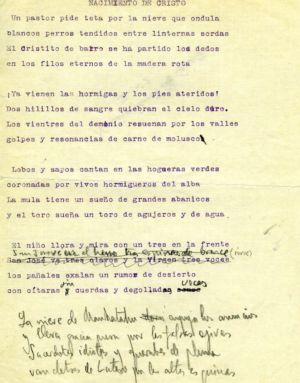
Handwritten notes made by Lorca.

When Federico García Lorca walked into the office of José Bergamín on the eve of July 13, 1936 and failed to find him there, he left behind a written note: “I dropped by to see you and I think I’ll come back tomorrow.”

But tomorrow never came.
The poet left Madrid for Granada just a few days before civil war broke out. He naïvely felt that he would be safer back home.
What he left his publisher on the table inside the newsroom of Cruz y Rayamagazine was the original manuscript – partly handwritten, partly typed, broken down into several parts and structured into 35 poems and 10 sections – of a masterpiece that was to change literature forever: Poet in New York.
Many will be familiar with the rest of the story; Lorca was executed on August 19 by right-wing forces, the original manuscript underwent all sorts of vicissitudes, and until now Poet in New York had never been published in the way that its author desired.

The book was originally going to be titled Introduction to death

After being lost for years, the original text finally emerged in 2003. The García Lorca Foundation bought it at auction for 194,000 euros. Until that June day, Lorca’s real intentions regarding this work had been shrouded in controversy and mystery.
But this week, Galaxia Gutenberg / Círculo de Lectores will deliver to bookstores the version of Poet in New York that Lorca himself would have liked to have held in his hands. The book comes with a meticulous analysis by Professor Andrew A. Anderson of Virginia University, and facsimiles of the original document where one can make out the handwritten lines and Lorca’s manual corrections over the typed text.
On Pablo Neruda’s recommendation, the book was originally going to be titled Introducción a la muerte (or Introduction to death). It was too premonitory, though inevitably truthful, and it was later toned down. The result is an unfinished work –the author and the publisher would have normally worked together to give it its final shape – although that does not make it any less valuable, striking or crucial.


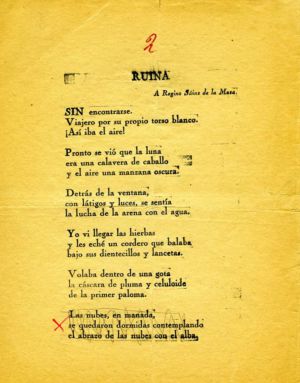
'Ruina', with the last verse crossed out.


The manuscript underwent an epic journey worthy of a chanson de geste. When war broke out, Bergamín went into exile, taking with him the poems that Lorca had conceived while staying at Columbia University for nine months in 1929-30, coinciding with the stock market crash and the onset of the Great Depression. “Lorca wanted most of them to be included [in the book], but not all of them. The excess ones have been referred to as orphans,” says Anderson.
Bergamín tried to get the book published in Paris, but his efforts were stymied by the hassle of his new life abroad and, very likely, by his inability to locate a few poems that Lorca had said he wanted to include but without providing a copy of them. During that time, however, two typed versions were produced that later served as the basis for the first editions of Poet in New York.
Bergamín later traveled to Mexico. “When he was there, Bergamín gave away the manuscript to Jesús de Ussía, who had provided financial support for his publishing house, Ediciones Séneca. Years later, when Ussía left Mexico, he left his personal possessions, including the Lorca manuscript, with a relative, Ernesto de Oteyza,” says Anderson. His widow then gave it away to the actress Manolita Saavedra, who kept it in her house in Cuernavaca until the 1990s. When Saavedra realized that a lot of people were searching for this manuscript, she decided to sell it. It went out on auction in 1999, but was not purchased by the foundation until 2003.
It was then that the text began to be carefully analyzed. This document contained the answers to the criticism that Bergamín had to endure after betraying the author’s intentions, at least according to many people. There were decisions that Bergamín made out of pure need, since some poems (like Crucifixión, purchased at auction by the Culture Ministry in 2007) were lost and could not be included in the volume. Although Lorca himself had demanded the original back from Miguel Benítez Inglott after giving it to him as a gift, he got no reply.

In the end, Poet in New York saw the light, and it included 32 poems

“In general, the criticism has not been fair. We were unaware of all the details of the process, and without that appreciation it is difficult to pass judgment,” adds Anderson.
The story of how Poet in New York was finally published is also worth telling. Between 1930 and 1935, there were numerous references to the book that Lorca had written during his US stay, and which he wanted to get published. But war prevented that last, necessary meeting between writer and publisher. Gathering the poems together was quite a feat, since the “to-be-included” list was left incomplete and Lorca had given some of the poems away to friends, or else sent them to magazines for individual publication.
In the end, Poet in New York saw the light, and it included 32 poems. It was first published in the US in 1940 and almost simultaneously in Mexico, where Bergamín had landed with a delegation of the Spanish Culture Junta, of which he was its first chairman. In Mexico, Bergamín founded the publishing house Séneca, which was loyal to the principles of Ediciones del Árbol, the Spanish company that would have put out the book there, had it not been for the war.
During his stay in New York, he offered the world premiere of the book to the publisher William Warder Norton, who took him up on it. But it was the Mexican edition that drew the most criticism, especially because of the editing work by fellow poet Emilio Prados, says Anderson, noting that that Prados changed several elements in the original, corrected the punctuation and included more than one appendix.

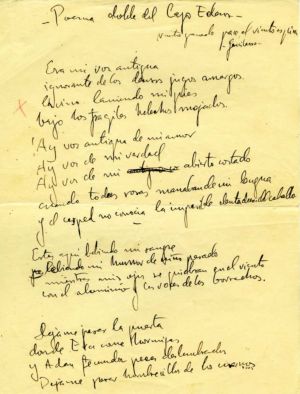
The first page of Lorca's Double Poem of Lake Eden.


Despite so many setbacks, the book was already starting to leave a mark. “It has inspired many poets of different nationalities and from different eras,” says Andersen. “With Residencia en la tierra I and II, we get the epitome of a certain type of avant-garde style during these years. In many ways, this text is very comparable to T.S. Eliot’s The Waste Land. Thanks to the second translation into English, dating from 1955, it influenced many US poets.”
Now, after a lifetime of coming and going punctuated by question marks and controversy, the wider public will finally have access to, if not the last word, then the next-to-last word by Lorca regarding his definitive conception of his most open, universal yet enigmatic body of poems.
Asesinado por el cielo (murdered by the sky), he wrote in the first verse of Vuelta de paseo (or, Back from a walk), as he explored his own solitude and amazement at Columbia University, where he gestated most of these poems. Now that his dream edition is about to see the light, perhaps the poet can rest a little more in peace, wherever he may be.


A LEGENDARY TRIP

- Federico García Lorca left his native Spain for the first time in the summer of 1929.

- After a fleeting stay in Paris, the poet arrived in New York, where he spent at least nine months. He stayed at a student residence in Columbia University.

-In March 1930 he took a train on his way to Cuba. From Key West, in Florida, he boarded a ferry that took him to Havana, where he spent around three months. 

- An ocean liner brought the writer (and the manuscript that now sees the light) to the port of Cádiz in July of that same year. Back in Spain, Lorca was in no hurry to get Poet in New York published.