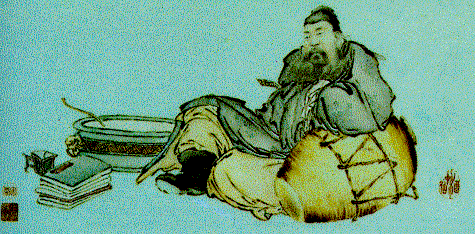
A Chinese poet of the Tang Dynasty, Li Bai (also known as Li Po, Li Pai, Li T’ai-po, and Li T’ai-pai) was probably born in central Asia and grew up in Sichuan Province. He left home in 725 to wander through the Yangtze River Valley and write poetry. In 742 he was appointed to the Hanlin Academy by Emperor Xuanzong, though he was eventually expelled from court. He then served the Prince of Yun, who led a revolt after the An Lushan Rebellion of 755. Li Bai was arrested for treason; after he was pardoned, he again wandered the Yangtze Valley. He was married four times and was friends with the poet Du Fu.
Li Bai wrote occasional verse and poems about his own life. His poetry is known for its clear imagery and conversational tone. His work influenced a number of 20th-century poets, including Ezra Pound and James Wright.
He has many names. In the West, people call him Li Po, as most of his poems translated into English bear that name. Sometimes it is also spelled Li Bo. But in China, he is known as Li Bai. During his lifetime (A.D. 701–62), he had other names—Li Taibai, Green Lotus Scholar, Li Twelve. The last one is a kind of familial term of endearment, as Bai was twelfth among his brothers and male cousins on the paternal side. It was often used by his friends and fellow poets when they addressed him—some even dedicated poems to him titled “For Li Twelve.” By the time of his death, he had become known as a great poet and was called zhexian, or Banished Immortal, by his admirers. Such a moniker implies that he had been sent down to earth as punishment for his misbehavior in heaven. Over the twelve centuries since his death, he has been revered as shixian, Poet Immortal. Because he was an excessive drinker, he was also called jiuxian, Wine Immortal. Today it is still common for devotees of his poetry to trek hundreds of miles, following some of the routes of his wanderings as a kind of pilgrimage. Numerous liquors and wines bear his name. Indeed, his name is a ubiquitous brand, flaunted by hotels, restaurants, temples, and even factories.
In English, in addition to “Li Po,” he once had another pair of names, Li T’ai Po and Rihaku. The first is a phonetic transcription of his original Chinese name, Li Taibai, the name his parents gave him. And Ezra Pound, in his Cathay—his collected translations of classical Chinese poetry—called Li Bai “Rihaku” because Pound had translated those poems from the notes left by the American scholar Ernest Fenollosa, who had originally studied Li Bai’s poetry in Japanese when he was in Japan. Pound’s loose translation of Li Bai’s “The River-Merchant’s Wife: A Letter” has been included in many textbooks and anthologies as a masterpiece of modern poetry. It is also one of Pound’s signature poems—arguably his best known. For the sake of consistency and clarity, let us stay with the name Li Bai.
He also has several deaths ascribed to him. For hundreds of years, some people even maintained that he had never died at all, claiming to encounter him now and then. In truth, we are uncertain about the exact date and cause of his death. In January 764, the newly enthroned emperor Daizong issued a decree summoning Li Bai to serve as a counselor at court. It was a post without actual power, in spite of its high-sounding title. Yet to any man of learning and ambition, such an appointment was a great favor, a demonstration of the emperor’s benevolence and magnanimity—and, in Li Bai’s case, a partial restoration of the high status he had once held in the court. When the royal decree reached Dangtu County, Anhui, where Li Bai was supposed to be located, the local officials were thrown into confusion and could not find him. Soon it was discovered that he had died more than a year before. Of what cause and on what day, no one could tell. So we can say only that Li Bai, despite his renown, passed away in 762 without notice.
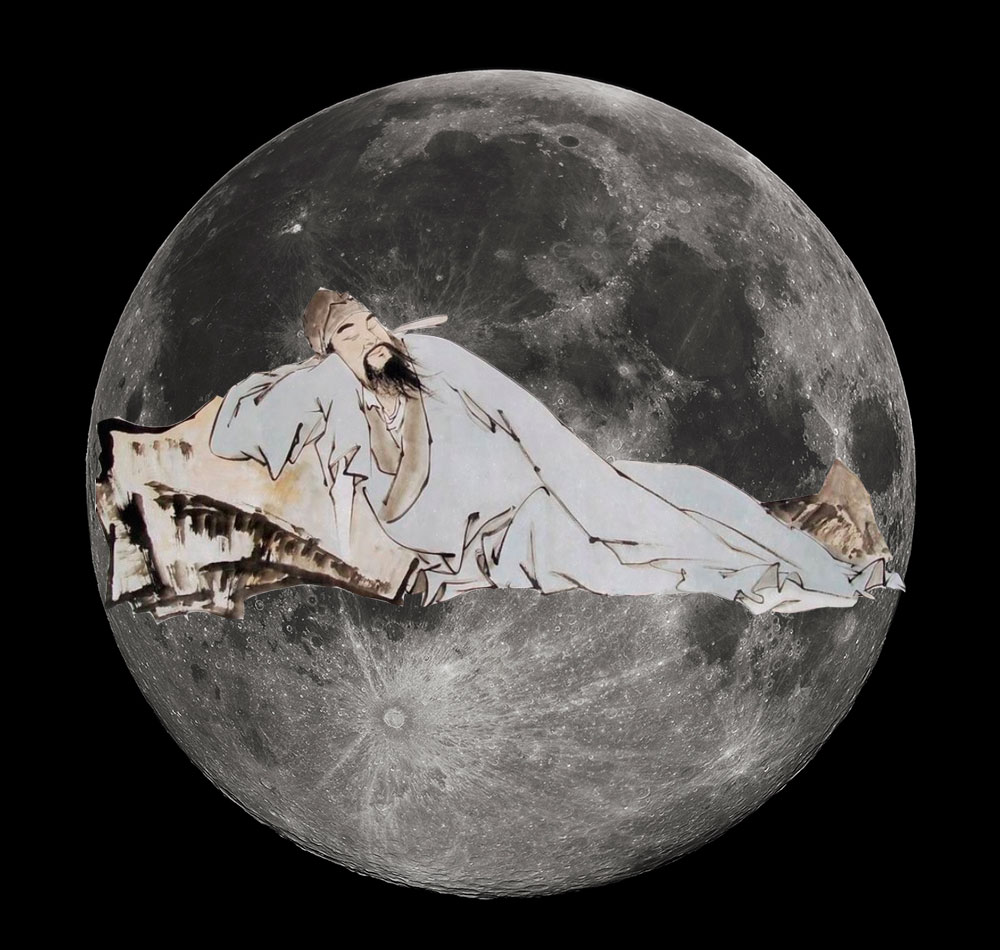
However, such an obscure death was not acceptable to those who cherished his poetry. They began to give different versions of his death, stories spun either to suit the romantic image of his poetic personality or to provide a fitting conclusion to his turbulent life. In one version, he died of alcohol poisoning; this was in keeping with his lifelong indulgence in drink. Another claims that he died of an illness known as chronic thoracic suppuration—pus penetrating his chest and lungs. The first mention of this comes from Pi Rixiu (838–83) in his poem “Seven Loves”: “He was brought down by rotted ribs, / Which sent his drunken soul to the other world.” Although there is no way we can verify this claim, it sounds credible—such a chest problem could have been caused by his abuse of alcohol. In his final years, Li Bai’s drinking and poverty would have aggravated his pulmonary condition. But the third version of his death is far more fantastic: in this version, he drowns while drunkenly chasing the moon’s reflection on a river, jumping from a boat to catch the ever-shifting orb.
Even though this scene smacks of suicide and is perhaps too romantic to be believed, it is the version that has been embraced by the public—in part because Li Bai, as his poetry shows, loved the moon. Even in his early childhood, he was fixated on it. In his poem “Night Trip in Gulang,” he writes:
As a young child, I had no idea what the moon was And I called it a white jade plate. Then I wondered if it was a mirror at the Jasper Terrace That flew away and landed on top of green clouds.
In Chinese poetry, Li Bai was the first to use the image of the moon abundantly, celebrating its loftiness, purity, and constancy. He imagined the moon as a serene landscape with sublime dwellings for xian, or immortals, who are often surrounded by divine fauna and flora and their personal pets. The beliefs of the ancient Chinese did not separate divinity from humanity, and their imagined heavenly space resembled the human world, with similar (but more fantastic) landscapes and architecture and creatures. If cultivated enough, any human being could rise to the order of divinity, becoming a xian—many temples in China worshipped these kinds of local deities. Heaven was inhabited by these beings, who were somewhat like superhumans, powerful and carefree and immortal.
The moon in Li Bai’s poetry is also associated with one’s home or native place, and as a beacon shared by people everywhere, universal and ever reliable—“Raising my head, I see the bright moon, / And lowering it, I think of home” (“Reflection in a Quiet Night”). The legend of his attempt to embrace the moon suggests an ultimate fulfillment of his wish and vision—a reversed spiritual ascent. Some of his contemporaries believed him to have been a star in his previous life, and so by joining the moon in the water, he returned to the heavenly space where he had once dwelled. The brief “Li Bai Biography” in the eleventh-century book New Tang History reads, “When giving birth to Li Bai, his mother dreamed of the star Venus, so he was named Taibai (Venus).”
The poets who came after him have continued to celebrate his moonlit death: even though they know it may not be true, across the centuries they have eulogized the shining moment in their verses. Even today, lovers of Li Bai’s poetry indulge in the myth. One contemporary scholar writes that Li Bai “rode a whale, floating away with the waves, toward the moon.” This heavenward journey is presented from the distraught, drunken poet’s point of view so that Li Bai appears to be returning to his original, divine position. Such romanticization shows the nature of scholarship around Li Bai, which is partly based on legends and myths. Because people want him to have a glorious end, they have been eager to perpetuate the moon-chasing legend.
However, for all the imaginative attempts to glorify him, a single clear voice spoke about his situation presciently when the poet was still alive and in exile. His staunch friend Du Fu laments in his poem “Dreaming of Li Bai”:
冠蓋滿京華 斯人獨憔悴 孰云網恢恢 將老身反累 千秋萬歲名 寂寞身後事
《夢李白》
The capital is full of gorgeous carriages and gowns, But you are alone gaunt and sallow despite your gift. Who is to say that the way of heaven is always fair? At your old age you can’t stay clear of harm. Your fame that’s to last ten thousand years Will become a quiet affair after you are gone.
Ha Jin left his native China in 1985 to attend Brandeis University. He is the author of eight novels, four story collections, four volumes of poetry, and a book of essays. He has received the National Book Award (for his novel Waiting), two PEN/Faulkner Awards, the PEN/Hemingway Foundation Award, the Asian American Literary Award, and the Flannery O’Connor Award for Short Fiction. In 2014, he was elected to the American Academy of Arts and Letters. He lives in the Boston area and is a professor in the creative writing program at Boston University.
To wash and rinse our souls of their age-old sorrows, We drained a hundred jugs of wine. A splendid night it was . . . . In the clear moonlight we were loath to go to bed, But at last drunkenness overtook us; And we laid ourselves down on the empty mountain, The earth for pillow, and the great heaven for coverlet.
My hair had hardly covered my forehead. I was picking flowers, paying by my door, When you, my lover, on a bamboo horse, Came trotting in circles and throwing green plums. We lived near together on a lane in Ch'ang-kan, Both of us young and happy-hearted. ...At fourteen I became your wife, So bashful that I dared not smile, And I lowered my head toward a dark corner And would not turn to your thousand calls; But at fifteen I straightened my brows and laughed, Learning that no dust could ever seal our love, That even unto death I would await you by my post And would never lose heart in the tower of silent watching. ...Then when I was sixteen, you left on a long journey Through the Gorges of Ch'u-t'ang, of rock and whirling water. And then came the Fifth-month, more than I could bear, And I tried to hear the monkeys in your lofty far-off sky. Your footprints by our door, where I had watched you go, Were hidden, every one of them, under green moss, Hidden under moss too deep to sweep away. And the first autumn wind added fallen leaves. And now, in the Eighth-month, yellowing butterflies Hover, two by two, in our west-garden grasses And, because of all this, my heart is breaking And I fear for my bright cheeks, lest they fade. ...Oh, at last, when you return through the three Pa districts, Send me a message home ahead! And I will come and meet you and will never mind the distance, All the way to Chang-feng Sha.
Two poets of the golden age of Chinese Poetry appeared on a set of of Poets and Philosopher stamps issued in 1983. The first is Li Bai (also known as Li Po) born in 701, who had what is described as a "hard living life" which means he liked a drink or two; any poetry collection of the Tang Dynasty will contain many of his poems.
The painting is a modern one created by Liu Lingcang (1906-1989) who was apprenticed at 14 and and as a young man went to Beijing alone living off the sale of his paintings to follow the masters of his chosen art. He himself became a great scholar of painting history and painting theories and in in his 70 year art career he spent 40 teaching those skills. It is interesting to see the scroll painting he made of Li Bai which expands the view of the poet and appeared as "Landscape of Tang Poetry"
Next is Du Fu (also known as Tu Fu) 712-770 who is known in China as the "Poet Sage". But let the words of these poets tell their own story. They share a page in my copy of Soame Jenyns's (who was keeper of Oriental Antiques in the British Museum) second collection of translations of Poems of the T'ang Dynasty, you will see why he has done this.
"Sending Off A Friend" by Li Po
Looking north of the city you see the line of blue hills, Sparkling water flows past the eastern gate. Here we part once for all; A solitary waterweed drifts off into the distance. When I think of the wandering clouds you will come back into my thoughts Sunset will bring with it memories of you. We part now with a wave of the hand; as we turn our horses they neigh farewell.
"With the width of Heaven between us thinking of Li Po" by Du Fu
A chill wind springs up from the horizon, What are your thoughts now I wonder? When will the wild geese arrive? Rivers and lakes are big with autumn floods Your literary compositions are a foe to your success, The ghouls are gleeful when people (like you) pass by I fear your path corresponds to that of the "aggrieved spirit". Throw a poem to him in the Mi-lo River.
Legend has it that Li Po died in a most poetic way by falling from his boat when he tried to embrace the moon in the Yangtze River. The 'aggrieved spirit' reference in the poem Jenyns says is an allusion to Ch'ü Yüan, who committed ritual suicide by holding a rock and wading into a river, today celebrated by the dragon boat racing festival.
An entry to Virdian Postcard's Sunday Stamps celebration of National Poetry Month.
Facing my wine, I did not see the dusk, Falling blossoms have filled the folds of my clothes. Drunk, I rise and approach the moon in the stream, Birds are far off, people too are few.
The autumn air is clear, The autumn moon is bright. Fallen leaves gather and scatter, The jackdaw perches and starts anew. We think of each other- when will we meet? This hour, this night, my feelings are hard.
The lovely Lo Fo of the western land Plucks mulberry leaves by the waterside. Across the green boughs stretches out her white hand; In golden sunshine her rosy robe is dyed. 'my silkworms are hungry, I cannot stay. Tarry not with your five-horse cab, I pray.'
I climb up high and look on the four seas, Heaven and earth spreading out so far. Frost blankets all the stuff of autumn, The wind blows with the great desert's cold. The eastward-flowing water is immense, All the ten thousand things billow. The white sun's passing brightness fades, Floating clouds seem to have no end. Swallows and sparrows nest in the wutong tree, Yuan and luan birds perch among jujube thorns. Now it's time to head on back again, I flick my sword and sing Taking the Hard Road.
Amongst the flowers I am alone with my pot of wine drinking by myself; then lifting my cup I asked the moon to drink with me, its reflection and mine in the wine cup, just the three of us; then I sigh for the moon cannot drink, and my shadow goes emptily along with me never saying a word; with no other friends here, I can but use these two for company; in the time of happiness, I too must be happy with all around me; I sit and sing and it is as if the moon accompanies me; then if I dance, it is my shadow that dances along with me; while still not drunk, I am glad to make the moon and my shadow into friends, but then when I have drunk too much, we all part; yet these are friends I can always count on these who have no emotion whatsoever; I hope that one day we three will meet again, deep in the Milky Way.
Amidst the flowers a jug of wine, I pour alone lacking companionship. So raising the cup I invite the Moon, Then turn to my shadow which makes three of us. Because the Moon does not know how to drink, My shadow merely follows the movement of my body. The moon has brought the shadow to keep me company a while, The practice of mirth should keep pace with spring. I start a song and the moon begins to reel, I rise and dance and the shadow moves grotesquely. While I'm still conscious let's rejoice with one another, After I'm drunk let each one go his way. Let us bind ourselves for ever for passionless journeyings. Let us swear to meet again far in the Milky Way.
If heaven loved not the wine, A Wine Star would not be in heaven; If earth loved not the wine, The Wine Spring would not be on the earth. Since heaven and earth love the wine, Need a tippling mortal be ashamed? The transparent wine, I hear, Has the soothing virtue of a sage, While the turgid is rich, they say, As the fertile mind of the wise. Both the sage and the wise were drinkers, Why seek for peers among gods and goblins? Three cups open the grand door to bliss; Take a jugful, the universe is yours. Such is the rapture of the wine, That the sober shall never inherit.
A slip of the moon hangs over the capital; Ten thousand washing-mallets are pounding; And the autumn wind is blowing my heart For ever and ever toward the Jade Pass.... Oh, when will the Tartar troops be conquered, And my husband come back from the long campaign!
Since yesterday had to throw me and bolt, Today has hurt my heart even more. The autumn wild geese have a long wind for escort As I face them from this villa, drinking my wine. The bones of great writers are your brushes, in the School of Heaven, And I am a Lesser Xie growing up by your side. We both are exalted to distant thought, Aspiring to the sky and the bright moon. But since water still flows, though we cut it with our swords, And sorrows return, though we drown them with wine, Since the world can in no way answer our craving, I will loosen my hair tomorrow and take to a fishing boat.




.jpg)
.jpg)




.jpg)