Showing posts with label Janine Mendes-Franco. Show all posts

Friday, October 28, 2022

An interview with Roger Robinson, winner of the 2019 T.S. Eliot Prize in poetry


2019 T.S. Eliot Prize for Poetry winner Roger Robinson. Photo by Naomi Woodis, used with permission.


An interview with Roger Robinson, winner of the 2019 T.S. Eliot Prize in poetry


Written byJanine Mendes-Franco
Posted 14 February 2020 2:26 GMT
 

On January 13, 2020, Trinidadian-British poet Roger Robinson won the T.S. Eliot Prize for Poetry for his poetry collection “A Portable Paradise.” The T.S. Eliot Prize honours “the best collection of new verse in English first published in the UK or the Republic of Ireland.”

The judges praised Robinson's work for “finding in the bitterness of everyday experience continuing evidence of ‘sweet, sweet life.’”

The book is divided into five sections, each of which ends with a poem exploring the theme of paradise, with topics ranging from London's tragic Grenfell Tower fire to the Windrush controversy. Issues of migration, racism, identity and inequity, are all presented in bold, raw, and honest ways.

Maybe it’s the sting of dissent, maybe it’s the hint of West Indian swagger that makes the reader curious to see where Robinson's poems go, but he has a rare ability to place himself in the midst of things and yield to that immersion, yet remain a truthful observer. Robinson's words are a balm to the bitterness of life — the collection compassionately recognises the humanity within us all, bound together by an almost reverent tone of dignity, even in powerlessness.

I got in touch with Robinson shortly after his win and chatted with via email about winning the prize, the collection itself, and why empathy is so important.

Janine Mendes-Franco (JMF): Congratulations! “A Portable Paradise” is a really important piece of work. Is the prize something you’d had your eye on, or did the win come as a happy surprise?

Roger Robinson (RR): I never have my eye on prizes, but I appreciate the prize. I’m always about getting the poems to people rather than trying to win a prize. I do like how the prize is getting me to a wider range of reader, though.

JMF: Interesting that Eliot himself was American-born but chose to live and work in England. You, on the other hand, were born in England and, having returned to Trinidad as a child, also chose to eventually settle in the UK. Have you thought about those parallels and why, for instance, Trinidad might be good for formation, but England might be better for creation?

RR: Hmmmm…interesting. I think Trinidad is also good for creation, but England is good for commerce and access to the international publishing industry.

JMF: The UK Guardian described you as a “British-Trinidadian dub poet.” Do you identify with that? How would you explain what “dub” poetry is to someone who’s never heard that genre of music or listened to a spoken word performance? 

RR: I’ve made a few dub albums. I think other people have called me a dub poet; I've not necessarily referred to myself that way. Dub poetry to me is poetry influenced by reggae rhythms, with a working-class focus.

JMF: It’s not coincidental that music has played such an integral role. You have a band (King Midas Sound), you’ve done recordings and music videos, and while all poetry has rhythm, yours has a musicality that stays with the reader. How did you hone your craft into something this unique and feels so authentic?

RR: I don’t know. I think I write from the things that interest me in a moment and I’m truthful to my interests. I don’t think it was a planned thing. Honing craft came through enjoyment of the rigours of practice.

JMF: It’s a daring thing, to be a truth-teller when the truth is a difficult thing to come by. Some of your work is almost like an intersection of journalism and poetry. Is it important to you that your collections are read by those who see “truth” differently from you?

RR: I think that I write like I am, so I’m no more daring than my own emotional truths. It’s no more important to me for people who see truth differently to read it, even though I like the idea of people developing and practicing empathy. The practice of empathy by all different types of people would be more important to me.

JMF: Were there truths you believed about yourself in Trinidad (which I assume was your benchmark for paradise), that did not translate in the UK? If so, did poetry help bridge the gap? What make you start thinking about the idea that paradise might be portable?

RR: I started thinking that paradise might be portable because I wanted it to be — and because my grandmother went to England and brought most of her 11 children to England on the money she made sewing dresses. Her children were her paradise.

I think in England I got a sense of myself as an international artist, which I did not get in Trinidad.

JMF: Quite a few of your poems in this collection have an underpinning of faith in something greater — a more enduring paradise if you will. What did you want this to accomplish?

RR: I wanted people to understand the power of prayer in their time of trauma.

JMF: The “hero” of many of your poems is the underdog in general and the migrant specifically. How, if at all, does the outsider experience inform your writing?

RR: Hmmmm…I can’t tell; I’m too close to it to see. I’m sure it does. I mean, when I came to England I lived in tower blocks so I knew about living in one. I guess it made me see things in a different way.

JMF: I understand you might be coming to Trinidad for the 2020 Bocas Lit Fest. Are you interested in connecting with other Caribbean writers?

RR: Yeah, I am coming to Bocas and I'm definitely interested in meeting other writers. Trinidadian poets like Andre BagooShivanee Ramlochan and Muhammad Muwakil are gaining in world recognition, and I’d love to connect with Caribbean writers when I’m there.

JMF: Who have been your greatest influences?

RR: Poets like Kwame DawesLinton Kwesi Johnson and Sharon Olds. People like Muhammad Ali. Musicians like David RudderBrother Resistance, and Bunji Garlin.

JMF: Poetry in Trinidad and Tobago is not necessarily well consumed, though it weaves its way into everything from soca and rapso music to spoken word performances, all reminiscent of the call and response tradition of the kalinda [martial art]. In a sense, all this is Caribbean poetry. Why do you think poetry is a powerful medium?

RR: I think it’s powerful because it helps people to practice empathy. Also it allows people to observe someone practicing vulnerability. A lot of inhumanity will occur without empathy and vulnerability.

JMF: Any advice for regional poets?

RR: Keep writing no matter what anyone says; don’t stop writing.

JMF: What are you most proud of when it comes to this collection?

RR: That I didn’t leave anything back. I gave it all.


GLOBAL VOICES 


Thursday, October 13, 2022

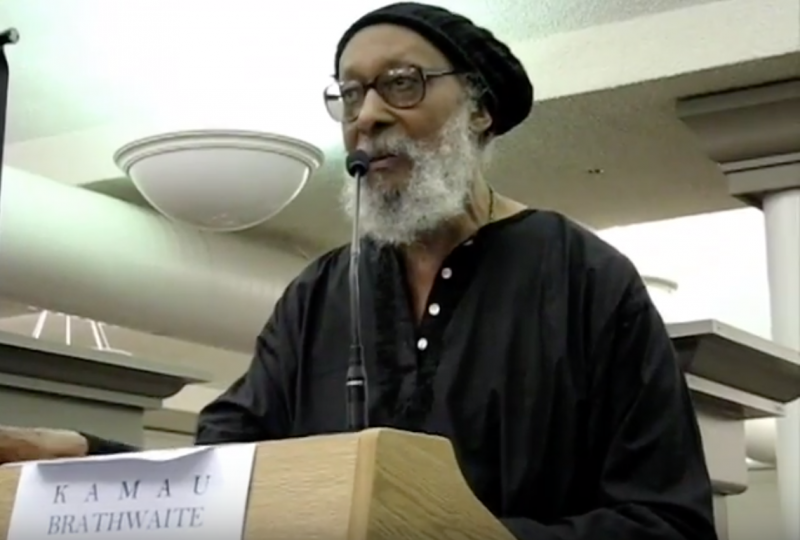
Kamau Brathwaite leaves behind a legacy of language

Barbadian poet Kamau Brathwaite reads his poem “Calypso” at “Calypso” at the University of Virginia in April 2008. Screenshot taken from a YouTube video uploaded by RJ Ramazani.

Barbadian poet Kamau Brathwaite leaves behind a legacy of language

Il poeta barbadiano Kamau Brathwaite lascia dietro di sé un retaggio linguistico (Dante)

The esteemed Barbadian poet Kamau Brathwaite, whose unique voice was universally recognised as an integral part of the canon of post-war West Indian literature, died on February 4, 2020, at the age of 89.

Born Lawson Edward Brathwaite, his evolution to Kamau Brathwaite — that deliberate pairing of his chosen African first name with his given Briton surname — is representative of the space he carved out for the two to coexist. His work, known for its innovating “Creolisation” of language, was integral in helping to forge a sense of regional identity in the painful aftermath of slavery and colonisation. Alongside writers like Derek Walcott and V.S. Naipaul, Brathwaite helped raise the Caribbean voice to reach the ears of the world.

He got his start through Frank Collymore‘s bold literary magazine Bim, which allowed emerging writers’ work to be read alongside more established, published West Indian authors. The blog Memo from La-La Land suggested:

But if it was [Frank] Collymore’s encouragement that kept alive the poetic vein in Brathwaite, it was his time in the Gold Coast (modern day Ghana) from 1955 to 1962 that built the vivid image in his mind of the close relation between the African and the Caribbean experiences. In my view, Brathwaite’s lifelong quest rests upon the premise that Caribbean culture is intrinsically connected to African culture, not by means of an ethereal or genetic connection, but through an active transformation of the social norms that took place over more than three centuries of slavery […]

In a region where, decades later, there is still a debate over the use of “proper” English versus the loaded phrase “dialect”, Brathwaite coined the term “nation language”, which he defined as “the kind of English spoken by the people who were brought to the Caribbean, not the official English now, but the language of slaves and labourers, the servants who were brought in.”

His intelligent and loving defence of this hybrid as not just valid in terms of language, but integral to Caribbean identity, inspired many other West Indian writers, including Sam Selvon and Louise Bennett. What it also did was place stock in the value of the region's oral tradition, through which many African customs were upheld and passed on over the course of the transatlantic slave trade.

As Facebook user Tara Inniss-Gibbs put it:

Reading Kamau is the closest you can feel to putting the intense emotion of both trauma and love for a language that is not your own on to the page…

Memo from La-La Land further explained:

Brathwaite claims through his poetry that orality – speech – is king. […] For instance, in 1992 Brathwaite published a selection of poems, mostly from his first two trilogies, ‘The Arrivants,’ (1972) and ‘Other Exiles’, (1975), except at this stage he had discovered the advantages of working on a computer. This led to the development of his ‘Syncorax video style’ texts, which is another way of describing the usage of various font styles and sizes throughout the book. The changes occur both within a poem and from poem to poem and the spectacular graphic effect lends itself to being discarded as an aesthetic caprice, or an ode to the wonders of technology. Upon second scrutiny, however, it becomes evident that the graphic innovations are, in fact, included to highlight, to reproduce, the natural emphasis and modulation that pertain to Caribbean speech.

Brathwaite's first three poetry collections — “Rights of Passage”, “Masks”, and “Islands” — published in quick succession in 1967, '68 and '69, earned him global recognition and critical acclaim. They were later republished as “The Arrivants”. His subsequent trilogy — “Mother Poem” (1977), “Sun Poem” (1982), and “X/Self” (1987) — also delved into questions of identity.

Once his passing was announced on social media, regional netizens began sharing their remembrances. Posting the words of his poem “Calypso”, Barbadian multi-media artist and curator Annalee Davis said on Facebook:

I remember his lecture at Frank Collymore Hall many years ago — that very beautiful lilt in his voice, a rhythm that could only have come from Barbados, and a most unique way of using his very own tongue that honoured who we are. […]

His use of nation language and the breadth of work he produced leaves an indelible mark on us all and I know that people around the Caribbean and its diaspora will mourn his passing as we will in Barbados.

The country's prime minister, Mia Mottley, paid homage to Brathwaite as “easily one of the titans of post-colonial literature and the arts”, while the George Padmore Institute described him as “one-third of the pan-Caribbean trio of founders of the seminal Caribbean Artists Movement” (the other two being Trinidadian John La Rose and Jamaica-based Andrew Salkey).

Facebook user Candace Ward said that Brathwaite's “influence on [her] work as a Caribbeanist was profound”, while academic Bartosz Wójcik remembered his kindnessProfessor Kenneth Ramchand remembered Brathwaite's towering contribution:

Kamau was versatile and always interesting. He wrote a most important book about Creolisation, discoursed extensively on ‘nation language’ which he demonstrated brilliantly in his poetry, and was the prime influence in the region's eventual discovery of its potent folk and oral traditions. His work and his theories fed on the subterranean links between the Caribbean, Africa and the African diaspora, and it was especially sensitive to the music, rhythms and imagery of African-American culture. […] I have never wavered in my admiration for his passionate interest in our culture and society, his revelation of his native Barbados as root and bright symbol and the unceasing formal experimenting in his verse. It is consoling that like Walcott and [Wilson] Harris he is not lost to us, since he has passed into the consciousness of our civilisation.

Kamau Brathwaite was also an academic and well-respected educator; he studied at the University of Cambridge's Pembroke College and holds a Ph.D. from the University of Sussex. He was a recipient of both Guggenheim and Fulbright Fellowships and published many books about African culture and identity.

His time spent in Ghana as an education officer greatly impacted his understanding of the black experience. Some of his important academic works include “Folk Culture of the Slaves in Jamaica,” (1970), “Afternoon of the Status Crow”, (1982), and “History of the Voice”, (1984), in which he put forward his theories on nation language. He also had professorial stints at New York University and The University of the West Indies.

Well-recognised in the literary world, Brathwaite was the 2006 international winner of the Griffin Poetry Prize, for his collection “Born to Slow Horses”. He also won the Neustadt International Prize for Literature (1994), the Gold Musgrave Medal for Literature from the Institute of Jamaica (2006), the Poetry Society of America's Robert Frost Medal (2015) and the PEN/Voelcker Award for Poetry (2018).

As much as his scholarly writings chronicled the post-colonisation Caribbean experience, however, it is Brathwaite's poetry that captured the imagination of both the region and the world. In the words of Facebook user Richard Drayton:

[I]t was as a poet/shaman that his name will be forever resonant whenever Caribbean [people] try to make sense of themselves.

GLOBAL VOICES

Monday, October 10, 2022

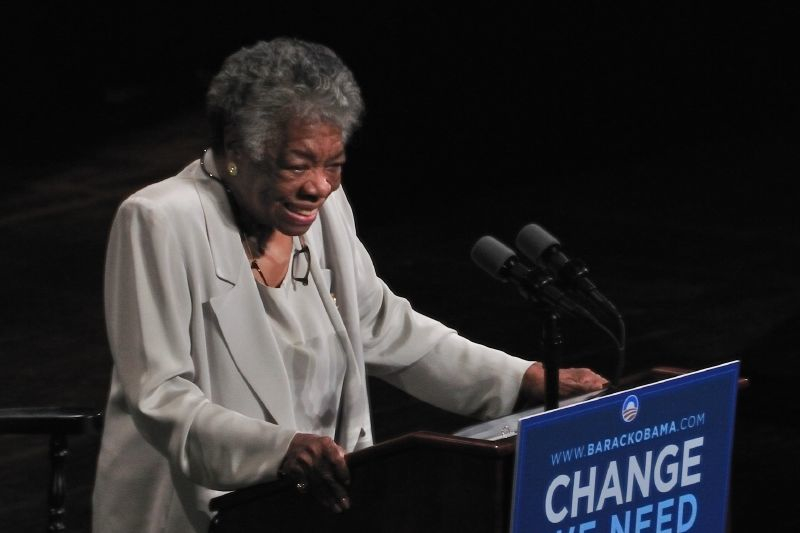
Maya Angelou / A Phenomenal Woman with a Caribbean Connection


Dr. Maya Angelou, speaking at The Carolina Theater, Greensboro, North Carolina, September, 2008. Image by Talbot Troy, used under a CC license.


Maya Angelou: A Phenomenal Woman with a Caribbean Connection


Written byJanine Mendes-Franco
Posted 1 June 2014 22:33 GMT


Maya Angelou has been noticeably written and tweeted about since her death on May 28. Her passing resonates quite deeply in the Caribbean – and not only because of the potency of her words – the author also had West Indian roots (her maternal grandfather was Trinidadian). Regional bloggers have been processing their grief over the loss by sharing what her life and writing meant to them.

In honour of Angelou's Caribbean connections, Repeating Islands republished a post which originally appeared in Slate magazine, detailing the author's stint as a singer, when she recorded her first and only album, entitled Miss Calypso.

Some bloggers were not even aware of Angelou's West Indian ancestry until her death. What's the idea? said as much in her post, The dream and hope of the slave:

Maya Angelou lived a long, lovely life, full of daring, accomplishment and acclaim. I did not know that her grandfather was a Trinidadian.

Still I Rise was the first poem in my under-educated literary life that moved me with its direct relevance to my own life as a descendant of enslaved peoples and perhaps more so, because it so expressed the exuberant defiance which black women need (ed) to leap over sexism and marginalisation.

Roberta, the blogger, went on to quote excerpts of the poem, saying:

It is a poem of such triumph ‘Out of history’s shame, I Rise…’

Now, I am thinking of the last line, ‘I am the dream and the hope of the slave’ as the region struggles with inequalities and with discrimination, especially against the LGBT community. That we would wish to perpetuate laws that make criminals of people who love other people of their own sex seems far enough away from the dream of emancipation. Can we not remember that slavery was also justified in the name of religion?

On Facebook, Nicholas Laughlin echoed the same sentiment, referring to a statement the author had made five years ago:

‘To love someone takes a lot of courage,’ she said. ‘So how much more is one challenged when the love is of the same sex and the laws say, “I forbid you from loving this person?”‘

–Maya Angelou, interviewed by the New York Times, May 2009

Since everybody with a pulse is rushing to memorialise Maya Angelou today, and with the Bain affair still weighing heavy on my mind, it seems a good moment to recall her thoughts on a question of justice the Caribbean is struggling with.

What's the idea? also viewed Angelou's advice as incredibly relevant when it comes to the global issue of violence against women and girls:

In her Ode to the UN, Maya Angelou ends with these words:

When we come to it
We, this people, on this wayward, floating body
Created on this earth, of this earth
Have the power to fashion for this earth
A climate where every man and every woman
Can live freely without sanctimonious piety
Without crippling fear

When we come to it
We must confess that we are the possible
We are the miraculous, the true wonder of this world
That is when, and only when
We come to it.

Some netizens, especially on Twitter and Facebook, reposted quotes by Angelou that resonated with them. Trinidadian blogger Kris Rampersad bade Angelou a simple farewell:

Thank you for sharing your mind and emotions and the spirit and the power with us Maya Angelou. So many women drew energy from you…

Raquel Cepeda, a US-born writer with Dominican roots, recounted the one occasion she literally ran into Maya Angelou:

Once, when I was about 19 or 20, I darted past Bloomingdale’s in New York, running late to something—I forget—and literally ran into a large, imposing figure walking out of the shop as I sprinted by. I felt as if I had ran into a brick wall. As I stood there in a daze, rubbing my nose, I heard this majestic voice say every-so-slowly, ‘Child, slow down. Where on earth could be more important than being with your self right now?’ My knees started to wobble when I realized this person was Maya Angelou. She glided off, in that regal way of hers, before I could fix my lips to apologize. And that’s why there’s a nod to her book, I Know Why the Caged Bird Sings, which I had just read around that time in the title of my book Bird of Paradise… I wish I could have told her that in person, but alas, I never ran into her again.

And Still I Rise, a St. Vincent and the Grenadines-based blog that was named after one of Angelou's poems, honoured her this way:

We first met in the pages of ‘I know why the caged bird sings’ and from that moment you became one of my heroines…You taught me so much by your words both written and spoken on my place in history, the beauty of my womanhood and the spirit that rises despite the obstacles. Thank you, Thank you, phenomenal woman you!

The blogger, like many others, also quoted one of Angelou's most stirring poems, ‘When Great Trees Fall’:

And when great souls die,
after a period peace blooms,
slowly and always
irregularly. Spaces fill
with a kind of
soothing electric vibration.
Our senses, restored, never
to be the same, whisper to us.
They existed. They existed.
We can be. Be and be
better. For they existed.

Trinidadian diaspora blogger Afrobella felt like “[her] heart was being squeezed in a fist” when she learned, from her Facebook feed no less, of Angelou's death. She explained that she had been asked to write a piece on the author's legacy for a Trinidad and Tobago daily:

In that piece I compared Maya to Mount Rushmore or the Giant Sequoia trees, like the ancient leatherback turtles that return to Trinidad’s beaches to nest, like Trinidad’s most popular beach, Maracas. I mean that in the sense that Maya Angelou seemed to belong to us, she seemed ancient and eternal. It’s impossible to imagine her not here to dispense wisdom, to recite a poem that rattles our hears and resonates in our spirits. We never thought she’d go away.

To Afrobella, the impact of Angelou's life was so staggering, “it [was] easy to feel dizzy and overwhelmed:

So instead of going broad and speaking about her in grandiose and sweeping terms, I want to get very specific and focus on one particular way that Maya Angelou touched me. Her poem, Phenomenal Woman, helped to change my life.

For someone in my age bracket — there never was a time before Phenomenal Woman. For us, there was never a time when there were these indelible, unforgettable, undeniable words intended to uplift, celebrate and triumphantly proclaim that we are beyond beautiful, we are worthy of desire and admiration from ourselves as well as others. That it isn’t just about how we’re built, it’s about who we are and how we carry ourselves in the world.

In that poem Maya defined herself, but she also helped to define a generation to come. Black women around the world grew up knowing those words, knowing that we too were or at least could be phenomenal women.

We who are 35 or younger, never knew a time when Maya Angelou’s words weren’t there to lift us up. We were blessed to be born into a world where she was a constant.

The blogger, Patrice Grell-Yursik, ended her tribute by quoting the poet herself:

In her own words, ‘when a poet dies something hopeful in the national psyche disappears.’ I know I’m not the only one who’s already feeling the void.

Thank you, Maya Angelou. Thank you for speaking for us. Thank you for sharing with us. Thank you for being with us for as long as you were able. Thank you for everything you gave to us, you gave the world so, so much. Thank you for teaching us, for shaping us and for leaving us a legacy to live up to.


GLOBAL VOICES