Wednesday, March 16, 2022

Isaac Babel Riding with Budyonny by Elaine Feinstein


Isaac Babel Riding with Budyonny


ELAINE FEINSTEIN
25 JUNE 2019

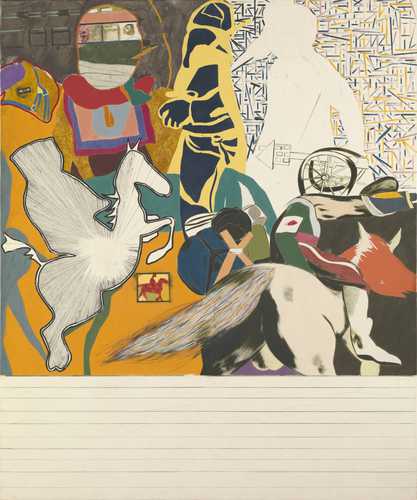
This April, Elaine Feinstein presents her poem, Isaac Babel Riding with Budyonny, based on R.B. Kitaj’s work of the same name. This work is not currently on display in Tate galleries, but Erasmus Variations by the same artist is on display in Tate Britain, and Isaac Babel Riding with Budyonny can be viewed in the Tate Collection online.

The Poetry Society is curating this year’s selection in the organisation’s centenary year. Founded in 1909, the Society is now one of Britain’s most high-profile arts organisations, helping poets and poetry thrive in Britain and beyond. Membership is open to all, though members include many of the UK’s most eminent poets. It publishes the highly respected journal Poetry Review; and also works to deliver a programme of poetry in education, supporting and developing creativity among young people and communities.


Isaac Babel

ISAAC BABEL RIDING WITH BUDYONNY

A swirl of ochre —- then a brighter yellow
        fills in the woodcut lines of an alien figure;
another stubby man wears a red scarf:
        Carnival colours. What’s the story here?

 This is the euphoria of Revolution:
        Ukraine in flames, the air a grey smoke.
Ash beneath dark skies. From a horse’s white rump,
        the colours turn in a kaleidoscope.

But where is Babel? Such insolence
        for a myopic Jew —- to ride
alongside Kuban Cossacks into Chagall’s
        villages of dirt-floor shacks.

The Whites have already trashed the stelt.
        Babel rides with the Red Cavalry,
shamed by their courage, though they loot and kill.
        Bystander angel, he records the dying.  

 Kitaj has sketched a man with a bird’s head,    
        against the scribbled map of a little town,
an image styled after a medieval
        Haggadah, telling the story of Passover.

Secrets of a shared family tree:
        the faithful passions of the trapped,
the cheating promises of liberty –
        Kitaj, like Babel, draws the savagery.


TATE


Monday, March 14, 2022

Each Bird Walking by Tess Gallagher


Each Bird Walking

by Tess Gallagher


Not while, but long after he had told me,
I thought of him, washing his mother, his
bending over the bed and taking back
the covers. There was a basin of water
and he dipped a washrag in and
out of the basin, the rag
dripping a little onto the sheet as he
turned from the bedside to the nightstand
and back, there being no place

on her body he shouldn’t touch because
he had to and she helped him, moving
the little she could, lifting so he could
wipe under her arms, a dipping motion
in the hollow. Then working up from
the feet, around the ankles, over the
knees. And this last, opening
her thighs and running the rag firmly
and with the cleaning thought
up through her crotch, between the lips,
over the V of thin hairs–

as though he were a mother
who had the excuse of cleaning to touch
with love and indifference
the secret parts of her child, to graze
the sleepy sexlessness in its waiting
to find out what to do for the sake
of the body, for the sake of what only
the body can do for itself.

So his hand, softly at the place
of his birth-light. And she, eyes deepened
and closed in the dim room.
And because he told me her death was
important to his being with her,
I could love him another way. Not
of the body alone, or of its making,
but carried in the white spires of trembling
until what spirit, what breath we were
was shaken from us. Small then,
the word holy.

He turned her on her stomach
and washed the blades of her shoulders, the
small of her back. “That’s good,” she said,
“that’s enough.”

On our lips that morning, the tart juice
of the mothers, so strong in remembrance, no
asking, no giving, and what you said, this
being the end of our loving, so as not to hurt
the closer one to you, made me look
to see what was left of us
with our sex taken away. “Tell me,” I said
“something I can’t forget.” Then the story of
your mother, and when you finished
I said, “That’s good, that’s enough.”


Thursday, March 10, 2022

Books and writers / Osip Mandelstam

Osip Mandelstam


 Osip (Emilevich) Mandelstam 

(1891-1938)

also: Osip Mandel'shtam

Russian poet and essayist, who is regarded alongside Boris Pastenak, Marina Tsvetaeva and Anna Akhmatova as one of the greatest voices of the 20th-century Russian poetry. Most of Mandelstam's works were unknown outside his own country and went unpublished during the Stalin era (1929-53). Along with Anna Akhmatova, Mandelstam was one of the foremost members of Acmeist school of poetry. His early works were impersonal but later he also analyzed his own experiences, history, and the current events.

Monday, March 7, 2022

A Symbolic Friendship / Taras Shevchenko And Ira Aldridge In Odessa and Ukraine


A Symbolic Friendship: Taras Shevchenko And Ira Aldridge In Odessa and Ukraine

By Vadim Goloperov 
October 18, 2016

A newly staged play in New York City focusing on the unlikely friendship between Ukraine’s national poet Taras Shevchenko (1814-1861) and the African American actor Ira Aldridge (1807-1867) provides a good opportunity to revisit this remarkable story and its illustration of the symbolic relationship between Ukraine and the United States of America.

New York City’s East Village has always been a mecca for experimental theater, a place where theater goers with the most varied tastes could find represented whatever sort of work they cared for. The Yara Arts Group, led by Ukrainian-American Virlana Tkacz, is the resident company at the La MaMa Experimental Theatre and is particularly intriguing in that it often grapples with a complex and historically contingent idea of Ukrainian culture. Tkacz is well known in the New York downtown theater scene as well as her collaborations with the broadway legend Andre DeShields. The company’s focus is on adapting original theater pieces based on ‘eastern’ (however broadly defined) historical materials that may be little known outside their own culture. The original pieces are often rooted in extensive research and documentation of folk or traditional historical culture, often inspired by epics or epic historical events which are then than transformed into theater productions.

Often the group’s work is quite political and topical, as was the case with the theater piece “Dark Night Bright Stars”, crafted in honor of the birthday bicentennial of the great Ukrainian poet and painter Taras Shevchenko. The presentation of the play was noteworthy for having mostly dodged the obvious pitfalls of a subject that was somewhat pedantic in character. It is noteworthy that Aldridge is now himself getting more attention in the US after having been an ideologically based sensation in the USSR – which would often attack the failures of America’s relationship to its black citizens as part of its propaganda. “Dark Night Bright Stars” was performed twice in the United States, once at the Ukrainian Gogolfest festival, and was brought to Ukraine by the U.S. Embassy as part of the American Festival in Odessa. It had also been presented by experimental theaters in Lviv and Kyiv (notably enough, right after the events of the Maidan), making it a rare instance of truly international cultural exchange.

The African American actor was beloved in Europe and continued to garner a cult following in the former Soviet Union. The two great artists, who rose up from serfdom and slavery, could not speak to each other directly because of the language barrier, so they had to find a common language in art and song. Their meetings were documented in the memoirs of Count Tolstoy’s 15 year old daughter, Katya (Ekaterina Tolstoy Yunge), who sometimes acted as their translator. In fact the communication between the two was relatively brief – it lasted only two months, and took on very unusual forms. The African American actor did not speak a word of Russian – much less Ukrainian. He could not even pronounce his new friend’s name, instead referring to him as “the artist”. In turn, the Ukrainian poet and artist knew only a handful of English words – but this did not impede them from communicating and even developing a true affection for each other. Utilizing gestures, body language, and at times an interpreter, they succeeded in communicating feelings and thoughts across the language barrier. Within only a few hours, they bonded over their shared artistic nature, love for Shakespeare, and lives that turned out to hold striking parallels. Aldridge was in Europe as a sort of ‘internal’ exile –and Shevchenko had only recently returned from exile. Their art and artistic interests were also similar in many ways. Ira Aldridge gained renown for his tragic roles, while Shevchenko is known mostly for his lyrical tragedies.

Ira Frederick Aldridge, the first great African American theatrical actor, was born on July 24, 1807 into the family of a preacher. Already in childhood Ira dreamed of becoming an actor, but many obstacles stood in the way of his dream – not least among them the harsh racial segregation which was instituted in the USA at the time. Today, the entire world praises and enjoys the talents of actors such as Morgan Freeman, Denzel Washington, and Samuel L. Jackson; but it is only a relatively short time ago the appearance of a Black actor on the stage would shock and infuriate the public. It was mostly for this reason that Ira left the country of his birth and moved to London. Once there, he soon gained wide European fame for his brilliant performances in Shakespeare’s tragedies “Hamlet”, “King Lear”, “Othello” and the “The Merchant of Venice”. However, his ordeal was not over – even in London Ira was often subjected to persecution by racists and proponents of slavery. To escape this hostile atmosphere, the actor would often spend time in other European cities where people were less prone to judge him on the color of his skin. Aldridge was popular in Prussia and in the Russian Empire, where he received several prestigious awards. In fact, it was after one of his performances in St. Petersburg in 1858 that the fateful meeting between the actor and the poet Shevchenko took place. Taras Shevchenko was so overwhelmed by Aldridge’s performance that after the play, he literally barged into the actor’s dressing room and kissed him! Later, the two artists would spend a lot of time communicating during their visits with Count Fyodor Tolstoy – during this time, Shevchenko painted the well-known portrait of Ira Aldridge (which now resides in Kyiv).

What did the two geniuses talk about? History retains only excerpts of their dialogues recorded by Ekaterina Tolstoy Yunge. Of course, one of the main topics of their discussions was the oppression of Black Americans and its parallels with the treatment of serfs within the Russian Empire. Much has been written about their touchingly close friendship – Aldridge was the descendant of slaves, Shevchenko a former serf. Both men carried a deep understanding of the tragedy of the oppressed individual as well as that of the oppressed nation – and the knowledge of this pain served as a basis for their friendship. Aldridge recounted his childhood experience of covertly sneaking into a theater on the doors of which hung a sign reading “Dogs and negroes forbidden” and his memories of establishing the first Black theater in Baltimore (it would later be destroyed by a racist mob). Shevchenko spoke about his grim childhood, including the degrading experience of buying his own freedom from a landowner. The two artists served as perfect representations of their respective nations’ struggle for freedom. In Shevchenko’s case, his legacy was silenced in the Soviet Union long after his death – when books spoke about him, they mentioned only his disdain for and struggle against Russian feudalism. Only in European literary accounts can Shevchenko’s passionate fight for Ukraine’s freedom and self-determination be found. After 1991, when the Soviet Union fell together with its legacy of censorship, Shevchenko’s life and work gained a new context and readership.

Ekaterina Tolstoy Yunge’s memoirs contain many other interesting details of their conversations. For example, Aldridge did not approve of Shevchenko’s admiration of George Washington, saying that the president “…did not rise above his time and did not end slavery”. Aldridge himself was fond of the nineteenth century liberals Radischev, Chernyshevsky, Dobrolyubov and especially Herzen (they had met in London). The two often discussed art and creative matters. For example, Shevchenko was not fond of the performance given by a German actress who played the role of Desdemona in a St. Petersburg production of Othello, in which Aldridge also participated. “You should have killed her in the first act already!” – he joked sarcastically.

Aldridge was the subject of rumors – gossipers claimed that some actresses refused to work with him because he would get so possessed by the role of Othello that they feared he could really suffocate them. Aldridge had a sense of humor about this, once remarking to a Russian theater critic: “These rumors are gross exaggerations. I have played Othello over 300 times, and in all that time I murdered only four or so actresses. You must agree, the percentage is negligible – your Desdemona from Moscow had no reason to be afraid”.

We also know that Aldridge often asked Shevchenko about his homeland. It is believed that it was Shevchenko who finally convinced the American actor to tour Ukraine – Aldridge visited Kyiv, Odessa, Kharkiv, Poltava, Zhitomir and Elizavetgrad during the years between 1861 and 1866. He was met by an adoring public in each city. Even though Aldridge performed exclusively in English, a language many in the Russian Empire did not speak or understand, his mastery of acting was so ineffable that words receded into the background and the audience was emotionally captivated by the great Shakespearean actor’s mere stage presence. His success in Ukraine reached epic proportions. “Odessa News” reported that after one of his Odessa performances, a young woman tossed him a bouquet of flowers – as well as her golden bracelet!

Besides his “trademark” role of Othello, audiences in Odessa and Zhitomir greatly enjoyed his interpretation of the Jewish merchant Shylock in Shakespeare’s “The Merchant of Venice”. Perhaps the city’s Jewish population appreciated Aldridge’s nuanced portrayal of the character as not simply a stingy and dishonest Jewish caricature, but also an intelligent and suffering man as well as a loving father. This speaks to the actor’s capacity to deeply understand the complex personas of Shakespearean characters. Interestingly, the complexity of Shylock’s character was noted by writer Aleksander Pushkin in his “Table Talks”: “Shakespeare’s characters, unlike those of Moliere, are not representations of some specific passion or flaw; they are living creatures filled with multiple passions and multiple sins – their circumstances betray their multifaceted and many-layered natures. Moliere’s stingy merchant is just that, whereas Shakespeare’s Shylock is greedy, clever, humorous, a doting father – all at once”. Thus, the famous negative Jewish stereotype, frequently portrayed onstage in a one-dimensional, primitive manner was portrayed in an entirely new light through Aldridge’s skillful acting – which was warmly received by viewers in Odessa and Zhitomir.

However, the actor’s visit to Odessa was not without unpleasant moments. Aldridge sometimes had to deal with expressions of his colleagues’ petty jealousy: the actress whose family name was Mochalova, who played Desdemona alongside Aldridge, recalled that when she lay down on the prop bed during the performance she realized that the boards supporting the bed frame had been sawed down. Thankfully, she was able to warn Aldridge in time and the performance went off without a hitch. Aldridge was furious, but was able to keep his composure and finish the play.

Another interesting episode from the artists’ friendship was recounted by the Jewish Soviet writer Yechiel Falikman in his short story “Black Brother”. In it, while posing for a portrait, Aldridge tells Shevcheneko a story of how he – already a well-known actor – was thrown out of a train by one of the railroad owners because the latter “did not wish to travel in the same train car as a Negro”. The story ends dramatically: the train that Aldridge was forced to leave crashes, the racist owner dies but the conductor – who treated the actor with compassion – survives. Shevchenko was moved by this tale, but still remarked that it is better not to rely on accidents or God’s wrath. He was convinced that the time when the oppressed and enslaved would gain their freedom – both in his country and across the ocean – was at hand.

That hope would indeed soon come true. Ira Aldridge lived to see slavery abolished in his homeland in December of 1865. Aldridge was so affected by this news that despite being firmly established in London, with a wife and several children, he decided to return to America. Tragically, he would never make it home – Ira Aldridge died suddenly in 1867 in Poland, en route to perform in St. Petersburg. By that time, his Ukrainian friend was also no longer alive – unlike Aldridge, Shevchenko did not live to witness his people gain their freedom. In a cruel twist of fate, he died in 1861 mere days before feudal law was revoked in the Russian Empire and the serfs were freed. His dearly beloved homeland of Ukraine would only gain independence more than a century after the poet’s death.

The memory of the two great men and their friendship lives on in their home countries of Ukraine and the USA to this day. Aldridge and Shevchenko did much to popularize each other’s work with their respective audiences. According to the accounts of some Ukrainian immigrants in the USA and Canada, many Black American families had a portrait of the theater pioneer Ira Aldridge hanging in their homes, and in some households, a portrait of the actor’s Ukrainian friend – the mustachioed man with a similarly broad forehead, sorrowful gaze and complex fate – hanging alongside him.

THE ODESSA REVIEW


Saturday, March 5, 2022

Ukrainian Writer Yurii Andrukhovych On Literary Translation And Beat Poetry

Yurii Andrukhovych

Ukrainian Writer Yurii Andrukhovych On Literary Translation And Beat Poetry

By Vladislav Davidzon 
May 17, 2017

Yurii Andrukhovych is perhaps the most renowned prose writer, poet, essayist, and translator in contemporary Ukrainian literature. He was born in the city of Ivano-Frankivsk and first came to prominence after he co-founded the Bu-Ba-Bu poetic group in 1985. He is a fierce defender of Ukraine’s democratic path. An early adaptor of post-Modern literary techniques to Ukrainian literature, he has published five novels, four poetry collections, short stories, various volumes of essays, as well as literary translations from English, German, Polish, and Russian. He met with Vladislav Davidzon, the Chief Editor of The Odessa Review in Odessa’s 2K Dva Karla Bessarabian Bodega for a long lunch and many glasses of Bessarabian wine.


The Odessa Review (Vladislav Davidzon): You are a well known as a literary translator   Let’s speak about your translations from the German language. I especially adore the work of Walser and I know that you are a fan as well.

Yurii Andrukhovych: Well, to say I am a fan may be an exaggeration, but Robert Walser is someone who truly changed European prose in the 20th century. He is in the same class as Kafka or Musil. In terms of the German-speaking world, Walser has not received the recognition that he deserves, and there are many reasons for this, his fate being among them. But I know all of this thanks to the fact that in his homeland of Bern that there is a certain “Walser Center,” which displayed not only some of the manuscripts but also publications of his work, translations into many languages. Whenever something related to Walser appears, the Center obtains it, and this center initiated a project — because they found few of his works translated into Slavic languages — which is connected with a key work, his short novel (or long story), “The Walk.” There are several versions of it, a few editions from different years, but there is one that is considered fundamental, canonical, and the center conceived of a project wherein the texts would be translated into Slavic languages across Eastern Europe, not by translators as such, but rather by well-known writers from from these countries who would be able to become translators and agree to take part in the project. For instance, the Russian translation was undertaken by Mikhail Shishkin, the famous writer, who now lives in Switzerland. He was at the first festival here in Odessa. In any case, I worked within the coordinates of a certain commission, taken up from Switzerland and elsewhere, and I was very happy to be invited to be involved in the translation, because I discovered an outstanding writer as I began to work on the translation.

OR: And how was the Walser translation received in Ukrainian literary circles? More precisely — do we need Walser in Ukrainian prose today, and did he have some kind of visible impact on Ukrainian prose in the past?

YA: Effect? Well, there was no sensation or bombshell. I can speak about an unanticipated effect upon myself, related to another of my translations and another author — Bruno Schulz, the Polish author. The Walser translation was my next work after Schulz, and, well, there wasn’t the kind of impact that there had been with Schulz. Schulz was at the time a widely-read author, and his book sold fairly well, and continues to sell. But Walser, he worked in such narrow literary circles, you might say that he is a delicacy for “gourmets,” connoisseurs. So I was very happy to somehow participate in this. He can already be said to have been part of this community in our country as well.

OR: It is interesting that we in Ukraine are entering a kind of, one might say, renaissance of early modernism, and that Ukraine, as a literary culture is absorbing all of those forgotten or obscure authors.

YA: Yes, there was such a phase, but it was either incomplete or resulted in catastrophe, in the 1920’s, when all of this happened synchronously…

OR: Along with the West. With Vienna, with Prague.

YA: Precisely. And maybe also Paris, and in this way somehow symbolically in Odessa, through the Odessa film studio, which was called “Hollywood on the Black Sea.” The young and creative flocked here, even from the capital, which was then Kharkiv, and from Kyiv, in order to be closer to our own “Hollywood.” At the time, filmmaking seemed more interesting than anything in the world; to be engaged in cinematography, to write screenplays was considered more interesting than writing novels.

OR: And more profitable as well. 

YA: Yes, yes. And at that time, this was true as well. And this was happening alongside similar processes in Western Europe, but it all ended, as we know, with the Stalinist repressions. That which you are asking about, it now has a hint of anachronism to it — that is to say, we must succeed in mastering what we did not achieve at that moment, what failed to become part of the cultural discourse at the time, but we also need to break new ground.

OR: Of course.

YA: Not simply to switch over to translating Bruno Schulz, Joseph Roth, Walser et cetera, et cetera and nothing more — now we need to advance forward, as well.  

OR: Well, this problem is not unique to Ukraine. In the West too, there is a process of remembering the forgotten modernists. 

YA: I think that many of these authors came back into fashion, but at first during the Belle Epoch, I mean between the First and Second World Wars. At that time, many interesting things occurred, not just Hitler and Mussolini, but many other things in the Western world, and it seems to me that even… 

OR: Writers such as Vita Sackville-West or Wilfred Owen who were mostly forgotten 30 years ago. People in the West are beginning to read them again also. 

YA: Yes, I found this to be true when, fairly recently, I taught for one semester in Berlin, at Humboldt University. My task was to deliver a kind of original seminar, a kind of special course, and I focused on a theme that could be described as “contrived poets.” That is to say, my students had to invent a poet, complete with the era in which he or she wrote, his or her language, culture, and in the end, ideally, they were to write poetry on behalf of their fictional poet. In my view, the most successful of these projects was created by a German poet, who invented a certain Christian Lodal, who supposedly created German surrealism in the 1920’s, being half German and half French. And as for where the student got this idea, it is because in German poetry, surrealism is a niche that has yet to be filled. They had expressionism, yet it was widely believed that surrealism was not possible in the German language, i.e. that it is a purely French phenomenon, maybe Spanish, but that the German language simply does not allow for it. My student set out to invent a poet who established German surrealism because he himself had translated Breton, and was his friend. So he thought of a fictional biography and I must say, that he wrote about forty poems on behalf of “Lodal.” And if you were to read them, comparing them with the work of their supposed “era,”, I have a feeling that if such a poet had actually existed, these poems would be in any anthology of 20th century German poetry. 

OR: A very talented student, then.

YA: Yes, very talented. He wrote not only on behalf of fictional poets. But my point is this, that at the beginning of the 21st century, there appeared a tendency to return to that which had  been confusing or unintelligible to us formerly.

OR: At what stage would you say is the craft of the translator of Western literature in Ukraine, and what kind of specific problems do you see? 

YA: Fundamentally, the problem remains that there are many classics and works of modernism which have yet to be translated, because if we were to translate a relatively large number of works, the translations would appear thanks to the fact that cultural institutions financed in these countries — the Goethe Institute, the Austrian Cultural Forum, the Polish Institute, British Councils — they accentuate, and I think that this is true, accentuate topical literature, contemporary authors. Yet we should ask why is this so? Because these authors will come back. You can invite them to appear, they can deliver a presentation in a way that can sell books; it’s publicity, it is media appearances on television, et cetera. Ezra Pound won’t be making any appearances or doing any readings.

OR: He is in Venice now, where he’s been for a long time. He isn’t interested in leaving.

YA: One must be a fan, an expert, everything in the world. Well, I don’t know if you know about my project, it is somewhat of a different time, a different kind of poetry, but thanks to the fact that I received a Fulbright grant in 2000, I was able to work on my own anthology of American Poetry, of Beat poetry. But it covered not only the Beat poets, but also others in the ’50’s and ’60’s, encompassing nine different authors.

OR: Which poets, exactly?

YA: Gregory Corso, Allen Ginsberg, Gary Snyder, as well as several from the New York School, including Frank O’Hara and some poets from the Black Mountain School. The anthology was released in 2006. It was named after a line in a Frank O’Hara poem — he has a poem about the death of Billie Holliday, “The Day Lady Died,” for which I have the interpretation “The Day of Mrs. Day’s Death” And this anthology garnered a cult readership, but again, if I did not conduct this research through the Fulbright Program— to study the writing of American poets of those decades— I would not have accomplished this. I needed a year in American in order to get access to all of those publications.

OR: And where did you live?

YA: I was in Pennsylvania, at Penn State. Of course, it would have been preferable to be in New York City or San Francisco. By the way, Lawrence Ferlinghetti is also in my anthology.

OR: And he’s still alive, you know; he must be nearly one hundred years old. 

YA: Yes, he and I were in contact. I had wanted to meet him for a long time, and went to San Francisco just to meet him while I was in California.

OR: At the City Lights Book Shop.

YA:  Yes, and I started speaking with one of the employees, probably a bookseller, and I said that I am translating the works of Mr. Ferlinghetti, I am working on an anthology and I’d like to speak with him. I sent him emails for several months.

OR: And he didn’t answer, naturally.

YA: Not once. And this guy told me, “well, yes. I understand you perfectly, but you know that he is (at that time) 84 or 85 and he doesn’t have the time to answer every email.” But that was almost 20 years ago, and he is nevertheless still around. And then I left, but I did actually catch sight of him there. We were simply crossing the street at the same time, passing each other at a red light.

OR: Like a scene from a movie.

YA: Yes, exactly. That is how I encountered Ferlinghetti, though I didn’t detain him there on Broadway, when we only had a few moments.

OR: And you didn’t introduce yourself?

YA: I decided that it had already happened in the most interesting possible way, exactly as it needed to have happened.

OR: Then you are a true poet. If you were a literary critic, you would have run after him.

YA: And I remember the last poet — [surname at 19:03]. I am not a professional translator. At one point I will be translating Sheksaip, and then American poets from the second half of the 20th century, and then Schulz or Walser. In this sense, I am a selective translator. I was in the U.S. in what turned out to be the last few months of Gregory Corso’s life. I loved him very much. When I was still in the States with my grant, I read in the news that he had died the night before. I became friends with an American, a friend of mine there whom I often consulted about slang…

OR: And who was this?

YA: A local poet from Penn State. I think his name was Jim Brassfield. So, I visit Jim and I tell him, look, “once again I was unlucky — Corso is no longer alive.” He told me, “But you wouldn’t have been able to learn anything from him anyway, as he had been in a vegetative state for many years.”

OR: He was a heavy drug-user.

YA: Yes. Ah well, such stories. The point being that it was an ambitious project for me in the sense that — this might be interesting to you — I wanted it to be a sort of sabotage in Ukrainian poetry. I wanted to show Ukrainians how dark things can be.

OR: Its fairly conservative, Ukrainian poetry.

YA: Yes, yes. I wanted to present a kind of non-conformist poetic volume in which there is pornography, drugs, hooliganism. And this is the poetry that changed America, meaning it has the power to change a country.

OR: Your anthology is also your subversive statement, your protest. 

YA: I don’t presume to judge, but it seems to me that many poets of the next generations have started to write in a very relaxed fashion. It’s the sense that, “hey, we can do that too. We are the beatniks of our time.” That’s something.

I would not explain this by saying that my anthology was released and suddenly everyone’s eyes were opened. Simply that it was released at the right moment, when the time was ripe for such a thing.

OR:  You were telling me about the 175th anniversary of the great poet Ivan Kotliarevsky before we turned on the tape recorder.

YA: Yes, he was a landowner from Poltava. He became an author, which even he had not expected, the first author in the world, in history, to write a literary work which was released in the contemporary Ukrainian language rather than Church Slavonic. We can even consider him to be a modern author. Although he was writing at the end of the 18th, beginning of the 19th century, you can practically read his work without a dictionary, its all intelligible. He wrote a great parody, a parody of the Latin epic of Virgil. He rewrote the story of the six parts of the Aeneid. The first three parts were published in St. Petersburg — by plagiarists — without his knowledge, but it was released in 1798, the same year that Pushkin was born.

OR: He was of the older generation.

YA: Yes, yes. So in the middle of the 18th century the “Onegin Verse” was written, this verse can actually be said to be “Kotlyarevsky Verse,” but I’ll speak about it at some point. In general, it is this very funny work, comical, parodying the world of ancient heroes, and transferring them to the soil of late 18th-century Ukraine. The Trojan War becomes the battle of the Zaporizhye Cossakcs with the Turks, featuring many realities and artifacts of that times – it becomes, one could say, an encyclopedia of life in that era. It is filled with the names of different dishes, there are dozens of kinds of alcohol: vodka, mead. In general, it is a very bright thing, which would later become baroque, but was already in classical verse. In his life, the author was never a loser in the sense that he didn’t succeed in publishing own work. Plagiarists published his work in St. Petersburg, the first three parts of his work, and he died while writing the last three. Only four years after his death was the first edition published, and this year, 175 years later, the complete edition will be published for the first time. So along with our friends, we are making a multimedia collage — I have some essays about him, I have my own poems that are inspired by his work, and there are pieces of the original poem from which we will create a collage with, complete with a video installation, electronics, there will be a double bass, perhaps a guitar. We will unveil our project at the opening of the Arsenal in Kyiv on May 17th.


THE ODESSA REVIEW


Thursday, March 3, 2022

Club Midnight by Charles Simic


Club Midnight

by Charles Simic


Are you the sole owner of a seedy nightclub?

Are you its sole customer, sole bartender,
Sole waiter prowling around the empty tables?

Do you put on wee-hour girlie shows
With dead stars of black-and-white films?

Is your office upstairs over the neon lights,
Or down deep in the dank rat cellar?

Are bearded Russian thinkers your silent partners?
Do you have a doorman by the name of Dostoyevsky?

Is Fu Manchu coming tonight?
Is Miss Emily Dickinson?

Do you happen to have an immortal soul?
Do you have a sneaky suspicion that you have none?

Is that why you throw a white pair of dice,
In the dark, long after the joint closes?


Tuesday, March 1, 2022

Last Picnic by Charles Simic

The Picnic Party
Jack Vettriano


Last Picnic

by Charles Simic

Charles Simic / Último picnic


Before the fall rains come,
Let’s have one more picnic,
Now that the leaves are turning color
And the grass is still green in places.

Bread, cheese and some black grapes
Ought to be enough,
And a bottle of red wine to toast the crows
Puzzled to find us sitting here.

If it gets cold—and it will—I’ll hold you close.
Night will come early.
We’ll watch the sky, hoping for a full moon
To light our way home.

And if there isn’t one, we’ll put all our trust
In your book of matches
And my sense of direction
As we grope our way in the dark.


Monday, February 28, 2022

Mystic life by Charles Simic


Mystic life

by Charles Simic

Charles Simic / La vida mística


“lifetime’s solitary thread”

For Charles Wright


It’s like fishing in the dark,

If you ask me:

Our thoughts are the hooks,

Our hearts the raw bait.


We cast the line over our heads,

Past all faith, past all believing,

Into the starless midnight sky,

Until it’s to sight.


The line’s long unraveling

Rising in our throats like a sigh

Of  a long-day’s weariness,

Soul-searching and reverie.


Saturday, February 26, 2022

Nothing by Charles Simic


Nothing

by Charles Simic

Charles Simic / Nada


I want to see it face to face
And then I intend to raise hell
No, I don’t have anything prepared
I’ll rely entirely on inspiration
Also, my ancestors who
Just now begin to laugh their heads off.
In all probability, I’ll make a fool of myself
Turn away grinning stupidly –
Light a cigarette with
Trembling fingers
Ask about the weather:
About that cloud, shaped
Like a medicine bundle
Hovering so still in the windless sky


Thursday, February 24, 2022

Psalm by Charles Simic


Psalm

by Charles Simic

Charles Simic / Salmo


You’ve been a long time making up your mind,
O Lord, about these madmen
Running the world. Their reach is long
And their claws must have frightened you.

One of them found me with his shadow.
The day turned chill. I dangled
Between terror and valor
In the darkest corner of my son’s bedroom.

I sought with my eyes, You in whom I do not believe.
You’ve been busy making the flowers pretty,
The lambs run after their mother,
Or perhaps you haven’t been doing even that?

It was spring. The killers were full of sport
And merriment, and your divines
Were right at their side, to make sure
Our final goodbyes were said properly.