Monday, December 20, 2021

Plants in Contemporary Poetry / Ecocriticism and the Botanical Imagination


Plants in Contemporary Poetry: Ecocriticism and the Botanical Imagination 


John C. Nichols
January 31, 2019 John C. Nichols

John Charles Ryan, Plants in Contemporary Poetry: Ecocriticism and the Botanical Imagination. New York: Routledge, 2018.

John Charles Ryan situates Plants in Contemporary Poetry: Ecocriticism and the Botanical Imagination as a major innovation in the field of ecocriticism. Moving beyond anthropocentric literary studies, the book succeeds in establishing interdisciplinary connections between the fields of neurobotany and literary plant studies, a subfield of ecocriticism. Ryan traces both natural history and botanical experience in twentieth-century Anglophone poets and sets himself against those ecocritics who implicitly presume botanical life to be of a lesser order than animal life because it is largely stationary and expressionless. His aim in writing Plants in Contemporary Poetry is to “disclose the power of verse to anticipate and parallel scientific thought through a freedom of imagination unrestrained by… prevailing discourses of botanical life” (4).

Ryan’s means of engaging the power of poetry is to forward a methodology he calls “phytocriticism,” which is an approach to literary criticism that is invested in phytophenomenology, or botanical being-in-the-world. Ryan’s work emphasizes botanical agency rendered for readers’ apprehension through poetic language. Not wanting to invalidate the imaginative representation of plants in poetry, Ryan attempts to balance discoveries and recoveries in neurobotanical research with poets’ biographies and thematic analysis of individual poems. He often cites the work of Charles and Erasmus Darwin, and Michael Marder, whose work on plant thinking and plant phenomenology is pivotal to Ryan’s understanding of vegetal dialectics.

Comprised of eight exhibitory chapters and an introduction, Plants in Contemporary Poetry effectively introduces readers to the variegated possibilities of phytocriticism and vegetal dialectics. Chapters Two through Nine are each devoted to both an individual Anglophone poet and a theme within their work read through a phytocritical lens. The poet’s themes range from vegetal souls to vegetal hope to plant temporality, all of which Ryan presents with a thorough grounding in ecocritical research.

Ryan’s first chapter outlines the theoretical grounding for his book and presents a compelling definition of his primary approach to poetic analysis, which he classifies as an optic, or a way of looking. An optic of vegetal dialectics, for Ryan, prioritizes the “generative tensions of contradictoriness” found in the vegetal world and the botanical imagination (15).1 He writes that the vegetal optic takes note of the “oscillation of states of difference and sameness between plants and non-plants” (16) and traces this oscillation in different formulations throughout the remainder of his chapters.

Chapters Two and Three extend the vegetal dialectic through a consideration of the plant soul and the plant body, respectively. By presenting an anthropological and botanical history of the inclusive tensions present in Australian poet Les Murray’s syncretic work, Ryan considers how poetry can generate what he calls the “ensoulment of plants—as active, percipient, and responsive beings” (48). Ryan argues that by combining Aboriginal and Christian approaches to the world, Murray’s poetry demonstrates a kind of panentheistic understanding of plant souls, suggesting that the means of a plant’s ensoulment in poetry must be connected to its habitat and movement through space.2 Meanwhile, Mary Oliver emphasizes the physical bodies in which the plants’ souls are manifested. Grounding his argument about Oliver’s poetry in recent research into the affinities between mammalian and botanical bodies, Ryan argues that an ethical relationship between humans and plants cannot maintain that plant bodies are disposable material. Instead plants and humans are subject to similar environmental conditions and will “partake in a common fate” (75).

Ryan concretizes the relationship between human and plant bodies and souls in the next several chapters. In a chapter on Elizabeth Bletsoe, Ryan considers the power of “bioempathic emplacement” to heal reciprocal wounds in the plant world caused by humans. Focusing his argument on Bletsoe’s radical form, Ryan suggests that the poet attends to environmental degradation of vegetal habitats, especially the loss of historically medicinal plants. He writes that her work “exemplifies the capacity of radical botanical writing to intervene in the rigid conceptualization of plants as mute, immobile, insensate things” (89), which demonstrates the empathic/affective qualities of plants. Like Oliver, Bletsoe engages with the botanical world to draw attention to and preserve the loss of knowledge derived from the land.

While Chapter Five considers Alice Oswald’s use of botanical humor as a resource of hope in the dialectic relationship between plants as background and plants as agents, Chapters Six and Seven connect vegetal dialectics to botanical memory and plant temporality in language. Ryan argues that Louise Glück endows plants with the ability to have memories of themselves, their environmental contexts, and human action. Drawing on Marder’s work in botanical philosophy, Ryan claims that Glück gives plants a voice, indicating plants’ cognizance of their own temporality, that they have an experienced past brought forth by a “dialogue of memories” (138) between themselves and humans. Glück’s poetry offers a resistance to the erasure of past injustices towards vegetal bodies.

By looking at “plant time” through the poetry of Judith Wright, Ryan suggests a possible means of redemption through the apperception of botanical temporal experience. He locates this plant time in the seasonal movements of death and rebirth that plants undergo throughout their life cycles, arguing that Wright’s conception of “vegetal temporality” emerges in those encounters between her native Queensland flora and apperception of different temporal experiences, especially those endemic experiences that have been marginalized in “the Australian biocultural landscape” (164). In Ryan’s estimation, Wright’s figuring of non-human temporality enables readers to attune themselves to the rhythms of plants’ experiences of time.

Ryan’s study culminates with readings of the poetry of John Kinsella and Joy Harjo. Considering the death of plants and significant environmental change to a biologically fragile region, Ryan emphasizes what he calls “botanical melancholia” in Kinsella’s poetry dealing primarily with the Wheatbelt region of Western Australia (191). Plant death evokes affective and emotional responses (such as mourning) in human subjects, which Ryan identifies as the germ for Kinsella’s larger poetics, recognizing a legacy of environmental destruction of non-animal species within the Wheatbelt region while at the same time tentatively hoping for better ecological behavior within it.

Ryan’s most convincing arguments about vegetal bodies and the human emerge in a discussion of hope, love, and plants in Joy Harjo’s poetry in his final chapter. Focusing on the figuring of plants as “a counterforce to the alienation, placelessness, despondency, and resentment of life in contemporary technocratic society” (221), Ryan deftly and convincingly demonstrates the capacity of plants to instill and inspire hope in humans. This hope encourages human actors to work for the healing and conservation of the botanical earth, if we can but imagine plants as the “image bearers” of hope. Plants, in Harjo’s poetry, allow us to imagine the material possibilities of hope through and alongside plants themselves, with the purpose of imagining and working towards a healed world from the ground up.

As a book aiming to lay the groundwork for the field of phytocriticism, Plants in Contemporary Poetry does satisfyingly good work. Ryan’s deep knowledge of both natural history and current conversations in neurobotany and related fields makes itself apparent on nearly every page. However, future work in plant studies also needs to practice showing how vegetal dialectics are evidenced in literature through a close engagement with the formal features already present in the works themselves; Ryan’s work too often omits readings of form in its arguments. That being said, Plants in Contemporary Poetry ought to serve as a critical foundation for ecocritics interested in exploring the possibilities of plant agency, vegetal dialectics, and related themes in any literature that foregrounds the importance of botanical life and bodies.

Endnotes

  1. The contradictoriness here is a stance that can trace its lineage to Adorno’s Negative Dialectics. But rather than resulting in something essentially negative, Ryan’s work (as his last chapter shows clearly) returns to the sublation forwarded by Hegel’s understanding of dialectics at the same time that he attempts to flout this tradition to decenter anthropocentric conceptions of plant bodies.
  2. Panentheism is a term coined by nineteenth-century philosopher Karl Krause meant to suggest that God is in everything in the world but, unlike pantheism would suggest, that everything is not God. It has been used in connection with several eco-theological and ecocritical conversations by Episcopal Priest Matthew Fox, as noted by J. Scott Bryson in Ecopoetry: A Critical Introduction, Salt Lake City: University of Utah Press, 2002, 120-121.
John C. Nichols
John C. Nichols is Graduate Teaching Associate and PhD Candidate at the University of Tennessee, where he specializes in ecocriticism and American literature as well as theories of place, regionalism, and landscape ethnoecology. While he was the John Hurt Fisher research fellow at Tennessee, he assisted with the development of the Literary Knox website and walking tour. He is currently writing a dissertation on landscape agency, ecosystemic ethics, and regional American literature. He has published a brief essay on the dialectics of control in Sergio de la Pava’s 2008 novel A Naked Singularity at The Curator.

ASAP JOURNAL


Sunday, December 19, 2021

Jennifer Chang / Conversation with Owl and Clouds


Conversation with Owl and Clouds

by Jennifer Chang


Owl-night, moon-gone, my wherewithal
is yellow pine. Is trillium and unfurled frond.

Clouds,—a cantilever of the trees, vapor-
plied architecture of the ephemeral—teach me

the apparition-life, what tunes the branches’
nocturne off-key: how do bodies turn into

song? Glow of dust and sandstone light, stars
dropped like pebbles, like crumbs, heretofore

a fairy tale trail. Barn owl, secretive and out-
spoken, you spout two minds, a hiding place

and a traffic sign. What’s this absence
you speak of? Nonsense-yakking lost soul,

lost soul, the self-question that grows—
Who what?—odd and old.

Build me up into the fog, into brevity
made beautiful, the wet-dressed disaster

that’s rain, that’s the storm-threat of forest fire.
I want to be ornate and ornery. More than

a vapor-child, a night’s ward like the white
monkshood tucking under its bud, too shameful

to flower. I am hearing it: spring’s first wild melt,
each drop trickling into the next, a minor

chord. So snow’s gone, so how can I be
ice dissolving in water?

Cloud me, sparrowing and bark-loose,
each season’s dark ambition: a patient pattern

gone. O, I am hearing it: this say-nothing
noise, how the world’s clamor-born and

sorrowful, tricked for loss, the silent purpling
of crocuses mouthing back at the owl:

I will not, and soon—


JENNIFER CHANG’s poems have recently appeared in Indiana Review, Pleiades, Seneca Review, and the Virginia Quarterly Review. Her work is also included in Asian American Poetry: The Next Generation (University of Illinois Press, 2004). She is the winner of the 2004 Campbell Corner Poetry Prize.


Saturday, December 18, 2021

Kay Ryan / A Poet Traces Her Personal Obsessions, in Prose


A Poet Traces Her Personal Obsessions, in Prose

SYNTHESIZING GRAVITY

Selected Prose
By Kay Ryan


By David Orr
April 14, 2020

There’s something tricky about publishing a poet’s prose. It’s not that poets lack the native ability to write essays or reviews or memoirs — they’re generally as well equipped to do so as fiction writers, many of whom aren’t shy in entering unfamiliar arenas. But prose and poetry, although often portrayed as binary stars exerting equal force, are in fact more like a vast planet and its tiny, clinging moon.

Most of humanity lives in the forests and cities of prose, but a poet spends her days amid frigid gray rocks with only the occasional company of other poets. The journey from this remote territory is long, and the change in customs is extreme, which is perhaps why so many books of “selected prose” by poets are loaded with mystical bombast — the kind of posturing you’d expect from people not really comfortable in a new terrain. It’s also the reason that when we pick up a poet’s prose, we expect it to tell us about that mysterious idiom, poetry. “How marvelous that you speak this extraordinary language,” we say. “Could you sum it up for us in plain English?”

If anyone could manage this task, it should be Kay Ryan, whose “Synthesizing Gravity: Selected Prose” has just been published. Ryan is one of America’s most decorated poets — she’s received the Pulitzer, among other glittery knickknacks — but she came to prominence late; her first book to be widely reviewed, “Elephant Rocks,” was published in 1996, when she was over 50. She doesn’t have an M.F.A. or Ph.D. (the driver’s licenses of the poetry world), and she’s never taught creative writing. All poets consider themselves outsiders, but even the island of misfit toys has its fringier characters, and for much of her career Ryan was one of them. “I have always understood myself to be a person who does not go to writers’ conferences,” she writes. This is a sentiment most human beings can surely endorse, but it’s not the norm in the land of sestinas.

Ryan’s poetry is itself an exception to current conventions, as it avoids overt personal or political references in favor of warped takes on everyday sayings (“Home to Roost”), uses larky internal rhymes that work like the springs inside a mattress — “bounce” is the kind of word that seems appropriate to a good Ryan poem — and flirts pretty heavily with light verse. “Silence” is typical:

Silence is not snow.
It cannot grow
deeper. A thousand years
of it are thinner
than paper. So
we must have it
all wrong
when we feel trapped
like mastodons.

This doesn’t look at all like the typical contemporary American poem, and yet it’s remarkably nimble and memorable. These observations may not be unrelated.“Synthesizing Gravity” is a delight, if a tart and idiosyncratic one. The book is divided into four sections, more or less keeping to a theme (essays on general subjects, essays and reviews of individual writers, etc.). There is no mystical bombast here whatsoever. Indeed, there is very nearly the opposite, delivered by a writer with a full command of the English sentence and an electric talent for metaphor. As in: “Almost any random poem by a great poet can become your private key to their Enigma machine; although the Enigma machine keeps spitting out different daily codes, you will sense the same deep gizmo behind it.” Note the cheeky, unpretentious excellence of “gizmo.” Or (in one of the few essays not having to do with poetry): “There is always a feral scent to Annie Dillard’s writing, and always a little spatter of blood — from birth, the kill, the dissection, the thorn of the rose.” Note “spatter” rather than the clumsier “splatter,” and the carefully delayed “thorn of the rose.”

Ryan’s touchstone poets are those you’d expect from her own poems — Frost, Dickinson, Marianne Moore, Philip Larkin, Stevie Smith. She’s a keen reader of each of them, particularly Smith, whose deliciously loony, merrily hostile writing has bewildered many a Serious Reader of Poetry. Here is Ryan on her unique appeal: “Call her childlike, or childish; say that it is unattractive for a grown woman to steal the good stuff out of the tea sandwiches; but add that her method of getting along was sustainable, that her solitary stand, her combination of fierceness and indecision, her tweaking of demons’ beaks, continued to nourish as well as any of the more familiar modes.” This seems exactly right (and Smith would have loved “demons’ beaks”). Nor is Ryan reluctant to call attention to the clay on the boots of her heroes. On the ostentatiously combative Frost: “The constant black hat can get to be a tiresome pose. It’s as though the suspicious part of Frost saw every beautiful thing that he was capable of as a rock to throw.”

Ryan has all of a critic’s skills, but this isn’t a critic’s book. That’s not a put-down but an observation. The prose of a true poet-critic — Randall Jarrell is the classic example — engages with a wide variety of writers, styles, problems and pleasures; it provides a window on the art for new readers (perhaps not the widest window, but even so). “Synthesizing Gravity,” however, is a poet’s book about poetry, and a fairly circumscribed one at that. The same figures recur. The same lines recur. Frost’s tiny poem “A Dust of Snow” is discussed not once but twice, yet you will search in vain for any substantial analysis of Auden or Plath, to say nothing of the poems of any living writer whatsoever.

This can be frustrating, especially since Ryan is such a strong thinker and writer. Certainly you don’t expect her to spend any time on, say, Charles Olson, whom she probably read in embarrassed silence, if she’s read him at all. And while it would be interesting to see her thinking on Ashbery, you don’t expect it. But there are long essays here on Frost and Marianne Moore, so it seems odd to see nothing on Elizabeth Bishop, who is the most prominent heir to these writers, and whose work is both a complement and a challenge to Ryan’s approach.

Yet if Ryan gives us a view through a keyhole, it’s a view often made richer by its constraints. The essay that many readers will fix on here is “I Go to AWP,” which caused a minor ruckus when Ryan first published it back in 2005 in Poetry magazine. A.W.P. is the Association of Writers & Writing Programs conference, an annual event in which more than 10,000 creative-writing industry folk gather in a vast hotel in some large American city and try to kindle the fire of art while drinking plonky wine in Grand Ballroom E. Ryan is dry and droll as you might expect (“I am given a black tote bag when I register. Very nice with the A.W.P. logo”), and yet the heart of the piece is a quietly severe self-interrogation. Ryan has always felt herself to be different, to be striving for a kind of perfection. And yet here she is, surrounded by waves of thoroughly mediocre writers, many of whom probably think of themselves the same way.In this context, what is difference? What is kindness? At the end of the piece, she finds herself waiting for an airport shuttle with another attendee, who turns out to have used one of Ryan’s essays in a writing class. Ryan can’t bring herself to feel the scorn she believes she should — perhaps? — feel. “No, I didn’t even struggle in my chains,” she writes. “Instead I felt pleased that my essay had proven useful, and flattered to be recognized, and wanted very much to be likable in person.” Whether or not she’s likable in person, the writer who knew to use “likable” in that sentence — who understood the desperate, humble longing in that word and didn’t hesitate to apply it to herself — that writer is more than likable; that writer is worth reading.

David Orr is the author of a poetry collection, “Dangerous Household Items,” and three books about poetry.

SYNTHESIZING GRAVITY
Selected Prose
By Kay Ryan
305 pp. Grove Press. $25.

THE NEW YORK TIMES


Friday, December 17, 2021

Wordsworth and the Invention of Childhood


William Wordsworth


Wordsworth and the Invention of Childhood


Prior to the 18th century, children were considered little adults. It was only during the Romantic Era that the concept of childhood emerged.

Strange Fits of Passion / Wordsworth’s revolution

By: Erin Blakemore
September 28, 2015


The Romantic Era was more than just opium bingeswild landscapes, and epic literary rivalries. It was also concerned with nostalgia for bygone worlds, simpler times, and the past. Linda M. Austin writes that these preoccupations helped the Romantics bring about something beyond poetry: a nostalgic concept of childhood that still resonates today.


The “innocent child of nature,” writes Austin, was a purely Romantic invention, one that coincided with the invention of childhood in the wider culture. Before the 18th century, children were widely regarded as little adults, but in the 19th century that conception changed, in part due to Romantic ruminations by poets like William Wordsworth.

Austin tracks changes in childhood throughout the early 19th century, from laws that required birth to be publicly registered from 1836 on to shifting ideas about the age of consent. However, notes Austin, these ideas were often confused and contradictory, so Romantic essayists and poets referred to childhood as an experience as opposed to a duration of time. In works like Charles and Mary Lamb’s Mrs. Leicester’s School, writes Austin, “childhood is what is remembered as childhood, but it always emerges from the gap created by something that has happened to someone.”

Wordsworth took childhood nostalgia to another level, writes Austin, with poems like “The Pet-lamb” and “Lucy Gray.” By portraying children who “[frolic] outdoors” and who seem to embody adult preoccupations with memory and nostalgia, children come to represent adults’ sentimental attachments and fantasies of simpler times.

Romantic poets often found themselves “longing for the small figures” that represented their own memory, writes Austin. Combined with societal changes and the Romantics’ own influence, she suggests these “perennial” children contributed to the creation of a longer real-life childhood—one irrevocably identified with nostalgia, bitter-sweetness, and the sadness of growing up.

JSTOR DAILY


Thursday, December 16, 2021

The Vampire by Delmira Agustini


THE VAMPIRE

by Delmira Agustini

Translated by Alejandro Casares


In the bosom of the sad evening
I called upon your sorrow… Feeling it was
Feeling your heart as well. You were pale
Even your voice, your waxen eyelids,

Lowered… and remained silent… You seemed
To hear death passing by… I who had opened
Your wound bit on it—did you feel me?—
As into the gold of a honeycomb I bit!

I squeezed even more treacherously, sweetly
Your heart mortally wounded,
By the cruel dagger, rare and exquisite,
Of a nameless illness, until making it bleed in sobs!
And the thousand mouths of my damned thirst
I offered to that open fountain in your suffering.
.  .  .  .  .  .  .  .  .  .  .  .  .  .  .  .  .  .  .  .  .  .  .  .  .  .  

Why was I your vampire of bitterness?
Am I a flower or a breed of an obscure species
That devours sores and gulps tears?


Delmira Agustini
El vampiro

En el regazo de la tarde triste
Yo invoqué tu dolor… Sentirlo era
Sentirte el corazón! Palideciste
Hasta la voz, tus párpados de cera,

Bajaron… y callaste… y pareciste
Oír pasar la Muerte… Yo que abriera
Tu herida mordí en ella —¿me sentiste? —
Como en el oro de un panal mordiera!

Y exprimí más, traidora, dulcemente
Tu corazón herido mortalmente,
Por la cruel daga rara y exquisita
De un mal sin nombre, hasta sangrarlo en llanto!
Y las mil bocas de mi sed maldita
Tendí á esa fuente abierta en tu quebranto.
.  .  .  .  .  .  .  .  .  .  .  .  .  .  .  .  .  .  .  .  .  .  .  .  

¿Por qué fui tu vampiro de amargura?…
¿Soy flor ó estirpe de una especie obscura
Que come llagas y que bebe el llanto?

Wednesday, December 15, 2021

Lucia Perillo / To Nightingales


To Nightingales

by Lucia Perillo


There is a bird for just about any kind of grief:
loon for the operatic grief, woodpecker for grief that comes like a hammer
and nightingales for the grief that is a fantasy—
face it, nightingales: here in the New World you don’t even exist.

* * *

And yet I hear you calling out from cyberspace,
your song that is constant while we grow old—
Keats said it first, and now a click on your breast
gives anyone ten seconds of your unchanging pennywhistle.

* * *

But the song is a trick: it sounds like the same bird but it is not:
as Bozo the clown was a series of men
so the bird I hear must have already rotted.
And outside, it’s another bird who’s taken up your song.

* * *

By “outside” I mean out in the English woods—
in America, the closest we come are your cousins.
Family Turdidae, the sweet-singing thrushes,
bird for the most practical of griefs.

* * *

In England, you go by Luscinia luscinia:
creatures named for the light, just like me,
light that comes late and now wanes so early:
nightingales you are also good birds for a winter grief.

* * *

Grief that is hoping the solstice will hurry
and the robin returns to chow down on the lawn.
His Latin name (Turdus?) brings me to your feces,
which Japanese women dab on their faces so they’ll look young.

* * *

Label says: “Nightingale Droppings can also brighten your kimono”
but you don’t have kimonos, or robes like the boxers
with your name on the back, your beautiful name,
that is the link between us, like these blue letters to resurrect your song.


Tuesday, December 14, 2021

British Library apologises for linking Ted Hughes to slave trade

Ted Hughes


British Library apologises for linking Ted Hughes to slave trade

This article is more than 1 year old
The poet had been wrongly included among more than 300 figures whose collections were associated with wealth obtained from colonial violence

Treasure trove' of unseen Ted Hughes and Seamus Heaney writing found


Alison Flood
25 November 2020

The British Library has apologised to Carol Hughes, the widow of the former poet laureate Ted Hughes, after it linked him to the slave trade through a distant ancestor.

Hughes’s name had been included on a spreadsheet from the library detailing more than 300 figures with “evidence of connections to slavery, profits from slavery or from colonialism”. Hughes’s link was through Nicholas Ferrar, who was born in 1592 and whose family was, the library said, “deeply involved” with the London Virginia Company, which was set up to colonise North America.


Ted Hughes, in 1966. Photograph: Jane Bown

Hughes was not directly descended from Ferrar, who died childless. Jonathan Bate, a biographer of the poet laureate, had hit out at his inclusion on the British Library’s list earlier this week. “Black Lives Matter, but this is going too far,” he wrote on Twitter. “Also, Nicholas Ferrar had no children: are we sure that the connection wasn’t family myth-making? Has anyone actually done a family tree?”

Now the library has publicly apologised for his inclusion, saying that the link should not have been made. “In particular we wish to apologise to Mrs Carol Hughes and to other family members and friends, owing to a reference included in the spreadsheet to a distant ancestor … which we withdraw unreservedly,” said the library. “While the document involved has been removed pending review, this reference will not be made again.”

The British Library said that its curators were working to identify collections “associated with wealth obtained from enslaved people or through colonial violence”, with the aim of sharing the information with researchers. But it admitted that “early presentation of these findings has caused confusion and concern, particularly in relation to connections drawn between named individuals and their ancestors”. “We regret profoundly the distress that this has caused and have removed the spreadsheet pending a review of this research,” it added.

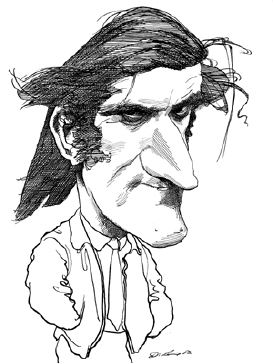
Ted Hughes
David Levine

In a statement to the Times, Carol Hughes welcomed the “full apology” for “highly misleading comments … attempting to link the poet somehow with tenuous allegations of involvement in slavery by someone alleged to be a very distant ancestor who was born in the time of Shakespeare”. She also noted the library’s “acknowledgment of the distress caused by comments on the library’s website that should not have been made, and its assurance that these comments will not be repeated”.

Bate called the inclusion of Hughes “an error on so many levels - not only the tenuous, centuries-old connection, but also the fact that Nicholas Ferrar wrote a pamphlet attacking slavery even before the British slave trade had begun!”

“Over-zealousness of this kind undoes the important work of excavating the history of the institutions that have benefited from slavery - it plays into the hands of both the ‘cancel culture’ and the ‘anti-woke’ press,” he said.

According to the Encyclopaedia Britannica, Ferrar is chiefly known for bringing the poetry of George Herbert, which Herbert had asked him on his deathbed to destroy or publish, to public attention. He was also the founder of a Christian community at Little Gidding.