Sunday, June 7, 2020

Clive James / The last interview


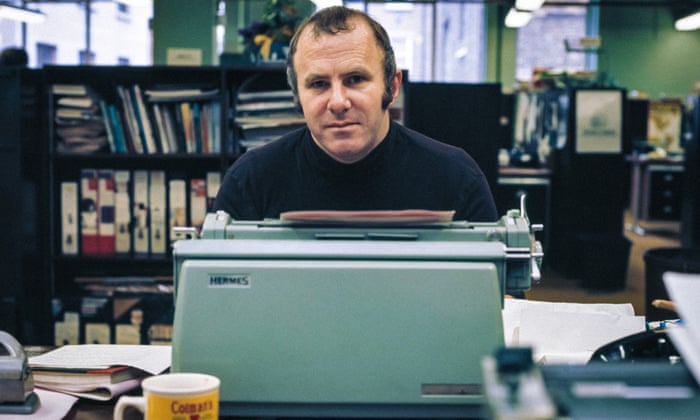
Clive James in 1977 at the offices of the Observer, where he worked as television critic.

Clive James: the last interview


Two months before his death, the broadcaster, poet and critic spoke about his own mortality

Rachel Cooke
Sunday 1 December 2019

J
ournalists shouldn’t interview people they know, or even (I think) acquaintances with whom they’re friendly. But in September I broke this rule, and went to Cambridge to talk to Clive James about his latest book.


The day before, I’d taken a call from his daughter, Claerwen James, the artist and my friend of more than 25 years. Clive was soon to publish a short book about Philip Larkin. He was pleased with it, and wanted to tell people about it. But he was also too ill, by this point, to see a stranger. Would I come? It would mean so much to him. I told her that I would.
I want to be clear. It is Claerwen who was, and is, my friend, not Clive. But still, he was a big and beloved figure in my life, and not only because she and I could spend hours at a time talking about our fathers in particular, and men in general. When I first met him, I was 25 and miserably toiling as a trainee in a Fleet Street newsroom. I knew no one, and nothing, and I was very shy, and thanks to these things – and the fact that he was a genius – I was a bit intimidated by him at first. Nevertheless, in those early years, he influenced me in all sorts of small but vital ways. I have a strong memory of an afternoon some time in about 1998. Claerwen and I walked into a room to find Clive listening to Joan Sutherland singing Bellini’s opera Norma. He was in a state that seemed to me to be close to sexual ecstasy: legs apart, head thrown back, a look of pure bliss on his face. I knew nothing of opera then, but as he translated her words for us – he sprang out of his chair to do this – I thought to myself: I’ll have what he’s having, thanks. That recording of Norma was the first opera I ever owned on CD, bought that very week. Clive’s enthusiasm, as bright and as powerful as a Klieg light, could make you want to read, listen to, watch or look at almost anything.
He was – this has already been said – very, very clever and very, very funny; he had a way of making you see that something could be both ridiculous and magnificent, and ever since I first learned this from him, I’ve always borne it in mind. He had, too, a sybaritic side that I adored. He could squeeze such pleasure from things. I’ve never seen anyone drink a bottle of Jacob’s Creek with so much enjoyment as him; it might as well have been Château Lafite in his glass. I thought of him, always, as deeply generous.
He noticed you, and what you were up to. Whenever, in later years, he was trying to get me to come to one of his book launches – I didn’t need much persuading – he would send me such sweetly beseeching emails. His “dazzlement division” needed me, he would insist. A certain kind of flirtation, like a certain kind of teasing, is a form of kindness, and for all that I did not take these messages too seriously (he was like this with everyone), that was how I received them: as kindnesses.
What I loved most of all, though, was to see him make Claerwen laugh. It’s my strongly held belief that a man who can make his own daughter – who is almost bound to be, however loving, a sceptic so far as her male parent goes – collapse into laughter is basically doing all right.
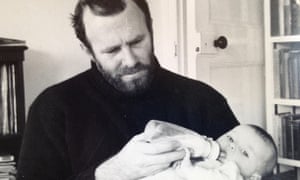
James with his baby daughter Claerwen, in a photograph taken by her mother, Prue Shaw.
James with his daughter Claerwen, in a photograph taken by her mother, Prue Shaw. Photograph: Courtesy of Claerwen James


On that day in September, he made us both laugh a lot. When I arrived, he was sitting in the thin autumn sunshine on the little balcony off his sitting room (a balcony that once overlooked the famous maple tree that was the subject of one of his late poems). He had grown a beard, and that, and his happy wave when I came in, made me think of Robinson Crusoe. I was shocked by the way his cancer had ravaged his face – contrary to reports last week, it wasn’t his leukaemia that killed him, but a metastatic squamous cell carcinoma; in other words, it was the Australian sunshine he absorbed in his youth that did for him in the end – but his eyes were refulgent, and he was so full of grace, and so intact in every other way. Somehow, he was the very essence of himself. It was heart-stirring to see, an almost numinous thing, though I knew he didn’t believe in God.

Larkin had always been a bond between him, Claerwen and me: we just think he is the Man. The book Somewhere Becoming Rain is a gathering together of everything Clive ever wrote about Larkin. It was Claerwen’s idea; she designed the cover, and it’s dedicated to her. On that day, we talked about Larkin first.
When he grew tired, we gossiped a bit. He and Claerwen were looking for a new box set to devour, and I recommended Succession. (She told me later how much he liked it.) Finally, we looked at a draft of The Fire of Joy, which will be published next year and is a collection of “roughly 80 poems to get by heart and say aloud”.
As I turned its pages, I was struck, all over again, by the astonishing range of his reading. Here were Auden and Keats and Wyatt. But here, too, were poets I’d never heard of. Clive read (in multiple languages) like his life depended on it – and perhaps it did, in a way. Words, to him, were as necessary as water. What follows is part of our conversation. At the time, I knew it would be our last, and yet it was so easy. Clive loved to have an audience – and I loved to listen.

Philip Larkin, 1979.
Photograph: Jane Bown

Can you remember when you read Larkin for the first time?
The answer is yes, yes, yes – and yes. It was the cold winter of 1964. My landlord, a young publisher, said that if I really wanted to catch up with modern English poetry, I should read Philip Larkin. So I read The Less Deceived. Although I like to think that I brought a certain receptivity to the party – I was his ideal reader – I was knocked out straight away.
How did he make you feel?
First of all, the spoken rhythms were so wonderful. I still think he’s the tops in that way. Second, I knew exactly what the poems meant – and that’s what staggers me, still, about him. There can’t be many poets in any language who communicate with their readers on such a basic level. I went quietly mad for him.
I’d just arrived from Australia, and I wanted to tell him these things, so I wrote to him. I don’t know what drove me to be so crazy as to think he would have time to read a letter from me, let alone to answer it, which he did. Jesus Christ. It [my fandom] was akin to love. But [if you’re the poet] you don’t want too many lovers turning up.
By the time his last collection, High Windows, was published in 1974, you were in a position to review it. Was that a big deal for you?
Yes. The feeling was: this is history, and it’s happening to me. It’s an unbeatable thing, writing about art. It’s heaven.
Did it sadden you, what happened to Larkin’s reputation in the period after his letters came out in 1992, and his biography the following year? [Larkin stood accused of racism and bad behaviour to women.]
Yes. I could talk about this for ever, which is a bad sign. There were faculty members here in Cambridge saying we shouldn’t read Larkin. What the fuck does that mean? Who else are you recommending we don’t read?
My reaction was, and is, people shouldn’t do this. It’s scary. If you are sensitive to language at all, I can’t see how you can’t admire him on some level. The connection between poetry and morality somehow got firmly established in the English university system through [the critic] F R Leavis; poetry came to have to do with virtue.
Personally, I’ve always thought that English literary history suffers from its shortage of villains. It needs more bastards in the [John Wilmot, Earl of] Rochester mould. But that said, while Larkin shouldn’t have said those things, he was [outwardly] the model of a gentleman. It’s impossible to imagine him being rude, or even sharp to someone.
I think there are various big and obvious reasons why some people wanted to diminish him. One would be his enviable reputation. Another would be the fact that he just didn’t cooperate. He stayed in Hull. London literary life wasn’t for him.

That life was for you, though, wasn’t it?
Ha, yes. I enjoyed it, the whole business. The argy-bargy. The tangle. My rivals, even.
And Larkin’s poems sail on, don’t they?
Yes, and that’s the loudest thing to say. Though it could have been a near-run thing, they won through.
If we were on a desert island, what Larkin poems would we want?
First of all, I’d be trying to attract your attention. So it would be the romantic ones. But … we’re on a desert island! I’d already have your attention.
No, there are so many. I’d have The Whitsun Weddings, Aubade, Church Going, Mr Bleaney, Dockery and Son, To the Sea, An Arundel Tomb, At Grass – it’s fabulous – Next, Please. His range of evocation is unmatched since metaphysical times, and he has – people forget this – such a feeling for the countryside, puttering along in his very unpowerful car.
What about death? Larkin is preoccupied with it, and I wonder what you feel about that, now.
My family was marked by tragedy [James’s father, a prisoner of war in Japan, was later killed when a plane bringing POWs home crashed in Manila Bay]. But I, personally, have been marked by all the blessings. I’m giving thanks for life now, which isn’t much like despair, is it?
But Larkin was different. He knew it would end in silence, and he was afraid of the silence. He didn’t like the idea of not being here. I’m not like that – and my death might come as a relief to quite a few people. I’d rather like it not to hurt, that’s all.
Will you write another book?
Suppose I did another volume of memoirs…
Would you like to?
Yes, but I don’t think I have the energy. I’ve been hit in the face by a cricket bat at 1,000 miles an hour. I think the last round-up is here. But that’s OK. It would be bad manners to complain. I’ve had a lucky life, and I’m grateful for it.


Sunday, May 24, 2020

Sex, lies and despair / Unseen letters reveal Larkin's tortured love


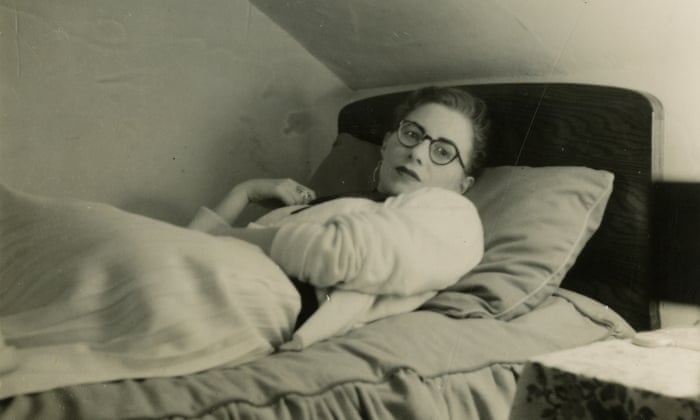
 Monica Jones in a photograph taken by Philip Larkin. Photograph: The estate of Philip Larkin

Sex, lies and despair: unseen letters reveal Larkin's tortured love

A cache of 2,400 letters between the poet and his long-time lover and muse, Monica Jones, charts an explosive and flawed romance

Dalya Alberge
Sunday 24 May 2020

“He lied to me, the bugger, but I loved him.” So Monica Jones described the revered poet Philip Larkin – a pithy but affectionate account of a lover who was serially unfaithful, but whose “utterly undistinguished little house” in Hull she turned into a shrine after his death.
Previously unpublished letters, however, reveal the full extent of her fury, fears and frustrations over a painful four-decade-long partnership with the man who wrote some of the most cherished verse in the English language.
“I don’t want to be and I won’t be an object of pity like a beggar’s sore,” she wrote to him in one letter. “I know you just think of me as a SITUATION, something to be fixed,” she lamented in another. She wrote repeatedly of feeling terribly alone and “so frightened”. Such was her despair that she referred to a bruised shoulder as “a kind of company”.
Her heart-wrenching thoughts are contained in 54 boxes filled with 2,400 letters to Larkin that she left to the Bodleian Library, Oxford, with the strict instruction that they were to remain closed until decades after her death. She died in 2001, aged 78.
Now Professor John Sutherland, a leading scholar and Jones’s close friend, has been given unrestricted access to the extraordinary collection.
He told the Observer that the letters were “explosive in their nature”, and represented “virtually everything that she wrote to Larkin over 37 years of separated love”.

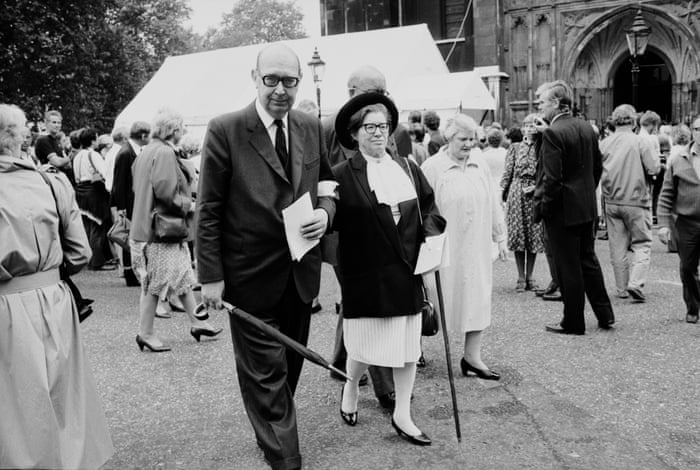
Philip Larkin and Monica Jones at the memorial service for Poet Laureate Sir John Betjeman at Westminster Abbey, London, in 1984.

Describing it as “the last great exchange of letters in literary history”, he said it was “like she’s ripping open her soul and her mind, letting it pour out. There’s a whole range of emotions. Sometimes she is furious when he doesn’t turn up for a meal she’s cooked. Other times, she’s just meditative.” She wrote of her emptiness: “Every smallest thing is too much for me.”

Larkin and Jones were both born in 1922 and studied at Oxford, although they first met at the then University College Leicester in 1946. He was a newly appointed deputy librarian and she was an English lecturer, a striking woman with peroxide hair. Larkin transferred to Queen’s University Belfast in 1950 and then five years later to the University of Hull. Jones lived for his visits. Their once-passionate relationship, blighted by their heavy drinking, lasted until his death in 1985.
Sutherland said: “Larkin had two women in Hull [one of whom was Maeve Brennan]. He would fit Monica in when he was visiting his mother up the road [in Loughborough] … Then he’d be back to Hull and the other women.”
Jones knew of those women, yet she repeatedly declared her love for Larkin in her letters: “I am so blessed to have you in my life.”
Sutherland said: “Her letters resemble a literary stream of consciousness – at times, more surging flood than stream. They have odd disjunctions. After a pages-long savage diatribe against Maeve, Monica suddenly reminds Philip to water the flowers.”
Larkin appreciated Jones as his intellectual equal, unlike his other women. He dedicated his breakthrough collection, The Less Deceived, to her – though it includes poems about his other partnerships. He bequeathed the bulk of his estate to her.
But the fact that he wrote so little poetry has been blamed on the stultifying effect of Jones, Sutherland said: “His poetry depends on four slim volumes … Around 100 poems.”

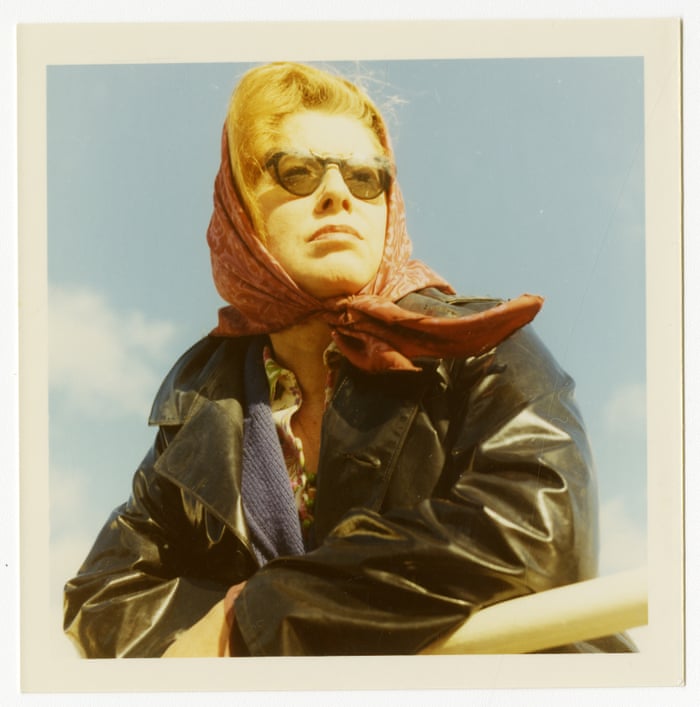
Monica Jones photographed by Larkin on the Isle of Mull, Scotland, 1971. Photograph: The estate of Philip Larkin
He noted that Kingsley Amis, Larkin’s closest friend from Oxford, was particularly vicious, dismissing her as a “grim old bag”.
“Margaret Peel in [Amis’s novel] Lucky Jim is a terrible caricature of Monica. Kingsley hadn’t met her at that point. Philip gave Kingsley all the details. He could be cruel in that way. She wrote an incredibly impassioned letter to Philip saying, ‘I am not so egotistical as to think everybody wants to put me in a book and I do not believe you would be so treacherous’.”
Jones has also been vilified for destroying 30 volumes of his diaries and private papers.
Sutherland, professor emeritus of modern English literature at University College London, was taught by Jones, and he attributes his career to her. He is now finishing a book on Jones, based on the letters, to be published next year by Weidenfeld & Nicolson. He expressed surprise that no one had written a biography of her before as she was the most important person in Larkin’s life.
He said no other biographer of Larkin had “enjoyed access to these letters”, which the Bodleian has catalogued in a “feat of librarianship at the highest level”. Poignantly, some of the envelopes still bear her lipstick marks.
The correspondence ends in the early 1970s when they got telephones. Sutherland said: “After that, he would telephone every night. When her health collapsed in the early 1980s, she moved in with him. They got drunk together. He died and she lived on drunkenly.
“She was a strange woman. You had to know her, to know the good things about her. He treated her badly, but always wrote fondly. It was an odd mixture … He did come near to trying to break up with her, but they needed each other. They were both very unhappy people.”
Sutherland hopes “to salvage Monica Jones from the versions of Monica Jones which circulated in her life and still circulate”. “From the unplumbed depths of the 54 boxes, one can exhume a Monica Jones to stand alongside Philip Larkin, not behind him as his dim correspondent shadow.”


Wednesday, May 13, 2020

3,000 corrections for the poet Miguel Hernández


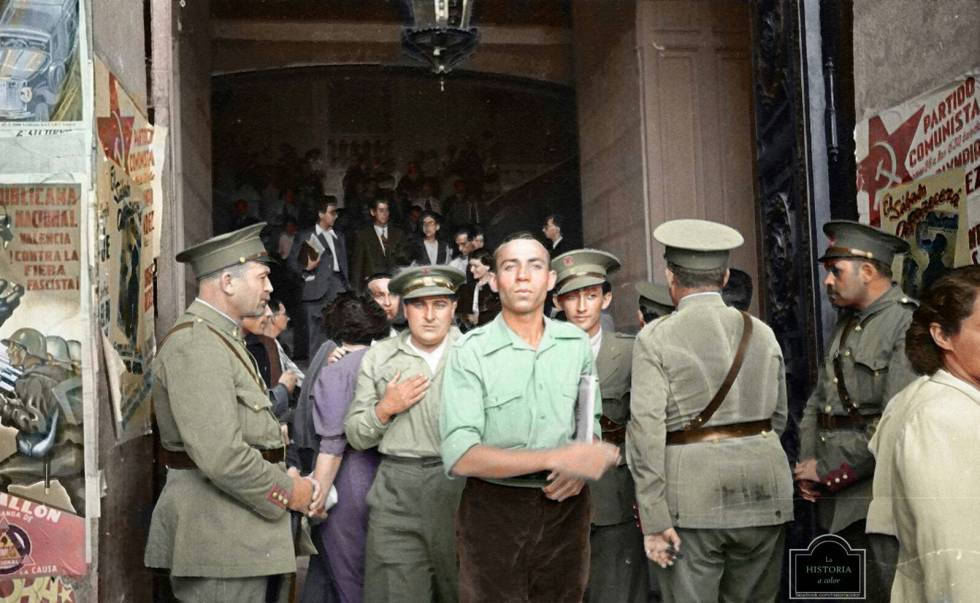
Miguel Hernández leaving the International Congress of Writers for the Defense of Culture, held in Valencia in July 1937.
Miguel Hernández leaving the International Congress of Writers for the Defense of Culture, held in Valencia in July 1937. WALTER REUTER (FONDO ZÚÑIGA)


3,000 corrections for the poet Miguel Hernández

A new edition of the writer’s collected works contains 30 never before released poems

English version by Debora Almeida.
Jesús Ruiz Mantilla
23 October 2017

Josefina Manresa, Miguel Hernández’ widow, said her husband liked to imitate nightingales and tell dirty jokes. “The first thing she loved; the second, not so much,” recalls Lucía Izquierdo, the poet’s daughter-in-law who in charge of his legacy. Recently she accompanied professor Jesucristo Riquelme in the presentation of a new edition of the author’s Complete Works (1910–1942), published by Edaf.

It is an exhaustive compilation, with everything he left behind thoroughly edited. The collection includes about 3,000 corrections to his writings, 30 unpublished works of different genres and 50 texts, which are “conspicuously altered from what was previously known,” says Riquelme.


It has taken this professor of language and literature at the University Miguel Hernandez of Elche more than eight years to complete this project, with the help of the publisher Carlos R. Talamás. He has examined the poet’s legacy, retraced his footsteps, and analyzed everything from manuscripts to correspondence.

What remains is this volume of almost 2,000 pages, where his poetry shines along with his war stories, press articles, dramatic works, images and traces of a happy, desolate, and combative biography. “It is about the writer who has turned the poetic word into ethics,” says the person responsible for this exhaustive literary work.

Ambition and passion

From his style reminiscent of the Basque poet Luis de Góngora, to his breakout Perito en Lunas (Expert on moons), Miguel Hernandez’s brilliant journey to the heart of literature lasted a decade. His vitality, ambition, and passion took him to the top of the Generation of ’27, a group of influential Spanish poets.

He was encouraged and supported chiefly by the poet Vicente Aleixandre and received with reservations by the poet Federico García Lorca. He retreated to the mud of the trenches, roused the militiamen, never forgot his peasant origins and hours among herds as a shepherd, and he died sighing for his children in a prison corridor. His belongings at the time of death included: a jumpsuit, two T-shirts, a sweater, a dress shirt, a pair of underpants, two pillowcases, a belt, a towel, a napkin, two handkerchiefs, a pair of socks, a blanket, a pot and a jar.


That is all he had in his jail cell in Alicante, a city in southeastern Spain, when he died on March 28, 1942, 75 years ago. His pages were his more valuable possessions, with poems that offer a full portrait of the man. His life dazzled poet Pablo Neruda. “Few poets are as generous and brilliant as the boy from Orihuela,” said Neruda, about Hernández who came from Orihuela in Alicante province. “The awful, awful beauty of his ingrained heart,” said a captivated Juan Ramón Jiménez, a fellow Spanish poet.


His poetry shines alongside his war stories and dramatic works

But it was Aleixandre who took care of him, guided him and made him great after his death by helping his widow in the postwar years. Josefina Manresa was a constant muse for the poet. But one must not forget the passion he once had for the surrealist painter Maruja Mallo. “Together with her, he discovered a carnal love, an almost orgiastic experience, that marked him tremendously,” said Riquelme. This new edition brings new light to that relationship.

“In many of the poems, the change of a word completely disrupts its meaning. We have verified errors involving draft revisions,” adds Riquelme about his editing. He has had a great deal of time and access to the poet’s work but gaps remain, like a collection of letters. “It's still early. We constantly receive unpublished letters from different archives. While finishing up this project, we will have received about 100 new letters. The collected letters is underway, but it must be dealt with carefully.”

For now, this new collection replaces the other two editions of Hernández’ complete works. This new volume also includes an archive of images with photographs, documents and originals. “These are keys for reading the book, and they are important as many of the texts,” Riquelme concludes.

Tuesday, May 5, 2020

Live / “¿Por qué me fui a enamorar de ti?” / Mon Laferte at the 32nd Hispanic Heritage Awards


LIVE! 
“¿Por qué me fui a enamorar de ti?” 
By Mon Laferte 
at the 32nd Hispanic Heritage Awards


Norma Monserrat Bustamante Laferte, known professionally as Mon Laferte, is a Chilean-born Mexican dual citizen singer-songwriter and actress who is currently the most listened to Chilean artist on Spotify worldwide. She is also the Chilean artist with the most nominations in a single edition of the Latin Grammy Awards (5 in 2017). She received a Latin Grammy in 2017 for Best Alternative Song for "Amárrame.” To date she has sold in Latin America 1,500,000 digital copies between albums and singles, making her the Chilean singer with the most sales in the digital era.


Thursday, April 30, 2020

New Irish Writing / April’s winning poems


Kevin Graham
Kevin Graham

New Irish Writing: April’s winning poems

How to Use This Poem, and Homage to Wendell Berry, both by Kevin Graham


Kevin Graham
April 30, 2020

How to use this poem

Walk out of your life by ducking under
hanging ivy on a summer’s day
and feel the earth culminate underfoot.
Finches and snipes will skitter
in the elms’ leaves, hawthorn seed
spilling into the air. Your broad-leaved
heart will check itself in the shade
of the banks of a river without a name.
Belts of stinging nettle will guide you
under the stone arch of amnesia,
past the grief of bluebells and honesty
of wood-sorrel. Running through time’s
passage will be all the stanzas of light
you meant to experience. Branches
will part like so many good intentions
and the sun will warm your collar bones.
Once near the sea, you’ll be able
to take this page and hold it level
with the horizon, examine it for mistakes.
The current you feel will be equal
to the square root of peace multiplied by sky.

Homage to Wendell Berry

You’d like it here, this picture postcard
where the scenery scans like a Van Gogh –
rolling fields, endless sky. The scent of anemone,
milkweed, blue-eyed grass, bluntleaf.
Cycle paths crisscross like a net of consciousness
reasoning nature’s lot. We know the world’s
in trouble, you called it fifty years ago
yet we live in a bubble of our own making
where temperatures soar and our hearts
are sold to global corporates. Here
the young sustain the earth, sweat gold,
brush away muck and count against death
the loaded basket. Keeping abreast
of life’s fruit takes its toll: an orchard
of plum trees, the green breeze carrying
a patch of wild strawberries. Vineyards
line up like soldiers and the fields are lit
with the yellow flames of courgette flowers.
We cycle knee-deep in an absence
of ignorance unable to see the path ahead,
counting breath, listening carefully.
Kevin Graham’s recent poems have appeared in The Stinging Fly, Causeway/Cabhsair and Crannóg. He lives and works in Dublin


Tuesday, April 21, 2020

Carol Ann Duffy leads British poets creating 'living record' of coronavirus


Photograph: Murdo MacLeod
Illustration: Triunfo Arciniegas

Carol Ann Duffy leads British poets creating 'living record' of coronavirus

Major names including Imtiaz Dharker, Jackie Kay and father-and-son poets Ian and Andrew McMillan to document outbreak in verse
Alison Flood
Monday 20 April 2020


Carol Ann Duffy has launched an international poetry project with major names including Imtiaz Dharker, Roger McGough and Ian McMillan, as a response to the coronavirus pandemic.
The former poet laureate hopes the project, entitled Write Where We Are Now, “will provide an opportunity for reflection and inspiration in these challenging times, as well as creating a living record of what is happening as seen through our poets’ eyes and ears, in their gardens or garrets”.
Hands, Duffy’s poem, was written on 26 March and sees the author reflecting on how every Thursday, “we clap at the darkness”, and on how she can see the hands of her absent daughter “when I put my head in my own”. Another contribution from the Scottish poet takes a fiercer tone: Since You Ask sees her “Scunnered, stymied, shafted, shaded, / shat on from a great height, spaffed, spooked.” It ends: “OK, OK, OK. Onwards.”


Hands by Carol Ann Duffy

We clap at the darkness.

I hearken for the sound

of my daughter’s small hands,
but she is miles away...
though I can see her hands
when I put my head in my own.  

In Andrew McMillan’s Garden, he writes of how at first the dead “were few / enough to name them / but soon they grew too many / the vast fields of them”.
Duffy is spearheading the project with the Manchester Writing School at Manchester Metropolitan University. Contributors range from new and emerging poets to award-winners Raymond Antrobus and Andrew McMillan, and some of British poetry’s biggest names, such as Gillian Clarke and Jackie Kay.
“We need the voice of poetry in times of change and world-grief. A poem only seeks to add to the world and now seems the time to give,” said Duffy, who is creative director of the writing school.
In Cranes Lean In, Dharker writes of a phone call with her daughter while she looks over a London in lockdown: “Petals brush my face. / You say at last // the cherry blossom / has arrived // as if that is what / we were really waiting for.”
She wrote it, she said, “standing at a window looking out over the marooned city. London had stopped its eternal building and the streets and stations were becalmed.”
“That was the day it suddenly came home to many mothers what this meant, this strange waiting time without their children,” Dharker went on. “I could hear the phone calls all over the world, people separated and searching for words of hope and consolation to give each other. The words my daughter gave me were about kindnesses, and something we had both been waiting for: the cherry trees blossoming in the parks and streets of London.”


Cranes Lean In by Imtiaz Dharker

Cranes lean in, waiting for an all-clear

that will not come. 

Forehead pressed to glass,

phone at my ear, I learn

to sail on your voice

over a sadness of building sites, 

past King’s Cross, St Pancras,

to the place where you are.

You say nothing

is too far, mothers

will find their daughters,

strangers will be neighbours,

even saviours

will have names.

You are all flame

in a red dress.  

Petals brush my face.

You say at last

the cherry blossom

has arrived

as if that is what

we were really waiting for.


McMillan, winner of the 2015 Guardian first book award and a contributor alongside his father, Ian, said it was “really important to record as a continuing historical document the times we’re living through”.

“I’ve always believed a poet’s job is to be a witness, and this is just another example of that,” said McMillan, who said he had found it very hard to write his poem.
“There are some things which feel beyond language – huge numbers of deaths, untold suffering, unmanageable fear. We’re dealing with abstracts and the first instinct within that is to reach for abstracts ourselves, but abstracts don’t make for good poetry,” he said. “All I tried to do, and all I think any of us can do, is focus on something small and contained and concrete, and try to tell it that way.”

In Unbecoming Maramot, Romalyn Ante, an award-winning poet who works as an NHS nurse, writes after a shift: “She walks an unlit road on her own, yet not alone. / Look at her now – night after night, shift after shift.” TS Eliot-winning poet George Szirtes is writing a new poem every day for the project, while Moira Egan and David Tait are writing from lockdown in Italy and China respectively.
Prof Malcolm Press, vice-chancellor of Manchester Metropolitan University, called the initiative inspiring. “I am sure that these outstanding poems will voice the sentiments and feelings that many of us around the world will share,” he said. “At the same time, I am confident that these innovative and imaginative works will inspire creativity and hope.”


Sunday, April 19, 2020

Geoffrey Brock / Weighing light


Weighing light

Often the slightest gesture is most telling, 
as when he reaches tenderly in passing 
to pluck the yellow leaf from the dark fall
of her hair, or even the absence of all gesture:
the way she doesn’t need to turn to know
who, in this gathering of friends, has touched her.
It was as if he dreamed some private garden.
Perhaps he woke from it, mid-reach, to find
his hand too near her hair in this crowded yard,
and maybe even now she’s shuttering in
(she’s even better than you or I at that)
a storm of worry and recrimination—
did anyone notice? how could he do that here!—
by seamlessly continuing to tell you
about her trip to see her favorite Vermeer
this morning in the Delft show at the Met:
“So now they say she isn’t weighing pearls
or gold or anything—it’s just the light
gleaming off empty scales.” So much is hard
to know for sure. If I confronted her,
she’d say it was just a leaf—who could afford
to disagree? Could we? Now she’s explaining
how the girl faces a mirror we can’t see into
and how behind her hands a gloomy painting
of the Last Judgment: “Over her head God
floats in a cloud,” she says, “like a thought balloon.”
But you don’t hear. You’re watching me. I nod.