This college campus extension, one building only, formerly part
of the asylum on these asylum grounds. The classrooms, converted patients’
quarters and beneath us the tunnels. Such horror and history. We’re like
the city atop the buried city, the students could pickax and shovel into quieted
collected voices of the mad, and madhouse keepers, instead of drudging through MLA
documentation. We’re like a parallel universe of institutions, like Roethke’s sad pencils.
Sandy Fontana teaches composition, literature, and creative writing at Shawnee Community College. She received her MFA from Southern Illinois University Carbondale along with the 2002, 2003, and 2004 Academy of American Poets Prize. Her poetry has been published in Atlanta Review, Hayden’s Ferry Review, Nimrod, Slippery Elm, and The Labletter.
After three years of incredible concerts, inspiring musical encounters and numerous tours in 21 countries, BGKO continues to evolve, delight and flourish. We are happy to announce our newest iteration: Barcelona Gipsy balKan Orchestra.
After so much intense work and growth, we are responding to the urge to expand our artistic horizons. While we remain very interested in Klezmer music, we also want to gather inspiration from a wider spectrum of genres. Balkan music is, for us, a set of musical traditions and multiethnic cultures that surpass geographical confines, drawing on the historical traditions that have forever inhabited these lands: Ashkenazi and Sephardic Jews, Gypsies, Ottomans, Arabs...
And as always, the Gipsy music of Eastern Europe will always be present in the essence of our artistic energy.
En route to this horizon we welcome a new clarinetist to the band: Joaquín Sánchez Gil, from Málaga, also creative artisan of wind instruments. He is a lover and expert of Balkan and Middle Eastern traditions as well as flamenco.
No longer with us is the clarinetist, Robindro Nikolic , co-founder of the old Barcelona Gipsy Klezmer Orchestra. He continues his own unique artistic path with new projects. We want to take this occasion to express our deep admiration and gratitude for the wonderful years of learning and performing with Robindro. You can follow him here: www.robindronikolic.com.
We are also enjoying the increasingly active collaboration of Oleksandr Sora, Ukrainian classical violinist and virtuoso of Eastern European music.
Regarding the Barcelona Gipsy balKan Orchestra... we are happy to be presenting a new video and two unreleased tracks very soon!
We will continue to work with renewed strength, inspiration and energy! So please stay tuned!
Always,
Barcelona Gipsy balKan Orchestra
BGKO are:
Sandra Sangiao (Voice - Catalunya)
* (In this video, the group counted on Vroni Schnattinger's violin collaboration)
Should it be denied? If I am the last man walking on the earth I would have to deny it if there are no birds to sing an autumn song if there is no autumn if the time of the seasons has already passed I would have to deny it if there is no blue for me to tell my bewilderment if I am where the colours have no name in the gardens’ incessant final judgement I am the last man shouting on the earth who shouts to the sky that has hidden itself forever and I would have to deny it to whom, to God? God is perchance the artist of silence for there are so many leaves that are not or keep falling into the abyss and explode in the squalid air but what air.
Shrouded in golden leaves, we wait. The world doesn’t end at sunset and only dreams limit themselves to things. Through a labyrinth of blank hours time leads us on as autumn falls over our house, our patio. Shrouded in a relentless fog we wait, we wait: nostalgia means to live without remembering the word we are made of.
You are in need of everything: grey roads, deep glooms, birds that sing even in silence; the sky, an autumn leaf, hands empty, love unreturning, snow’s whiteness; dawn lights, you are in need of everything the dream requires, to become one with the music of the most faraway blues so that eventually your soul will have confidence in death.
The afternoon I knew your death– the summer’s purest, the almonds had grown up to the sky, and the loom halted in the rainbow’s ninth colour. How, by the white rim, did her movement go? How was your flight by that thread woven which gave almost the name of destiny?
Only the clouds uplifted in the light told everybody’s writing, the ballad of who has seen a kingdom and another kingdom and remains within the fable. They carried your body, snow between dust branches that have already heard the song and keep peace of the nightingale among the tombs.
I shut the garden gates, the castle’s high windows. Indeed I grudged the troubadour, transmuting wood to water, flower and lute, entry. He sang his song; time has unravelled what the Lord has ravelled, silver tapestry already happening, moonlit wandering, yet returning to the skein. Alone you may find the shape that awaits you.
I don’t know what blue was, there and then, lonely, I don’t know what forest imparted to the bitter moon its enchantment, the sunflower found under the ship on voyages that recall the Mediterranean clear waters. The afternoon I knew you were leaving was death’s purest: you were in my memory talking to me among the lilies, in some lines by Saint John of the Cross. What sky was there, what hand knit slowly, what songs brought the pain, the marvel that is awed of being at that hour in which the moon burst on the almonds and burned down the jasmines. You came by the side of the sea from where a song is heard, perhaps from a drowning virgin, as your steps on the land.
Then you departed through my soul, you queen of ancient fables, dust kindred to those ships that once seeded from sandal- -wood and cedar the wine sea. Alone you travelled, beautiful, in silence, stone-beautiful; in your shoulder a violin stopped in its tracks. The almonds in the courtyard and the jasmines announced a summer storm. The sky shattered my house’s mirror, death resounded deep in the cistern. I was thus lost in that fiery bramble, in which our memory conceals our loved ones. I wore blue mourning and remained alone
The Poetic Principle: Poe on Truth, Love, Reason, and the Human Impulse for Beauty
“A poem deserves its title only inasmuch as it excites, by elevating the soul. The value of the poem is in the ratio of this elevating excitement.”
BY MARIA POPOVA
“True poetic form,” Edward Hirsch wrote in his wonderful meditation on how to read a poem, “implies a mind so miraculously attuned and illuminated that it can form words, by a chain of more-than coincidences, into a living entity.” James Dickey, in his guide on how to enjoy poetry, argued that “poetry makes possible the deepest kind of personal possession of the world.” In his sublime Nobel Prize acceptance speech, the late and great Seamus Heaney asserted that poetry works to “persuade that vulnerable part of our consciousness” and remind us that we are “hunters and gatherers of values.” But, surely, all these exaltations apply to good poetry — great poetry, even. The question, then, is what makes great poetry, and why does it make the human soul sing so?
Arguably the most compelling answer ever given comes from Edgar Allan Poe in his essay “The Poetic Principle,” which he penned at the end of his life. It was published posthumously in 1850 and can be found in the fantastic Library of America volume Edgar Allan Poe: Essays and Reviews (public library), which also gave us Poe’s priceless praise of marginalia.
Poe begins with an unambiguous definition of the purpose of poetry:
A poem deserves its title only inasmuch as it excites, by elevating the soul. The value of the poem is in the ratio of this elevating excitement. But all excitements are, through a psychal necessity, transient. That degree of excitement which would entitle a poem to be so called at all, cannot be sustained throughout a composition of any great length. After the lapse of half an hour, at the very utmost, it flags — fails — a revulsion ensues — and then the poem is, in effect, and in fact, no longer such.
And yet, he argues, this isn’t necessarily how we judge poetic merit — he takes a prescient jab against our present “A for effort” cultural mindset to remind us that the measure of genius isn’t dogged time investment but actual creative quality:
It is to be hoped that common sense, in the time to come, will prefer deciding upon a work of Art, rather by the impression it makes — by the effect it produces — than by the time it took to impress the effect, or by the amount of “sustained effort” which had been found necessary in effecting the impression. The fact is, that perseverance is one thing and genius quite another
(It’s interesting that he uses the term “sustained effort” more than a century and a half before the findings of modern psychology, which has upgraded the term to “deliberate practice” to illustrate the qualitative difference in the effort necessary for achieving genius-level skill.)
After discussing a couple of examples of poems that elevate the soul, Poe takes a stab at what he considers to be the most perilous cultural misconception about poetry and its aim, a fallacy that profoundly betrays the poetic spirit:
It has been assumed, tacitly and avowedly, directly and indirectly, that the ultimate object of all Poetry is Truth. Every poem, it is said, should inculcate a moral; and by this moral is the poetical merit of the work to be adjudged. We Americans especially have patronized this happy idea; and we Bostonians, very especially, have developed it in full. We have taken it into our heads that to write a poem simply for the poem’s sake, and to acknowledge such to have been our design, would be to confess ourselves radically wanting in the true poetic dignity and force: — but the simple fact is, that, would we but permit ourselves to look into our own souls we should immediately there discover that under the sun there neither exists nor can exist any work more thoroughly dignified — more supremely noble than this very poem — this poem per se — this poem which is a poem and nothing more — this poem written solely for the poem’s sake.
He goes on to outline a dispositional diagram of the human mind, a kind of conceptual phrenology that segments out the trifecta of mental faculties:
Dividing the world of mind into its three most immediately obvious distinctions, we have the Pure Intellect, Taste, and the Moral Sense. I place Taste in the middle, because it is just this position which, in the mind, it occupies. It holds intimate relations with either extreme; but from the Moral Sense is separated by so faint a difference that Aristotle has not hesitated to place some of its operations among the virtues themselves. Nevertheless, we find the offices of the trio marked with a sufficient distinction. Just as the Intellect concerns itself with Truth, so Taste informs us of the Beautiful while the Moral Sense is regardful of Duty. Of this latter, while Conscience teaches the obligation, and Reason the expediency, Taste contents herself with displaying the charms: — waging war upon Vice solely on the ground of her deformity — her disproportion — her animosity to the fitting, to the appropriate, to the harmonious — in a word, to Beauty.
(I wonder whether Susan Sontag was thinking about Poe when she wrote in her diary that “intelligence … is really a kind of taste: taste in ideas.”)
Beauty, Poe argues, is the highest of those human drives, and the domain where poetry dwells:
An immortal instinct, deep within the spirit of man, is thus, plainly, a sense of the Beautiful. This it is which administers to his delight in the manifold forms, and sounds, and odors, and sentiments amid which he exists. And just as the lily is repeated in the lake, or the eyes of Amaryllis in the mirror, so is the mere oral or written repetition of these forms, and sounds, and colors, and odors, and sentiments, a duplicate source of delight.
[…]
The struggle to apprehend the supernal Loveliness — this struggle, on the part of souls fittingly constituted — has given to the world all that which it (the world) has ever been enabled at once to understand and to feel as poetic.
Acknowledging that the poetic sentiment may manifest itself in forms other than poetry — art, sculpture, dance, architecture — he points to music (“Music”) as an especially sublime embodiment of the Poetic Principle:
It is in Music, perhaps, that the soul most nearly attains the great end for which, when inspired by the Poetic Sentiment, it struggles — the creation of supernal Beauty. It may be, indeed, that here this sublime end is, now and then, attained in fact. We are often made to feel, with a shivering delight, that from an earthly harp are stricken notes which cannot have been unfamiliar to the angels. And thus there can be little doubt that in the union of Poetry with Music in its popular sense, we shall find the widest field for the Poetic development.
(Again, I wonder whether Poe was on Susan Sontag’s mind when she wrote that “music is at once the most wonderful, the most alive of all the arts,” or on Edna St. Vincent Millay’s when she exclaimed, “Without music I should wish to die. Even poetry, Sweet Patron Muse forgive me the words, is not what music is.”)
Poe returns to the subject of beauty as the ultimate source of this “Poetic Sentiment” in all its varied expressions with an argument that rings all the more poignant and stirring today, in an age when we question whether pleasure alone can make literature worthwhile. Poe writes:
That pleasure which is at once the most pure, the most elevating, and the most intense, is derived, I maintain, from the contemplation of the Beautiful. In the contemplation of Beauty we alone find it possible to attain that pleasurable elevation, or excitement, of the soul, which we recognize as the Poetic Sentiment, and which is so easily distinguished from Truth, which is the satisfaction of the Reason, or from Passion, which is the excitement of the heart. I make Beauty, therefore — using the word as inclusive of the sublime — I make Beauty the province of the poem, simply because it is an obvious rule of Art that effects should be made to spring as directly as possible from their causes: — no one as yet having been weak enough to deny that the peculiar elevation in question is at least most readily attainable in the poem. It by no means follows, however, that the incitements of Passion, or the precepts of Duty, or even the lessons of Truth, may not be introduced into a poem, and with advantage; for they may subserve, incidentally, in various ways, the general purposes of the work: — but the true artist will always contrive to tone them down in proper subjection to that Beauty which is the atmosphere and the real essence of the poem.
He then offers a precise, unapologetic definition of poetry:
I would define, in brief, the Poetry of words as The Rhythmical Creation of Beauty. Its sole arbiter is Taste. With the Intellect or with the Conscience, it has only collateral relations. Unless incidentally, it has no concern whatever either with Duty or with Truth.
[…]
While [the Poetic Principle] itself is, strictly and simply, the Human Aspiration for Supernal Beauty, the manifestation of the Principle is always found in an elevating excitement of the Soul — quite independent of that passion which is the intoxication of the Heart — or of that Truth which is the satisfaction of the Reason. For, in regard to Passion, alas! its tendency is to degrade, rather than to elevate the Soul. Love, on the contrary — Love … is unquestionably the purest and truest of all poetical themes. And in regard to Truth — if, to be sure, through the attainment of a truth, we are led to perceive a harmony where none was apparent before, we experience, at once, the true poetical effect — but this effect is preferable to the harmony alone, and not in the least degree to the truth which merely served to render the harmony manifest.
Portrait of Poe by Benjamin Lacombe. Click image for details.
Poe ends with an exquisite living manifestation of his Poetic Principle — a sort of prose poem about poetry itself:
We shall reach, however, more immediately a distinct conception of what the true Poetry is, by mere reference to a few of the simple elements which induce in the Poet himself the true poetical effect He recognizes the ambrosia which nourishes his soul, in the bright orbs that shine in Heaven — in the volutes of the flower — in the clustering of low shrubberies — in the waving of the grain-fields — in the slanting of tall, Eastern trees — in the blue distance of mountains — in the grouping of clouds — in the twinkling of half-hidden brooks — in the gleaming of silver rivers — in the repose of sequestered lakes — in the star-mirroring depths of lonely wells. He perceives it in the songs of birds — in the harp of Æolus — in the sighing of the night-wind — in the repining voice of the forest — in the surf that complains to the shore — in the fresh breath of the woods — in the scent of the violet — in the voluptuous perfume of the hyacinth — in the suggestive odor that comes to him, at eventide, from far-distant, undiscovered islands, over dim oceans, illimitable and unexplored. He owns it in all noble thoughts — in all unworldly motives — in all holy impulses — in all chivalrous, generous, and self-sacrificing deeds. He feels it in the beauty of woman — in the grace of her step — in the lustre of her eye — in the melody of her voice — in her soft laughter — in her sigh — in the harmony of the rustling of her robes. He deeply feels it in her winning endearments — in her burning enthusiasms — in her gentle charities — in her meek and devotional endurances — but above all — ah, far above all — he kneels to it — he worships it in the faith, in the purity, in the strength, in the altogether divine majesty — of her love.
Find more of Poe’s timeless wisdom in Edgar Allan Poe: Essays and Reviews and complement it with his meditation on marginalia and Lou Reed on the challenge of setting Poe to music.
I have never seen battles quite as terrifyingly beautiful as the ones I fight when my mind splinters and races, to swallow me into my own madness, again.
After literature and written art had to fight a tough battle for attraction during the first decade of social media, owing to a certain group of writers it is now on a significant rise.
Artists, that emerged under the challenges and circumstances of the digital platforms, have brought back an art form that was declared dead. How Instagram and Twitter have offered jumpstarts to careers of authors like Rupi Kaur, Atticus and Dean Cocozza, sets a blueprint for thousands of aspiring writers. We asked Cocozza about his relationship to social media and current career plans
A race for the reader’s attention
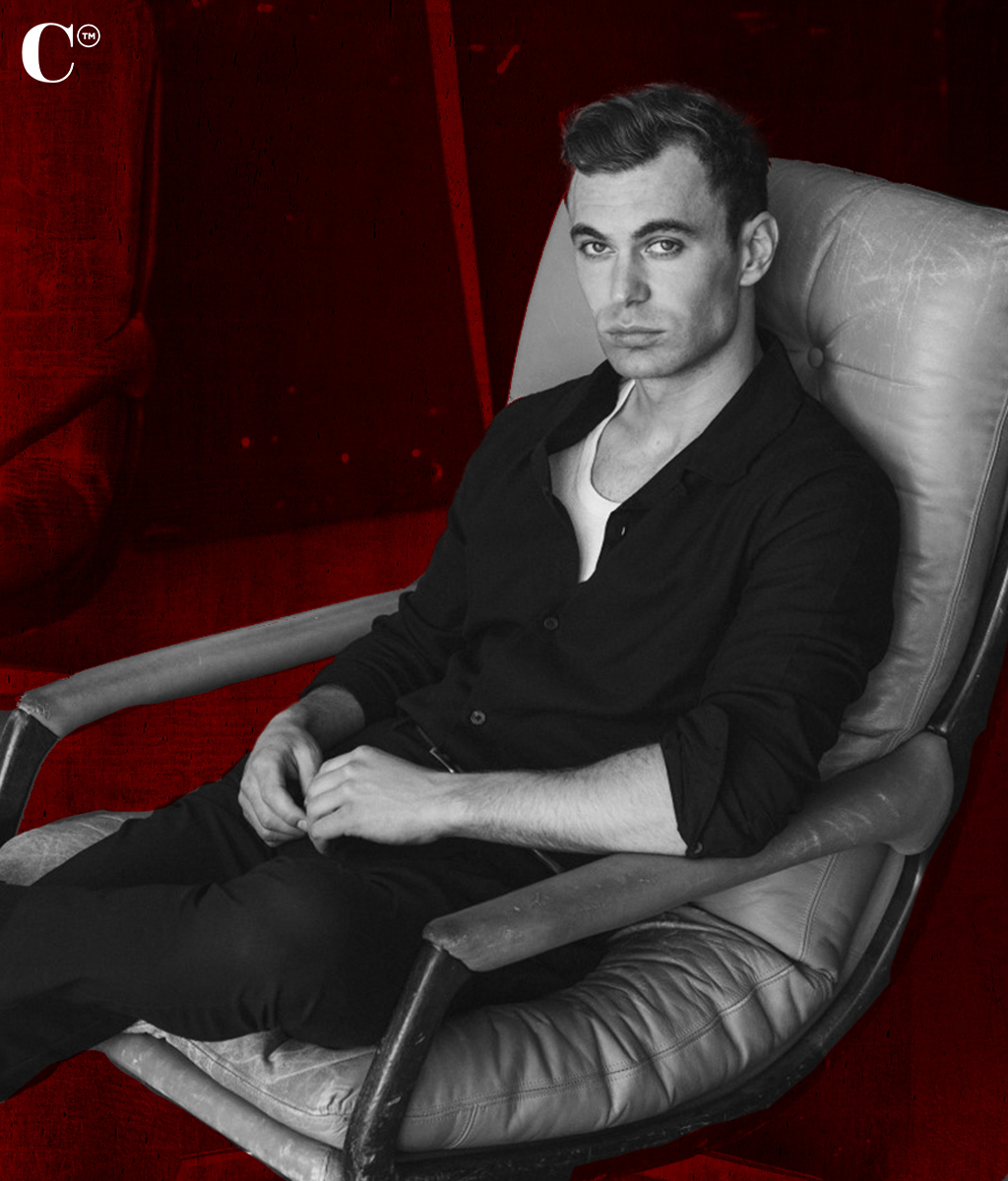
When asked about his beginnings as a writer, Dean Cocozza makes clear he has come some journey.
“I started writing lyrics for my music as a teenager, then was asked to write more and more for other artist. I’ve never been a fan of rhyming, so my personal favourites were always pieces that would rather be categorized as poetry.”
He immediately had to experience, that translating art to social media is not as simple as posting whatever his pen put down.
“Anyone who uses the platform with an intent will quickly learn that you only have the glimpse of a moment to catch the viewer’s attention. So the work I shared shifted to be more to the point, often one liners. Then stuff started to go viral.”
The success and demand for more poems resulted in his first book ‘zero dark thirty’, which sold out quickly. Despite the book containing mostly short writings, even said one-liners, Cocozza emphasizes that “it was a very personal project resulting from a certain period of time” in his life.
A sold out book, as well as thousands of shares and likes approve his creations, but what does it mean to a writer?
“I wouldn’t put my writings out there, if I wasn’t curious about the possibility of it resonating with people. Of course it’s nice. But at the end of the day, I don’t write for social media. It’s more of a diary, a mood board that can help testing waters. There are much bigger things that I work on and plan to get involved in.“
A mission to bring back emotional depth
When asked about his goals for the future, it is clear that cinema is more than just an inspiration for the British-German artist, but even more the destination.
“I am looking to work more and more in the film industry. Besides personal experiences, a big part of my inspiration has always come from 1960’s French cinema, where dialogues and emotional depth had a unique authenticity.”
Visual projects are no new terrain for Cocozza, who’s writings and scores have been featured in several productions for film and fashion magazines.
And as much as 60’s French cinema with its unconventional directors was called the New Wave (Nouvelle Vague), the last years have brought a new wave of writers and poetry, each of them an advocate for their own cause. Whereas bestseller authors Rupi Kaur and Nayyirah Waheed are not only popular but also important voices of BIPOC female artists, male writers like Atticus & Dean Cocozza are carefully breaking with social media’s extreme forms of fragile masculinity with their emotional content. And in it seems their poetry seems to sell better too.
In-between monetized content, blatant advertising and ‘perfect lives’, social media holds a spot for a new generation of artists, including literature. Critical thinkers and authentic writers, remind the app’s consumers of their emotional human nature.
Art galleries and bookstores might have lost a big part of their audience to digital media - but the art itself will always find ways to survive.
Once I had a love and it was a gas Soon turned out had a heart of glass Seemed like the real thing, only to find Mucho mistrust, love's gone behind
Once I had a love and it was divine Soon found out I was losing my mind It seemed like the real thing but I was so blind Mucho mistrust, love's gone behind
In between What I find is pleasing and I'm feeling fine Love is so confusing there's no peace of mind If I fear I'm losing you it's just no good You teasing like you do
Once I had a love and it was a gas Soon turned out had a heart of glass Seemed like the real thing, only to find Mucho mistrust, love's gone behind
Lost inside Adorable illusion and I cannot hide I'm the one you're using, please don't push me aside We could've made it cruising, yeah
Yeah, riding high on love's true bluish light
Once I had a love and it was a gas Soon turned out had a heart of glass Seemed like the real thing only to find Mucho mistrust, love's gone behind
In between What I find is pleasing and I'm feeling fine Love is so confusing there's no peace of mind If I fear I'm losing you it's just no good You teasing like you do