Thursday, August 30, 2012

Rae Armantrout / Six Poems


Six Poems 
by Rae Armantrout


THE GIFT

You confuse
the image of a fungus

with the image of a dick
in my poem

(understandably)

and three days later
a strange toadstool

(white shaft, black cap,
five inches tall)

appears
between the flagstones
in our path

We note
the invisible

web
between fence posts

in which dry leaves
are gently rocked.


SUSTAINED

     1

To come to
in the middle

of a vibrato—
an “is”—

that some soprano’s

struggling
to sustain.

     2

To be awake
is to discriminate

among birdcalls,
fruits, seeds,

“to work one’s way,”
as they say,

“through.”

     3

Just now
breaking

into awareness,
falling forward,

hurtling inland
in all innocence


BORDER PERFECTION

     1

The days are shorter,
but the light seems to stretch out,

to hark
from a long way off.

Horizons
snap into focus,

while shadows
are distended, smudged.

It’s happening again;
we take

discrepancies
for openings.

     2

The sign
that the guy behind me

in the “border protection” line
is demented

is his impatience,

the way he asks
again and again

what we’re waiting for


THE VESICLE

     1

To our amazement,
when fed on fatty acid,

the vesicle
did not simply grow,

it extended itself
into a filament.

Now the king’s youngest daughter said,

“I wish I had
something like that”—

and the whole vesicle
transformed

into a slender tube
which was quite delicate.

     2

Monks
mimed one another’s
squiggles

carefully
by candlelight

as if they thought
creation trailed something,

as if they knew
creation looked like this

from what is
always

the outside.


EXACT

Quick, before you die,
describe

the exact shade
of this hotel carpet.

What is the meaning
of the irregular, yellow

spheres, some
hollow,

gathered in patches
on this bedspread?

If you love me,
worship

the objects
I have caused

to represent me
in my absence.

     *

Over and over
tiers

of houses spill
pleasantly

down that hillside.
It

might be possible
to count occurrences.


WITH

It’s well
that things should stir
inconsequentially
around me
like this
patina of shadow,
flicker, whisper,
so that
I can be still.

     *

I write things down
to show others
later
or to show myself
that I am not alone with
my experience.

     *

“With”
is the word that
comes to mind,
but it’s not
the right word here.


CONJUNCTIONS:54, Spring 2010


Friday, August 24, 2012

Alberto Barrera Tyszka / Poetics


Poetics
by Alberto Barrera Tyszka
Translated by Guillermo Parra

It should be clean and brilliant,
like a razor blade
sunk in a glass of wine.

Like a sprig of basil
on the ice.

It should be mortal,
always.

Like desire.


Alberto Barrera Tyszka
Poética

Ha de ser limpia y brillante,
como una hoja de afeitar
hundida en una copa de vino.

Como un tallo de albahaca
sobre el hielo.

Ha de ser mortal,
siempre.

Como el deseo.


Monday, August 20, 2012

James Wright / Lazy on a Saturday Morning


Lazy on a Saturday Morning
By James Wright

Gulls poise on the wet arms
Of the woman who is in love with the sea.
She floats away from the shore on an oak leaf, calling me
By a strange name.


Sunday, August 12, 2012

Jacques Prevert / Family Life

FAMILY LIFE 
by Jacques Prevert
FAMILY LIFE (1)

The mother knits
The son goes to the war
She finds this quite natural, the mother
And the father?
What does the father do?
He has his business
His wife knits
His son goes to the war
He has his business
He finds this quite natural, the father
And the son
And the son
What does the son find?
He finds absolutely nothing, the son
The son: his mother does her knitting,
His father has his business
And he has the war
When the war is over
He'll go into business with his father
The war continues
The mother continues knitting
The father continues with his business
The son is killed
He doesn't continue
The father and mother visit the graveyard
They find this natural
The father and the mother
Life goes on
A life of knitting, war, business
Business, war, knitting, war
Business, business, business
Life with the graveyard

FAMILY LIFE (2)

The Mum knits
The kid goes off to the war
It seems kind of normal, to the Mum
And the Dad?
What's the Dad up to?
He's got his job
His old lady's got her knitting
His kid's gone off to the war
He's got his job
It seems kind of normal, to the Dad
And the kid?
What about the kid?
What does he make of it all?
Sweet fuck all
His old woman's got her knitting
His old man's got his job
And he's got the fucking war
And when the war's over
He'll get a job
Like his old man
Anyhow the war goes on
His old woman goes on with her knitting
His old man goes on with his job
He gets his fucking brains blown out
He doesn't go on
He goes under
The Mum and Dad
Go visit the grave
Which seems kind of normal
To the Mum and Dad
And life goes on
A life of knitting, the war, the job
War, knitting, war
Job, job, job
Life in a bloody graveyard


Monday, August 6, 2012

Jacques Prevert / Breakfast

Jacques Prevert
París, 1955
Photo by Robert Doisneau
Breakfast

He poured the coffee
Into the cup
He poured the milk
Into the cup of coffee
He added the sugar
To the coffee and milk
He stirred it
With a teaspoon
He drank the coffee
And put back the cup
Without speaking to me
He lit a cigarette
He blew some rings
With the smoke
He flicked the ashes
Into the ashtray
Without speaking to me
Without looking at me
He got up
He put his hat
On his head
He put on
His raincoat
Because it was raining
He went out
Into the rain
Without a word
Without looking at me
And I
I took my head
In my hands
And I wept


Tuesday, July 31, 2012

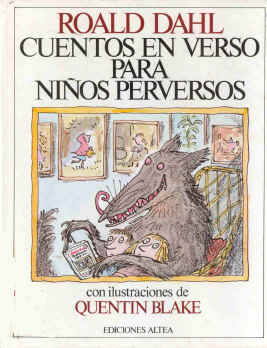
Roald Dahl / Little Red Riding Hood and the Wolf


Little Red Riding Hood and the Wolf
As soon as Wolf began to feel
That he would like a decent meal,
He went and knocked on Grandma’s door.
When Grandma opened it, she saw
The sharp white teeth, the horrid grin,
And Wolfie said, “May I come in?”
Poor Grandmamma was terrified,
“He’s going to eat me up!” she cried.
And she was absolutely right.
He ate her up in one big bite.
But Grandmamma was small and tough,
And Wolfie wailed, “That’s not enough!
I haven’t yet begun to feel
That I have had a decent meal!”
He ran around the kitchen yelping,
“I’ve got to have a second helping!”
Then added with a frightful leer,
“I’m therefore going to wait right here
Till Little Miss Red Riding Hood
Comes home from walking in the wood.”
He quickly put on Grandma’s clothes,
(Of course he hadn’t eaten those).
He dressed himself in coat and hat.
He put on shoes, and after that,
He even brushed and curled his hair,
Then sat himself in Grandma’s chair.
In came the little girl in red.
She stopped. She stared. And then she said,
“What great big ears you have, Grandma.”
“All the better to hear you with,”
the Wolf replied.
“What great big eyes you have, Grandma.”
said Little Red Riding Hood.
“All the better to see you with,”
the Wolf replied.
He sat there watching her and smiled.
He thought, I’m going to eat this child.
Compared with her old Grandmamma,
She’s going to taste like caviar.
Then Little Red Riding Hood said,
“But Grandma, what a lovely great big
furry coat you have on.”
“That’s wrong!” cried Wolf.
“Have you forgot
To tell me what BIG TEETH I’ve got?
Ah well, no matter what you say,
I’m going to eat you anyway.”
The small girl smiles. One eyelid flickers.
She whips a pistol from her knickers.
She aims it at the creature’s head,
And bang bang bang, she shoots him dead.
A few weeks later, in the wood,
I came across Miss Riding Hood.
But what a change! No cloak of red,
No silly hood upon her head.
She said, “Hello, and do please note
My lovely furry wolfskin coat.”
Caperucita Roja y el Lobo.
Estando una mañana haciendo el bobo
le entró un hambre espantosa al Señor Lobo,
así que, para echarse algo a la muela,
se fue corriendo a casa de la Abuela.
“¿Puedo pasar, Señora?”, preguntó.
La pobre anciana, al verlo, se asustó
pensando: “¡Este me come de un bocado!”.
Y, claro, no se había equivocado:
se convirtió la Abuela en alimento
en menos tiempo del que aquí te cuento.
Lo malo es que era flaca y tan huesuda
que al Lobo no le fue de gran ayuda:
“Sigo teniendo un hambre aterradora…
¡Tendré que merendarme otra señora!”.
Y, al no encontrar ninguna en la nevera,
gruñó con impaciencia aquella fiera:
“¡Esperaré sentado hasta que vuelva
Caperucita Roja de la Selva!”
-que así llamaba al Bosque la alimaña,
creyéndose en Brasil y no en España-.
Y porque no se viera su fiereza,
se disfrazó de abuela con presteza,
se dio laca en las uñas y en el pelo,
se puso la gran falda gris de vuelo,
zapatos, sombrerito, una chaqueta
y se sentó en espera de la nieta.
Llegó por fin Caperucita a mediodía
y dijo: “¿Cómo estás, abuela mía?
Por cierto, ¡me impresionan tus orejas!”.
“Para mejor oírte, que las viejas
somos un poco sordas”. “¡Abuelita,
qué ojos tan grandes tienes!”. “Claro, hijita,
son las lentillas nuevas que me ha puesto
para que pueda verte Don Ernesto
el oculista”, dijo el animal
mirándola con gesto angelical
mientras se le ocurría que la chica
iba a saberle mil veces más rica
que el rancho precedente. De repente
Caperucita dijo: “¡Qué imponente
abrigo de piel llevas este invierno!”.
El Lobo, estupefacto, dijo: “¡Un cuerno!
O no sabes el cuento o tú me mientes:
¡Ahora te toca hablarme de mis dientes!
¿Me estás tomando el pelo…? Oye, mocosa,
te comeré ahora mismo y a otra cosa”.
Pero ella se sentó en un canapé
y se sacó un revólver del corsé,
con calma apuntó bien a la cabeza
y -¡pam!- allí cayó la buena pieza.
Al poco tiempo vi a Caperucita
cruzando por el Bosque… ¡Pobrecita!
¿Sabéis lo que llevaba la infeliz?
Pues nada menos que un sobrepelliz
que a mí me pareció de piel de un lobo
que estuvo una mañana haciendo el bobo.


Versión de Miguel Azaola.
Little Red Riding Hood and the Wolf.(Revolting Rhymes)
Roald Dahl (Wales, 1916-1990)


Monday, July 30, 2012

Langston Hughes / Renaissance man of the south


Renaissance man of the south

Gary Younge remembers Langston Hughes, America's most popular poet, whose centenary is celebrated in London next week


Gary Younge

Saturday 26 October 2002

In 1920, an envelope postmarked from Kentucky arrived at the offices of the African-American artistic and intellectual magazine Crisis. Inside it was a poem called "The Negro speaks of rivers". When the literary editor, Jessie Fauset, read it, she handed it straight to her editor and mentor, WEB du Bois. "I took the beautiful dignified creation to Dr du Bois," she recalled, "and said 'What colored person is there, do you suppose, in the United States who writes like that and is yet unknown to us?' "

The "colored person" in question was Langston Hughes and within a few years of the poem's publication he would be known to all of Black America and to any lovers of prose poetry elsewhere whose appreciation allowed them to venture across the colour line at the time.

A full century after his birth, the breadth of his appeal and the durability of his work is now beyond doubt. Earlier this year, Hughes, who died in 1967, was voted America's most popular poet in an online poll by the Academy of American Poets, ahead of the likes of Robert Frost and Emily Dickinson. Now, contrary to the exhortations of Public Enemy's rap anthem "Fight the Power" - "I'm black and I'm proud / I'm ready, I'm hyped and I'm amped / Most of my heroes don't appear on no stamp" - the US postal service has issued a 34 cent stamp bearing his face.

Any doubt about the enduring and universal qualities of his work are easily dispelled by just one verse of "Let America be America again", which is as pertinent today as it was in 1938:

O, let my land be a land where Liberty
Is crowned with no false patriotic wreath,
But opportunity is real, and life is free,
Equality is in the air we breathe.
(There's never been equality for me,
Nor freedom in this "homeland of the free.")

Given the huge array of talent that emerged from the Harlem renaissance, the rush of artistic, musical and literary energy that emanated from upper Manhattan after the first world war and was all but decimated by the Wall Street crash, it is shocking that only Hughes, and to a lesser extent his onetime friend, the novelist Zora Neale Hurston, appears to have made it beyond the confines of race, place and time. Other writers, such as Claude McKay, Rudolph Fisher and Jean Toomer are feted in literary circles and known to African-American readers, but have never enjoyed the mainstream acclaim they deserve.

But Hughes was, in every sense of the word, a Renaissance man. As well as writing poetry, plays and essays throughout his life, he worked on ships and in laundries, covered the Spanish civil war for the Afro-American newspaper in Baltimore and toured central Asia after plans to stage a musical in Moscow foundered.

He was born in Missouri to a frustrated father, who abandoned the family and America in favour of personal ambition and Mexico, which in turn frustrated and impoverished his mother. While she travelled the country looking for work, Hughes was raised by his grandmother - a highly politicised woman whose first husband had been killed at the abolitionist insurrection in Harper's Ferry, where John Brown, along with 21 other men - 16 of them white - had attempted to establish a base in the Blue Ridge Mountains from which they would assist runaway slaves and launch attacks on slaveholders. The uprising was crushed by the local militia and the rebels killed.

Hughes spent his boyhood in Kansas and adolescence in Ohio, a lonely, sensitive child, who recalled being driven "to books, and the wonderful world in books", counting among his main influences Walt Whitman, Paul Laurence Dunbar and Carl Sandburg. It was this teenager who posted his poem to Crisis. So by the time he arrived in Harlem, after a short stint in Mexico with his father and dropping out of Columbia University, he was already well known.

Both his personal story and the intellectual conclusions he had drawn from it embodied the mindset of the "New Negro" - the urban, urbane, self-confident, black northern relatives to their downtrodden, culturally deprived cousins in the rural south - of which the Harlem renaissance was the cultural expression.

In 1926, Hughes published a manifesto, "The Negro Artist and the Racial Mountain", that still resonates: "We younger Negro artists who create now intend to express our individual, dark-skinned selves without fear or shame. If white people are pleased we are glad. If they are not, it doesn't matter. We know we are beautiful. And ugly too. If colored people are pleased we are glad. If they are not, their displeasure doesn't matter either. We build our temples for tomorrow, strong as we know how, and we stand on the top of the mountain, free within ourselves."

Hughes was true to his word, his work unashamedly informed by the black American experience - his ashes were spread under Harlem's Schomburg library - but never defined by it. In his autobiography he described his work as "poems like the songs they sang on Seventh Street - gay songs, because you had to be gay or die; sad songs, because you couldn't help being sad sometimes. But gay or sad, you kept on living and you kept on going."

Eager to frame his poetry in a manner that would lend it popular appeal, he was bold in his efforts to manipulate the genre. He once urged a publisher to bill him as "the original jazz poet". "Jazz gives poetry a much wider following and poetry brings jazz the greater respectability that people seem to think it needs," he said in 1958. "I don't think it needs it but most people seem to."

But while this made his work popular it also brought down stern criticism from the "talented tenth" of the black American intelligentsia (Hurston branded them Negrotarians) who felt he was vulgarising his artistic talents. Moreover, in the era of new criticism, Hughes's straightforward style did not sit well with literary scholars keen to abstract his work from its context. Even James Baldwin trashed his book of selected poems in 1959.

Hughes's work suffered during and shortly after his trip to the Soviet Union in 1932, when overt polemicism gave a shrill and occasionally hysterical tone to his work. It was a lapse in artistic judgment that would have political consequences. In 1953, he was forced to testify before the Senator Joseph McCarthy's House Un-American Activities Committee. There, he named no names, insisted he had never been a member of the Communist party and effectively denounced some of his own work. It was a humiliating experience.

He started his testimony: "Poets who write mostly about love, roses and moonlight, sunsets and snow must lead a very quiet life - seldom does their poetry get them into difficulties." But that was not Hughes's style. Not that he did not write about those things, but when he did, the sun set or the moon shone in a world where black people, rarely depicted before with the full complement of human emotions, were the ones showing love and giving roses.

His strength, as a writer and a human being, was to understand that his talent was the starting point for his engagement with the world at large. "Words have been used too much to make people doubt and fear," he said. "Words must now be used to make people believe and do. Writers who have the power to use words in terms of belief and action are responsible to that power not to make people believe in the wrong things."

From Selected poems:

Harlem

What happens to a dream deferred?

Does it dry up
like a raisin in the sun?
Or fester like a sore -
and then run? Does it stink like rotten meat
Or crust and sugar over- Like a syrupy sweet?

Maybe it just sags
like a heavy load.

Or does it just explode?

THE GUARDIAN

Saturday, July 28, 2012

My hero / John Keats by Helen Dunmore


My hero: 


John Keats

by Helen Dunmore


Helen Dunmore
Saturday 27 March 2010


"Talking of Pleasure, this moment I was writing with one hand, and with the other holding to my Mouth a Nectarine – good God, how fine. It went down soft, pulpy, slushy, oozy – all its delicious embonpoint melted down my throat like a large beatified Strawberry."

Whereas Byron drank soda water to preserve his figure and Shelley wrote a treatise on the natural diet, Keats ate his nectarine, and we taste it 200 years later. Keats was always the man for me. I read his letters in my mid-teens, before I knew much of his poetry. He was warm, earthy, self-mocking, funny and endlessly interested in gossip, weaving a brilliant weft under and over the letters' darker warp of sickness, death and mental anguish.

In the Keats-Shelley house in Rome, you can stand in Keats's bedroom and see the flowers on the ceiling that he saw when he lay dying. All the furniture was burned, as it had to be by law, because he had died of tuberculosis. He'd foreseen the whole ugly business from the first moment that he coughed up arterial blood, because his medical training forbade self-deception as much as his nature forbade self-pity. "I cannot be deceived in that colour; – that drop of blood is my death-warrant; – I must die."

The words reveal an essential toughness. Keats sees things as they are, with all their contradictions. He moves within a few lines from a joke about Winchester's fresh-flannelled doorsteps to the news that he has been writing the "Ode to Autumn". He remarks ironically, in one of his most agonised letters: "The knowledge of contrast, feeling for light and shade, all that information (primitive sense) necessary for a poem, are great enemies to the recovery of the stomach."

When I first read these words I barely understood them, but all the same there was a shock of recognition. At school, poems were all about meaning, and that didn't correspond to what I experienced when I tried to write them. Keats knew that you could write with a nectarine in one hand, and the juice would run into a poem.


THE GUARDIAN


Thursday, July 26, 2012

My hero / Ted Hughes by Michael Morpurgo

Ted Hughes


My hero Ted Hughes

Michael Morpurgo
Saturday 31 Octuber 2009


I
first met Ted Hughes down by the River Torridge in Devon where he was fishing. He was already by this time a huge literary hero of mine. As a teacher in junior schools I had listened to his Poetry in the Making with many classes of children, and been inspired with them to turn my hand to writing. There is no better invitation to write than this book. He simply says: we can all do this. We are all storytellers, all poets, it is a question of keeping your eyes and ears open, and your heart too. And listening hard to the music of the words we use.


That meeting down by the river was to change my life profoundly. He was a near neighbour, a great friend, and a huge supporter of Farms for City Children, the educational charity Clare, my wife, and I began over 30 years ago. He believed, as we did, that for a city child the experience of living and working in the countryside could be as life-changing as a great book or a great poem.
We collaborated on a book about the farm, All Around the Year, and from then on regularly showed each other work in progress. Can you imagine how encouraging that was for a young writer still finding his voice? When my children's novel War Horse failed to win the Whitbread prize, he took me out for the day, not to console me, but to tell me that I had written a fine book, and that I would write a finer one.
Shortly before his early death, he and I worked together to create the post of children's laureate, because he believed, as I did, that someone should be out banging the drum and blowing the trumpet for the best of children's literature.
He may be gone, but he and his work remain unforgettable.

Wednesday, July 25, 2012

My hero / Les Murray by Daljit Nagra

Les Murray
Photograph by Adam Hollingworth


My hero: Les Murray


'His poetry celebrates sprawling beyond conventional boundaries'

Daljit Nagra
Friday 2 September 2011 22.55 BST


I
t may not be obviously apparent, but the Usain Bolt of modern poetry is surely the great Australian poet Les Murray. I love those speedy, powerful lines that can run on for several verses without the tedium of punctuationAs a connoisseur of lively rock music, I look for something similar in poetry, and Murray's comes closest to that raw, hard-edged experience.

I frequently dip into Murray's rough cuts to gain inspiration for my own poems. His poetry celebrates sprawling beyond conventional boundaries: "we are a colloquial nation / most colloquial when serious". His style is rarely formal, and its music is best understood when heard in performance: Murray rattles along in an intimate voice that's strangely devoid of modulation, with energy-release presiding over pedantic sense.

My favourite Murray moments are those where his pace is loaded with a baroque linguistic excess. This reinforces the illusion of someone thinking fast on their feet. He regards a bed as a "Pleasure-craft of the sprung rhythms", a bulldozer "stands short as a boot on its heel-high ripple soles", a shirt is "soaking in salt birth-sheen".
I don't share Murray's Catholicism, but I do admire his conviction; most of his collections are dedicated "To the glory of God". In a poem that addresses his dead father, he writes: "Snobs mind us off religion / nowadays, if they can. / Fuck them. I wish you God." I admire my poetry heroes on the basis of their work rather thananything else. As a result I've learned little about Murray's life. But I was fortunate to meet the great man at the Rotterdam International Poetry festival this spring, and I soon came to admire his warmth, openness and especially his quick wit: over breakfast one morning, the conversation turned to languages and I asked Murray what languages he'd learnt at school. He scoffed: "Languages? Where I come from it was considered an achievement to have a roof in yer mouth!"
Tippoo Sultan's Incredible White-Man-Eating Tiger Toy Machine!!! by Daljit Nagra is published by Faber.

Tuesday, July 24, 2012

Cristina Peri Rossi / Saturday Night

poboh:

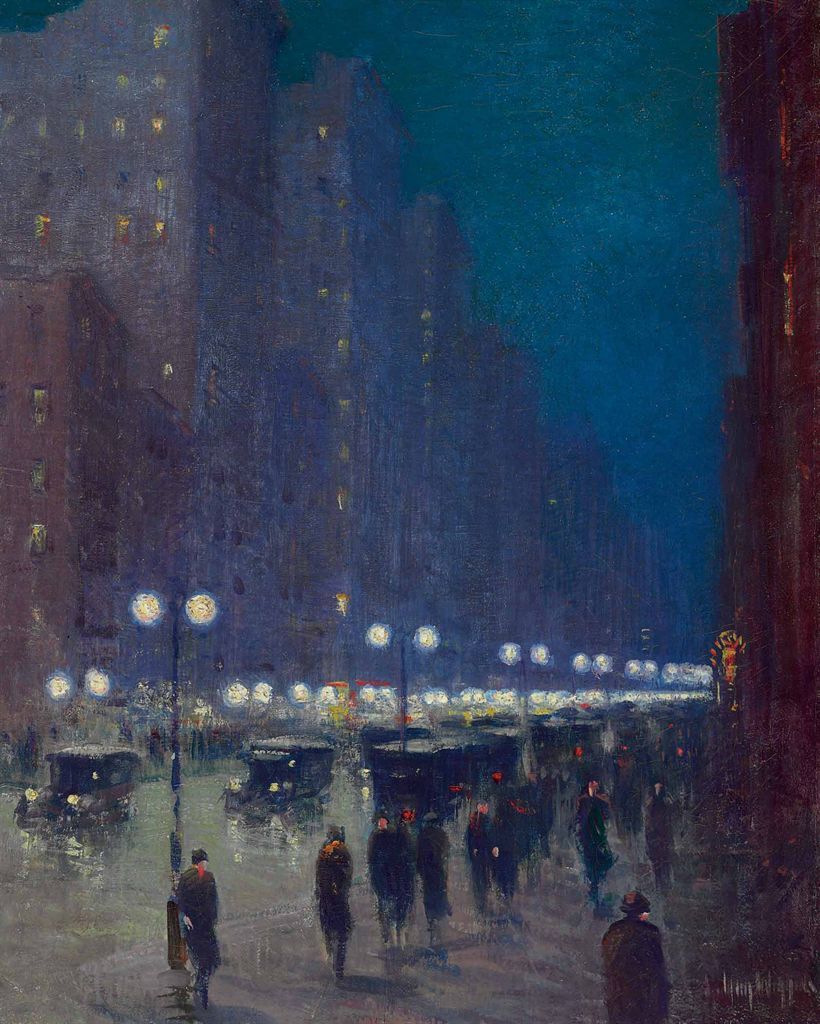
“Lower Fifth Avenue at Night”, Guy Wiggins.
American Impressionist Painter (1883 - 1962)


SATURDAY NIGHT
by Cristina Peri Rossi
Translated by Tatiana de la Tierra
In the solitary dawn
through drifting secondhand smoke
and sidewalks sticky with spit
I go out walking
to escape the nocturnal silence of my room 
seeking bright lights 
oh, those neon friends who always ward off 
my internal wolves 
my hungry demons
(my Vallejo ancestors). 
I go in search of something 
losing myself in the narrow streets round the harbor 
looking for company, 
oh, the sweet drugs that since Baudelaire 
have run along the gutters of cities at nighttime 
—London, Paris, New York, Madrid— 
oh, the unknown flesh that stirs, aroused by a look. 
Finally I find it: some sleazy joint that’s still open 
a prison cell of solitary pleasures 
a peep show hidden between the trees: 
a bookstore open all night 
where I can wallow among the books 
luxuriate in other people’s verses 
and finally reach orgasm 
with one of Allen Ginsberg’s self-destructive poems.